

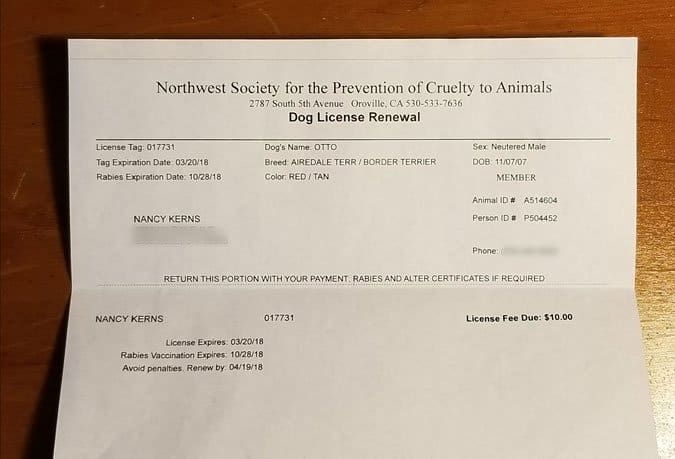
I adopted Otto on June 16, 2008. He was brought into the shelter as a stray dog on May 7, 2008. He was estimated to be about six months old, and was vaccinated that day with a five-way vaccination (distemper, adenovirus-type 2, coronavirus, parainfluenza, and parvovirus) and a separate three-way vaccination (adenovirus-type 2, parainfluenza, and bordetella) made by a different company.
On May 14, 2008, he was given a rabies vaccine.
Otto was vaccinated several more times with the five-way vaccines before I adopted him, but I’m not going to talk about those vaccines right now; I want to focus on the rabies vaccine – the only vaccine that dog owners are legally required to give their dogs in most states. Rabies vaccination earned this “special” legal status due to the historical threat that rabies poses to humans; as recently as my childhood in the 1960s, domestic dogs and cats were still common vectors for spreading this deadly disease to humans. Thanks to vaccination laws, this is no longer the case. Today, the most common vectors for rabies are bats, raccoons, and skunks.
Nevertheless, there are laws that require dogs to be vaccinated against rabies in all of the United States. All of the states save three (Kansas, Minnesota, and Ohio) require dogs to be vaccinated against rabies at least every three years; in those three states that lack state laws that require rabies vaccination for dogs, there are city and county laws that require it. (Curious about your state? All of the states’ statutes regarding rabies vaccinations are collected in this terrific website.)
In California, where I live, dogs are required to have their first rabies vaccination at the age of four months, their second no more than a year later, and additional rabies vaccinations every three years after that.
So far, I have complied with my state laws regarding rabies vaccination. Otto was vaccinated for rabies again on April 2, 2009, and again on March 20, 2012.
His most recent rabies vaccination was on October 28, 2015. (Note that we were out of compliance with state law from March 21, 2015 through October 28, 2015.) So he is “due” for a rabies vaccination by October 28 of this year.
Why Should I Dread Another Rabies Vaccine for My Dog?
All vaccinations pose some risk, which must be weighed against their benefit. Since rabies is a fatal disease, is present in the United States, and carried by wild animals (bats, raccoons, and skunks are the most common vectors), and since we live in an area where all three of those vectors are present, I believe that immunization against rabies is a terrific idea. That said, it’s been demonstrated that dogs can be safely immunized against the disease with fewer vaccinations – and that the rabies vaccine can present serious adverse side effects in dogs.
It’s anecdotal, but in my own experience, senior dogs are more likely to suffer adverse effects from rabies vaccinations. My last senior dog, Rupert, had suffered from environmental and dietary allergies his whole life. In his later years, these were fairly well under control, with assiduous management of his diet. But he did have a massive allergy flare-up within a month of his last rabies shot, and getting the allergies under control again took a while. And I can’t tell you how many times I’ve heard friends and acquaintances say, “My senior dog was perfectly healthy until not long after his last rabies shot; he just sort of fell apart after that!” Maybe these were all coincidental; after all, statistically, senior dogs are at higher risk of all health problems. But the risk of these adverse effects is unwarranted in dogs who have already been immunized against the disease!
The Rabies Challenge Fund has been working for a decade to extend the legally required interval for rabies vaccinations to five and then seven years, in an effort to reduce the number of unnecessary vaccinations our dogs would be required to have over their lifetimes. (Note: If you are looking for a great charity to support, consider a donation to this non-profit; their work, which has been funded to date largely by breed clubs and individual dog owners, will benefit countless millions of dogs.)
On January 25, 2018, the Rabies Challenge Fund announced, “Results to date of the Rabies Challenge Fund research study showed protection from live rabies virus challenge five years after the dogs received two doses of rabies virus vaccine. Other data are still being collected and analyzed for the 6.5 and 7-year post-vaccination periods.” In other words, the Fund’s studies are proving what had been hypothesized: the rabies vaccines work for longer than their makers were willing to prove they work, so dogs don’t need to be given as many vaccines over their lifetimes in order to be protected against contracting the disease and/or infecting others.
It will take some time, however, for these promising results to be used to change state laws, to extend those vaccination requirements.
Avoiding Rabies Vaccine Legal Requirements
Currently, there is only one way to get a legal exemption from vaccinating your dog: to have a veterinarian help you apply for an exemption from your state or local animal control authorities. Each state has a different process (again, see the terrific resource, RabiesAware.org); in California, a veterinarian must submit an annual request for an exemption, and be able to verify and document that a rabies vaccination would endanger your dog’s life.
I know people who, unable to convince a veterinarian of the potential risk of a fifth, sixth, or even seventh rabies vaccination to their senior dogs have, instead, reported their dogs to their local animal control agencies as “deceased.”
Given Otto’s high-visibility job (modeling for both WDJ and its Instagram page), I’m not sure I could pull that one off. But I have until October 28 to figure out an alternative. (Although, because my city’s animal control department won’t issue Otto another license until his legal rabies vaccine period is longer than the licensing period, he is currently unlicensed. If he gets picked up as a stray or bites someone before all this is resolved, the fines will be much higher than they would be if he were currently licensed. Not that either of those things are going to happen, but still…)
I don’t want to sound like I’m being frivolous about a disease that can kill people. But again, the possibility that my four-times vaccinated dog could possibly get or transmit the virus is virtually zero – and the possibility that the vaccine could adversely affect him is far higher. I think four vaccines is sufficient, and I’m looking for a way to stay within the bounds of the law while avoiding any more vaccines.
Are you concerned about administering the rabies vaccine to your senior dog? Have you pursued a way to avoid this? Spill it in the comments, below!




I he lived in Ohio most of my life and raised 4 dogs over the years and had never known or been told by the veterinarians that they didn’t need the vaccination. Have another 15 year old currently so going to make sure he doesn’t get another one. Thanks for letting us .
Last year I took my very healthy, very feisty 10 year old male Boston Terrier for checkup and rabies shot. With out asking/telling me they gave him a 3 year rabies shot. I didn’t know till I looked at the paper work. Had they informed me I would have declined the 3 year rabies shot as we live 15 min. from the vet and it seems unnecessary. Before we got home, the back of his neck where they gave the shot, was swollen as big as my fist. We went right back to the vet. and they said that swelling was normal. Really? He has had the single rabies shot every year of his life and never had a reaction. They told me just give him some Benadryl and he would be fine. He wasn’t. In a few hours he could hardly walk, followed by several grand mal seizures. He wouldn’t eat or drink or move from his bed for 3 days. I massaged the swollen mass, put warm packs on it and gave more Benadryl when I could entice him to eat a treat. The swelling lasted for 3 weeks, the seizures became fewer. He has NEVER been the same. Showing no interest in the things he loved doing until the day of the shot. I will NEVER take him for another one. Nor any other elder dog I own.
I am postive Rabie shot killed my 18 yr old dog just in March.He was blind but in great health but died after that fatal shot.
My 10 yo male Chihuahua has developed diabetes about a year or so ago…She was receiving insulin and doing fine with a proper diet and walks. Then the time for the 3 years rabies shot came last month and by law I had to give it here in MA. I never had a dog or knew about potential adverse reactions as he never had any before. He received the 3 years rabies shot on a Tuesday, by Friday he was collapsed, unable to eat, he was drinking only water, stayed without food for over 48 hours and started vomiting a dark liquid and his stool was liquid. He could not walk in a word he was Destroyed! My poor beautiful agile little dog was Killed by that Rabies shot. I put him to sleep that Saturday because he was in so much pain and distress. All along his VET declined that it was from the vaccine, could not give a diagnostic though. She told me that would take thousands of dollars to determine what he has and he may not be saved. Not having those means, that was the only solution I saw to end his suffering. DO NOT give vaccines to old, fragile dogs. This is what happens if you do ! :((((
A month ago exactly I took my 15-year-old Vizsla into the vet to get a local anesthetic growth cut off of her belly. Previous to that, she had plenty of energy, was alert, would scarf down food, and could walk. When she was getting her growth cut off, they gave her a rabies vaccination without telling me. She stopped eating after the visit.
I am now waiting for the at home vet to show up to euthanize her. She stopped eating, she stopped walking, she lost all life in a matter of two weeks. I know older dogs decline quickly, but this was intense at how fast the decline was was.
My 17 year old Pomeranian was dead 2 weeks after a rabies shot. It was during Covid so I could not go in. The vet tech took him from the car for what I thought was a check on his heart meds. They gave him a rabies shot. Ne ver again with an old dog.
My 13.5 yr old Springer went in for vaccines(rabies and two others) on Dec 18, 2021. From that day forward, she’s has been lethargic and simply not the energetic, happy friend I had on Dec 17. Sleeps nonstop and has a breathing issue recently diagnosed. Changed vets (who said Kota did not need rabies at her age) in Jan 2022 ….will be saying goodbye to my sweet girl later this week.
My 10 yr. Malti-Poo Psycho was a rescue and I’ve never in almost 70 years had a better, more loving dog. I took him to the vet to get an exemption but he denied it saying that Psycho was in perfect health and he could find no reason. Unfortunately, I took him to get his rabies shot and he had a heart attack 2 days later, died that night. NEVER AGAIN.
In some states and counties, you can get an exemption from your vet that allows you to skip the rabies vaccine. That is not allowed in Cook County, Illinois, where I live. Although my dog was 16 years old last year when the vaccine was due, I had to go ahead with it and found a holistic veterinarian who offers the thimersol-free version and some herbal support. I did not want to risk her having to be quarantined in some kennel if she nipped someone. That’s never happened but now she is blind and could get startled. Also, we still go places for scent detection training and trials. By the way, I’ve been told the one-year and three-year vaccines are exactly the same thing so why ever get a one-year shot? We get titers every year or so for the other vaccines. It’s been almost 11 years since the last vaccinations for distemper, parvo and hepatitis and she still has immunity.
Titer whenever possible is my philosophy. Titering means that the vet can draw blood to measure how much of the vaccine is still in your pet’s system. The last titer I did, our vet said there was enough to wait another 3 years without a vaccine! We are pushed to vaccine much too often! Stand up for what you believe and what sits best with you in your heart. When uncertain, at least titering can give you answers. God bless all the animals and their owners out there.