

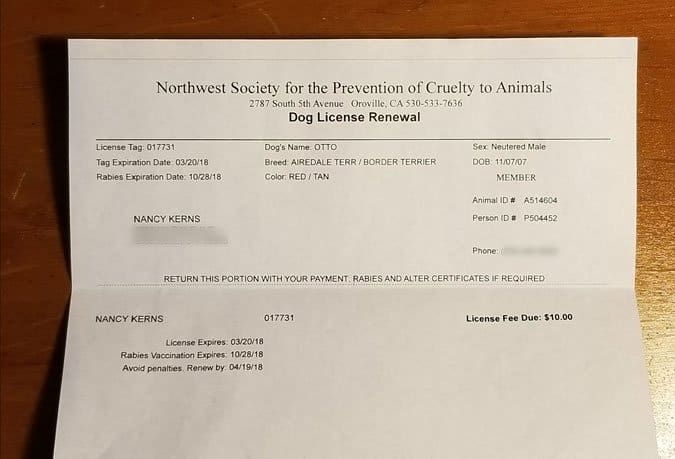
I adopted Otto on June 16, 2008. He was brought into the shelter as a stray dog on May 7, 2008. He was estimated to be about six months old, and was vaccinated that day with a five-way vaccination (distemper, adenovirus-type 2, coronavirus, parainfluenza, and parvovirus) and a separate three-way vaccination (adenovirus-type 2, parainfluenza, and bordetella) made by a different company.
On May 14, 2008, he was given a rabies vaccine.
Otto was vaccinated several more times with the five-way vaccines before I adopted him, but I’m not going to talk about those vaccines right now; I want to focus on the rabies vaccine – the only vaccine that dog owners are legally required to give their dogs in most states. Rabies vaccination earned this “special” legal status due to the historical threat that rabies poses to humans; as recently as my childhood in the 1960s, domestic dogs and cats were still common vectors for spreading this deadly disease to humans. Thanks to vaccination laws, this is no longer the case. Today, the most common vectors for rabies are bats, raccoons, and skunks.
Nevertheless, there are laws that require dogs to be vaccinated against rabies in all of the United States. All of the states save three (Kansas, Minnesota, and Ohio) require dogs to be vaccinated against rabies at least every three years; in those three states that lack state laws that require rabies vaccination for dogs, there are city and county laws that require it. (Curious about your state? All of the states’ statutes regarding rabies vaccinations are collected in this terrific website.)
In California, where I live, dogs are required to have their first rabies vaccination at the age of four months, their second no more than a year later, and additional rabies vaccinations every three years after that.
So far, I have complied with my state laws regarding rabies vaccination. Otto was vaccinated for rabies again on April 2, 2009, and again on March 20, 2012.
His most recent rabies vaccination was on October 28, 2015. (Note that we were out of compliance with state law from March 21, 2015 through October 28, 2015.) So he is “due” for a rabies vaccination by October 28 of this year.
Why Should I Dread Another Rabies Vaccine for My Dog?
All vaccinations pose some risk, which must be weighed against their benefit. Since rabies is a fatal disease, is present in the United States, and carried by wild animals (bats, raccoons, and skunks are the most common vectors), and since we live in an area where all three of those vectors are present, I believe that immunization against rabies is a terrific idea. That said, it’s been demonstrated that dogs can be safely immunized against the disease with fewer vaccinations – and that the rabies vaccine can present serious adverse side effects in dogs.
It’s anecdotal, but in my own experience, senior dogs are more likely to suffer adverse effects from rabies vaccinations. My last senior dog, Rupert, had suffered from environmental and dietary allergies his whole life. In his later years, these were fairly well under control, with assiduous management of his diet. But he did have a massive allergy flare-up within a month of his last rabies shot, and getting the allergies under control again took a while. And I can’t tell you how many times I’ve heard friends and acquaintances say, “My senior dog was perfectly healthy until not long after his last rabies shot; he just sort of fell apart after that!” Maybe these were all coincidental; after all, statistically, senior dogs are at higher risk of all health problems. But the risk of these adverse effects is unwarranted in dogs who have already been immunized against the disease!
The Rabies Challenge Fund has been working for a decade to extend the legally required interval for rabies vaccinations to five and then seven years, in an effort to reduce the number of unnecessary vaccinations our dogs would be required to have over their lifetimes. (Note: If you are looking for a great charity to support, consider a donation to this non-profit; their work, which has been funded to date largely by breed clubs and individual dog owners, will benefit countless millions of dogs.)
On January 25, 2018, the Rabies Challenge Fund announced, “Results to date of the Rabies Challenge Fund research study showed protection from live rabies virus challenge five years after the dogs received two doses of rabies virus vaccine. Other data are still being collected and analyzed for the 6.5 and 7-year post-vaccination periods.” In other words, the Fund’s studies are proving what had been hypothesized: the rabies vaccines work for longer than their makers were willing to prove they work, so dogs don’t need to be given as many vaccines over their lifetimes in order to be protected against contracting the disease and/or infecting others.
It will take some time, however, for these promising results to be used to change state laws, to extend those vaccination requirements.
Avoiding Rabies Vaccine Legal Requirements
Currently, there is only one way to get a legal exemption from vaccinating your dog: to have a veterinarian help you apply for an exemption from your state or local animal control authorities. Each state has a different process (again, see the terrific resource, RabiesAware.org); in California, a veterinarian must submit an annual request for an exemption, and be able to verify and document that a rabies vaccination would endanger your dog’s life.
I know people who, unable to convince a veterinarian of the potential risk of a fifth, sixth, or even seventh rabies vaccination to their senior dogs have, instead, reported their dogs to their local animal control agencies as “deceased.”
Given Otto’s high-visibility job (modeling for both WDJ and its Instagram page), I’m not sure I could pull that one off. But I have until October 28 to figure out an alternative. (Although, because my city’s animal control department won’t issue Otto another license until his legal rabies vaccine period is longer than the licensing period, he is currently unlicensed. If he gets picked up as a stray or bites someone before all this is resolved, the fines will be much higher than they would be if he were currently licensed. Not that either of those things are going to happen, but still…)
I don’t want to sound like I’m being frivolous about a disease that can kill people. But again, the possibility that my four-times vaccinated dog could possibly get or transmit the virus is virtually zero – and the possibility that the vaccine could adversely affect him is far higher. I think four vaccines is sufficient, and I’m looking for a way to stay within the bounds of the law while avoiding any more vaccines.
Are you concerned about administering the rabies vaccine to your senior dog? Have you pursued a way to avoid this? Spill it in the comments, below!




My 13 yr old chi/ rat terrier seems to be having a reaction to her rabies shot from last week. I’m going to call the vet this morning and see what they suggest. She was real happy and healthy before the vaccine and started seeming off right after. This morning I had to carry her outside. She’s shaky and doesn’t want to walk. Heartbroken is the word. I will never vaccinate a senior dog again.
I was only asking about giving my dog ,the rabies vaccine at same time as the 5-1 vaccine?but now I dont know whst to do?my dog is 11 years old,pom-winnie
My 15 year old Jack Russel is due for a rabies shot she is a house dog only goes out in a fenced in yard and wants to come in right away she has never been around other dogs. I’m afraid to have her vaccinated after reading about all the dogs that died after getting rabies shot what can the township of East Brunswick do to me if I don’t take her 4 her rabies shot.
Part 2
I did not previously mention that my perfectly happy and healthy 11 year old Doberman Pincher had completely stopped eating and drinking fluids immediately after receiving the “Required” Rabies Vaccine in Orange County California which is now tied in to the I.R.S.
stating that if it is not done promptly further legal action will be taken such as property seizures and docked income etc..
My Dog “Max” was like my Brother.
He died in my arms after the most violent convulsions I have ever seen in my Life.
Along with a severe vomiting of a green Bile substance and drooling with shortness of breath along with a heightened heart beat.
The look in his eyes I will never forget as long as I live.
It’s as if he knew this wasn’t right.
Like,”what did you do to me”?
I feel very guilty about this.
I would have NEVER given him this Vaccine.
I only did so because I was forced to do so by the State Law of California.
I repeat.
“Max” never had any issues his entire life.
Not even for one day.
The Convulsions were so horrific that his head was shaking and swaying sided to side for a span of about 8-10 inches.
It was so severe I thought his teeth would be knocked out and that his eyes would pop out of his head.
The pure white sides of his eyes turned red.
When I held him my entire shoulder was vibrating.
I stayed with him side-by-side reassuring that I was there for him until he would calm down enough and go to sleep which he did quite comfortably.
He died in my arms several hours later.
A moment I will never forget.
R.I.P. my Brother “Max” 😢
Our sweet girl died 9 days after her rabies vaccine. Nothing else changed, nothing else noted. We were out of town and the pet sitter found her in the morning. Her last rabies was 8 years prior. I regret that decision everyday.
My 15 1/2 year old Jack Russell is a bit overdue for her rabies vaccine I live in a county that doesn’t accept exemptions. I worry that if she nips someone, which she has never done, that she would be subject to a a 10-day quarantine in a county facility. That would kill her. She is blind, mostly deaf and has separation anxiety but is otherwise healthy. Will have to find a source for mercury-free vaccine and hope for the best.
Senior dogs should be exempt from the Rabies vaccine IMO. I took my 13yr old Shi-Poo in to the vet so he can get his allergy med refilled, and they wanted to give him a Rabies vaccine. I told them he will not be getting any more vaccines, the vet tech argued with me so I left. The vet refuses to refill his allergy med. He still suffers from allergies but that is way better than him dying too soon because of a rabies shot.
Please check out Anti-Vaccinosis from Adored Beast. It helps, truly it does. I also believe our dogs are over vaccinated. My Buddy will be due on 2021 again. Out dogs have had more skin allergy problems in this country in the last 20 or so years. Is it the laws or the frequency or the size of the shot? Does your vet tell you when the booster is changed or only after your dog throws up and gets the runs within 24 hours and a complaint. I think there is some truth to a conspiracy between vets and chemical companies. And what about the fact of reportedly high suicides in VETERINARIANS. We choose not to put pesticides on our lawns but what are we allowing to be administered by our vets? What is the difference in the size of a one year rabies booster or three year? I’ve heard from a vet they are the same.
Almost all the dogs in this set of comments are small breeds and many are seniors. Could the problem be a mismatch between the vaccine’s strength and the size/age of the dogs? So much allopathic medicine is takes a one-size-fits-all approach to dosing. I’m unusually slim and find I need to cut many of my prescription drugs in half or take them infrequently because they’re just too strong for me. My neurologist recognizes the problem. Other docs seem baffled by it. Wonder if there’s a similar problem in veterinary medicine.
Ty I have a 11yr old daschund no more rabbie shots for him and other shots he is due for a rabies next year nope I just moved to Illinois I don’t even feed him kibbles no more I get DC Harvey’s and I’m looking up a preventative for heartworms so I don’t have to give him the heartland pill I’m a new dog mom. I want to go all holistic