Dogs go belly up for many reasons, not the least of which is when they roll in the grass or snow or even on the floor to scratch their back. Obviously that activity will have a different look than other belly-up reasons. Let’s explore them together.
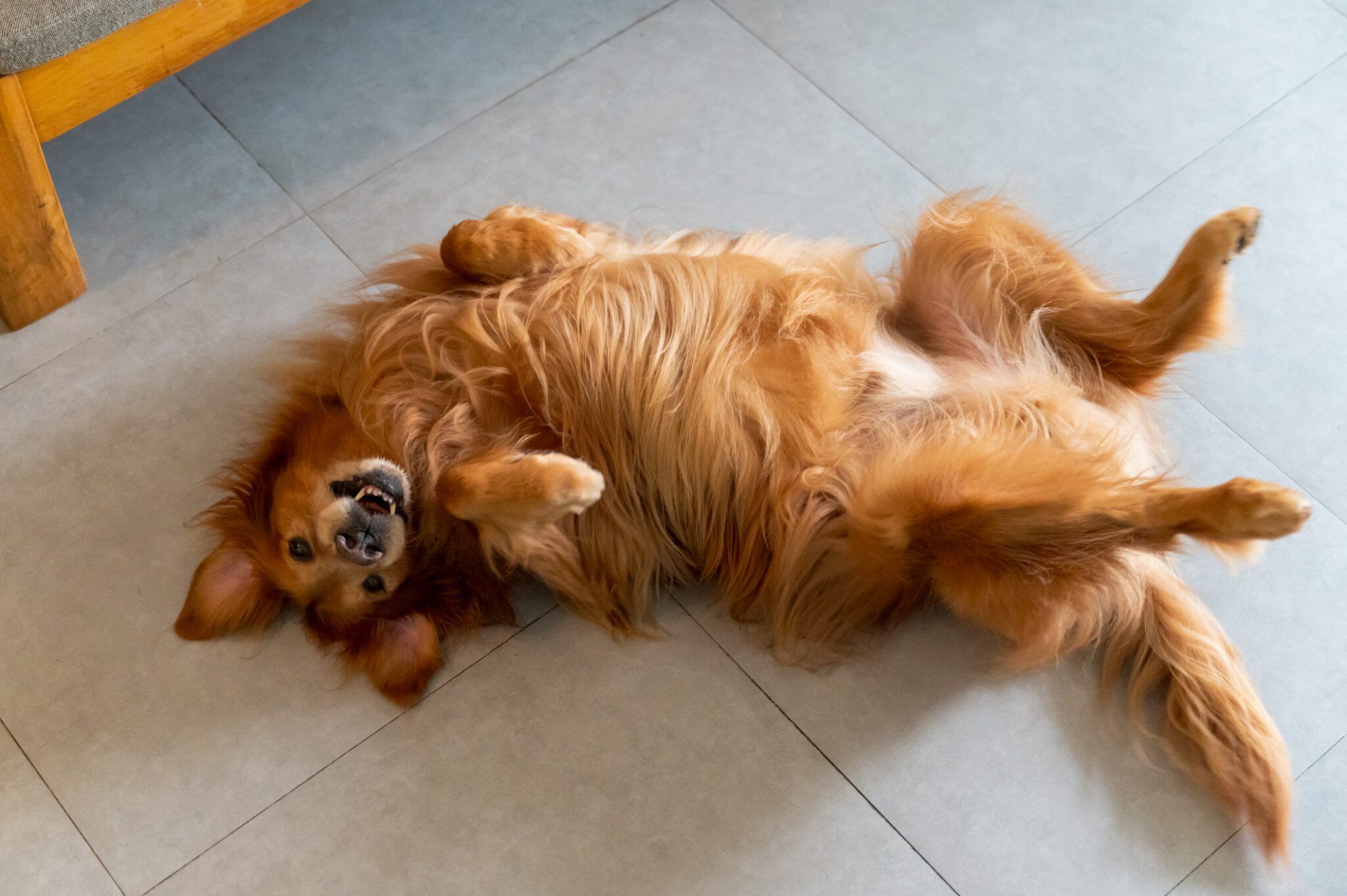
It’s pretty easy to know your dog is feeling happy and playful when he’s looking up at you with a doggy smile and joyfully rolling around on his back, possibly kicking out, and enjoying the back scratching. He’s happy, loose, and wiggly, and seeking connection with you.
My dogs have different ways of looking for a connection with a belly rub. Keric, the Caucasian Shepherd, will plop on his side and then roll on his back while stretching his legs out above him parallel to the floor, head tilted to the side while grinning. Meridiana, the Chow Chow, will suddenly drop to the floor and flip on her back, rolling back and forth with a huge grin while grunting and groaning. Both dogs also use this action as an invitation to play with the other, while inviting their human (me!) to participate initially by getting the party started with a hearty belly rub.
Dog Showing Belly Means Discomfort
Dogs can also go belly-up in what some trainers refer to as a “tap out.” A tap out is a stop signal. It means please don’t go further. The dog is saying he is not comfortable with your proximity. It’s a dog request to please not hurt them or make them feel even more stressed. Think of the frightened puppy meeting a big dominant dog for the first time. The puppy is scared and feels vulnerable. His ears are probably back, and he stays still, not playfully rolling about. It’s a belly-up position showing submission.
Tap Out vs. Belly Rub Request
These are distinct differences in the body language of a tap out versus a belly rub request.
When dogs are doing a tap out, their body language is more of what some might call submissive. Their front legs may be tight up on their chest. Their mouths will look tight. Their tails will likely be tucked or hugging the line of their body. Their ears will likely be back. Their body will be notably rigid.
Now if a dog is truly inviting a belly rub, they will exhibit more of what we consider a dog-feeling-safe body language. That includes a more rounded and relaxed looking position with legs stretched out versus rigidly tight. Their mouths will look relaxed, and their tongue may be hanging out. Their eyes will be much softer looking. Their body will look more stretched than poised. They will be more likely to lean into touch than shrink away from such.
Learn to Read Belly Up in Dogs
Tap outs don’t look friendly to the professionally educated eye but because of a lack of education on the subject to dog parents, there is unfortunately an assumption that any belly-up position by a dog is an invitation to rub said belly. This is not true. Many dog bites can be prevented by learning more about what a relaxed position inviting physical contact looks like versus a request for safety and some personal space.
Remember, while dogs may want to be close to a human for comfort, they may not want to be touched in that context so placing themselves next to a human is not an invitation to touch. What you must look at is the whole context. If a dog does place himself next to you, even if this is your own dog, looking at the context that includes body language so that you are respectful of their body autonomy will go a long way toward having earned that dog’s trust moving forward. When we know more, we do better.