
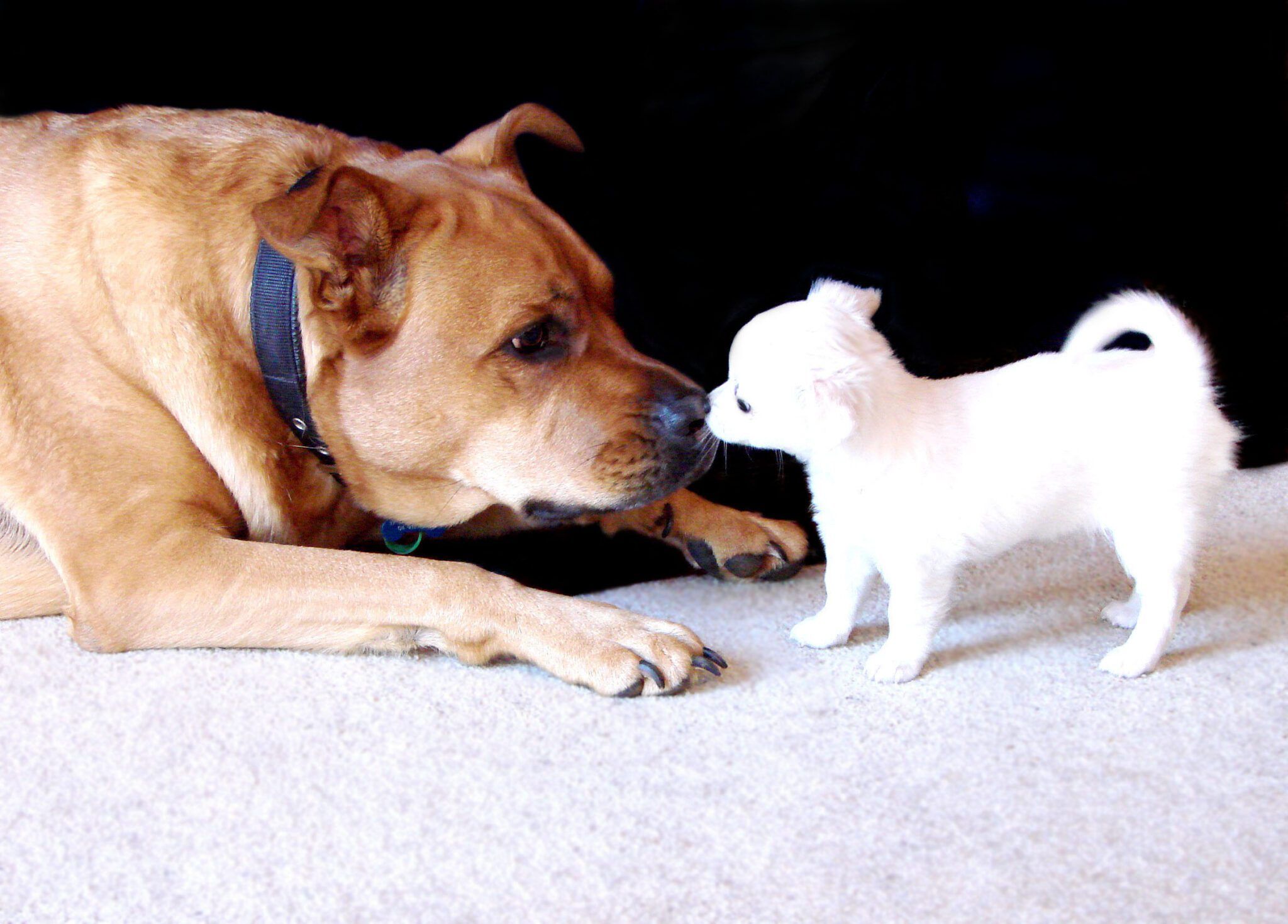
Adding a new puppy is exciting! But introducing a puppy to a resident dog needs to be done gradually, respecting your older dog’s routines, boundaries, and relationships with human family members.
Develop a puppy-proof section of your home that will both keep your pup safe and keep him contained when needed. Let the dogs first meet on neutral territory, such as a public location or a friend’s house, and keep that experience brief. Once the puppy has arrived in your house, ensure that your older dog still gets daily one-on-one time with you that does not include the puppy.
Preparing to Add a Puppy
You already have toys and puppy food. To prepare for calm, safe introductions between your puppy and your resident dog, add these things to your list:
- Crate
- Baby gate (one or several!)
- Edible chews or stuffable puzzle toys
- High-value treats that your older dog loves
The crate and baby gates are critical to both keep your puppy out of trouble when unsupervised and to ensure that the puppy is not constantly bothering your older dog. I recommend confining your puppy whenever you cannot supervise him. Depending on the size and fitness of your two dogs, you may be able to use a low gate that your adult dog can jump over but the puppy cannot. This gives your older dog an escape route if the puppy is being annoying.
The chews and toys are perfect to allow both dogs to enjoy a treat while in each other’s presence.
And the high-value treats are a special reward to give your adult dog when she is close to the puppy and interacts with him in a positive or neutral way.
Off-Location Introduction
Your older dog considers your home to belong to her. Depending on her personality, she may be aggressive toward an unfamiliar dog entering her space. Introducing a new puppy in a neutral location is ideal if possible.
Allow the two dogs to sniff each other through a gate or crate door. This serves as an initial introduction without any worry about your older dog nipping at or knocking over the puppy.
Then take the dogs for a side-by-side walk. Ideally each dog should be with their own person, but if you are a skilled leash handler, you may be able to guide one dog on either side of you. The goal with this walk is to give both dogs a common activity that removes their focus from each other.
Watch both dogs’ body language. If either one of them appears tense, afraid, or aggressive, keep them apart. If their posture is loose and relaxed, you can gradually walk them closer together, so they are able to sniff the same things and come into contact. If any tension develops, move farther away until both dogs relax again.
How to Help an Older Dog Accept a Puppy
Start by considering how your adult dog feels about puppies. Does she love playing with tiny pups, or does she shy away from them? Is she excited about rough physical play, or does she tend to growl and snap at dogs who are too pushy? This information will determine how slowly you need to take the introductory period.
Here are some tips for success:
-
Create Positive Associations
You want your dog to associate your puppy with positive things. Give your dog a high-value treat any time she looks at the puppy and praise her for approaching the puppy in a friendly manner. Feed the dogs close to each other but in separate crates so that there is no worry about food theft.
-
Provide Safe Puppy-Free Zones
Puppies are rambunctious, and older dogs may or may not enjoy that. Make sure that your older dog gets breaks from babysitting throughout the day by confining the puppy to a room or crate for a nap and keeping the puppy busy with other activities when your adult dog is resting. As your dog gets comfortable with having the puppy around, she may not need as many breaks.
Sometimes it may be necessary to teach your puppy that certain rooms or pieces of furniture are off-limits. This is especially important if your older dog is either really shy or can be grumpy toward other dogs.
-
Respect and Enforce Boundaries
Your older dog will teach the puppy how she does and does not want to be treated, but you can speed this process by backing her up. Rude behaviors that many adult dogs don’t enjoy include being jumped on, having their toys or treats stolen, being woken from a nap, and being bitten or chewed on too roughly. If your puppy is being obnoxious and your older dog tenses up or growls, redirect the puppy by calling him to you or tossing a toy. If puppy persists in bothering your older dog when she is clearly not in the mood, confine him. If your older dog is resting, keep the puppy away from her so that he cannot pester her.
Do not scold your older dog for growling at the puppy. She is communicating how she feels, and her comfort matters. She probably did not ask for a puppy to be added to the family, so it is important to respect her agency and control of her body while the puppy is growing up and learning manners.
-
Provide Daily Personal Attention
Puppies are of lot of work and require a lot of extra attention. But your adult dog still needs attention too! Set aside some time every day for an activity with just you and your older dog. This could be a walk, playtime, or just cuddling in bed. It can be anything that your dog loves to do with you. This one-on-one time reinforces your bond and will help to prevent your adult dog from feeling jealous of the puppy.