

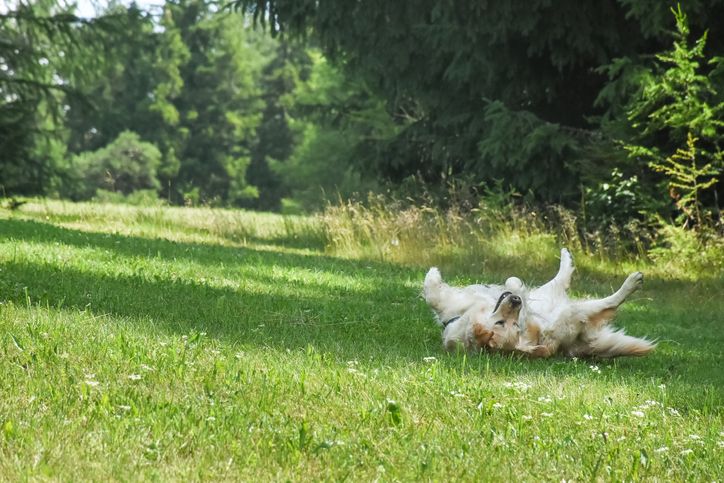
Dogs roll on their backs for many reasons, and it’s up to us to figure out why. A dog who really enjoys a belly rub may roll on his back and wiggle with a happy face and usually tongue out, asking you to give him a relaxing rub. And who can resist soft eyes inviting you to play?
Dogs May Roll on Their Backs as Part of Dog Play
Dogs do love to play. A study published in a 2015 issue of Behavioural Processes determined that a dog rolling over during play was a “combat maneuver adopted as part of an ongoing play sequence.” The researchers found the frequency of rollovers depended upon how long the play lasted. They considered none of the movements submissive but instead decided the dogs were either exhibiting defensive or offensive maneuvers during the play. This study debunks the idea that a dog rolling over, or showing their stomach to you or another dog, is a sign of submission.
But, in the classic 1967 paper in American Zoologist, Rudolf Schenkel of the University of Basel in Switzerland describes the rolling as passive submission expressing “some kind of timidity and helplessness, like coming out with your hands up or waving a white flag.” Indeed, many of us have witnessed a younger dog, especially a puppy, rolling over on his back when confronting a bigger, scarier dog. There’s no wiggling, just back down, paws up. His face may look worried, often with a whale eye and tail tucked. Is it submission? Does it work? Usually.
From another angle, however, researchers in Scientific American speculated that a dog rolling on his back “might be essentially playful, executed tactically, for combat purposes, to encourage play, avoid a play bite (defensive maneuver) or deliver a play bite (offensive maneuver).” They found the rollover to be more part of play fighting, with the dog on the bottom continuing to “block bites and launch them at their competitor.”
Again, it’s body language. The submissive dog appears to be non-combative, giving up any fight. The dogs playing may use rolling on their back to gain an advantage in a play fight. You need to read the dog.
Dogs Roll Because of Itchy Skin
Of course, the practical reasons for rolling on your back are easier to understand, and the most common one is simply itchy skin. He can’t comfortably reach his back any other way to get that satisfying scratch in. This is commonly noticed when the scratching is excessive, especially to the point of damaging the hair or the skin. It’s often accompanied by other scratching, such as at the ears, or chewing at his belly and could be a sign of fleas, ticks, parasites, or an allergy.
Watch the rest of the dog’s behavior:
- Does his rolling look manic?
- Is he scratching where he rolls?
- Is the skin red or irritated?
If your dog is constantly rolling, look for hair loss, odor, or parasites. Does it hurt when you touch that area? In addition to these reasons—and the allergies parasites mentioned above—your dog could be trying to alleviate pain. A pulled or tight muscle, for example. Watch his body language. Does he look determined or painful or like he’s having the time of his life? If he’s hurting, veterinary help is probably a good idea.
Dog Roll to Hide Their Scent
It can be really annoying to give your dog a loose run on a safe trail only to find him rolling in a carcass. Why on God’s green earth would your dog do that? Well, animal experts believe another cause of rolling goes back millions of years to when dogs were wild and had to hunt for food. They roll in a scent other than their own to hide their own scent, so their prey won’t smell them as they approach. And usually the more it stinks, the better it is. Other animals’ urine or feces, or even a dead animal, are best for the job of masking.
We know that dogs smell in layers, unlike humans. For instance, when we find a rose that smells like a skunk sprayed it, we only smell the skunk spray. But a dog smells the skunk spray and the rose.
Similarly, a dog can smell a tree that two or more dogs have marked with urine and identify those dogs. And when you see your dog sniffing the breeze, he’s identifying scents familiar and foreign, and dogs have an uncanny ability to smell things, which is one of the reasons they are such an asset in criminal investigations. Dogs enjoy scent, which may be one of the reasons scent games are increasing.
Why Do Dogs Roll in the Grass?
Rolling in grass is also all about scent—covering it up, adding scent, or picking it up to himself. Dogs’ noses are up to 50 times more sensitive than ours, depending on the breed, so they can smell lots of gross things that they think are perfect for rolling.
An older study with wolves, published in the Canadian Journal of Zoology, found that wolves were most likely to rub in an odor not usually in the wolf’s environment or a familiar scent that is slightly different. And, not surprisingly, they found that some wolves seemed to roll in scents believed to have a strong aversion or attraction.
Your dog’s hunting instinct makes him roll in the grass, makes him roll where another animal has urinated or defecated, and makes him roll in a dead animal. It is speculated that rolling covers up his own scent so he can get closer to prey before they sense him.
What Does It Mean When a Dog Rolls in Grass?
Rolling can be a way to communicate with other pack members (including you!), telling them he’s nearby or to stay away from this area because it’s his.
And remember too that what smells good to us usually doesn’t smell good to them—and vice versa. So don’t be surprised when, as soon as you bathe your dog in that expensive, sweet-smelling shampoo, the first thing he does is roll in the grass or something else that stinks. That may well be because he thinks that he smells horrible!
And sometimes your dog rolls just because it feels good and makes him happy. And that’s just as natural as rolling in something due to scent.

Oh, yes. I took Caesar to the beach once and he found a dead, decomposing squirrel and rolled all over it. He got a dunking in the ocean and then a thorough bath when he got home.