
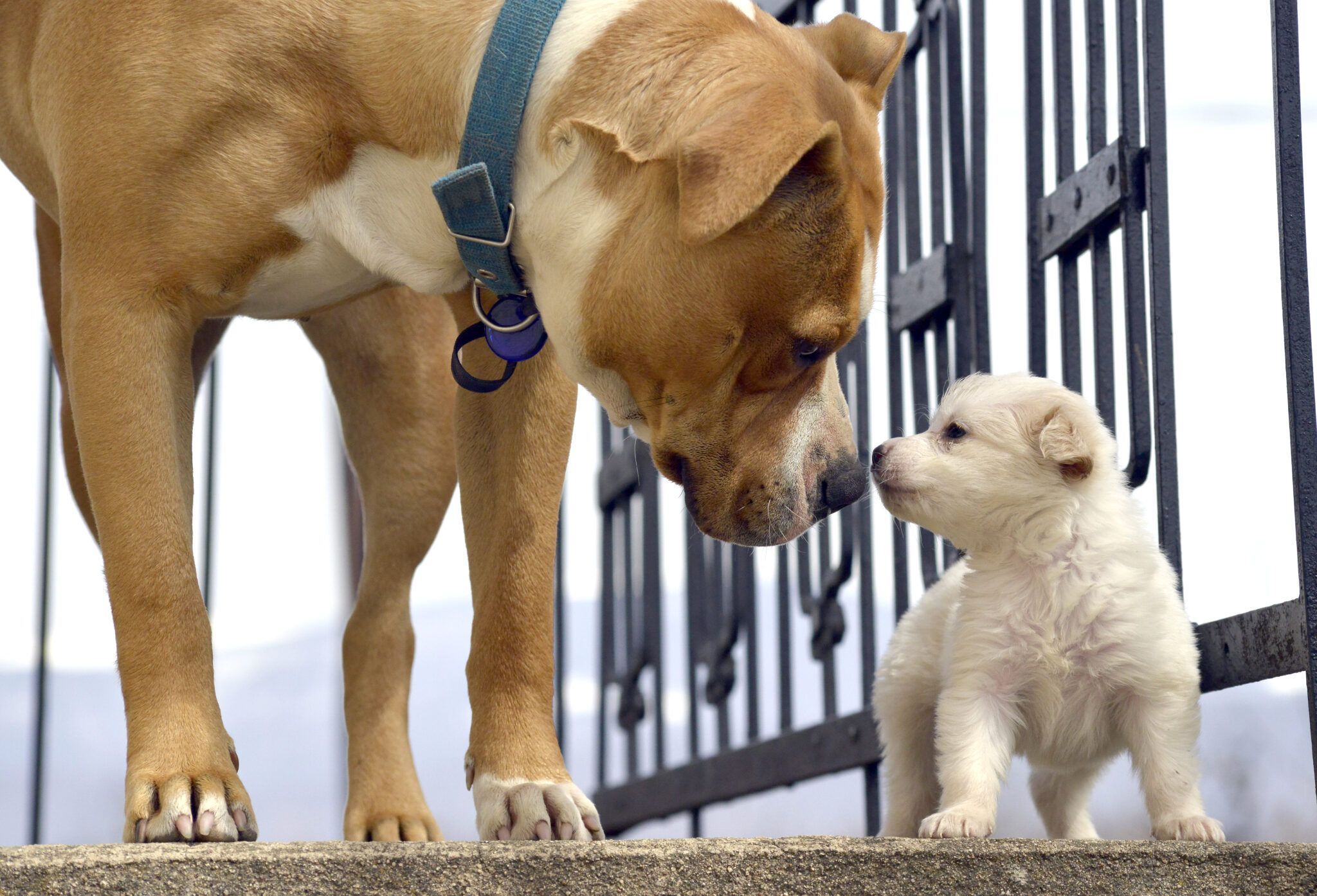
Watch two dogs interacting at a dog park and you might not think much of it; a quick sniff, a wagging tail and they’re off! What you’re actually seeing, though, is a sophisticated exchange of information happening across multiple channels at the same time. Dogs communicate through body language, facial expressions, vocalizations, and scent and they do it constantly; with each other, with us, and with the environment around them.
Understanding how dogs communicate with each other doesn’t just make you a more informed care giver. It helps make you a better advocate for your dog, as you can better recognize when an interaction is going well, when it isn’t, and when it’s time to intervene.
Dog Body Language: The Primary Channel
The position of a dog’s body, the way they hold their tail, the angle of their ears, and the fluidity of their movement all carry meaning. Experienced dogs read these signals in real time, making constant adjustments in response. Let’s look at some different aspects of body language and what they mean:
- Posture and movement—A dog who is confident and comfortable will carry themselves in a relaxed and fluid way with their weight evenly distributed and their movement loose and free. Whereas an assertive or aroused dog might shift their weight forward and stand tall, making themselves appear larger. A dog who is unsure will do the opposite and lower their body, shifting their weight backwards or even roll onto their side to signal they pose no threat.
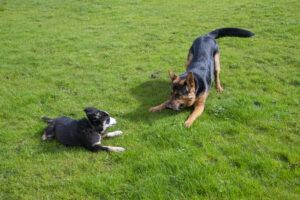
- The play bow—Front end down, rear end up is a universally understood signal in the canine behavioral repertoire. It’s an invitation to play and also serves as a reset when play becomes too intense.
- Tail position and movement—A tail held high and wagging rapidly signals arousal and confidence. But a wagging tail doesn’t always mean friendly. A tail held low or tucked is a sign of fear or uncertainty. Research has discovered that a loose, mid-height, loping tail wag is usually a good sign. The direction also matters! A tail wagged to the right is associated with positive emotional states whereas a left bias tail wag is associated with negative emotional states and dogs appear to detect this as well.
- Ear position—Ears carried forward signal alertness or interest whereas ears flattened against the head show fear, appeasement, or submission. Ears that are held slightly back or loosely to the side indicate a relaxed dog. Ear position does vary depending on morphology (floppy ears vs. pricked ears).
Dog Calming Signals
Calming signals are a specific category of dog body language first described by Norwegian dog trainer Turid Rugaas. These are behaviors used to communicate peaceful intent and to de-escalate tension. They include yawning, lip-licking, turning the head or body away, blinking slowly, sniffing the ground, and moving in an arc rather than a straight line towards another dog.
Calming signals are not random behaviors. They’re intentional communication and signal the dog is not a threat or that they are uncomfortable. When another dog responds to calming signals appropriately by softening their own body language or redirecting their approach, the interaction typically stays safe. If calming signals are ignored, tension can easily escalate.
Understanding Dog Facial Expressions

Dogs have surprisingly expressive faces, especially their eyes. Soft eyes (relaxed, slightly squinting), signal comfort and relaxation. Whereas a hard stare where the whites of the eyes are visible (also called “whale eye”), is a warning. It’s one of the clearest signs a dog is feeling threatening.
The mouth also tells a story. A relaxed, slightly open mouth with a lolling tongue shows a dog is calm and comfortable. A tight, closed mouth is a sign of a dog who is concentrating or assessing the environment. The submissive grin where the lips are pulled back is frequently misread as aggression however in reality it’s appeasement.
Interpreting Dog Vocalizations
Dogs can vocalize in a few different ways and each means something different:
- Barking is highly context dependent and can signal everything from alarm (sharp and rapid) to a desire to play (intermittent and high pitched).
- Growling is communication, not aggression. A dog who growls is saying they are uncomfortable and need space. Punishing a growl doesn’t resolve the discomfort and can teach the dog to skip the warning and go straight to a bite instead.
- Whining signals distress, frustration, or the desire for attention.
- Howling is typically a response to sounds such as a siren or other dogs howling. Some dogs might howl when experiencing separation from their caregiver.
How Dogs Use Scent to Communicate

Dogs experience their world primary through their sense of smell. Accordingly, a significant portion of their communication with other dogs occurs through olfaction and includes:
- Urine marking—The information contained within a dog’s urine includes their sex, reproductive status, and health. When a dog pauses to investigate every tree or bush on a walk, they’re reading their local bulletin board of information left by other dogs in the neighborhood
- Anal glands—When dogs greet each other nose to rear, they’re exchanging detailed chemical information about who this dog is, how they’re feeling, and what they’ve recently eaten and this information gathering happens in seconds!
- Pheromones—Pheromones are chemical signals (detected by the vomeronasal organ) that operate below the level of conscious awareness and influence social behavior in ways we are still learning about.
When Dog Communication Breaks Down
Not all dogs are proficient communicators, especially those who missed critical socialization windows during puppyhood. These dogs often struggle to read and respond to signals accurately. A dog who was isolated during this time may not recognize a play bow as an invitation or know how to respond to appeasement signals from another dog.
Physical alterations such as docked ears and tails can also affect communication, making it harder for other dogs to read them.
Communication can also break down when early signs are ignored and a dog is pushed past their limit. A dog who has yawned, looked away, licked their lips, and tried to move away has run out of options and may need to get louder and harder to miss: a growl, a snap, or a bite. In most cases the warning signs were there. They were just not seen or ignored.
What Owners Can Do: Helping Your Dog Communicate Better
The most important thing an owner can do is to learn to read and respond to your dog’s signals. If they’re yawning repeatedly during a greeting, turning away, or trying to move away, they are communicating clearly. Holding them in place or encouraging the other dog to keep approaching teaches your dog that their communication doesn’t work, which will likely cause fear, frustration, and anxiety.
Give dogs time and space to communicate on their own terms and be ready to intervene if needed. Short positive interactions are much more beneficial than prolonged interactions that end badly.
If your dog consistently struggles to communicate with other dogs, it’s worth consulting a qualified behavioral professional. These patterns may not resolve on their own and early intervention can make a big difference.
Supporting your dog’s social development means prioritizing quality over quantity. A handful of positive interactions with well-matched dogs does more for a dog’s social confidence than dozens of chaotic ones at a busy dog park.
How Dogs Communicate
Dogs are sophisticated communicators. The more fluent you become at reading your dog’s body language the better equipped you are to support them in their interactions with other dogs and in their relationship with you.
References
Mariti, C., Falaschi, C., Zilocchi, M., Carlone, B., & Gazzano, A. (2014). Analysis of calming signals in domestic dogs: Are they signals and are they calming?: 3. Journal of Veterinary Behavior: Clinical Applications and Research, 9(6), e1-e2.
Siniscalchi, M., Lusito, R., Vallortigara, G., & Quaranta, A. (2013). Seeing left-or right-asymmetric tail wagging produces different emotional responses in dogs. Current Biology, 23(22), 2279-2282.
Quaranta, A., d’Ingeo, S., Minunno, M., Straziota, V., Nolè, M., Ventriglia, G., … & Siniscalchi, M. (2025). Decoding dog communication through the physiology and behavior of urine marking. Scientific Reports.