

Shaping, or as it’s formally known, “shaping by successive approximations,” simply means breaking down a behavior into tiny increments, and reinforcing the dog at each incremental step until you’ve achieved the full behavior. Some trainers believe that shaping is the ultimate approach to operant training, and that any steps that stray off the pure shaping path are detrimental to ultimate results. Others incorporate shaping as I do – as a valuable part of a multi-faceted training program.
The Science Behind Behavior Shaping
The shaping process works because behavior is variable. In any series of repetitions of a behavior, your dog will give you variations in the manner that the behavior is performed – faster/slower, bigger/smaller, higher/lower, harder/softer, etc. If you wanted to shape your dog for a perfect obedience competition sit – straight, fast, and in proper heel position — you’d break the behavior known as “Sit” into those three components and work on them one at a time, capitalizing on the variability of your dog’s behavior for each one.
Perhaps you choose to start with speed. Your dog’s average sit time might be three seconds. Your goal is a one-second sit. In any given number of repetitions of “Sit,” some will be faster than three seconds, some will be slower, and some will be right on the three-second mark.
If you were to be scientific about your shaping program, you’d time the sits with a stopwatch, only click and treat (mark and reward) those that were three seconds or faster, and keep a written journal of your progress.
If you are less rigorous, you’d guesstimate the times and strive to click the faster sits. Over time, your dog’s average elapsed sit speed time would decrease, perhaps to two seconds, as he realized that only faster sits get clicked, and deliberately tried to sit faster to make you click more often.
Now you raise the bar – only sits that are two seconds or faster get clicked. By breaking your goal of fast sits into smaller increments of time, you gradually shape your dog to do that lightning-fast one-second show-ring sit that you covet.
Shaping is not just for the show ring. It has a number of important applications and benefits for all kinds of training, including:
• Accomplishing a behavior that your dog finds physically difficult or confusing, such as a teaching a Greyhound to sit.
• Encouraging your dog to perform a behavior that he finds mentally difficult or confusing, such as teaching a crate-wary dog to enter his artificial doggie den.
• Fine-tuning a behavior your dog can already do, such as teaching fast, straight, close sits.
• Helping your dog learn how to offer behaviors, try new things, and think creatively in order to solve problems, through shaping games such as 101 Things to Do With a Box (below).
Shaping Techniques
There are several ways to shape a behavior. You can use “lure/prompt shaping” as a sort of hybrid technique: you’re still showing the dog what you want him to do by luring with a treat, or prompting with a target or other body language, and reinforcing increments of progress to the final behavior.
Shaping “purists” tend to scoff at lure/prompt shaping, but it can be very effective at getting behaviors more quickly, although slower at teaching dogs to think creatively and offer behaviors freely. Dogs in basic good manners classes are often taught the “Down” with lure-shaping, by luring the dog’s nose toward the floor with a treat, clicking and rewarding as the dog makes any progress toward the floor with his nose or other body parts.
You can use “basic shaping,” where you have a goal behavior in mind and, without any prompting, reinforce small increments that the dog offers, such as described above for a faster sit. And you can “free shape” – by doing training exercises without any preconceived notion of where you want the behavior to go. Free shaping is the most difficult concept for novice trainers, who are often legitimately perplexed by the idea of training without knowing what behavior you’re trying to train.
Lure/Prompt Shaping
Greyhounds are notoriously difficult to teach to sit. Theories abound as to why this is so; one theory has to do with the Greyhound’s unique anatomy – a body shape that makes sitting an uncomfortable position. Whatever the reason, it does seem that while most dogs offer sits easily, these long, lean, muscular dogs are somewhat reluctant to do it.
To lure-shape a sit in a reluctant sitter, hold a treat at the tip of your dog’s nose and lift it up slightly. If he lifts his nose to follow the tidbit, click and treat. Repeat this step, lifting the treat slightly higher and a little bit back over the head.
When each step seems easy for the dog, progress a little farther, continuing to move the treat back over the head. At the same time, watch for a bend in the hind legs. Be sure to click the slightest bend in the hocks, and when you start getting a consistent bend in the hocks, even a small one, keep luring, but only click the leg bend, not the head lifts. Reinforce gradually deeper bends in the legs until the dog is sitting.
Why not just push the dog into a sit, or “tuck” him into a sit by pressing in gently above the hocks? Certainly, some trainers do, and teach the sit successfully in this manner. However, some dogs are reluctant to sit due to back or joint pain, and need to learn to find a way to move into a sit that doesn’t hurt; your push may cause excruciating pain.
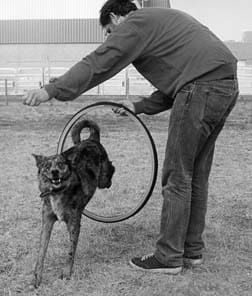
Other dogs resent being physically manipulated. That may or may not be the reason I had a recent client whose Scottish Terrier caused serious injuries to his prior trainer when she tried to push him into a sit. He resisted her first two push-sit attempts, and on the third try went up her arm with his teeth.
But other dogs may have other reasons for failing to catch on quickly. A case in point is a shelter dog I saw in my Intern Academy last summer – a beautiful English Pointer who had been purchased for hunting trial work but disqualified from competition due to a minor congenital rib deformity. At age four, he had never been asked to sit, and just didn’t seem to understand what we were asking of him.
In fact, he was the classic example of a shut-down dog – unwilling to offer any behavior at all. It took four days of the six-day academy, but on Thursday when his trainer finally got him to sit, the whole class applauded wildly. Best of all, the dog got it! His eyes lit up, and he proudly offered sit after sit after sit. In the remaining two days of the course he and his trainer caught up on all the lessons that had been on hold while they worked on the sit, and both graduated with flying colors and big smiles.
Basic Shaping
Some trainers profess to teach their entire entry-level classes using basic shaping only. I’ll admit I’m not that brave, but we do introduce the concept of basic shaping with our “Go to Your Place” exercise. I explain to my class that shaping is a Zen exercise – it takes patience and close observation, and that we’ll be splitting behavior rather than lumping. Lumping means to reinforce large chunks of behavior – capturing a sit, for example. In contrast, splitting means to look for the tiniest piece of movement, click and reinforce that, and build toward the final behavior. Splitting is the essence of shaping.
To shape a “Go to Your Place” behavior, set out a carpet square, dog bed, or blanket to designate “Place.” You can actually do this without a physical object to mark the place, but it’s easier for canines and humans to succeed with a visual marker – and then you can generalize the behavior easily by moving the marker to another spot.
Now stand back several feet from the carpet square and watch your dog very closely. You’re going to click and treat the tiniest motion toward “Place” – one step, a turn of the head, a flick of the ear … it doesn’t even have to be directly toward the spot – “in the general direction” will do.
If you’ve already reinforced your dog consistently for offered behaviors, he’ll probably catch on quickly. As he starts repeatedly making deliberate movements toward the rug to get clicked, you’ll hold out slightly longer to build more behavior. Just slightly! You want him to get a little frustrated and try harder (harder = bigger behavior), but if you hold out too long he may give up and quit offering behavior altogether.
As he gets closer to the mat you can move forward with him in order to keep delivering treats – but not ahead of him – that would be luring or prompting!
When he’s reached the mat, reset. Move yourself and your dog several feet back and start again. The goal is to shape him to go to the mat, not just to be on the mat. When he offers to go to the mat easily, start shaping him to lie down on it. The value of this exercise is to be able to park your dog there for a while. When he’s consistently offering to go lie down on his mat, you can add the verbal “Go to Your Place!” cue.
If your dog doesn’t offer behaviors easily, it may take longer to shape the Place behavior. Be patient, and remember to split – look for the tiniest of movement to reinforce. If he wants only to gaze adoringly into your eyes, look at the rug instead of him. If he just lies down at your feet for a snooze, invite him back to his feet, reposition him, and look for movement to reinforce as he repositions. The more you can find to reinforce, the less likely he is to lie down for another nap.
Dedicated shapers may write out their complete shaping plan, considering each potential step in the process, and measuring their progress against the written plan. Less scientifically disciplined trainers may work with just a mental picture of their shaping plan. You can do each shaping session for as long or as short as you like. Assuming your dog is happy to play the game, you can keep on playing! As with all training, try to end the session while your dog is still enthusiastic and successful.
Dubhy’s Picnic
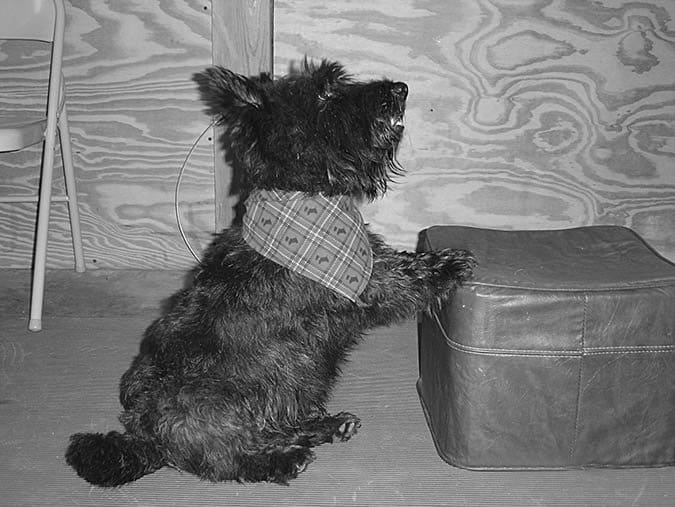
I decided to shape Dubhy to flip open a picnic basket with his nose. I could have used pure basic shaping, in which case the steps in our shaping plan might have looked something like the one below. Because I’m doing basic shaping with a behavior goal in mind, not free shaping, I wouldn’t click random offered behaviors that aren’t in the shaping plan.
Note that I would click and treat several times at each step, unless, of course, Dubhy took a quantum leap over several steps, in which case I’d be prepared to leap with him.
1. Looks at basket
2. Moves toward basket
3. Sniffs basket
4. Sniffs basket closer to basket lid corner where opening is
5. Sniffs basket at basket lid corner
6. Nudges lid corner (here I might need to hold out to wait for stronger behavior to get the nudge)
7. Nudges lid corner harder
8. Nudges hard enough to move lid corner
9. Nudges hard enough to lift up lid corner
10. Nudges hard enough to lift lid corner higher
11. Nudges hard enough to flip lid open
When I put my plan into action and began training Dubhy to flip open the basket, I chose to take a shortcut and do a little prompting with a target stick. That allowed us to skip steps 1-4 and go directly to step 5, sniffing the basket lid corner. From there, it only took a few minutes for Dubhy to repeatedly offer a strong, reliable “open the basket” behavior.
Now that we have reliability with the goal behavior of opening the basket, I could incorporate it into a trick routine – perhaps packing picnic supplies into the basket, or unpacking them and laying them out on a waiting picnic blanket. Or perhaps he could find a small “lost” dog who was trained to lie quietly hidden in the basket. Or…?
Free Shaping
Free shaping is great for encouraging a dog who is somewhat shut down to offer behaviors, because he can’t be wrong. Anything he does that even remotely relates to the exercise gets clicked and treated. Once the dog is easily offering random behaviors, then you can, if you choose, switch to basic shaping with a goal behavior. Here are a couple of free shaping exercises you can experiment with:
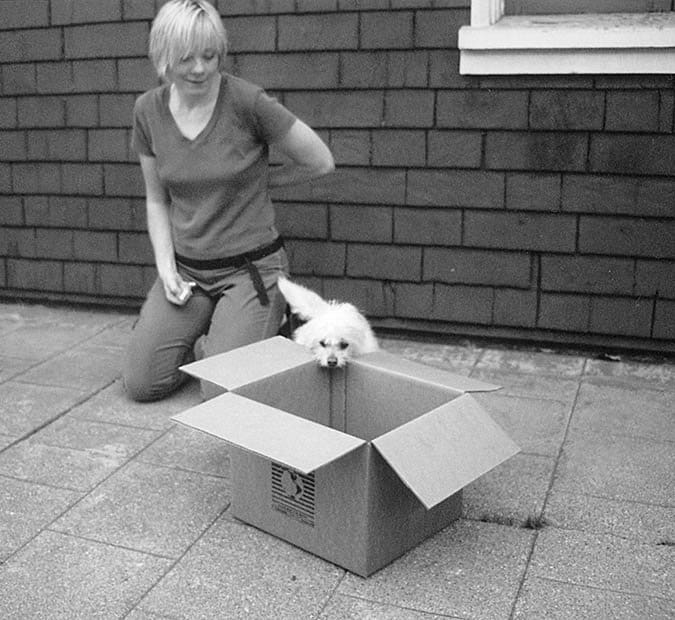
101 Things to Do With a Box – You can use any old cardboard box for this, or it doesn’t even have to be a box! You can play “101 Things to Do With Anything.”
Your dog can be on leash, or off, if he’ll stay and keep working with you. Set a chair a few feet back from the box or object, sit in the chair, and wait. As with the “Place” exercise, you’re looking for tiny pieces of behavior to click and treat – any behavior that relates to the box – a look, a step, a sniff, a push … only this time you have no specific goal in mind, and you don’t have to build up to a behavior – random behaviors are fine.
If your dog gets hung up on one particular behavior you can stop clicking that one and wait for something else. The more confident your dog is about offering behaviors, the more easily you can just quit clicking one thing and wait for another. At some point, if you wish, you can decide on a goal behavior based on the ones your dog has offered, and shape it into something specific – front feet only in the box; hind feet only in the box; all four feet in the box; turn the box over; fetch the box; or…?
Body Parts – Body Parts shaping helps your dog learn to offer behavior, and it also helps you realize how precise this process can be for shaping the tiniest of movements.
Sit in a chair with your dog facing you, and watch your dog closely for a movement in one of his body parts. Even a tiny movement will do. For example, you could watch for a flick of his ear, a turn of his head, the lift of a paw, or a tongue flicker.
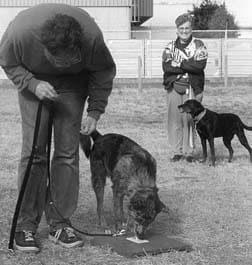
When you have captured one of these movements with your click and treat, that’s the one you’ll continue to focus on. Sit and wait for another movement of that same body part. Click and treat. Your goal is to reinforce that accidental behavior until your dog begins deliberately offering it. When he does, you can name it, incorporate it into a trick routine, or keep working with it to shape it into something bigger if you choose.
I really came to appreciate the power of shaping when I first purchased agility equipment, set it up in the backyard, and ran to get Dubhy, to see what he’d do with it. To my delight, as I introduced him to each piece of equipment, he immediately started doing stuff – sniffing it, pawing at it, biting it, jumping on it, just trying out different things to see what he needed to do to get me to click. Made training a breeze!
Karen Pryor’s 10 Laws of Shaping
In her landmark book, Don’t Shoot the Dog, behavioral biologist and past dolphin trainer Karen Pryor says, “…a well-planned shaping program can minimize the required drilling and can make every moment of practice count, thus speeding up progress tremendously.” She also tells us that the successful application of shaping principles makes the difference between shaping that is frustrating, slow, boring, and disagreeable, and shaping that is happy, fast, and successful.
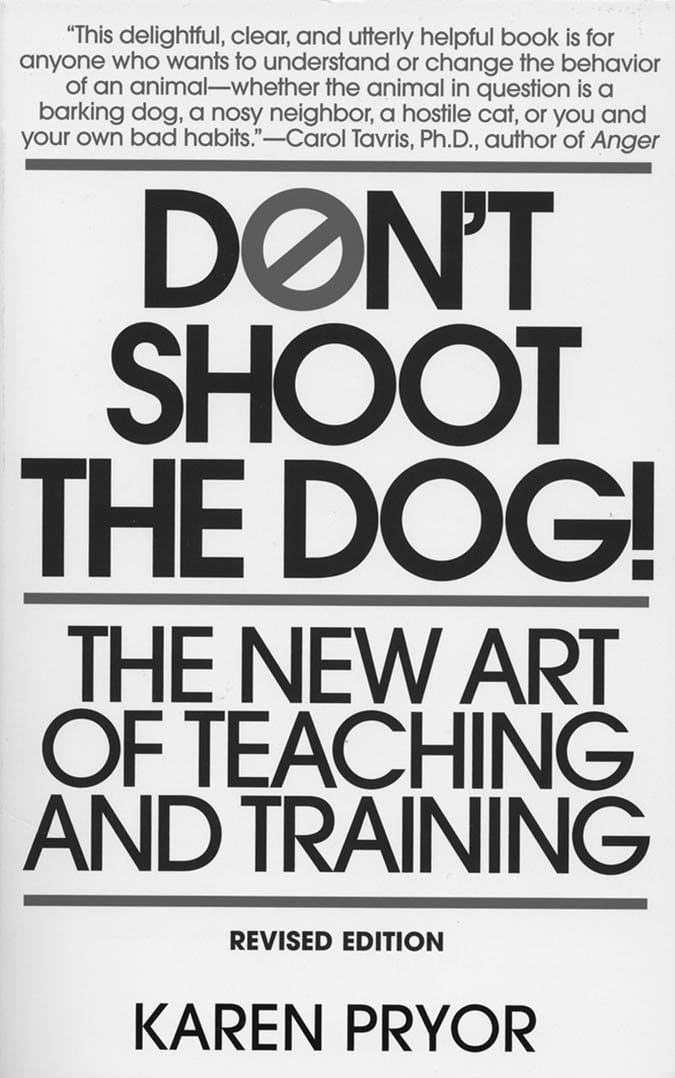
Here are the 10 principles that Pryor suggests you follow for the most enjoyable and successful training:
1. Raise criteria in increments small enough that the subject always has a realistic chance for reinforcement.
2. Train one aspect of any particular behavior at a time; don’t try to shape for two criteria simultaneously.
3. During shaping, put the current level of response onto a variable schedule of reinforcement before adding or raising the criteria.
4. When introducing a new criterion, or aspect of the behavioral skill, temporarily relax the old ones.
5. Stay ahead of your subject. Plan your shaping program completely so that if the subject makes sudden progress, you are aware of what to reinforce next.
6. Don’t change trainers in midstream; you can have several trainers per trainee, but stick to one shaper per behavior.
7. If one shaping procedure is not eliciting progress, find another; there are as many ways to get behavior as there are trainers to think them up.
8. Don’t interrupt a training session gratuitously; that constitutes punishment. (Author’s note: For example, you’re in the middle of training and the phone rings. You drop what you’re doing and run to answer the phone. This is “negative punishment,” because the dog may perceive that whatever he did made a good thing [you/ training] go away. Instead, take time to gracefully end what you’re doing with the dog to attend to an interruption. I use an “all done” cue that lets the dog know the training session is over.)
9. If behavior deteriorates, “go back to kindergarten.” Quickly review the whole shaping process with a series of easily earned reinforces.
10. End each session on a high note, if possible, but in any case quit while you’re ahead.


Describe the Pros and Cons of SHAPING, giving example to illustrate your discussions.