

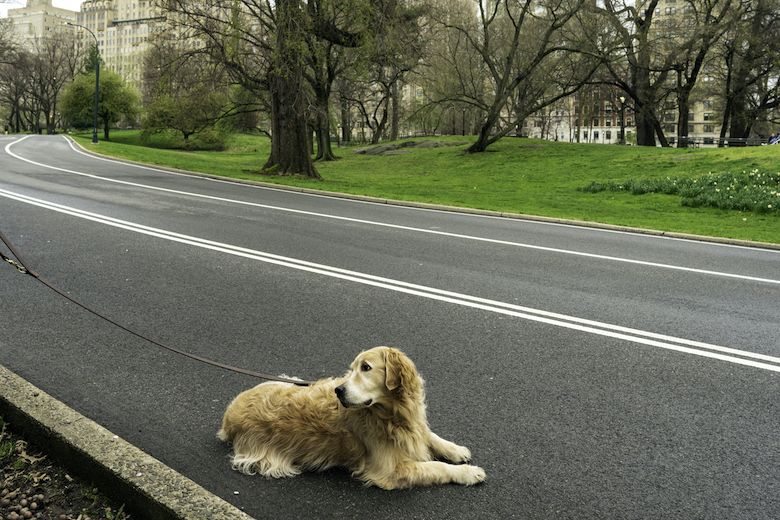
I cringe whenever I hear someone refer to a dog as “stubborn.” It is patently unfair to label a dog as stubborn. Dogs do what works for them (as we all do), and when they aren’t doing what we ask, they have a good reason. When your dog doesn’t respond to your cue, perhaps he’s come to associate it with something aversive, perhaps he doesn’t understand what you’re asking, or perhaps he’s too distracted or stressed and your request doesn’t even register in his brain. In any case, it’s our job, as the supposedly more intelligent species, to figure out how to get our dogs to want to do what we want them to do.
Some humans believe dogs should do what they are told, simply because we tell them to. “Because I said so!” hearkens back to childhood, when parental directives were often accompanied by the implied “Do it, or else!” In these days of a more enlightened dog training philosophy, this coercive approach isn’t what many of us want with our dogs. We prefer relationships based on a cooperative partnership.
If your dog isn’t doing what you ask, consider these questions:
Are you training competently? Remember, dogs shouldn’t have to do what we say just because we tell them to – or just because they love us. We want them to want to do it. Make sure your reinforcers are valuable enough that your dog will eagerly offer the behaviors you ask for, and that you are marking and/or delivering the reinforcer with good timing so your dog associates the reinforcer with the desired behavior.
Is there something aversive about the behavior? Years ago, my first Pomeranian, Dusty, started refusing jumps when we were training for the Open Division of obedience competition. I didn’t punish him for not jumping – I took him to my veterinarian and discovered he had bad hips. It hurt him to jump. A behavior can also be emotionally aversive. If a car ride always means a trip to the vet, your dog could become very reluctant to jump into the car. Your challenge is to make car rides consistently predict “good stuff” – a hike in the woods, a trip his favorite canine pal for a play session, or? If he’s refusing to enter his crate because he has mild separation distress and associates crating with you leaving, alleviate the separation distress through behavior modification (and possibly appropriate medications), and then convince him that crating is wonderful.
Does he not understand? You may have taught him to respond to a cue for the desired behavior, but perhaps you’ve used body language prompts in the past without realizing it, and now, absent the prompt, he doesn’t understand what you’re asking of him. Fade all prompts if you want him to respond reliably to verbal cues. Perhaps you’ve always trained in the kitchen in front of the refrigerator, and so he thinks “Sit” means “Sit in the kitchen.” When you ask him to sit in the living room, he doesn’t sit because it’s not the kitchen. He’s not being stubborn – he needs you to help him generalize his behavior so he understands that “Sit” means to put his tail on the ground wherever you ask him to do it. Even your tone of voice can matter. If you usually give cues with a happy voice but your own emotional state causes your voice to sound different, he may not understand.
Is he distracted? If you haven’t generalized your dog’s behavior to distracting environments, his attention will naturally be drawn to the multitude of exciting things happening around him. He’s not ignoring you; he probably isn’t even hearing you because he’s so focused on the fascinating world around him. Help him hear and respond to your behavior requests by training in various environments with gradually increasing distractions.
Is he stressed? “Stressed” is an even bigger challenge than “distracted.” When stress happens, the thinking part of the brain (the cortex) shuts down and the emotional part of the brain (the amygdala) takes over. We even have phrases in the English language to describe this phenomenon: “I was so scared I couldn’t think straight.” “I was out of my mind with worry.” When your dog is so stressed he can’t think straight, it’s unfair to blame him for not doing what you ask. Relieve his stress (remove him from the stressor, and/or do behavior modification to change his association with the stressor) and try again.
Your relationship with your dog will be so much happier when you stop characterizing him as stubborn and realize how you can help him be more responsive to your behavior requests. Now get busy helping him want to do what you want him to do.
Featured photo: Christine McCann/Getty Images
Read Next: The Right Way to Feed Treats to Your Dog




Where can I find evidence of this?
Only seems to be opinion from what I’ve read.
Would love to find evidence of the scientific study that says dogs aren’t stubborn.
When we got our last Labrador the breeder had told us he was her favorite because he was ‘the bad one’. Should have heeded the warning, lol. He stood out in his training class, and not in a good way. He sure entertained everyone in the class though.
He had a mind of his own, for sure, and I finally realized that we were both better off if I worked with him and focused on teaching him the house rules rather than trying to make him into a ‘perfect dog’. The best decision I ever made because we became best friends and he was my Soul Dog, for sure.
Certain breeds are known for being stubborn and I know some dogs just don’t make the cut for being a seeing eye dog, etc., so why is it not possible for some dogs to just be stubborn? Sorry, strongly disagree here. We know dogs share a lot of similar emotions as people, just not the more complex ones, so why can’t a dog share certain personality traits and be stubborn?
My 11 month old goldendoodle is a sweetheart, except when she picks up something she knows she shouldn’t have and refuses to give it to me, clamping her jaw so tight I can’t get it out and so we have a stare down til she finally gets tired. This could be trash on a walk, a dangerous bone found on a walk, my clothing, you name it. Even trying a high quality treat in exchange does not work. Yes, she has a stubborn streak.
Are you old enough to remember Red Skelton and the “mean little kid” “If I do I gets a whuppin’ I Dood it!” That’s Ponko – a hienz mix rescue. Stubborn to the max.
I’ve had a variety of different breeds thru out the years and trained a lot of different dogs and do believe some dogs are stubborn. Right now I have a standard poodle and a boxer. Both are fairly well trained but training the poodle was a breeze, she just wants to please. The boxer is a whole nother story. When she doesn’t want to do something asked of her you can see her brain working on should she or should she not comply with the request. She eventually decides to do the right thing but it’s not a quick agreement. I do believe stubborn dogs are harder to train but not all hard to train dogs are stubborn. It seems to be a breed thing, bully breeds are quite a bit more stubborn then the “soft” breeds. They need many more repetitions of a desired behavior then saya border collie or poodle. Sometimes you have to get more creative on how you ask and reward
I rescued a dog a couple of years ago. They told me she was stubborn. I found out within a weak that she was almost deaf and within months completely deaf. I had to teach her hand signals and she learned in minutes. You just never know.