Whole Dog Journal is reader-supported. If you purchase through links on our site we may earn a commission. Whole Dog Journal does not accept money for its food and product reviews.
If you’re searching for ear plugs or ear covers for your dog, you’re likely looking for something that will keep your pup’s ears dry and free of debris. Dogs who most need this type of protection tend to have long ears, narrow ear canals, allergies, a history of recurrent ear infections, or a tendency to repeatedly shake their heads after swimming.
Fortunately, there are several ways to keep your dog’s ears dry with ear covers. Available types include:
- Snoods
- Bathing covers
- Swim caps
- Swim hoods
- Ear wraps
- Headbands
- Swim bands
- Stretch tubes
- Ear guards
What About Dog Ear Plugs?
Traditional ear “plugs” like those worn by humans are not usually sold for canine use. Although true ear plug for dogs do exist, the companies that make them had, when this article was written, gone out of business or their product lines were “temporarily unavailable.” Online searches for dog ear plugs bring up ear covers like those listed above.
When Ear Covers or Snoods May Be Useful
In addition to protecting the ears of swimming dogs, ear covers can be used during dental procedures to prevent fluids from collecting in a dog’s ears. Dogs with long ears can wear them at mealtime to keep their ears from being soiled by food. Snoods and other ear covers can protect ear hematomas or surgical stitches. Dogs sensitive to loud noises, such as the sound of a dryer during grooming, can relax without being stressed, and the compression that some bands provide has a calming effect on most dogs.
Why Protect Your Dogs Ears While Swimming?
Damp ear canals are a common breeding ground for yeast and bacteria, especially for dogs with long, floppy ears that reduce the flow of air around the ear canal. Even if a dog doesn’t develop an ear infection, water in the ears can be irritating. If your dog flaps her ears after every swim, try experimenting with headbands or snoods.
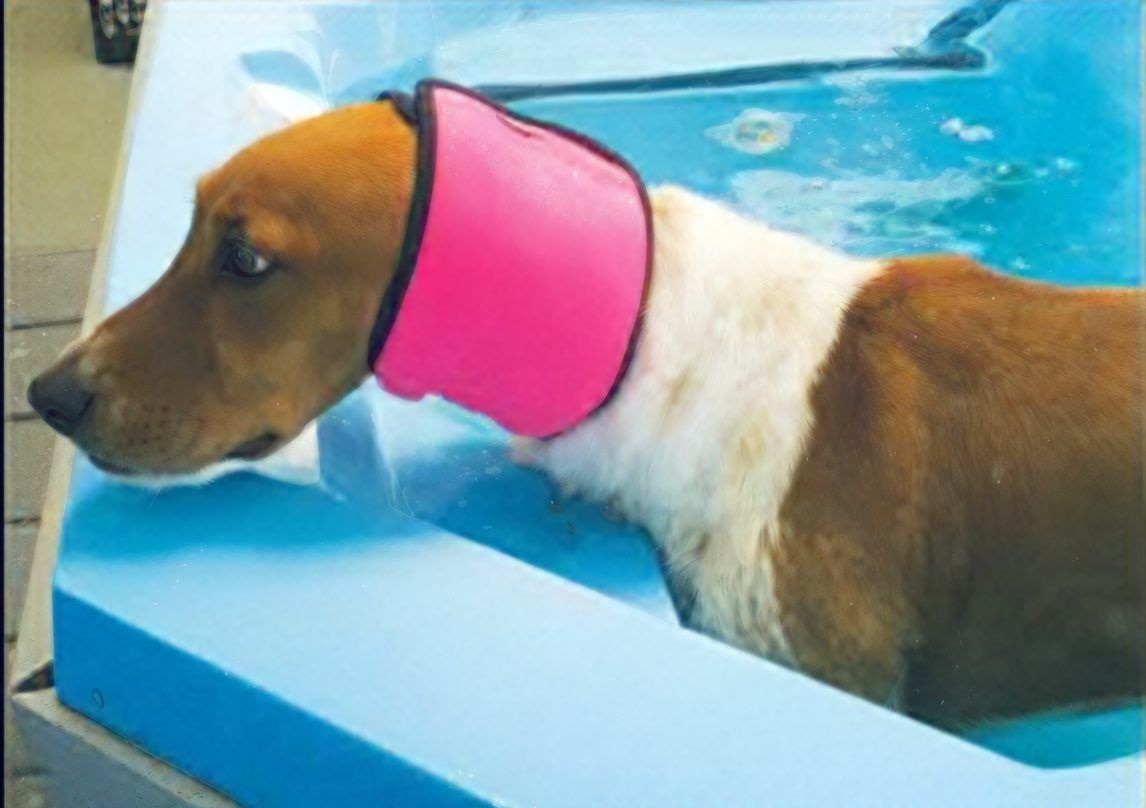
For swimming, the most suitable designs are usually snug, waterproof snoods rather than fabric hoods that reduce splashing but are not reliably water resistant. Snoods are external covers that hold the pinna (ear flap) close to the head so direct sprays and wave splashes can’t enter the ear canal.
Although the ear covers described here are designed for use in and around water, they can also help dogs relax, focus their attention, and be less distracted. In a previous article, I described how my Labrador Retriever, Chloe, shook her head whenever she swam, even though she didn’t have an ear infection. I purchased an AquaBandit and DogLeggs Swim Snood and found both of them helpful. Chloe swam every week at Apex Animal Hospital in Helena, Montana, where Adele Delp then worked as a veterinary technician. I left the head bands at the clinic’s therapeutic swimming pool for other dogs to try, and Delp said, “I think dogs are more comfortable when wearing a headband. Instead of shaking their heads, they relax and focus on swimming.”
When Casey, a six-year-old Border Collie, started swimming, he was intent on getting the ball, hypervigilant, and wild in the pool. “We tried a swim band on him,” said Delp, “and we were amazed at how focused and calm he became. Whenever we took it off, he became a wild man again. This led us to speculate about the band’s applications in thunderstorms and other stressful situations.
Like Chloe, most swimming dogs adjust quickly to head bands. And they work. Chloe seldom flapped her ears after she started swimming with a band.
| Product | Type | Materials | Sizes, Colors | Cost |
|---|---|---|---|---|
| Doglegg Swim Snood | External Hood | Water-resistant Neoprene | 4 colors, 5 sizes | $64 |
| Walkabout Snoodle | Head/Ear Cover | Water-resistant Neoprene | 4 sizes, 2 colors | $49 |
| Aquabandit | Headband | Water-resistant Neoprene | 5 sizes, 2 colors | $42-$45 |
| BAMY Ear Cover | Band/Ear Cups | Waterproof Diving Fabric | 3 sizes, pink | $9 |
Popular Dog Ear Covers: Uses, Fit, and Sizing
The Doglegg Swim Snood is made from water-resistant lightweight materials that prevent water from splashing into a dog’s ears. Designed for dogs with pricked or pendant ears, the Swim Snood is soft and flexible. Velcro fasteners help the snood stay in place. It can be hand-washed in warm water and hung to dry.
For correct sizing, measure the circumference of your dog’s head, including the ears (under the jaw and around the head over the ears). Size Extra Small (XS) measures 9 to 11 inches; size Small (S) measures 12 to 16 inches; size Medium (M) measures 17 to 20 inches, size Large (L) measures 20 to 25 inches, and size Extra Large (XL) measures 25 to 29 inches. See the Doglegg website for a video demonstrating how to measure and use the Swim Snood. It comes in red, camouflage, navy blue, and royal blue.
The manufacturer recommends the Doglegg Swim Snood for aquatic rehabilitation or conditioning, swimming, dental cleaning, oral surgery, grooming, and shielding for sound sensitivity.
The Walkabout Snoodle is made from water-resistant neoprene. To get the right fit, measure the circumference of your dog’s head under the chin and around the ears with ear flaps down. Size Small (S) measures 13 to 16 inches; size Medium (M) measures 17 to 20 inches, and size Large (L) measures 21 to 23 inches. It comes in pink or camouflage.
The manufacturer recommends the Walkabout Snoodle for swim therapy sessions, surfing, swimming, dock diving, oral care, dental procedures, grooming, and for a noise control/calming effect.
The Aquabandit head band uses a specially designed Smooth Skin Neoprene to create a seal over the ear canal with a design that matches the contour of a dog’s head. Adjustable Velcro creates a proper fit. The Aquabandit website recommends measuring tightly around the dog’s head and then subtracting 3 inches to ensure a snug fit. Size Small (S) measures 12-1/2 to 14 inches; size Medium (M) measures 13-1/2 to 15 inches; size Large (L) measures 14-1/2 to 16 inches; size Extra Large (XL) measures 15-1/2 to 17 inches; and size Extra Extra Large (XXL) measures 18 to 22 inches. The Aquabandit comes in black or yellow.
The manufacturer recommends using the Aquabandit for all types of swimming as well as to prevent sand, seeds, grass, and foxtails from entering the ear canal. According to the Aquabandit website, veterinarians recommend it as a post-surgical device to replace cumbersome Ace bandages.
BAMY Ear Covers are made from high-quality diving fabric and plastic, providing waterproof performance during swimming, bathing, or grooming sessions. The cover’s elastic strap design gives a snug and secure fit. To clean and maintain the ear covers, rinse them with water and wipe them dry after use.
Measure your dog’s head circumference as described above. Size Small (S) measures 10 to 15 inches; size Medium (M) measures 14 to 19 inches; and size Large (L) measures 18 to 24 inches. BAMY Ear Covers are available in pink, yellow, gray, and camouflage.
Safety and Limitations
Whatever the type, ear covers shouldn’t be relied upon to prevent any water or debris from ever entering a dog’s ears. They can be a good tool, but they’re not fool proof. Even when using ear covers, it’s important to keep an eye out for any unusual head shaking, tenderness, or odor that might indicate there’s a problem.
Also, getting a good fit can make a big difference when using ear covers since loose or ill-fitting covers won’t be as effective. Models and sizes can vary significantly so pay close attention to any manufacturer-recommended fitting instructions.
Tips for Teaching a Dog to Wear Ear Covers
Some dogs don’t mind wearing ear covers and take to them right away. Others have more trouble. To help a dog adjust to them, you’ll need to create positive associations with the covers. The trick is to go slowly and break the process down into small steps. That typically looks something like this:
- Start by showing your dog the ear cover and rewarding them for any movement towards it. Rewards can be treats, praise, playtime, or toys—anything that makes your dog happy.
- Next, show your dog the ear cover and wait until they touch it to reward them.
- When the dog is comfortable touching the cover, gently stroke their face and head with it.
- Place the cover (unfastened) on the dog’s head briefly and reward the dog.
- If the cover is the pullover type, hold it open and reward the dog for putting their nose through it (even briefly).
- When the dog is used to the cover being on their head, fasten it or pull it on, reward the dog, and immediately remove it.
- Gradually extend the length of time the cover remains fastened.
NOTE: If at any point in the process, the dog moves away or looks uncomfortable, give them a break and go back to the previous step.