

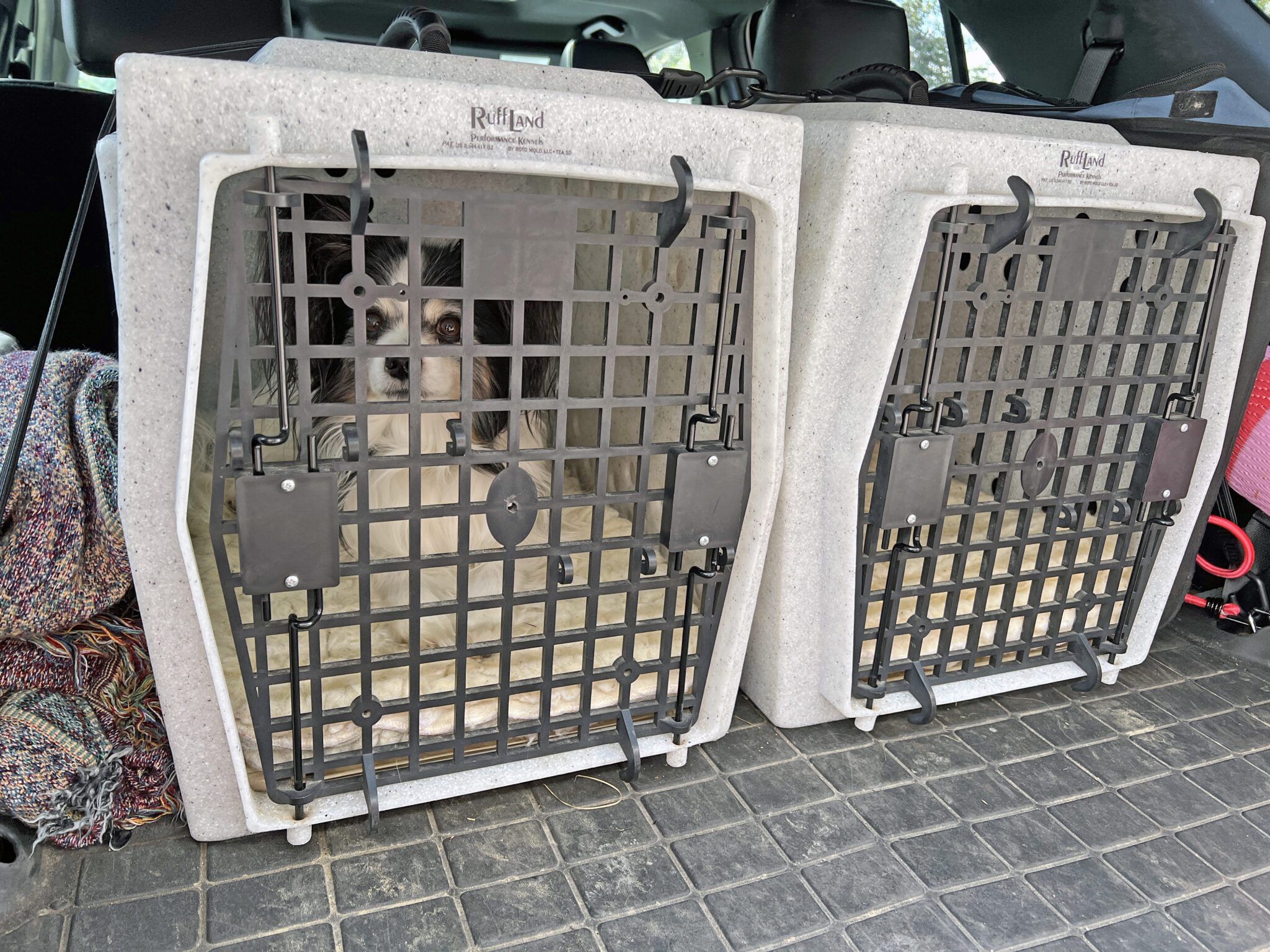
When it comes to both protecting and restraining your dog, buying a crate or kennel seems like a no-brainer. What isn’t so easy to decide is what type of crate or kennel to buy. Your options fall into three categories:
- Wire crates that offer optimal visibility
- Soft-sided crates are lightweight and portable
- Hard-sided dog crate constructed from thick plastic or heavy-duty aluminum
While wire and soft-sided collapsible crates are lower-priced and useful for things like visibility and portability, hard-sided crates offers structural integrity, privacy, and security that’s well-suited if you’re looking for a dog crate for vehicle travel, an airline-approved dog crate for commercial flights, or a comfortable (but extra-secure haven) for your dog at home. Hard crates are also most effective for behavior issues.
When a Hard Crate Is Best
A hard dog crate features solid walls on three sides with ventilation slits or wire-mesh windows. Unlike wire crates that offer your dog a 360-degree view of the environment around him, hard crates are better for car travel, flight cargo, and privacy. In contrast, wire crates are well-suited for house-training because they allow for maximum airflow and fold flat for easy storage.
Most consumer hard-crate models consist of two molded plastic shells that bolt or latch together, paired with a reinforced metal wire door. Higher-end rotational molding plastic and aluminum variants take things even further for extreme containment and vehicular crash safety. Note: Rotational molding construction is the same design used for white-water kayaks and commercial cooler chests, making the kennel virtually immune to cracking under heavy impact or flexing under pressure.
Key Features of Hard Dog Crates
To find the best travel dog crate or home refuge, look for these features:
- Size and Fit for Travel Dog Crates
The dog crate for car travel should be big enough for your dog to sit, stand up, turn around easily, and lie down. While it’s tempting to think bigger is better, oversized crates for car travel create possible injuries from a sudden stop, excess interior room increases the risk of impact injury against the interior walls.
Look for interior measurements rather than overall dimensions. Thick-walled or double-walled travel crates reduce the usable room inside. “So many people only look at the external measurements,” says Chris Loverseed, founder and head trainer at PK9 Gear. “Check the actual internal dimensions.”
- Ventilation and Environmental Placement
Ensure the crate is ventilated on at least three sides. Look for narrow slats or metal-reinforced grates that promote airflow without letting paws or muzzles poke through.
“Check it where you’re actually going to use it,” says Loverseed. Even the best-ventilated crate will lose its effectiveness if it’s not positioned right. “Are the ventilation holes still clear, or have you got things packed against them? If the dog likes being out of view, choose a crate that gives them that without needing to block the ventilation.”
- Security, Latches, and Panic Protection
Ensure that door pegs extend deep into the crate frame to prevent the door from bowing under pressure. It’s also important to note the difference between containment and psychological comfort. While a hard dog crate contains your dog and keeps him safe from escaping, it doesn’t address panic or separation anxiety.
“There is a difference between the dog not being able to break out and the dog not being able to hurt itself,” says Loverseed. “Teeth and nails can still get damaged. I wouldn’t leave a dog that’s panicking in there to keep trying [to escape]. Start with short sessions you can supervise, and if they’re struggling, get the vet and a qualified trainer involved.”
- Portability and Maintenance
Built-in handles make transporting empty crates easier. Molded plastic interiors are naturally leak-proof and easy to wipe down, hose off, or sanitize following accidents.
With these features in mind, we considered top crates (see chart) and then ranked them, with these coming out as our best choices in different categories:
Best Value CPS-Certified Crate: Cabela’s GunDog Kennel
Best for Crash Safety: Gunner’s G1 Kennel
Best Space-Saver for Travel: Impact Dog Crates Collapsible Aluminum
Best for High-Anxiety Dogs and Escape Artists: Impact Dog Crates Stationary Aluminum
Best for Everyday Transport: RuffLand Kennels Performance Kennels
| Manufacturer | Product Name | Recommended | Approximate Price Range | Material and Construction | Target |
|---|---|---|---|---|---|
| Cabela's | GunDog Kennel | Best Value CPS-Certified Crate | $380 – $400 | Single-body molded plastic with stainless door | Budget-conscious buyers seeking a 5-Star Center for Pet Safety crash-test safety |
| Dakota 283 | G3 Large Framed Kennel | $385 – $630 | Rotational molding plastic with steel door frame | Outdoor enthusiasts, hunting dogs, budget-conscious heavy-duty rotational molding plastic buyers | |
| Gunner | G1 Kennel | Best for Crash Safety | $550 – $900 | Double-walled, rotational molding plastic | Vehicle travel, maximum impact safety and 5-Star Center for Pet Safety crash protection |
| Impact Dog Crates | Collapsible Aluminum | Best Space-Saver for Frequent Travel | $800 – $1,200 | Foldable aluminum panels with drop-in locking pins | Frequent hotel stays, dog sports, temporary vehicle setups where cargo space is needed |
| Impact Dog Crates | Stationary Aluminum | Best for High-Anxiety and Escape Artists | $600 – $1,100 | Powder-coated aluminum with stainless hardware | Severe anxiety, escape artists, destructive chewers, permanent home/vehicle setup |
| Lucky Duck | Lucky Kennel | $550 – $750 | Light rotational molding plastic with injection-molded door | 5-Star Center for Pet Safety crash-test safety seekers wanting a lighter rotational molding plastic alternative | |
| Petmate | Sky Kennel | $75 – $400 | High-impact plastic shell with wire vents | Commercial airline cargo travel (IATA compliant), budget-friendly rigid travel | |
| Rock Creek Crates | Medium Stationary | $800 – $1,000 | Heavy-duty welded aluminum frame | Buyers wanting 5-Star Center for Pet Safety crash certification in a heavy-duty aluminum build | |
| RuffLand Kennels | Performance Kennels | Best Value for Everyday Transport | $230 – $435 | Single-piece rotational molding PE plastic | Working dogs, agility/sport dog owners, high-value everyday vehicular transport |
Hard Crate Seal of Approval
While there is no single government seal of approval for dog crates, there are government transportation regulations, industry standards, independent certification and testing programs, and manufacturer-commissioned testing.
The most straightforward benchmark for vehicle travel crates is the Center for Pet Safety (CPS). CPS says it doesn’t accept funding from product manufacturers. To earn a 5-Star rating, a crate must pass crash testing, maintain quality controls, and be truthful in marketing claims.
If you’re looking for a crate for air travel, the International Air Transport Association and USDA regulations establish requirements, but neither organization certifies individual crate models. The final decision on whether a crate meets compliance always rests with the operating airline.
Pros and Cons of Hard Dog Crates
| Pros | Cons |
| Superior impact safety: Ideal protection during road travel. | Bulky: Hard crates do not fold flat when not in use. |
| Den-like privacy: Natural visual barrier reduces reactive barking. | Warm-air retention: Requires careful monitoring in hot weather. |
| Easy cleaning: Plastic floor retains liquids and cleans quickly. | Reduced airflow: Less like to feel a breeze compared to open wire frames. |
| Chew resistance: Smooth interior walls offer fewer chew edges. | Weight: Heavy-duty models can be cumbersome to haul. |
Safety Tips for Using a Hard Dog Crate
- Remove collars and harnesses: Buckles, tags, or harness rings can snag on door wire grids or ventilation slots, creating a strangulation hazard.
- Secure the crate in your vehicle: A free-floating plastic crate becomes a projectile in a crash. Always secure the crate using heavy-duty ratchet straps attached to designated vehicle anchor points. “The biggest mistake is having it loose,” says Loverseed. “Use the restraints and anchor points specified for the setup. A carry handle or a luggage hook isn’t necessarily made for that job.”
- Be aware of the heat: Because solid walls hold heat longer than open-wire crates, never leave a dog in a hard crate in direct sunlight or in a vehicle without active climate control.
- Be careful of what you leave: While you want your dog to be comfortable, it’s important to know your dog’s tendencies. “I recommend having bedding because they’re generally made out of hard surfaces,” Loverseed says. “With some dogs, having an item of your clothing that smells like you can help soothe them a little bit. It’s dog-dependent, like how well they are crate-trained and whether they’re going to chew and swallow it.”
Why Invest in a Hard Crate?
While you’ll pay more for a hard crate than you will for a wired or fabric crate, a high-quality hard dog crate is a good investment for your dog’s safety and peace of mind. By matching your dog’s size, temperament, and travel needs to the right combination of ventilation, latch security, and structural strength, you create a safe, portable haven that protects your dog on the road, in the air, and at home.




I was surprised that my crate wasn’t even listed, perhaps because of the price?
Have had a Mim Variocage crate for nine years…..it’s solid, crash tested, has a crumple zone, good ventilation, an alternate escape door and comes in singles and doubles. I bought a double one (holds both dogs side by side), after I heard how unsafe wire crates were when traveling, and decided to think of it as a car essential that justifies its price. I know several friends who also have them and like.