

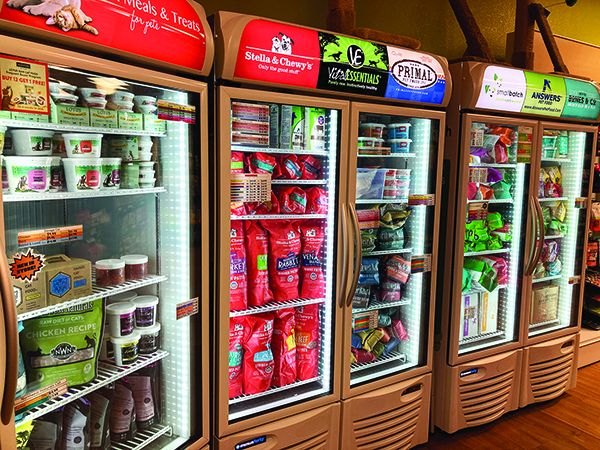
We’ve got some good news and some bad news for dog owners who are interested in feeding raw diets. First, the good news: Some dogs thrive on these diets. Today, there are many companies offering frozen raw dog food – some with many different formulations. The diets have long been available via direct-shipping but are increasingly available in pet supply stores, too.
The bad news: In addition to having the potential to deliver bacterial pathogens to your dog (and household), this segment of the pet food industry seems particularly prone to sloppy nutritional formulation. As a category, the diets tend to be extremely high in fat – high enough to pose a significant danger to dogs with a high risk of pancreatitis.
While many owners credit raw-food diets for their dogs’ vibrant good health, there are specific things you should look for (and look out for) when choosing one of these diets for your dog.
Before we get into specific purchasing recommendations, let’s talk about why people might want to feed a raw diet in the first place.
Common Traits of Frozen Raw Dog Food
Everyone should be clear about the fact that canines evolved eating diets comprised mostly of raw meat (and raw bones, organs, and other tissues from dead animals; wild canids and feral dogs still do).
The credit for popularizing an “evolutionary-style” diet to dogs in recent decades is usually given to Australian veterinarian Dr. Ian Billinghurst. His 1993 book, Give Your Dog a Bone, made a compelling case for the benefits of home-prepared diets for dogs – and specifically, diets that were comprised mostly of raw, meaty bones, supplemented by smaller amounts of organ meat, vegetables, eggs, and so on. Many people who followed his diet-formulation guidelines saw significant and almost immediate improvements in their dogs’ health – and a revolution was underway. Commercial manufacturers of these diets appeared practically overnight.
But every type of food for dogs that’s ever appeared on the market has won a certain number of fans and foes. No matter what type of diet being discussed, divisions develop and owners argue about “what’s best” for dogs.
You’d think that raw-diet advocates might hang together as allies; you’d be wrong. Raw feeders argue about the pros and cons of “whole prey” diets (those that attempt to mimic the proportions of meat, bone, and organs consumed by wolves), grain-containing and grain-free diets, diets that include whole raw bones and those that grind the bones, and diets containing synthetic vitamin and/or mineral sources and those that contain none.
Given these diverging opinions, today, about all that commercial raw, frozen diets tend to have in common is a preponderance of raw meat. If other ingredients are used, they tend to be whole, raw or very lightly processed foods. Certified organic, grass-fed, locally sourced, and/or humanely raised ingredients are more commonly found in this diet category than more conventional segments of the market.
The Truth About Frozen Raw Dog Food
What’s often lost in the arguments among raw-food fans is that no diet works well for all dogs. Just like humans (whose foods dogs have been sharing for quite some time now), what some dogs thrive on makes some dogs decline, and vice versa.
Theoretically, all dogs are equipped to eat like their wild forebears: a partly hunted, partly scavenged diet comprised largely of raw meat and other parts from dead animals. But as a point of realistic fact, raw diets don’t suit all dogs. Some dogs turn up their noses at raw; others are unable to digest uncooked ingredients well. Others may lack the immune-system rigor to defend themselves from chronic exposure to the pathogenic bacteria that’s present in much of the raw meat in the food supply (at least, the raw meat that doesn’t undergo a “kill step” – more about that in a minute).
Nevertheless, products based on some version of an evolutionary-type raw diet are very popular among some dog owners. Those who are committed to feeding a raw diet often cite a long list of benefits of these diets for dogs: better overall health and vigor, fewer allergies and digestive problems, cleaner teeth and fresher breath, nicer coats, improved reproduction in breeding dogs, and greater longevity and soundness.
This is anecdotal evidence, of course; sound, validated, generational studies comparing the health of raw-fed dogs to a population of kibble-fed dogs don’t exist. But it’s undeniable that some dogs do great on these diets! Many raw-food diet proponents stumbled upon this style of feeding their dogs after years of struggling with a dog who failed to thrive on every other type of diet – and there is no convert as dedicated as someone whose dog was sickly and is now well on a new diet.
Bacterial Concerns of Frozen Raw Foods and Solutions
Raw-food diets also have detractors, primarily for one overwhelming reason: the potential for pathogenic organisms in raw animal-source proteins to cause illness in animals and the humans in their household.
There are a number of pathogens that can be present in and/or on meat, including Salmonella spp, Campylobacter spp, Clostridium spp, Escherichia coli, Listeria monocytogenes, and enterotoxigenic Staphylococcus aureus. In more conventional types of pet food, these pathogens are rendered harmless through cooking – unless the heat-based process, whether it be extrusion, baking, or retort (canning) is inadequate. But there are also newer technologies being developed and implemented that can kill pathogens in raw foods without cooking.
Most of the largest, most successful raw-diet companies use one of these cooking-alternative, bacteria “kill-step” technologies, such as irradiation or high-pressure processing (HPP). (For more information about this, see “High Pressure Processing in Raw Dog Food,” WDJ April 2015.)
But a few companies are raw-diet purists; they often explain that they rely on superior sources of animal proteins, strict adherence to good manufacturing practices, and product testing to ensure that their products contain no pathogens.
We’ve seen credible evidence that dogs can (and often do) consume the most commonly found pathogenic bacteria in our meat and poultry supply (Salmonella) without developing illness. But given the state of the nation’s commercial food-processing oversight (not good), and reports of increasing populations and virulence of antibiotic-resistant pathogens, our own bias in raw-diet selection would mirror that of the American Veterinary Medical Association (AVMA): We recommend buying only those raw-diet products that have been subjected to pasteurization of some kind. This type of food is safely treated with HPP.
Claims of Frozen Raw Food Nutritional Adequacy
Although the popularity of dog food “mixers and toppers” has been increasing, most of these are clearly labeled as just that – “toppers” – a savory topping (some promising nutritional benefits) to add to your dog’s food. With the exception of these clearly identified topper products, in the kibble or canned food aisles, it’s uncommon to find products that are not labeled as “complete and balanced diets.”
However, this is not the case with raw frozen dog food. There are more producers of “intermittent and supplemental” diets in this pet-food category than any other. Nutritionally incomplete products are intended to provide some of the dog’s required nutrition, with the added benefit of proteins, enzymes, and vitamins that have not been reduced or altered by the heat of cooking. Some of these incomplete diets are prominently identified as such, but the labeling on others might be small (or covered with freezer frost!).
Because the incomplete diets may contain nutrients in levels that depart significantly from those required for a “complete and balanced diet,” we recommend avoiding those indicated for “intermittent and supplemental use.” Look for a nutritional completeness claim on each label – even if you plan to feed the product as just part of your dog’s diet. Also, you must make sure that it’s appropriate for your dog’s life stage.
“Adult maintenance” is the least complicated claim. Pay much closer attention if you are feeding a puppy or young (under a year old) dog. The nutrient requirements for “growth” or “all life stages” are one and the same, but be aware that these products must also specify whether they are formulated to meet the nutritional requirements for growth/all life stages including the growth of large-size dogs (expected to be 70 lbs. or larger as an adult) or except for the growth of large-size dogs. Large-breed puppies should be fed diets with less calcium; these would carry the claim, “(This product) has been formulated to meet the nutritional requirements for growth/all life stages including the growth of large-size dogs.”
Proof of Nutritional Adequacy Claims
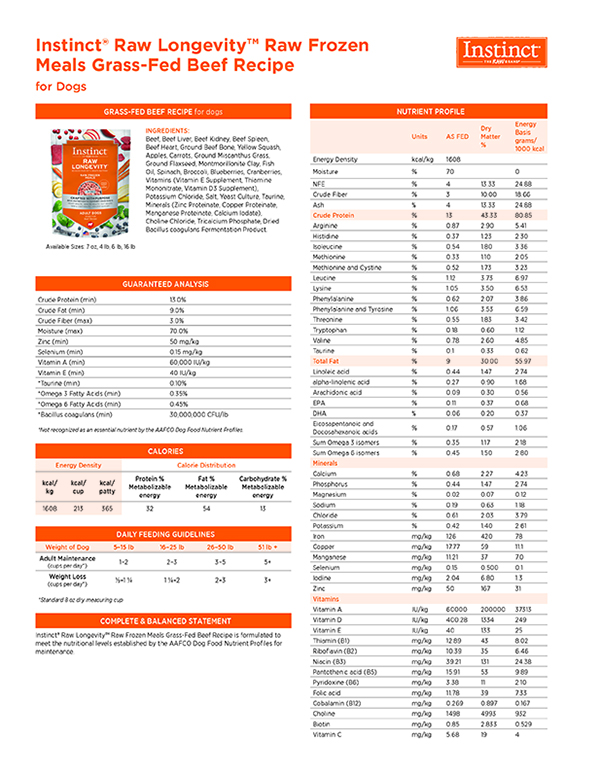
By law, the only nutrient levels that are required to appear on a pet food label are its minimum levels of protein and fat and maximum levels of fiber and moisture. These are provided on all food labels in the “guaranteed analysis.”
But “complete and balanced” dog diets must also contain minimum amounts of specific amino acids, linoleic and linolenic fatty acids, vitamins, and minerals, and have calcium and phosphorus levels within a certain ratio to each other. Though these nutrient levels are not required to appear on product labels, we recommend that dog owners ascertain that pet food makers are able to produce analyses that confirm the products meet the required nutritional levels established by the Association of American Feed Control Officials (AAFCO).
At a bare minimum, every pet food maker should be able to send you a complete “typical” nutrient analysis for all of their products. More often than not, the analyses provided show the expected levels of nutrients based on a computer analysis of the product’s formula. Preferably, these are posted on their company websites.
We have a strong preference for foods that have been subjected to laboratory analysis to confirm that their formulations deliver nutrient levels that meet the AAFCO guidelines. This is a significant expense for pet food makers – but it’s also of significant importance for dogs.
Watch Out for High Fat Levels in Frozen Raw Dog Food
We’re not sure why this is so, but the makers of frozen raw dog foods tend to formulate them with excessive amounts of fat. This attribute is not nearly as common with the makers of cooked frozen dog foods, so we’re at a loss to explain it. These diets don’t have to be high-fat.
Here’s a wrench in the works for conscientious dog owners who check the product labels, looking for high fat levels: Remember that the guaranteed analysis on the product label lists the minimum amounts of protein and fat. The product may actually contain much higher levels than what’s listed there. Argh! This is one of the reasons why we insist that you ask companies for their complete nutrient analyses; these should list percentages that are closer to the actual amounts in the product.
At the very least, pay attention to the caloric density of the food – the number of calories per ounce or kilogram – in the products you’re considering. In general, the higher the number, the more fat in the product.
When selecting a raw, frozen diet for your dog, we suggest that you look for products that have these attributes:
- Treatment with a pasteurization or bacterial ”kill step” such as high-pressure processing (preferably) or irradiation.
- A nutritional adequacy claim confirming that the product is a complete and balanced diet for dogs. For example, “This product was formulated to meet the nutritional levels established by the AAFCO Dog Food Nutrient Profiles for all life stages including growth of large size dogs (70 lbs. or more as an adult).” To reiterate, we do not recommend diets that are intended only for “intermittent or supplemental use.”
- Complete nutrient analyses for each product. Ideally, it’s clear that the reports are the results of laboratory analysis of the products, rather than the nutrient levels expected from a software analysis of the product formula.
- Fat levels that are not excessive. We recommend products with protein levels that are about twice the levels of fat for most dogs. Foods that contain more fat than protein should be avoided – especially for individuals and breeds that are subject to pancreatitis (for more about this risk, see “Signs of Pancreatitis in Dogs,” July 2021).
Devoted to Raw Dog Food?
If this type of diet has proven to really suit your dog – perhaps he’s had some health issues that have resolved on a raw dog food diet – we’d suggest reading another article with even more details and cautions. See “The State of the Commercial Raw Diet Industry,” WDJ September 2015, for even more in-depth recommendations.
If you’re just trying products from this category – perhaps in an effort to resolve some ongoing health issue for your dog – or using them as part of your dog’s rotational diet, these tips should help ensure you are buying the better products in the category.
As with every change of diet, start slowly and convert your dog to his new diet gradually, watching carefully for any signs of digestive distress (such as vomiting, diarrhea, blood in the stool, or lack of appetite). Use particular caution with dogs who are prone to pancreatitis – and retreat to your dog’s former diet if you observe any of the above-listed signs of dietary intolerance.



Article definitely biased in general against commercial raw diets. WDJ publishes lots of articles about kibble and canned and promoting your list of the best kibble and canned foods without emphasizing all the important problems with these diets in general. Even the very best kibble, by your standards, has a non-species appropriate percentage of high glycemic carb (necessary to make a dough to form kibble) and is super dehydrating to dogs fed on a daily basis and yet you ignore that problem when writing about kibble. Canned food is cooked at very high temps just like kibble and also has contamination from can lining and you never emphasize that when discussing the best canned foods. Why is that? How about mentioning that the major recalls in the past two decades that killed many dogs were canned and kibble foods by the big players like Royal Canin and Science Diet. How about an article about the toxic 3 D meats in canned in kibble products that are not found in raw commercial because raw commercial products can’t hide putrid ingredients from the consumer as can be hidden in kibble and canned.
Loved reading your comments in the whole dog journal regarding frozen food diets. I am so for that but have been reluctant to start because of those pathogens they talk about. So, I went with Dr. Marty’s food. this is food that is processed with biologically balanced nutrition. My woof loves the stuff and she seems to be doing well. So, that’s my story. would really appreciate your thoughts and yes, after reading everyone’s feelings concerning the frozen stuff. I will get some. Thank you for your time.
We are Dog loving company. Our all product is made with Pure Buffalo, Sheep & Cow full-grain leather. These are durable raw materials and are assembled with premier craftsmanship & stitch with recycled thread.
Excellent article, Nancy. Fair and balanced. I fed raw (generally home prepared) for many years and my dogs did wonderfully well on it. I raised litters, finished Champions, did well in performance and my dogs lived long healthy lives. Many of my puppy buyers also fed raw successfully. Age, the problem with carrying 40# cases of chicken parts down steep basement stairs, and the loss of one of my suppliers finally had me switching back to kibble. I was never anti-kibble, just felt it was better to feed my dogs raw when it was doable. Because we don’t feed organ meats to Dalmatians (the purines can cause urate stones) the one-size-fits-all mentality made commercial raw impractical. My dogs are doing well on kibble, but their teeth are not quite as pearly white, I’ve encountered my first case of anal gland issues, and the stools are much larger and smellier. Raw fed stools are small, dry and almost odorless – I miss that. But, my dogs are doing well on kibble and I still mentor aspiring raw feeders and consider it an excellent option for dog owners.
Even though I feed raw (currently a raw commercial diet), I didn’t react as strongly as some of the comments I’ve been reading. As Nancy points out, different dogs need different diets. Even before reading this article I had become aware recently of how ridiculously high in fat this supposedly good quality product is I’ve been using for years. With my now senior dog, that is starting to cause GI problems. Having said that, I do prefer a less processed food and can’t feed him kibble due to all his food sensitivities. (Yes, he developed those even on a raw food diet). I really don’t think folks need to be concerned that one article is going to turn people off of pursuing a raw diet. It just encourages me to continue to do my research on finding a better food for my dog.
I have been disappointed with WDJ for years for not testing and rating commercial raw food diets. This article somewhat explains why this has not happened: Nancy Kerns does not approve of a raw food diet. A response several years back to my complaint of no raw food review said there was a conflict of interest as Steve Brown (Steve’s Real Food) was on her Board or a contributor or some close association. If I am correct, he no longer owns that company. I have read that some 10%-12% of dogs are fed commercial raw (although that may include home prepared diets). Surely we deserve an unbiased rating of available products.
Well said…I agree. This publication just lost my subscription.
Two comments.
First, I’ve often wondered if the reason many vets won’t recommend a raw diet is fear of being sued by an unhappy client, especially since the vet doesn’t have many studies to refer to and back him up.
Second, the reason those studies haven’t been done is because there isn’t any money in it for the big commercial dog food manufacturers. Besides, why would they want to promote something that would compete with their kibble business?
As with almost everything, follow the money trail and there’s your answer.
I will address the first question, as I know many vets, and at least thirty have acquired golden retrievers from me, often because I feed raw. Most of them sell Science Diet or Purina in their lobbies (not the specialists), but feed their goldens from me a raw diet. It is a liability thing. If they recommend raw, and the client makes a mess of it, they fear blame. This has never actually happened, to my knowledge, but I understand their concern. It’s interesting, because there have been several significant recalls of kibble and canned foods for contaminations that caused illness and death in dogs, (mostly fungal, but there was that recall of an expensive canned food that was determined to be euthanized horse rather than beef), and vets might well have recommended some of these products, but vets were not blamed for this, manufacturers were. However, most people would not have fed raw had it not been recommended by someone, so. Vets often have a fairly low opinion of the general public’s ability to follow direction. I think the best way to deal with it is to give curious clients lists of websites and publications of raw feeding experts, and say, “I’m not an expert in this, but here are some resources if you’d like to pursue it.” That puts the onus and responsibility where it belongs, on the actual dog owners.
There’s are so many raw food companies not doing the work it takes to keep the food safe, nutritional or sourced properly.
I feed All Provide to my 3 Border Collies and couldn’t be happier with the product, the company & the service.
We need to do our homework & sadly I don’t think it’s in this article.
Don’t forget that the FDA has a zero tolerance policy for pathogens such as salmonella. These raw food companies know it, and that they are at greater risk of penalties than the kibble foods, and they have to be far more diligent about preventing a run-in with the FDA. (even though kibble has at least as many if not more salmonella problems, and has a greater history of sickness and death as a result)…I remember the recall of thousands of pounds of kibble at Diamond pet food for salmonella that killed at least 6 animals and sickened at least 14 people. That was an extreme case, and the truth is that salmonella affects people far more often than dogs, as dog’s have a physiology designed to handle it.
Keep in mind that this article’s focus is on commercial frozen raw diets, not raw diets in general.