

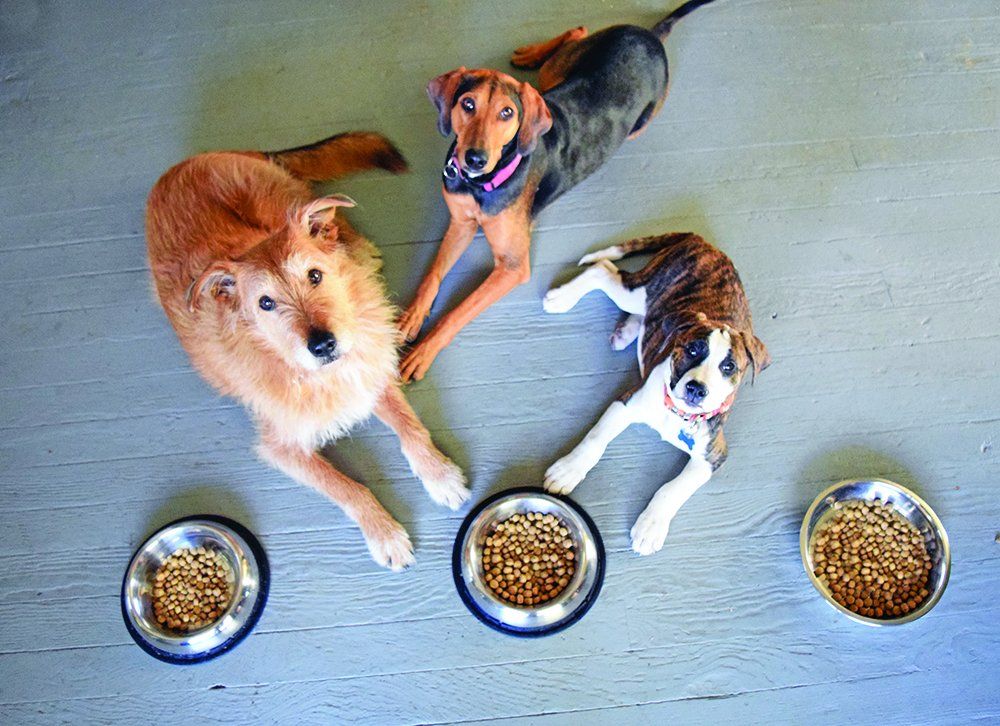
Taking responsibility for sharing your life with a dog brings many choices: How to train, what equipment to use, what are the best toys? When it comes to feeding a dog, the options are just as varied: Kibble or raw, with grain or without, meals in a crate or loose in the kitchen, free feed or meals served only at a certain time? In my years of teaching manners classes, the last question has come up a lot.
Free feeding is the practice of making food available to your dog at all times. Some people who free feed offer the dog’s full daily ration at the start of the day, while others make sure the bowl is never empty, adding more food whenever it starts to look low. It’s the canine version of a Vegas buffet – there is always something being served, at any time of day or night, and the dog can eat whenever he chooses.
Convenience is typically cited as the reason some owners choose the free-feeding method. Others believe that constant access to food can prevent food guarding, particularly with adopted dogs who might have come from a situation where food was limited. In reality, constant access to food can create ongoing stress in a guarding-prone dog, as he potentially feels he must always be “on guard” to protect his buffet.
Choosing to be a responsible dog owner means doing what’s best for your dog, even if it’s not always the most convenient option. Most animal professionals agree that meals versus free-feeding is the better option for our dogs, for many reasons, most importantly, the following:
1. Meals help teach and maintain clean house habits.
Simply put, if you don’t know when food is going into the dog, it’s much harder to know when it will need to come out of the dog! This is especially important when initially housetraining a puppy or newly adopted dog, but it holds true throughout the dog’s life.
When a dog is fed on a reasonably consistent schedule, it’s easy to determine his bathroom needs and develop a routine that is easy to follow. Even better than a set routine is to feed your dog in a “window of time.” This helps prevent stressing an anxious dog when life throws a curve ball and he can’t be fed at the exact time he’s used to; it also helps prevent the creation of a clock-watching, demanding, reminding dog.
2. Appetite is an important indicator of health.
Lack of appetite is often the first sign that a dog is not feeling well. If your dog has a habit of grazing throughout the day, it’s harder to know if he hasn’t eaten yet because he’s preoccupied by life or his stomach is bothering him.
In contrast, if your dog has been conditioned to exhibit signs of being hungry within a certain time frame, and readily eats when his meal is presented, you’ll have a reliable sign that he’s not feeling well if he turns up his nose at the bowl. At that point, the owner knows to be on the lookout for other signs of illness, and can decide if a vet appointment is warranted. Plus, if you do visit the vet, you’ll be able to accurately report how long your dog has been off his food.
3. Meal manners for multi-dog households.
In homes with multiple dogs, free feeding can make it nearly impossible to monitor each individual dog’s daily intake. It can also create situations where more assertive dogs are allowed to intimidate housemates into surrendering their portions. This often happens without the owners realizing. They may not intervene until the problem has persisted long enough that it’s noticeable due to a change in the dog’s weight. The longer a dog rehearses an unwanted behavior, the more challenging it can be to modify.
When feeding multiple dogs, it’s wise to teach them to mind their own business when it comes to food bowls. We all deserve to eat in peace. Even when a dog doesn’t seem to mind the intrusion of a visiting housemate under normal circumstances (say he responds by calmly switching to the un-manned bowl, instead), the stress of the other dog invading his territory may lead to snarky behavior – especially if the intrusion occurs on a day he isn’t feeling well or when there are other stressful things going on in the household.
When dogs are fed meals, it’s easier for the responsible humans to gently remind everyone to stay at their own bowl and not interfere with housemates. Adopting this routine also simplifies things when different dogs are on different diets.
4. Meals are more hygienic and prevent unwanted pests.
Ants are cunning little creatures. If you’ve never lived in a place where the very thought of a dropped morsel of food would lead to an invasion, consider yourself lucky – and don’t tempt the immortal insect gods! Food left in bowls is an open invitation for ants and other insects.
5. Meals can be used as valuable training opportunities for life skills.
Unfortunately, the Internet is rife with bad advice when it comes to feeding rituals for dogs. Much of it centers on the ill-conceived idea that humans must somehow assert their status over their dogs by demonstrating control over food and eating. Suggestions typically range from making sure owners eat first, while the dog watches, to ridiculous – even dangerous – ideas, such as spitting in a dog’s food or randomly taking it away as he eats, in an attempt to communicate the idea that it’s really your food and you’re kind enough to share it with him.
At best, such ideas are silly and unnecessary and, at worst, they can erode a dog’s trust in the owners and create the very guarding problems people think they will prevent.
My goal is not to achieve status over my dog. My goal is to teach my dog how to handle himself, as a dog, in the human world. When a dog is motivated to eat a meal, I can use feeding time to help teach several valuable behaviors, such as:
Come When Called.
Coming when called is the most valuable skill any dog will learn. It’s a behavior that might literally save his life. While I use several techniques to teach and maintain a strong recall behavior, simple classical conditioning is always on my list, and is something I practice during every meal.
Classical conditioning is about creating strong associations in a dog’s mind. When I know a dog loves food, and is excited about mealtime, I can easily transfer some of that love and excitement onto my recall word by saying the word a split second before reaching for and feeding a bite of food.
It doesn’t matter what the dog is doing at the time. He can be sitting, standing, etc. What matters is that he hears his recall word and food magically lands in his mouth no more than two seconds later. I can easily rapid-fire my way through 25 rounds of “Saber, here!” in about a minute, and consider this a valuable piece of our recall maintenance training.
Impulse Control.
Some dogs really love mealtime, and, as a result, quickly become over-excited, working themselves into a barking, spinning, jumping frenzy. This often prompts the owners to work faster in an effort to hurry up and deliver the food so as to quiet the chaos.
Unfortunately, delivering the bowl to an out-of-control dog rewards the out-of-control behavior! There are many ways to ask your dog to exhibit self-control in anticipation of receiving his meal, from expecting that he simply wait calmly and quietly, to requiring that he hold a formal stay. At the very least, I teach my dogs that overly excited behavior will backfire, causing me to put food away and walk out of the kitchen!
Formal Stay.
When a dog is motivated to eat, earning a bowl of food is a powerful reinforcer. After my young dogs have learned that remaining calm is the key to keeping me on-task with meal prep, I use feeding time as a prime opportunity for teaching the sit-stay.
Start small, by asking for just five seconds of self-control via a sit-stay as you hold your dog’s bowl of food. If the dog breaks position – including calmly lying down or standing up (since you specifically asked for a sit-stay) – simply set the bowl on the counter and disengage from your dog for 30 seconds or so. It’s wise to busy yourself during this time so that it’s easier to remain disengaged from a dog who might try and pester you as he works to figure out what just happened.
Also, there’s no need to reprimand or otherwise correct the dog when he breaks position. The goal is for your dog to realize that his action (breaking position) is what’s causing the dinner delay.
After 30 to 60 seconds, return to the kitchen, pick up his bowl, ask him to “sit” and “stay” and try again. Chances are good that his “Ah-ha!” moment will come within three tries. When he’s successful, and you reach your five-second count, be sure to use a clear release word (I like, “OK!”) before inviting him to eat. The release word lets him know that this time, getting up won’t result in you removing the bowl.
As he gets the hang of things, be sure to change up how long you ask him to stay, sometimes asking for more, sometimes surprising him with an easy, short stay, but always ending with the release word.
Prevent Guarding.
An ounce of prevention is worth a pound of cure. I much prefer to prevent food guarding problems than to fix them. Mealtime is the perfect opportunity to condition a dog to enjoy his owner’s presence while he’s eating. It’s easier when a dog eats at a reasonable pace, rather than inhaling his food at warp speed (which, in some dogs, is an early sign of guarding).
To buy yourself some time with an enthusiastic eater, try spreading his kibble onto a cookie sheet, adding a large obstacle to his bowl (a small, upside down terra cotta pot works well) to create a “kibble moat” of sorts, or try one of the commercially available bowls designed to slow a dog down by making it harder to inhale large mouthfuls at a time.
As the dog is eating, stand a few feet away and toss several pieces of a high-value treat on the floor near the bowl. He might not even notice at first, and that’s fine. You want to be far enough away so as not to disturb the dog.
Repeat this process during every meal. If there’s room, sometimes walk by, dropping the treat as you pass the dog. Don’t say anything. Just toss or drop the high-value treat. Eventually, he will realize that the “good stuff” is coming from you, and you’ll likely see him pause, in eager anticipation of the treat, as you walk by.
The idea is to build a positive association with a human near the dog and his food. We want our dogs to want us nearby when they’re eating – our presence becomes a predictor of good things. As he eagerly looks to you for the treat, sometimes ask him to “sit” and hand him the treat, then release him back to his bowl of food.
This method works well to prevent food-bowl guarding, or help reverse mild cases when caught early. If your dog is growling or snapping, or has already bitten somebody in proximity of his bowl, please consult a qualified, positive-reinforcement trainer before attempting to modify the behavior on your own.
Say “Bye-bye!” to the buffet
A little tough love is often all that’s needed to transform a dog accustomed to grazing throughout the day into a dog who readily eats meals when they are offered. To begin, make sure you have a solid idea of how much food your dog actually needs. Remember that what’s printed on the dog food bag is only a guide – and is usually significantly more than most dogs need. Plus, it doesn’t take into consideration the calories consumed throughout the day via training treats and special chews. Your dog’s individual metabolism will also greatly affect how much food he needs. For example, my previous dogs included a 30-pound Whippet and a small, 40-pound Golden Retriever who ate the same amount of food thanks to the Whippet’s fast metabolism.
Once you’ve decided on a quantity, split it into as many portions as you plan to feed meals. In general, puppies should be fed three (or even four) times per day until they are about 4 months old, at which time they can be fed twice a day. Most adult dogs seem to do best on two meals per day, but some people find that their dogs do better on one meal a day.
When it’s time for a meal, present the food and set a timer for five minutes. Your dog now has five minutes to eat his meal. If he eats a bite or two and walks away, that’s his choice, but you’ll pick up the bowl at the five-minute mark, and he won’t be offered food again until the next meal. (The only exception here is for young puppies or underweight dogs, in which case I will offer food again in an hour – but only for five minutes. You want the dog to understand that the buffet has closed and he needs to eats when food is offered, or it will disappear.) You can usually safely store what wasn’t eaten after only five minutes, but wet food should be refrigerated or thrown away.
When the adult dog chooses to walk away from the food bowl, he has effectively made the choice to skip a meal. That is his choice. If you have a second dog who is an eager eater, try letting your picky dog watch the eager eater happily eat his left-overs! (Then cut back on the eager eater’s next meal so as not to over-feed him.)
When dealing with a picky eater, it’s tempting to try hand feeding or augmenting the food with table scraps or other toppers, but that can actually encourage pickiness. A little warm water can often jump-start a picky eater by enhancing the smell, and it’s OK to decide on a healthy additive such as a little plain yogurt, but you don’t want to keep changing things up in an attempt to entice your dog to eat. Now is when you need to be strong in your commitment to some necessary tough love. No healthy dog will starve himself when you are offering food at regular intervals.
While a healthy dog won’t starve himself, some take longer than others to understand the new game plan and decide to eat when you offer a meal. The longest I’ve seen it take is three days. Yes, three days! Thankfully the owner hung in there, resisting the temptation to offer training treats and other snacks throughout the day (or caving in all together), and we were all excited to see the dog finally choose to eat dinner on that third day – and all offered meals that followed. Her dog wasn’t being stubborn when he walked away from an offered meal – he was just getting used to the new routine. Just like any new behavior, learning to eat at a specific time, when the dog is used to free feeding, can take time.
After you’ve gained your dog’s cooperation when it comes to meals versus free feeding, how you fine-tune the feeding routine is up to you. Some people stick with the five-minute mark, allowing the dog to come and go from the bowl as he pleases, but only for a set amount of time.
I prefer that my dog stays on-task when at the bowl, so if something catches his attention and he leaves the kitchen, I pick up the bowl right then. So, as long as you’ve established a willingness to eat when a meal is presented, we see no harm in making minor adjustments to fit your lifestyle with your dog’s.
If you find that your dog isn’t consistently finishing a portion, you might be offering more food than he needs. Remember to factor in training treats or portions of kibble that are delivered throughout the day. Try reducing his meal portion by 25 percent and see what happens. If he mows through a meal and seems like he’s starving, its wise to observe for a couple of weeks to see if he’s losing weight – in which case, maybe he needs more food, or a different food – or if the hunger is all in his head.
With a little patience and persistence, your dog should soon understand that his buffet lifestyle has ended, and you’ll both begin to enjoy the benefits of daily meals.
Stephanie Colman is a writer and dog trainer in Los Angeles.

Every dog who is fed on a schedule seems to be fat and stupid. That’s my observation. My dogs know there’s enough kibble when they need it, and they don’t have to do circus tricks just to eat. And they stay lean and fit. Maybe I’m the only person in the world, but I think if people look around proof is pretty obvious.
I couldn’t disagree with you more. My dad was a dog trainer, he was born in 1916 if that tells you anything. He always free fed. He never used food as leverage. Never tied himself or us to mealtimes. The bowl gets washed every night and put down full every morning. I have had either hounds or Labradors my entire life, and never had a fat or food agressive dog. Never had a disobedience issue, never had anyone fight over food. The food is always there, they walk by and take a bite. Nobody gobbles, no stomachs are twisted, no begging no worry they will run out of food, no in house potty mistakes. This article seems written from a control freak. Day 1 of puppy being home, put the food down, keep the bowl full and leave it at that.
I have 5 English bulldogs. I am an avid free feeder. Not. One. Issue. Ever. Agree completely!
This advice is insane! This is how you create aggressive behaviour. Not one thing in this article is advisable! I dont always do things as recommended, but I would never follow this advice. You should be arrested for promoting animal cruelty.
When I lived on the farm, we had 8 dogs, 5 indoor, and 3 outdoor(by choice of their own), all dogs had their own freedom of choice. When it came to food, they had 2 bowls inside and 3 bowls outside. Inside they had a large self filling dish that was checked on frequently, and outside they had a creek running spring water with three seperate bowls place in various areas of the yard. The food and water bowls inside and out also served a second purpose, it was their limits. Inside 5 dogs had free reign of downstairs with the exception of one, who is my first dog, and also my service dog who was the only one welcome to sleep in my bedroom. The others would mess upstairs and weren’t allowed upstairs. Outside, 8 dogs, their limits were set by their food and water availability… they learned their limits on their own. They became a pack, much like wolves, the senior, and the pups, were the most recognized, we made very little effort with them, and they still became the most well behave dogs, 2 dogs shared their training with the rest. Let them be themselves, that’s how you raise a dog
Sorry, but you’re quite possibly an idiot.
Free-feeding your dog is a good option for a well bahaved dog who is active. The writer of this one sided article suggests if you free-feed you are irresponsible, a statement suggesting a non-professional writer/trainer. I’m a 30 year vet and trainer. Most of our dogs are free feeders, it works all of the time with active dogs.
I have had labs for over 20years and have always free fed. With our dogs it prevents guarding and food aggression. Also, they only eat when they are hungry, not a bowl of food just because it’s been placed in front of them. I can always take food from them at anytime and they are pleased to eat with each other or on their own, knowing the bowl is always full. There is always food for everyone. As far as weight maintenance, we have also never had an over weight dog. They stay active and eat when their body is hungry. For our dogs and household free feeding is the only way I would do it.
My two dogs have always been free to graze but now I am working on training and making changes due to their behavior. They typically eat breakfast at 6am and are given wet food. This is the meal where they grow WAY too excited and whine. I will be sure to work on the tactic of making them sit nicely, which they are starting to learn but they are super crazy the moment they hear me get up. It’s pretty ridiculous.
I’ve been feeding them dry food around 3pm and I’ll leave the bowl down until 5pm. What are your thoughts on this method? Is that still too much time?
I have free fed all my dogs from the day I got my 1st one. I had multi dog household and single dog household and none of the 5 reasons not are within my experience. Never had an overweight dog never had a food aggressive dog , Assuming I don’t clean they’re dish often is insulting ! And yes it is quite easy to notice if they are not eating as much and to think lack of appetite is the only sign of a dog not doing well is wrong as well. Hope you can come up with 5 better reasons not to free feed because the 1st 5 suck lol
Hai Stephanie,
Your article is really helpful for me. I have a 3-month-old puppy. Now I can better take care of him. I like your Reasons #2 and #5. Thank you for your nice article.
my dogs are gettin on a bit age wise now choosin for online sai nsburys home deliv but boy the o.ld ole times any park at least he would make his own take on foragin at least 2 squirels he has helped himself to few pigeons aroun town defo countelss ducks by canal sides heck if we met any stray dogs or cats
Whaaaa??