


We know it’s okay to be apart from our dogs and to leave them home alone, but for how long, exactly? Is there a limit to the amount of time our dogs should spend alone? How should you deal with separation anxiety in dogs?
A lot of dogs might spend most of their waking hours home alone and seem to do just fine, but is it okay? Are they really fine? I sometimes wonder if, instead, this is something we say to ourselves to assuage our guilt, or to avoid taking a harder look at a cultural norm that could use an update.
Let’s look at how social isolation may affect dogs, and what we can do to minimize negative effects and maximize their well-being.

How Long Can a Dog Be Left Alone?
Let’s start with the most basic of truths: Most dogs will spend time home alone on a daily basis. How long depends on the owners’ lifestyle and schedule. Someone who works an eight-hour day and has a commute, followed by errands and evening activities, could conceivably leave their dog home alone for 10 to 12 hours in a single day and on a regular basis.
Dogs have historically been left alone for long stretches without a second thought. As recently as a couple of decades ago, if a family needed to be away from home for a day or two, how the dog felt about being left behind – whether indoors or outdoors – was not an important consideration. As long as he had enough food and water, most owners felt secure in the knowledge that he was all set.
Few people today would admit to leaving their dogs home alone for 24 or 48 hours or more, but leaving the dog home for 10 to 12 hours is not at all uncommon – and questioning this practice can sometimes lead to social ridicule. If an owner decides that after being gone all day, she’d rather not confine her dog or leave him alone for an additional few hours in the evening, she might be met with less-than-understanding responses. “You’re not coming out because you want to be home with your dog? That’s crazy! You’re letting your dog control your life!”
Here’s the thing, and I won’t pull any punches: 10 to 12 hours is too long for a dog to be alone in a single stretch.
I know, I know. It’s a very broad statement and there is always the argument that, “We’ve always done it this way and our dogs have always been fine!” What this means, though, is that the dogs who appear to be fine have simply learned to cope with something that is entirely out of their control. Being left alone for long stretches of time is not a likely choice that they would make if it was up to them. They’ve adapted to our routines, but it’s far from ideal for them.
We count on our dogs to be there for us when we’re ready to interact with them, but in between those moments, we expect them to do nothing and wait. It’s a tall order, but lucky for us, most dogs adapt incredibly well to anything we ask them to.
People whose dogs have difficulty adapting are the ones who come to us trainers, asking for help with behavior problems such as barking and destructive chewing, or emotional issues such as fear, anxiety, aggression, or over-excitement, to name a few. In fact, many of us trainers and behavior consultants are kept very busy as a result of the lifestyle to which many dogs are subjected!
Some home-alone dogs may experience separation anxiety. For more information about this extreme form of isolation distress in dogs, see trainer Pat Miller’s article on separation anxiety..
Trainers are often asked, “What’s the maximum amount of time a dog can be left alone in a single stretch?” There’s no simple answer to this. We know that in most cases, a dog will manage if he has no choice, but we shouldn’t push the envelope just because we can.
Let’s consider the dog’s basic needs. While not all dogs are alike, most adult dogs should be able to go outside to relieve themselves about three to five times a day (more often if they are sick or elderly) and shouldn’t be forced to “hold it” for more than four to six hours at a time, on average. We know most adult dogs can hold their bladders for more than six hours, but they really shouldn’t have to.
Granted, this is relative. Some dogs, if given the opportunity, will go outside to eliminate every couple of hours, while others – even with the freedom to do so – might still only eliminate three times a day.
You know your dog best and are in a unique position to figure out what his individual needs are. When you’re home during the weekend, does you dog stick to his usual weekday elimination schedule, or does he tend to go out more often?
Puppies need to eliminate way more often than adults, and although we can set up their “home alone” environment to include a space where they can eliminate indoors, there is still the question of how long they should be left alone without human company.
Yes, Dogs Get Lonely
Dogs are social animals and should have the opportunity to interact with people at least several times a day, and with other dogs on occasion, if this is something they enjoy.
It’s even more important to not leave puppies home alone all day. Puppies younger than 14 weeks of age are in a sensitive socialization period and benefit from lots of social interaction. They should be in the company of their family for significantly more time than an adult dog.
Again, for emphasis: Leaving a puppy home alone all day is a waste of valuable – crucial – socialization time that can confer lifelong benefits.
How Long Can a Dog Stay in a Crate?
I have a number of clients who, prior to consulting with me, had resorted to using crates in an effort to prevent their dogs from doing further damage to their homes through destructive chewing or soiling, or to curb barking at the windows. The irony is that the behavior issues were actually created by too-long stretches of isolation. Crating the dogs only made bad situations worse by increasing the dogs’ level of stress and further limiting their ability to interact with their surroundings.
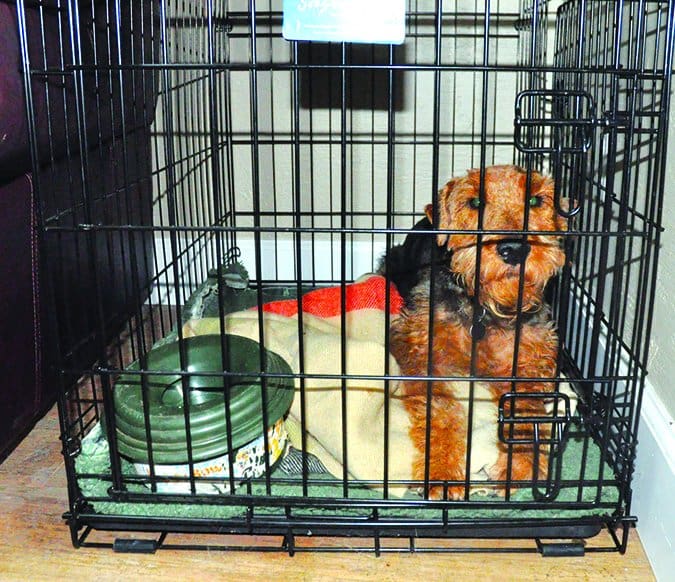
A crate is no place for a dog to spend an entire day. If necessary, confinement in a small space should be temporary and for short periods of time, say, a couple of hours, tops.
There’s often a comparison drawn between crates and “dens” – that somehow a small, enclosed space should instinctively make a dog feel relaxed and safe because it resembles a den. However, dogs are not “den animals” at all. And even if they were, they would be able to leave their dens whenever they please, which isn’t the case with crates.
And if your dog actually seeks out his crate to nap? Does that mean he loves it so much that he’d be okay in it for an entire day? Well, I have a favorite chair in the living room where I sometimes like to curl up and take a nap. My choosing to spend time relaxed in a space without budging for sometimes an entire hour is a far cry from being physically confined to that chair, unable to leave it to stretch, eat, drink, relieve myself, or just plain do something else. It’s time we rethink the use of crates and our dependence on them.
If the principal reason for using a crate to confine a dog during our absence is to avoid destructive or nuisance behavior, a better approach would be to address those behaviors through training, or through management that involves meeting the dog’s physical, emotional, and intellectual needs.
How to Keep a Dog Entertained While at Work
The following are a few ways you can avoid leaving your dog alone for too long. It can be hard to make this work, but if you dig deep and get creative, you’ll find there are actually more solutions available than you might have thought:
Doggie Daycare
Even if your dog is enrolled for just one day a week, that leaves you with only four more to go to cover an average work week! Of course, not every dog is a good fit for daycare, but for dogs who enjoy other dogs’ company, even just one day a week is a good step toward meeting his social and physical needs.
Keep in mind that not all doggie daycare operations are alike. Look for clean, well-designed locations with qualified staff who will manage interactions between the dogs and provide necessary rest periods. Also note that doggie daycare is not the right environment for young puppies.
Come Home for Lunch
If not every day, then as often as you can during the work week. If there are several family members in the household, consider taking turns coming home in the middle of the day to let the dog out to relieve himself and enjoy a short visit.
Hire a Dog-Walking Service
Dog walkers have been around for ages, but in the last decade this industry has seen a surge in numbers, possibly because more people who work outside the home are recognizing the importance of addressing their dog’s needs.
The types of services offered by professional dog-walkers can range from a quick home visit to a neighborhood walk, or even day training (when a trainer trains the dog in your home while you’re at work). Again, a caveat is needed here; there are some horrible dog-walking services out there.
Work From Home On Occasion
Telecommuting is more popular than ever as technology makes it easy for folks to perform their professional tasks from a home office.
Bring Your Dog to Work with You
Obviously, not everyone is in a position to do this. I frequently work with clients to treat their dog’s separation anxiety, and this suggestion is almost always met with an immediate negative response, “No way, I can’t do that.” However, it turns out that sometimes, it is possible.
Unless you’ve actually looked into it by communicating directly with the person who’s in the position to say yes or no, hold off before crossing the idea off your list of possible solutions. It may seem unlikely, but you may be very pleasantly surprised!
Arrange for Someone to Visit Your House and Let Your Dog Out
Ask a neighbor, or your co-worker’s teenage niece who loves dogs, or that kid down the street who does odd jobs. Not everyone is comfortable with the possible liabilities a scenario like this can present, but you may already have someone you trust to handle this type of task.
Naturally, your dog needs to be comfortable with someone walking into his home while you’re out, and in the best of cases, he’ll be thrilled to receive a midday visit!
Solutions Have Higher Cost, But Worthwhile Benefits
While some of these solutions involve an additional expense, consider it a normal part of owning a dog. When calculating a budget for expenses related to caring for a dog, owners may figure in the expenses for food, toys, maybe some grooming, and the occasional vet visit. All too often, though, money for training and other services like daycare, boarding, or dog walking tend to fall erroneously into the “luxury” category. In reality, these are essential services that contribute to meeting a dog’s needs more completely.
Maybe we’ve been asking the wrong question all along. Rather than trying to figure out how to best stretch the amount of time we can leave our dogs alone, we should be trying to help our dogs get more out of every day. This idea might take some getting used to, especially since it suggests that our dogs aren’t happy. Sometimes, though, it’s good to question the status quo and ask ourselves if we can do better.




Can you hold your pee for 10-12 hours.????? It can cause urinary tract infections. Except in an emergency dogs should not be left more than 4 to 6 hours maximum!
Anyone who spends the time and money to read a monthly newsletter (along with daily emails like this one) about dogs is obviously devoted to their animal and wants the best for them. While you might not agree with them, I think everyone here has their heart in the right place when it comes to their dogs.
Of course it’s good to know what the ideal is — goals help us improve ourselves and the lives of our dogs. But few of us live in an ideal world where we have control over everything that affects our dogs.
My last three dogs have been adult, German shepherd rescues. The first one came from a shelter, after being found abandoned on a golf course. My second one was 18 months when I became his third owner. His first owner had abused him; his second owner had neglected him to the point of abuse. He didn’t wag his tail for the first four months I had him.
When I adopted my current dog, I remember thinking I really wasn’t rescuing him, I was adopting him. He had been an owner-surrender to a shelter. A week later, he was taken in by a GSD rescue organization, which is where I found him. He didn’t seem to have any of the baggage my previous dogs had. I decided it was OK if I wasn’t rescuing a dog that might never find a good home. I looked forward to taking this dog everywhere with me. I own my own business so that was an option, including the ability to work from home some days. I couldn’t wait to start sharing my life with him.
But I had no idea of who I had adopted. After two long months and countless vet visits, it took an internal medicine specialist to finally diagnose his chronic diarrhea as a food allergy. His strict prescription diet enabled him to have textbook-perfect stool. Problem solved. But oh, the behavior problems. The temper tantrums. Lots of trainers and classes — one trainer, who specialized in reactive dogs — said he was the most messed up GSD she’d seen in a very long time.
The ear infections and sores continued. I took him back to the specialty veterinary practice (affiliated with Cornell) and he started treatment with a dermatologist. He’s allergic to everything: all grasses, mold, dust, maple, oak, pine — and wool. He now gets daily oral Apoquel medication, a bath with special shampoo once a week, and an immunotherapy shot every other week. Thankfully, we’ve been able to discontinue the B-12 injections. He’s making progress.
But he’s still difficult. High value treats? He is only allowed to eat one thing other than his prescription diet: alligator, which is available from only one source online. He’s not allowed any chewies. He has to be given unflavored ivermectin for heartworm preventative. He destroys and attempts to eat the plastic of puzzle toys I buy him (except for one, which unfortunately doesn’t occupy him very long). He gets fed his meals everyday with a Bob-A-Lot (treat dispensing toy, so he gets some mental stimulation). We live on four acres with an Invisible Fence (go ahead and scream at me — but he abides by it completely and it enables him to run as hard as he can/wants. It also keeps him safe and he adjusted to it very quickly). He’s never left outside unless I’m home, but the fact is, he doesn’t really like being outside by himself. Just like he doesn’t play with anything by himself. He also has no interest in playing ball (of any kind, including discs) with me outside.
He was rejected from doggie day care. During his interview, they said he was so anxious they were afraid he’d have a heart attack. They weren’t willing to try to ease him into it a little at a time.
And my business has become much more demanding of my time. Sometimes I feel I’m working just to pay his vet bills, which are significant — and a lifetime expense.
Sometimes I crate him for much longer than any of us know he should be. I feel guilty. I contacted the rescue organization (I had stayed in touch with them from the start) and asked if maybe he’d be better off with someone else. I got an almost immediate reply: she didn’t think anyone would take care of him nearly as well as I do. She doubted anyone else would adopt him. And when I asked what would happen to him if I brought him back she replied that she wouldn’t allow a dog to live his life in a kennel, i.e. returning him is his death sentence.
So I ask for a little perspective here. I wish I could do everything right for my dog. I think everyone on this thread would say the same thing about their dogs. His dermatologist tells me I’m not allowed to beat myself up over my shortfalls. She tells me he is the best cared for dog in the universe. He’s not and I know it.
Send me a Lotto ticket that will enable me to stop working and I will provide him an ideal life. In the meantime, I know his life is a lot better than it ever was. I also know I’m not living my ideal life either. The real world requires trade-offs. Yes, it’s good to know what to strive for. But let’s not forget we are (unfortunately) human.
Thanks for being such a devoted dog owner!
It’s so refreshing to see responsible dog owners! I salute you!
A bit off topic, but I think there is something to the idea of dogs being den creatures. When there are fireworks and they’re freaking out, my dogs are sent to their bedroom and chill in their den-like covered carriers which they sleep in. I never close the metal doors, though, as my rescue dog came to me with damaged teeth that most likely came from biting metal to try to get out of a cage.
We have an 11 year old Miniature Pinscher that we rescued 3 years ago. Her owner died unexpectedly on New Year’s Eve and no one wanted to adopt an older dog. Luckily, we learned about her through Next Door and Facebook and privately adopted her right before she had to go to a shelter. Very few people on this post mention using dog/baby gates. There’s a huge variety of these available on the market, even for large dogs. The gates are great for keeping dogs away from areas where they can be destructive, while still giving them free reign to roam about (so that they don’t have to be crated). Thankfully, my husband works from home and I am retired so our 13 lb. Min Pin is never alone for more than 3-4 hours. When she’s alone, she’s in the gated large foyer and adjacent mud room (both tiled), either on her daybed or in her crate (which has no door). She has no access to the carpeted areas, wood floors or the furniture when we’re away (although she did figure out how to open the gate and we’ve had to add a bungee cord). She used to be napping on her daybed when we came home until we put one of my husband’s favorite excercise sweatshirts in her crate. She loves snuggling in his ‘scent’ and now doesn’t race out to greet us as quickly as she did before. She now sleeps with the ‘aromatic’ (lol!) sweatshirt every night and clearly finds it very comforting. Needless to say, my husband had to buy another sweatshirt! We are so happy to have her and hope every rescue dog finds its forever loving home.
I have a puppy mill dog we adopted a couple months ago. She hated the crate. We tried keeping her in it at night since she wasn’t potty trained but she barked continually. We then tried confining her to a certain area. She didn’t like that either so we decided to just let her loose. She never made another sound and used the potty paper if needed. She also picked up potty training very fast. The other puppy mill dog we had before her wouldn’t come out of his crate for a long time. Since we don’t know the puppy mill dogs history or what they have been through, perhaps we have to learn some of this as we go. Each dog is different and has different needs. Although we have only had Daisy a few months, she’s a very happy girl and we are working on one issue at a time. I personally think they each have individual needs and personalities
and should be looked at that way and not in a one fits all scenario.
I have had 8 dogs and I had crates during training and they weren’t used often afterwards though I had a very wonderful dachshund who liked having one available.I also had a senior adopted spaniel who used it as a refuge.My current dog a spaniel should have always been crated when I wasn’t home.He had to have a very serious operation ( intusseptis?- telescoping of the intestines)when he was a year old.He ate everything – especially wood and the most peculiar things (cedar shoe trees etc)most bizarre was when he unpacked an antique pair of porcelain match strikers that were securely packed with bubble paper in a box under a heavy cupboard there were a few matches and he ate those too.He pulled staples, clips out of drawers ate eyeglasses and chargers shredded magazines but wood is his favorite. When I worked I had a dog walker he came twice a day and he was always alarmed at what had been chewed so I had to start crating him- my senior adopted dog was still alive and he had a companion in the apt..After the operation crating was a necessity not a choice.Whether his crazed wood chewing caused it is not known but I am sure it did not help.He is almost 4 now and he no longer chews but I still crate him- sometimes if I am down in the laundry room I leave him out but the other day I found him when I came back up playing with a pinecone that had rolled under a table during the holidays.I also have a cat now and I prefer to not leave them alone together- though she is quite mellow.He loves his crate he naps in it and sometimes when he sees me put my coat on he runs into it.I try not to leave him for more than 4 hours it is usually much less but I see no choice .The crate is a prized piece of real estate to the dog and the cat. I have seen the cat napping in it too.I think there are exceptions and some dogs need the security of the crate – I am home a lot more these days and he gets 5 or 6 walks a day so I think i tis better to keep him safe then go through another horrendous trip the emergency vet at 1AM.As i said my other dogs never required a crate unless they were sick or being housebroken but this dog needs it
Love this article!! One thing I thing should be said, over and over, is some people should not have a dog. If you don’t make the effort to find out what all is required of you, as an owner of such a beautiful animal, then remove the selfish side of why you want a dog then see what is left. Do you want the responsibility or do you not! Question (fair or not): Would you leave a child alone?? Would you expect to come home and everything to be ok?? If you would like to have a dog then be sure you can and will treat them as a member of your family, with the same respect!
I agree with you Barbra. I know of people who seemed to check “Get a dog” off in order to complete their lives or family. But then they are out or gone a lot of the time and leave the interaction with their pet to a walker. Even working dogs, who have a different place in the lives of their owners, still share a bond and hopefully mutual respect. I cringe when I hear of someone say they’re caving in and getting a puppy because their kids have been bugging them for one. Knowing their lifestyle, I can sometimes predict what a lonely life that pet will live. I do my best to “give the talk,” and even if they don’t like what they hear, at least I’ve tried!
Great article and it’s absolutely true that bringing your dog to work is a great option, and I agree it’s becoming more and more acceptable. We started bringing our 8-week-old puppy to work right away, five days a week (an ad agency). She instantly had a community of dog lovers socializing with her, taking turns looking after her when I had to be in meetings, and taking her to the lunch room to be with them when I couldn’t join. A baby gate worked great to keep her in my office until she was old enough to be trained and trusted with her whereabouts. (She barked a bit when she was quite little and I was out of eyeshot so we went in on weekends when no one was there and trained her to be quiet.) I keep a crate with a permanently open door under my desk for naps. A colleague even trained her to do tricks, and the whole office has treats on their desks — she goes around to visit everyone and they love it. Clients love it too. Now we have another dog (who started coming as a pup,too) and my dog and theirs are the best of friends.
We have 7 dogs. Two of them are Staffies that I rescued from a client’s building 5 years ago. We have to keep the Staffies separated from the others due to conflicts. The Staffies stay in the family room while we are away and the others stay n our master bedroom. We leave TVs on in each room. The Staffies each have a large crate. The crate doors are fastened in the open position all the time. The Staffies lounge in them, either one in each crate or both of them in one crate..their choice. We have video cameras installed throughout the house so we can check on them while we are gone. My wife is a nurse and is gone from 5:30am untl 3pm. I do IT and often work from home so the dogs are not left alone for long stretches. All our dogs are rescues. Thus far, all is well.
I tried adopting an adult rescue dog and found that I was becoming stressed out worrying about him while I was at work. So I’d speed home at lunch time to check on him every day. A 30 mile round trip drive. After a month I knew this wasn’t going to work and returned my precious dog to the shelter. Now I’m depressed and worried about him being scared and lonely at the shelter.
The shelter folks were kind. Telling me that at least the little guy had a month away from the shelter. And I was able to provide details about my little guys personality and habits. He was damn near an angel dog. Slept in bed with me and snuggled on the couch. Walked well on a leash. Never barked and was not the least bit aggressive. A total sweetheart. He’s a good looking dog so probably will be adopted soon.
I’m 5 years from full retirement and will adopt again. But this ordeal has left me emotionally raw.
I think this is the near-perfect example of why the article sets unrealistic expectations that make dogs worse off. The adult rescue dog seemingly had an excellent home and was returned to a shelter because the owner couldn’t come home at lunchtime. Talk about making the perfect the enemy of the good!