

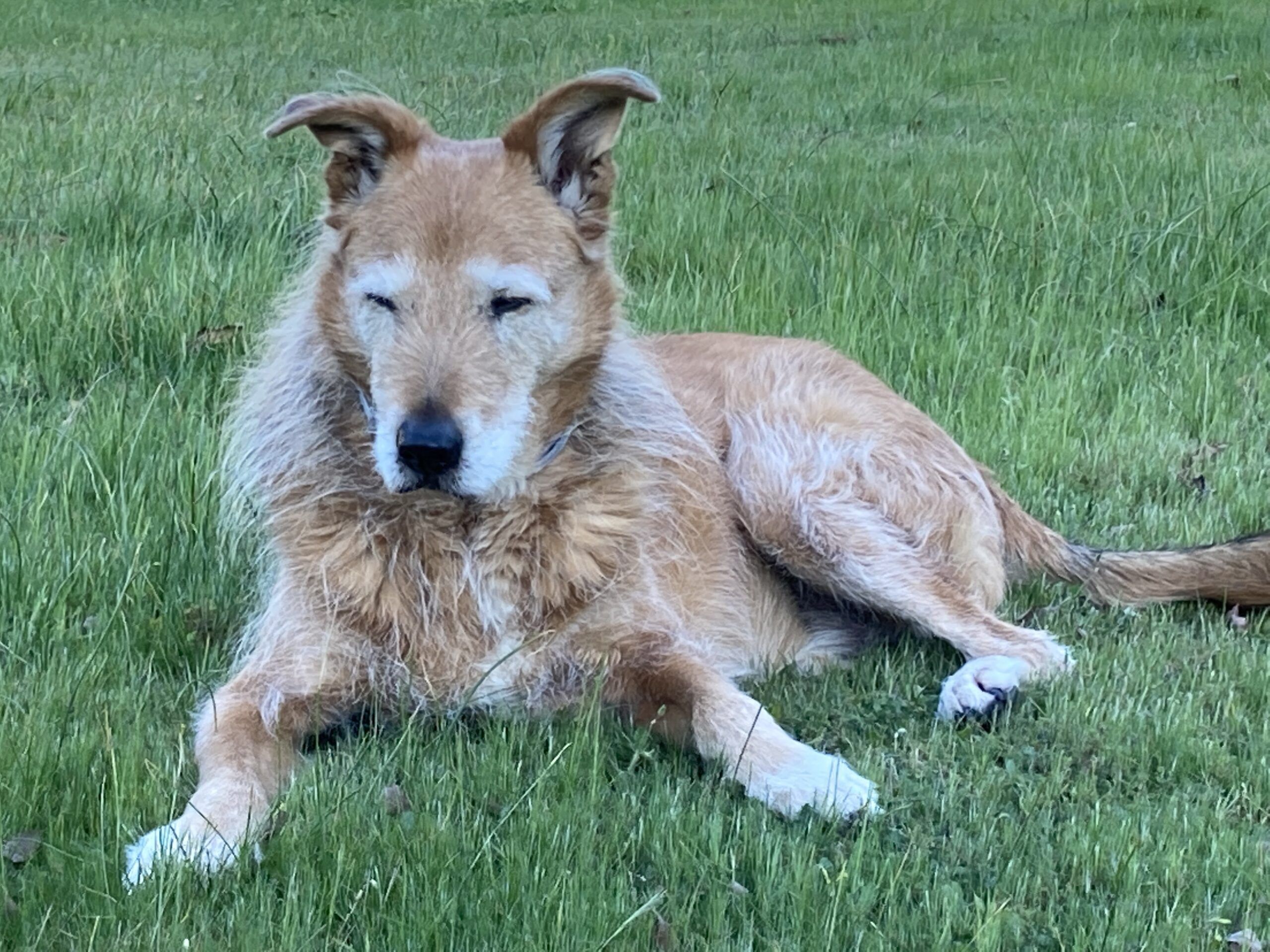
A few weeks ago I shared that my 14-year-old mixed-breed, Otto, was showing signs of age-related dementia. He’s also showing more discomfort related to his osteoarthritis. The post struck a chord with more than a few readers, and many of you mentioned things that had worked for your own dogs in the past, or a dog you knew. The suggestions included:
- Crating at night
- Herbal remedies, including California Poppy, Passionflower, and Chamomile
- Selegiline (generic name of Anipryl; prescription medication)
- Lions Mane (mushroom-sourced supplement)
- Aromatherapy
- Adaptil collar
- CBD chews (supplement)
- NaturVet’s Emotional Support (supplement)
- acetyl l-carnitine and alpha lipoic acid (supplements)
- Cholodin (supplement)
- Clomicalm (prescription medication)
- MCT oil (supplement)
- Melatonin (supplement)
- Trazodone (prescription medication)
- Purina’s “Bright Minds” food
- A night light
- SAM-e (supplement)
I appreciate every single one of these suggestions, and am glad that dogs have been helped by these things. At the same time, the list highlighted the helplessness that any of us may experience at a time when our beloved dogs have a chronic or ambiguous health issue. How the heck does one decide? You can’t do it all; it’s not fair to turn your dog into a chemical science experiment. Plus, if you are using multiple treatments, and your dog’s condition improves, do you know which thing helped? Do you keep doing all the things?
Important note: Anything you do has to start with your veterinarian. Just randomly adding things without knowing what’s wrong (or, at least, what’s not wrong) is irresponsible. It would be awful to learn, after you’d been giving your dog all sorts of various supplements and remedies that he had undiagnosed and untreated cancer, for crying out loud. We’re many thousands of dollars into Otto’s medical surveillance, including frequent blood and urine tests, x-rays, and abdominal ultrasounds – he even had an MRI a few years back, when he had a (fortunately benign) mass removed from his liver – and thank goodness AGAIN that I’ve been investing in Otto’s health insurance for many years.
I’m assuming that your vet is included in the discussion of “What can I do for my dog?” and you’re still at a loss – and I mentioned this specific frustration to my own vet, while she was treating Otto with acupuncture. She mentioned a couple treatments that helped her own senior dog who had dementia in that dog’s last years of life. I asked her, as a general question, “When there are so many options, where does a dog owner start? How do you know what to do?”
She answered, as I would expect a veterinarian would, “Ask your vet!” And I agree! And yet, in this very specific case, I have been asking a vet, three of them, in fact. Including her! And we’ve tried a few things without any of them making an appreciable difference.
My personal tactic is to try something for a minimum of a month; I’ve tried a couple more things for two or even three months when I was told that it takes time to see an effect. But if I see no effect whatsoever – if Otto’s behavior and gait absolutely do not improve in any way that I can see, I stop that particular supplement or treatment and try something else (see “Amantadine: Now for Relief of Chronic Pain,” WDJ August 2022).
The one thing I know works for Otto’s osteoarthritis pain is a prescription nonsteroidal anti-inflammatory drug, Galliprant. I’ve also tried gabapentin and Trazodone, which both have been recommended for pain as well as the sleeplessness Otto often displays at night. I also tried a month’s worth of SAM-e. I’ve stuck with the gabapentin the longest, but honestly, I don’t think it’s doing anything. I’m currently weaning him off of it, without seeing any decline or difference at all.
I recently bought a CBD product to try on Otto (after researching an article on how to choose a CBD supplement and writing an article about this, which will appear in the April issue). At his next acupuncture appointment next week, I’m hoping to pick up selegiline to give that a try. We discussed it at our last appointment, and I’ve left a phone message for the vet mentioning that I want to try it next.
The hard fact is, we can’t fix everything our dogs are suffering from with a pill or treatment – but because we can fix or improve many things, and because we love them, we remain hopeful.
Also – and I’m as guilty as anyone of this – it’s often easier to hope you can fix everything that’s wrong with a pill or supplement than it is to simply slow down and spend more loving time with our senior friends – to do more hands-on massage, gentle grooming, extra nail trims, and just being present with them. Writing this has helped me realize I need to do of more just that, and a little less fretting about the next pill to try.



In particular your last paragraph Nancy. Thank you Thank you Thank you.
Nancy, hopefully your Otto will do well on selegiline (Anipryl). Several dogs ago, perhaps 10-15 years ago, our beloved Sheba, a shepherd/husky mix, had dementia and the drug worked wonders for her. She was restored back to normal mentally. However, she was ultimately done in by a brain stem tumor. She seizured twice in one day and was unable to even raise up the upper half of her body from lying down. We had no choice but to let her go as she was unable to even move around on her own. We saw in her eyes that she asked us to release her from her misery. With great regret, this is what we did….
A breeder suggested Move Free. I get it from Costco. My 11 year old GSD has hip dysplasia and arthritis. The dosage for a human is 2 tabs….I give 1 tab nightly. I grind it to a powder and put it in her food. I have noticed a significant difference.
Dog Gone Pain! How can you forget Dog Gone Pain, on which you published an article a number of years ago. I had a Great Dane/Lab mix with severe arthritis who couldn’t tolerate any NSAID, and we had tried them all. I read your article and tried Dog Gone Pain, and it gave my dog her life back. A dramatic difference and she experienced no side effects.
I am sitting here crying my eyes out reading this article and the comments. I have a little Yorkie, she is going to be 11 soon. She is my first dog and the love of my life and I CANNOT imagine life without her. She has luxating patellas in both back legs and medial shoulder instability in both front legs. She gets PT and cold laser treatments as well as swimming. I rehabbed her for 7 months after the front leg injury. She got better WITHOUT surgery. She is small but mighty!! I am now dealing with the fact that she has developed Irritable bowel disease and she is getting sick at least once a week, throwing up and bloody diarrhea. With the help of my beloved Vet, I have tried everything from prescription food to various antibiotics that used to work, but now don’t. I took her to an internal medicine doctor who agreed with my beloved Vet that she needs to be on steroids to calm the inflammation down. I STILL haven’t put her on the steroids, despite filling the compounded prescription. I just cannot bring myself to do it because of all the nasty side affects. I just keep hoping she will get better like she always did before.
I have decided that I am going to wait until April (I am 65 years old and recovering from a total hip replacement ) and then I will be able to take her for walks again and maybe the fresh air and sunshine will help alleviate any side affects from the steroids.
If anyone here has experience with putting a Yorkie on steroids, would you kindly comment??
Not a Yorkie, but a dog with IBD, seizures, arthritis, numerous liver infections, gallbladder removal, cancer surgery, and a new heart murmur. He’s been on very low dose prednisone for years. Every time we try to wean him off, something else goes seriously wrong. For him, the adverse effects of prednisone are still better than the effects of eliminating it entirely. He’s closely monitored by his regular vet, and internal medicine specialist, and a neurologist.
As an animal massage therapist who co-owns a hydrotherapy pool for dogs, this is something we discuss with our clients quite regularly. For those who have the option, I will say that swimming or underwater treadmill can be hugely beneficial to arthritic dogs; the support of the water while getting exercise and moving stiff and sore joints and soft tissues can be really helpful. As for supplements and medications, it can be really difficult (and expensive), because there is no one-size fits all answer. Yes, talk to your vet! I will say, that with my own aging dogs and many client dogs, I have seen a huge benefit with the combination of hydrotherapy, acupuncture and cold laser treatments.
I just wanted to make you and others aware of Copaiba, an essential oil. Our 13 year old mini aussie went into a deep depression after losing his best canine buddy. Twice. He gained much too much weight in spite of our best efforts, didn’t want to move. He already had a malformed shoulder and resulting arthritis. He’s been on prescribed supplements for a long time. Then I consulted with Dr. Janet Rourke, “the essential oil vet”. Copaiba seemed to be the most helpful of her recommendations for pain. We had also gotten a puppy, primarily for him. Now he still has arthritis but he’s willing to play, to run a little bit, loves his walks again. He’s lost nearly 5 lbs and is now a healthy weight. I am so grateful! He is our third seriously arthritic dog. We’ve tried lots of things. I won’t attempt to delve into the science of copaiba; I would leave out too much. I just encourage others to check into it.
My 13 year old pup Henry (passed Dec. 2020) had such bad arthritis that my vet sent the xrays around to see if other vets thought he had some sort of autoimmune problem. The only thing that helped him was Adequan. We gave him shots every 2-3 weeks. Ultimately, I think not much alleviated his pain–he was also taking Dasequin, a tumeric supplement, etc. I tried CBD oil but it didn’t seem to have any impact at all. The Adequan did restore a bit of his mobility and seemed to prevent further degeneration of his knee joints (where the problem was).
I love WDJ and your “from the heart” articles. I have an 11 year old boxer girl, who is fortunately doing well. We have been on Galliprant for 2-3 years and it is a really good drug with less harm to other organs. I never liked gabapentin, made too drowsy. I give a joint supplement, a probiotic, and a CBD chew last thing at night. She has had an occasional bout of “something” in middle of night a few times — very gassy stomach and distress, and I am terrified of bloat, so recently did fecal and ultrasound. Yes, thank goodness for pet insurance. No conclusions on those tests, so may try a diet change and in the meanwhile giving omeprazole an hour before evening meal. We do love them so and want to do all we can to keep them happy and well.
For acid reflux try a product called “gut guard” it has licorice, aloe, etc. Great product for acid reflux. My 100lb dog started at 1 tsp with dinner daily and now just every other day. No reflux at all. Use in place of omeprazole.
My vet put my Ramses on Omeprezole for acid reflux, the same dosage I take for my acid reflux.
Galliprant worked great for Buddy. As did Senilife for the dementia.