

I have a number of friends (and a family member) who have dogs who are nearing the end of their days. I’m noting and processing the events and feelings they are experiencing – and hoping it is several years before I’m in a similar situation (my heart dog, Otto, will be 12 years old in November).
Beau
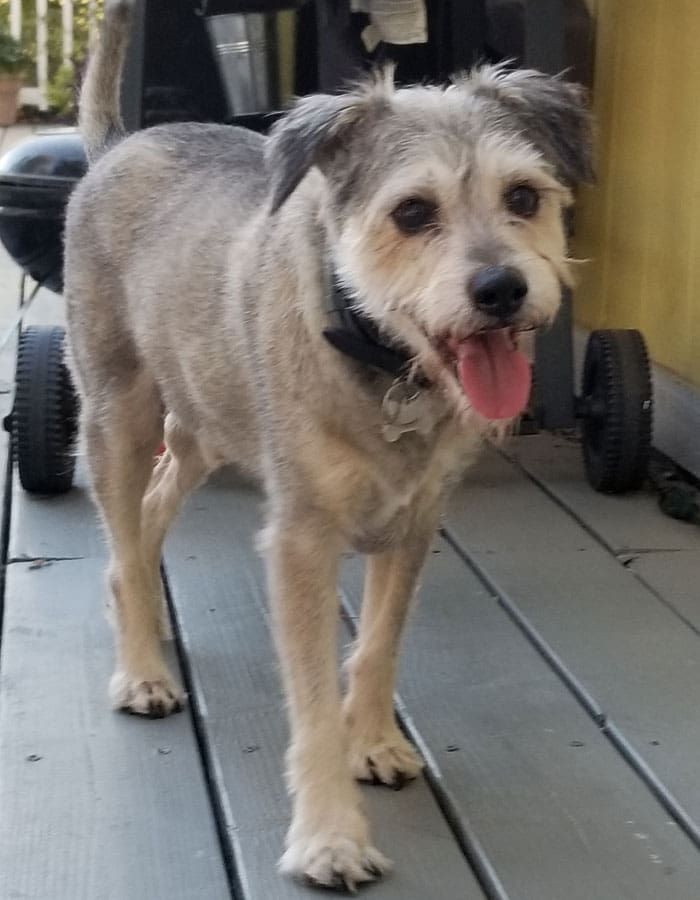
My sister and her husband have a really old Schnauzer-mix named Beau. He might even be a real Schnauzer. He’s so old, it’s hard to tell! They took in Beau when a friend in distress couldn’t keep him. The friend had gotten Beau as a puppy when her son was 10 years old, and that son is in his late twenties now, so… Beau is old. He has limited vision, limited hearing, has had several strokes and can’t walk a straight line, and is growing increasingly incontinent. On his bad days, it seems almost cruel that he is being kept alive. He may stagger or not be able to get up, he acts like he doesn’t know where he is and is anxious, and he may just suddenly completely empty his bladder on the carpet while standing still, seemingly unaware he is doing so.
But on his good days, he runs up the hall with the rest of his housemates, eats with gusto, goes outside through the dog door and potties without assistance or a reminder to do so, and enjoys his time on the sofa and in bed with his human and canine housemates. So they are very much afraid that if they call the vet to make a euthanasia appointment on one of his bad days, and he’s having a good day on the day of the appointment, the vet may decline to euthanize, or the staff may make them feel like creeps! In fact, they feel sort of pre-emptively guilty about even just talking about “Beau’s time.” My sister and brother-in-law love Beau and want him to have a good end. But when is the right time?
Chaco and Lena
There is Chaco, one of my former foster dogs. She’s younger than Otto, but has two failing knees and severe arthritis, and her owner lacks the health insurance or budget to pay for two knee surgeries. Her declining mobility has contributed, it seems, to weight gain, which compounds her problems.
Another friend is in a similar position with Lena, Otto’s very first playmate and friend. She has had one ACL surgically repaired, and underwent “conservative management” when the second one tore; her veterinarian says her hips, too, are quite dysplastic, and would have benefitted from surgery. Both hips and both knees, too? Her very devoted owner, my friend, could not have possibly paid for four surgeries – nor could she have gotten or afforded insurance after the first knee injury and x-rays showed the hip problems. Lena is maintained on daily pain medication and various joint supplements, and my friend takes her for frequent drives to places where she can take short, gentle walks. My friend has also been shopping for some sort of wagon or cart she could use to take the 70-pound dog on walks, so she at least can enjoy the changing scenery and odors. Lena, like Chaco, is getting fairly crippled, but is in otherwise good health and appetite. How long can my friends maintain them in this condition?
How to know when to let them go
Super dedicated owners can provide hospice care for dogs, if they are physically and emotionally able and have an appropriate home and time to do so. We ran a great article about this in 2010; it holds up well today. But not everyone has a schedule and home that would permit, as just one example, helping a large non-ambulatory dog outside to potty several times a day.
Not unrelated: Between all my dog-loving friends, I am aware of exactly ONE DOG who died peacefully in his sleep.
I just went looking; here are some links for information on how to know when “the time” is right for euthanasia:
https://www.americanhumane.org/fact-sheet/euthanasia-making-the-decision/
https://www.lapoflove.com/Quality-of-Life/How-Will-I-Know-It-Is-Time
When it is getting close to time to make an appointment for euthanasia, we have some other helpful articles to read. This one is by a long-time contributor to WDJ, trainer Lisa Rodier.
Also, trainer Jill Breitner’s article on what to ask before making an appointment for euthanasia and the companion piece to that article by Dr. Sally J. Foote are excellent sources of information about what you should know in advance.




It is never an easy decision. I regret making Danny suffer. I have tried not to be selfish with the next dogs. I do try to sit down and “talk” to them. I try and listen to what they are telling me. (Usually through tears which doesn’t help). I feel that it is humane to be able to let them go. They don’t have the ability to do the natural thing and go out in the woods to die. We can only do our best to alleviate their suffering. They would do anything for you.
This is my third comment – odd for me – i never comment. However this is so very important to me as i’m sure it is to many other dog friends – so important that i had to give my opinion concerning euthanasia just because it is such an important issue. And because it is i want you all to realize you do have a choice in this matter. Make is wisely.
To those of you that disagree with our so-called natural outlook – i’m sure you must realize that all our pets did not die peacefully in their sleep – most did not – however how do you all know for certain that your pet is suffering ? and if you feel he/she is, then isn’t there a type of medication that could assist with what you assume is pain? how do you know your pet wouldn’t rather spend their last days with you rather than at the vet or a mercy killer person…a stranger?
I knew for certain that my boy was suffering because he would wake himself up, crying, trying to move his back legs. For a year before he died, I gave him medications four times a day for the pain. It was only after that was no longer enough, and neither was the only other type of painkiller the vet could offer, and he was taking three days to eat what once was a day’s meal that I knew it was time. He did spend his last day with me: we spent the morning together and the the vet came in the afternoon – I don’t think he even knew she was there. He died in our living room with my husband and I holding/petting him. I felt, and still do, that our pets give us everything and the least we can do is ease their way. It was the last gift I could give.
My Uri was remarkably healthy his entire life and only in the last year of his life did he need medication four times a day to control his pain (he was fifteen). Then, when that stopped being enough and he started crying in his sleep because it hurt his hips to change positions, I knew it was time to say goodbye. He would never have left me voluntarily, whatever pain he was going through, so I felt that telling him he’d done enough was the last gift I could give. It broke my heart, but I have no regrets. He deserved a peaceful end and release from pain.
I heard a couple of veterinarians who specialized in helping people deal with losing their animals and making the decision to let go on the radio once. They said the people they interact with who have the most regrets are the ones who feel they let their pet suffer for too long. I kept that in mind when making the decision for Uri and, like I said, I have no regrets about the decision, though I miss my boy to this day.
Sometimes the only question isn’t when – it’s also how. We had been fortunate enough to find a mobile vet that we used for simple issues for our cat,s and when we felt it was time to euthanize them, we were able to do it at home.
Also, you may want to plan what to do with your pets remains before the time comes. We are fortunate to live on a large property in a county that allows burial of pets. We had three elderly cats that we had to euthanize within the course of one year. Each time I found it comforting to bury them here at home. Each grave is marked with a lovely shrub to help us remember the joy they brought us. I found it comforting to work through the steps of burying them – digging, purchasing and planting the shrubs – it helped with the grieving.
I had to let my 13-yr-old Pembroke Welsh Corgi go 2 mos ago after a year-long battle with transitional cell carcinoma. She had chemotherapy to prolong her quality of life with no side effects, but her last scans a year after her diagnosis showed significant metastases and her oncologist said she had 2-4 wks left. I loved this little girl with all my heart and I was shattered, but I did my best to keep her going, tempting her with human instead of dog food. Four wks after our appt., I could see that my girl’s quality of life had deteriorated to nothing. In her last 2 days she lost the ability to walk, and she would no longer eat or drink. In that way, she let me know that I had to let her go ASAP, and could not wait for our appt the next day with our regular veterinarian. My only regret is that I did not release her at least a day earlier.
I can’t help but wonder why so very many people feel they must euthanize their older dogs. I am 80 years old and have had several dogs in my lifetime – most often more than 1 at a time – however, every single one of them has died at home – we have never done a thing to speed up the dying process. Sort of like most most people want for themselves. Do all these people believe in so-called “assisted suicide” for their relatives, friends, etc.? If not, why your dog? Even if they are sick and dying, do you ever consider the natural process of life? Why do people find if necessary to play God?
@monnie levin, I hear what you are saying, and it’s a good and important question. And indeed if we left this up to nature, if these dogs were living wild in a forest somewhere, most of them would die in a few days. But as it is, we are providing them with food, water, a safe and comfortable place to sleep out of the weather, pain medications, antibiotics, and other supportive care.
It’s the equivalent of putting a person on artificial life-support. It often has great benefits, and the dog may get weeks or months more of a life very much worth living. But having stepped in to interfere with the natural process, it is left up to us to decide when to discontinue those services. When to “pull the plug.” If we no longer give the dog the option of the choice to crawl off and die on their own, we have already taken nature out of much of the equation. And at that point, many people would choose to do so in a way which means the least suffering for the dying dog.
There are no easy answers, and no one right way. But absent the natural process, it is not unreasonable to ask ourselves if we have come to the point where all of the many measures we are taking to prolong life are also merely prolonging suffering.
Very well said
Only 2 of our dogs went their own way…my soul dog Lobo just laid down and never got ip and my Tilo committed suicide by jumping or „falling“ into our pool. He never went near our pool but had lung cancer and was failing. He kep eating but became more and more withdrawn. On his last day he came up to me as he had on better days and wagged his big beautiful husky tail. To this day i am convinced that he said good-bye to me. That evening we found him in the pool….
Both of my great pyrenees probably staid too long because of their dedication to their duty of protecting us…..i still hurt to think how much these dogs gave while in pain….
What a lot of intelligent comments to this post! There are no simple, easy answers to the euthanasia question. I think we often agonize because our social attitudes about animal euthanasia and human euthanasia are conflicted. I once thought I had the definitive answer to the question. Then another dog taught me otherwise.
Over the lives of six dogs our experience of end-of-life possibilities has swung from one extreme to the other. Our first dog developed cancer back in the day when cancers were much harder for vets to diagnose and treat. We held on to Lady, desperately hoping for a medical miracle. Just after midnight on New Year’s Eve, her liver shut down which affected her brain. She developed “blind staggers.” I spent our last hours together walking in front of her around and around our kitchen, gently guiding her away from walls and cabinets. Her teeth chattered, she could not see where she was going, and I sobbed to see her in so much pain until we could reach the vet . I vowed I would never, ever let another dog suffer at the end of their life again.
Then came a dog who challenged my “rational” decision. Tory was a 105-lb lab/shepherd cross with an exuberant, boundless love of life and everything in it. She, too, developed cancer. Toward the end, she needed help getting out to potty, her appetite was diminished, her arthritic joints made getting up and walking painful. She slept most of the time. As our annual trip to our extended family’s summer camp approached, we worried about what to do. Cancel? Find a dog sitter who could deal with her special needs? Could she manage the long trip? What if there was a crisis where veterinay care was several hours away? Was it time euthanize?
I called an animal communicator author acquaintance about the dilemma. Before I even said hello, the woman boomed, “She says she’s GOING!.” Not only that, but Tory was emphatic that she wanted to die a natural death, savoring every experience and moment moment on earth to life’s end. So much for my vow.
We honored Tory’s wishes. She went to her beloved lake one more time and passed as she wished a few days after arriving home. She left peacefully surrounded by caring family and friends
So as I read others’ stories and think of my own, if you asked me to declare euthanasia right or wrong, good or bad, I would have to say…it depends. It’s never an easy decision. Just make it from love.
Where does Lena’s person live? I may be able to loan her a stroller if she lives near Chico, CA.
Marsha