

Dog ownership is not all puppy breath and humorous or beautiful Instagram photos of our dogs; there are times when it is breathtakingly difficult. These are the times when it helps to have good relationships with great vets, good information resources, great friends – and sometimes, deepish pockets. (Or at least a credit card without a balance on it already.) My message for today: Remember always that pain and loss is the flip side of dog ownership, the cost of all the joy they bring us. But it’s our responsibility to be grownups and deliver our dogs from pain and suffering when it’s needed.
Amputating my current foster pup’s badly injured leg
Last week, I delivered my foster puppy to a veterinary hospital to have his badly broken leg amputated – and days later, accompanied my good friend and her senior dog to the same clinic for euthanasia. Both visits were emotionally trying – but they both were in service of doing the right thing, the most responsible thing.
The pup I am fostering was brought into rescue with a leg that was broken, the vet estimated, about a month prior. The hock joint was just a smashed-up mess, with all those tiny bones in the joint all smooshed and displaced from where they are supposed to be– and the puppy’s body, of course, was trying to fuse and heal all of that damage, but given the location – in the very middle of his back leg, every time the pup took a step the broken joint would flex in all the wrong ways.
The pup is absolutely adorable and, as these things often go, has a totally sweet, funny personality. Of course the rescue group’s leader wanted to know whether the leg could be saved. The veterinarian who examined him said slowly, “Well, certainly, you could try to go down that road . . . we could get an orthopedic consultation. We couldn’t help him here . . . It would likely take two or even three surgeries, and months and months of healing and pain meds – and even then, the damage is so bad, he’s going to have arthritis no matter what, and it may end up having to be amputated anyway . . . .”
After seeing the x-rays, and talking to the vet, I felt compelled to push the rescue group to schedule amputation ASAP. The puppy was in pain; that was indisputable. The faster we could get him out of pain, the better. Surgery was totally iffy, and would mean months and months of more pain – and the pain of amputation would be pretty much done in a week or so.
I was bolstered in my opinion about this by having had a peripheral role in another rescue group’s handling of another young dog who had a broken leg; my best dog friend here in my town fostered that dog following the dog’s second surgery to repair a broken rear leg (the dog had been hit by a car – and the first repair failed and needed a total and more elaborate do-over, this time complete with bone grafts). The dog was young and energetic and excitable, difficult to keep under control – and she had to be kept on a leash most of the time, even in the house, to keep her from trying to whirl and play and do zoomies. For months and months the dog had to endure assiduous control, at times with pharmaceutical help to keep her calm, and often with pain medication. And despite all this, she was going to walk with a limp forever, and would need another surgery at some point to remove the metal hardware used to hold her leg together. It just didn’t seem worth it. With my encouragement, the rescue made an appointment for this puppy to have amputation surgery a little more than a week later.
But boy, oh boy, did I second-guess this decision all week. Every time I saw the pup put his leg down in what looked like a somewhat regular way, my heart would sink; maybe we should be trying to get an orthopedic consult after all. I was taking video of him at one point and he scratched behind his ear with his bad leg, and I was instantly convinced amputation was the wrong thing. But then I’d see him take a step that would make the leg twist in a sickeningly wrong way, or yelp as the paw hit a bit of uneven ground too hard and the shock would obviously carry up to the injured joint, and I’d feel relieved that we were doing the right thing. Right, wrong, right, wrong, all week.

Making the tough decision to euthanize your beloved dog
Meanwhile, my friend who had fostered that other dog with the bad leg a couple months ago was dealing with a terrible decision of her own: whether it was time to euthanize her senior dog, who had two terrible hips and two terrible knees. She had maintained the dog at a healthy weight her whole life, and maintained strict control over her activities, had supplied the dog with every type of “brain game” interactive toy and food puzzle that exists, had taught the dog a dozen tricks, took her for regular car rides and field trips where she could see interesting sights and smell interesting aromas, all in a low-impact way . . . but Lena’s body was finally just giving out altogether. She collapsed suddenly one day, horribly, and couldn’t get up. My friend brought her to an emergency appointment – on a Sunday, as these things tend to go – and Lena’s x-rays made the veterinarian shake her head sadly: so much arthritis, those hips, compressed vertebrae – it was a wonder my friend had gotten the dog to age 12.
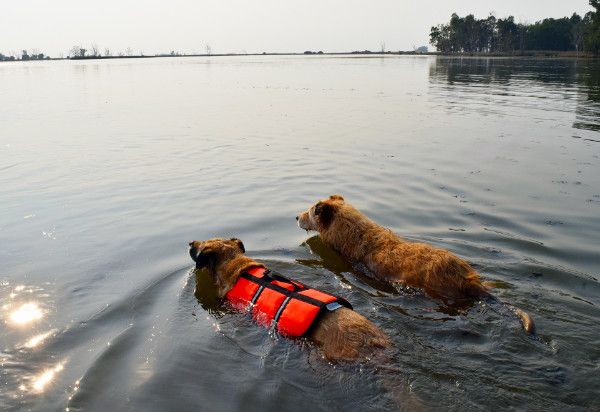
My friend made the final appointment for Lena for the following weekend, and, all week, gave Lena extra meds for pain and a ton of all her favorite foods, the ones she had to enjoy in tiny amounts her whole life in order to keep her weight under control. We planned a field trip for Lena and Otto, who had played and romped together when they were both young, to a spot in a nearby lake that is shallow and warm, where you can drive right up to the water. We put her life jacket on and she and Otto spent nearly an hour just sort of float-walking around us in the shallow water, not quite swimming, just barely touching their paws to the lake bottom. It was bittersweet, seeing her so happy and comfortable in the water – but knowing how much discomfort she is in every day as she goes about the daily business of life: getting up to drink and eat, going outside to potty, not being able to get up quickly to go bark at the mailman, and so on. And knowing that every day brings more risks of collapsing in pain.
I went with my friend for the final appointment. I have to say that it was absolutely the most peaceful and calm euthanasia I have ever been present for, and the veterinarian and the clinic responsible have my everlasting loyalty from now on. We had one of the first appointments of the day, and we waited for the vet on a blanket that we spread on a grassy area under some giant oak trees outside the rural clinic. The veterinarian and a technician came outside and, after a brief exam, administered a subcutaneous dose of sedative, and let us sit with Lena there under the trees until she grew very, very relaxed. When they came back out of the clinic to administer the euthanasia solution into a vein on her back leg, Lena barely noticed. Her owner stroked her face and told her what a good girl she was, and she slipped quietly away.
My friend and I agreed – if only humans could have deaths that were as peaceful and painless, with loved ones around us and birds singing overhead. But I know my friend will also second-guess herself. Was it too soon? Could Lena have made it a few more months, was there some other intervention that could have helped?
These are tough decisions – though of course, life and death decisions should be tough. My foster pup is recovering from surgery wonderfully – and the increasing mischief he is getting into tells me he is in less and less pain as each day passes. He gets the surgical stitches out two weeks after his surgery, and a few days later, he will go home to a new family – a mom and dad and teenaged girl who met him a few days before surgery and already love him. I’ve been reading about the care of “tripawd” dogs, and have assigned our veterinarian contributor to write an article about this for an upcoming issue, but I, too, still wonder if amputation was the right thing to do. This uncertainty, too, is part of the price of loving dogs like we do.



Thank you, Nancy, for a lovely and heartfelt article. Unfortunately, both situations are the price we pay for loving our furry friends. I have been fortunate that I could always euthanize my dogs at home, where we created a quiet and loving place for them to pass on. I did not want my beloved dogs to be stressed or in fear during their last moments with me. Of course many tears are shed during and afterwards and it takes a long time for the pain to change to a dull ache and finally to wonderful memories of their lives lived with me. It is hard, I know, but you done good!
I had to let my nearly 13 year old dog go yesterday. It was the hardest thing I’ve ever done. He was my heart dog, I loved him so much. We spent almost every moment of the last 12 years together and he was the sweetest, most affectionate and funny dog I’ve ever known. My heart is shattered. But he was in pain, and the pain could not be controlled except with fentanyl. His joy in life was gone. It was time. But oh, how I second guessed my self the few days prior.
I miss him and my heart hurts so much.
Thank you for this post Nancy……still brings tears and yet the certainty that we were doing exactly what we needed to do on that day that broke our hearts. There is a peace in knowing we held her and comforted her when she had to go……all the wonderful days that led up to that impossibly difficult day have helped with the grieving. She was 100% fine until she wasn’t that day. Dogs are so stoic….I learned so much from her in that moment when she so accepted just letting go. Goodbye sweet Lucy. You will remain in our hearts forever.
I’ve mentioned this before, not that I expect anyone to remember, but when we had to put down our senior Schnauzer, the veterinarian and her assistant came to our house. He was the “patriarch” of our furry family and didn’t want for him to just “disappear” from the household. Our other two little dogs and our cat were outside in the backyard. It was so peaceful (and yes, very sad) but I also was able to see how the other critters reacted. They all came up to sniff him and then just kind of “knew” that he was gone. They didn’t look for him once he was taken away to be cremated. They just knew. This was such a hard decision to make because his “mind” was still perfectly fine but his body was giving out.
When our 13-year old Westie girl started having neurological issues (running/walking in circles, etc), she was essentially the decision-maker. She had a huge seizure that basically brought on full dementia. We brought her to the emergency vet and we had her put down. She was absolutely not herself in any way. While it was still sad to not have her with us, it was also a relief to know that we honestly didn’t have any choices to make. (Does that make sense?)
It’s good that you let the other pack members have some closure. When my parents had to put their do gto sleep, Diana had only known her for about 7 weeks but was already learning from her, proper go for a walk behavior, going outside for pee and poop, how to beg at the dinner table (bad Daddy). It was done in the house in one of her favorite spots by the sliding glass door so she could survey the yard. All of her loved ones were gathered around her. When the vet came I put Diana in her crate so she wouldn’t be underfoot, but afterwards I brought her out to see. She took a sniff, accepted it and then was off. Animals have a different view of death than we do. She didn’t mourn and didn’t look for her. However if she was suddenly no longer in the house, I am sure she would have looked for her. I’ve seen that in other dogs we’ve had where one goes away (to the vet) and never comes back. I’ve left instructions for my parents that if for any reason I die, I want my dog to view my body so they know I’m not coming back.
My second dog, Goliath developed neurological issues. I had no idea what doggy dementia was at the time. This was almost 20 years ago. While it wasn’t too bad, he also started snapping at people for no reason. After he bit a neighbor we finally had to make the decision. It was the right one. He was in a different kind of pain. Noise would set him off howling and seemed to be painful. Perhaps it wasn’t dementia but a brain tumor. But he had a very peaceful passing.
Diana pawPrints is just approaching two years old but I am already thinking ten years down the road. She is 90 lbs. I’ll be over 75 years old by that time and unable to lift her. I can’t lift her now. I won’t know what problems of old age she will have. My vet doesn’t make house calls for euthanasia but has colleagues that do. I don’t know if I will have to be forced to make that decision or if I will be relieved of it like with Ramses. She may be my last dog as I’m not sure if I can handle another puppy at age 75. I sure can’t handle any more large dogs and I’ve always had large dogs. I am trying to be more dog-like and live in he now. As Scarlett O’Hara said, tomorrow is another day.
I, too, take in old dogs. Those who need someone to at last give them love and kindness, a warm bed and decent Vet care. It is always difficult to take them for that last trip but we cry for ourselves, not for them. If you care for them to the best of your ability, then euthanasia at the proper time is the last caring act.
Old “rescue” dogs are so grateful and give back all the love you pour in to them.
Perfect timing. I just went through this day before yesterday and it sounds like it could be the same clinic as I live in the same area. I was questioning myself these last two days. But when my old big boy could no longer walk and was in pain, I know it’s the right decision
Nancy,
You did it again. You clearly and compassionately articulated the joys and pains of living with dogs. Thank you.
Euthanasia is the final gift of love we can give our pets and also one of the hardest things to do.
We lost our Bernese Mountain Dog to cancer at the age of 7.
This is on the container holding his ashes
The Journey:
When the time comes ,and the road curves ahead to a place we cannot see,we give one final gift and let them run on ahead-young and whole once more.
Godspeed good friend we say,until our journey comes full circle and our paths cross again
I have adopted large old rescue dogs for the past 20 yeats and have had to euthanize 13 of them. The kindest thing you can do for your dog that is in pain and discomfort is to give him the beautiful death you describe. It is ALWAYS painful for the humans. For the dog is is a relief. In my cases with old dogs, they tell me when it is time to go with their eyes. I always wait for that signal. No matter how bad they are one day, they come back the next until sometimes I felt they would live forever.
My vet always came to my home and we made the process as gentle as possible. Several dogs did not react well to that sedative and it made them more reactive. Now, all I want is a calm, gentle dog to receive a double dose of the euthanasia drug (remember, big dogs sometimes need more). I hold them and talk to them as they go to sleep, telling them of the wonderful life they are going to live with all their relatives when they reach the Rainbow Bridge.
Often the vet and I both cry at the loss of another beautiful dog that had lived a life or horror but found happiness, trust and peace at my house. Only twice did I have to euthanize at the vet clinic when we went for emergency treatment but either we were too late or the dog was so sick it was best to put him down right then and there.
Oh Nancy, you couldn’t have written this at a more perfect time. Two days ago I had to let go of my beloved almost 14 1/2 year old dog. He and I had done everything together and created so many wonderful memories in those years. But he was diagnosed with lymphoma three weeks ago and it would have been a great disservice to him to try putting him through chemo or anything that would diminish his quality of life. So we kept him comfortable and spoiled rotten and let him go when he said it was time. I know it was the right thing to do but I’m still heartbroken. My heart goes out to your friend and all others who have had to make that decision. Still…it is the last gift we can give our loved one.