

Dog ownership is not all puppy breath and humorous or beautiful Instagram photos of our dogs; there are times when it is breathtakingly difficult. These are the times when it helps to have good relationships with great vets, good information resources, great friends – and sometimes, deepish pockets. (Or at least a credit card without a balance on it already.) My message for today: Remember always that pain and loss is the flip side of dog ownership, the cost of all the joy they bring us. But it’s our responsibility to be grownups and deliver our dogs from pain and suffering when it’s needed.
Amputating my current foster pup’s badly injured leg
Last week, I delivered my foster puppy to a veterinary hospital to have his badly broken leg amputated – and days later, accompanied my good friend and her senior dog to the same clinic for euthanasia. Both visits were emotionally trying – but they both were in service of doing the right thing, the most responsible thing.
The pup I am fostering was brought into rescue with a leg that was broken, the vet estimated, about a month prior. The hock joint was just a smashed-up mess, with all those tiny bones in the joint all smooshed and displaced from where they are supposed to be– and the puppy’s body, of course, was trying to fuse and heal all of that damage, but given the location – in the very middle of his back leg, every time the pup took a step the broken joint would flex in all the wrong ways.
The pup is absolutely adorable and, as these things often go, has a totally sweet, funny personality. Of course the rescue group’s leader wanted to know whether the leg could be saved. The veterinarian who examined him said slowly, “Well, certainly, you could try to go down that road . . . we could get an orthopedic consultation. We couldn’t help him here . . . It would likely take two or even three surgeries, and months and months of healing and pain meds – and even then, the damage is so bad, he’s going to have arthritis no matter what, and it may end up having to be amputated anyway . . . .”
After seeing the x-rays, and talking to the vet, I felt compelled to push the rescue group to schedule amputation ASAP. The puppy was in pain; that was indisputable. The faster we could get him out of pain, the better. Surgery was totally iffy, and would mean months and months of more pain – and the pain of amputation would be pretty much done in a week or so.
I was bolstered in my opinion about this by having had a peripheral role in another rescue group’s handling of another young dog who had a broken leg; my best dog friend here in my town fostered that dog following the dog’s second surgery to repair a broken rear leg (the dog had been hit by a car – and the first repair failed and needed a total and more elaborate do-over, this time complete with bone grafts). The dog was young and energetic and excitable, difficult to keep under control – and she had to be kept on a leash most of the time, even in the house, to keep her from trying to whirl and play and do zoomies. For months and months the dog had to endure assiduous control, at times with pharmaceutical help to keep her calm, and often with pain medication. And despite all this, she was going to walk with a limp forever, and would need another surgery at some point to remove the metal hardware used to hold her leg together. It just didn’t seem worth it. With my encouragement, the rescue made an appointment for this puppy to have amputation surgery a little more than a week later.
But boy, oh boy, did I second-guess this decision all week. Every time I saw the pup put his leg down in what looked like a somewhat regular way, my heart would sink; maybe we should be trying to get an orthopedic consult after all. I was taking video of him at one point and he scratched behind his ear with his bad leg, and I was instantly convinced amputation was the wrong thing. But then I’d see him take a step that would make the leg twist in a sickeningly wrong way, or yelp as the paw hit a bit of uneven ground too hard and the shock would obviously carry up to the injured joint, and I’d feel relieved that we were doing the right thing. Right, wrong, right, wrong, all week.

Making the tough decision to euthanize your beloved dog
Meanwhile, my friend who had fostered that other dog with the bad leg a couple months ago was dealing with a terrible decision of her own: whether it was time to euthanize her senior dog, who had two terrible hips and two terrible knees. She had maintained the dog at a healthy weight her whole life, and maintained strict control over her activities, had supplied the dog with every type of “brain game” interactive toy and food puzzle that exists, had taught the dog a dozen tricks, took her for regular car rides and field trips where she could see interesting sights and smell interesting aromas, all in a low-impact way . . . but Lena’s body was finally just giving out altogether. She collapsed suddenly one day, horribly, and couldn’t get up. My friend brought her to an emergency appointment – on a Sunday, as these things tend to go – and Lena’s x-rays made the veterinarian shake her head sadly: so much arthritis, those hips, compressed vertebrae – it was a wonder my friend had gotten the dog to age 12.
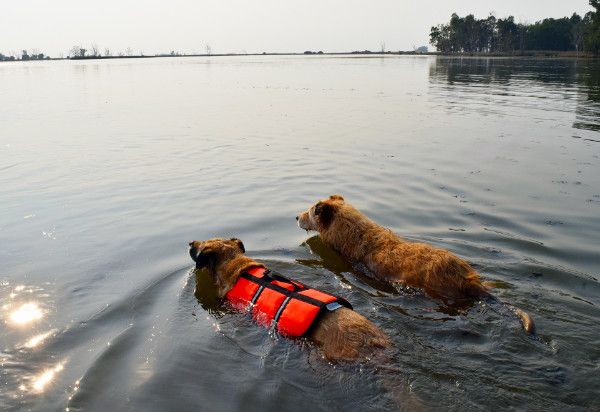
My friend made the final appointment for Lena for the following weekend, and, all week, gave Lena extra meds for pain and a ton of all her favorite foods, the ones she had to enjoy in tiny amounts her whole life in order to keep her weight under control. We planned a field trip for Lena and Otto, who had played and romped together when they were both young, to a spot in a nearby lake that is shallow and warm, where you can drive right up to the water. We put her life jacket on and she and Otto spent nearly an hour just sort of float-walking around us in the shallow water, not quite swimming, just barely touching their paws to the lake bottom. It was bittersweet, seeing her so happy and comfortable in the water – but knowing how much discomfort she is in every day as she goes about the daily business of life: getting up to drink and eat, going outside to potty, not being able to get up quickly to go bark at the mailman, and so on. And knowing that every day brings more risks of collapsing in pain.
I went with my friend for the final appointment. I have to say that it was absolutely the most peaceful and calm euthanasia I have ever been present for, and the veterinarian and the clinic responsible have my everlasting loyalty from now on. We had one of the first appointments of the day, and we waited for the vet on a blanket that we spread on a grassy area under some giant oak trees outside the rural clinic. The veterinarian and a technician came outside and, after a brief exam, administered a subcutaneous dose of sedative, and let us sit with Lena there under the trees until she grew very, very relaxed. When they came back out of the clinic to administer the euthanasia solution into a vein on her back leg, Lena barely noticed. Her owner stroked her face and told her what a good girl she was, and she slipped quietly away.
My friend and I agreed – if only humans could have deaths that were as peaceful and painless, with loved ones around us and birds singing overhead. But I know my friend will also second-guess herself. Was it too soon? Could Lena have made it a few more months, was there some other intervention that could have helped?
These are tough decisions – though of course, life and death decisions should be tough. My foster pup is recovering from surgery wonderfully – and the increasing mischief he is getting into tells me he is in less and less pain as each day passes. He gets the surgical stitches out two weeks after his surgery, and a few days later, he will go home to a new family – a mom and dad and teenaged girl who met him a few days before surgery and already love him. I’ve been reading about the care of “tripawd” dogs, and have assigned our veterinarian contributor to write an article about this for an upcoming issue, but I, too, still wonder if amputation was the right thing to do. This uncertainty, too, is part of the price of loving dogs like we do.



When our beautiful dobie girl, Sklya vomited a few times…we all thought it was the things she chews in the yard that cause such horrendous breath but that I can never find, or the stick she chewed up or the food she snatched off the table when no one was looking…could be anything. But when it didn’t stop the next day I brought her to the emergency clinic – a sunday and the local clinics all closed due to covid hours. Her blood work showed extreme elevation of liver enzymes that just 6 months ago were all normal. It surprised me. Xray normal, Ultrasound nothing obvious. Everyone suspected doberman related liver failure and possibly copper metabolism issues also related to the breed….I was in shock and dispair especially when we couldn’t work her into the sched for a biopsy until the following week and we werent sure she would be strong enough to make it thru that. They told me that soon she would be very sick. They were suprised with her high numbers that she was still eating. I decided to take her home.
So we started all the liver suppiments, she was taking 10 different tablets, liver support, copper binders – and rx diets. Tried antibiotics just in case, and …put her on steroids to help w inflammation even as we knew that this might alter the biopsy results if we get that far. She got much better in the next days. Was pretty good for a couple of weeks really. But she wasn’t right and soon the excitment of being fed canned food for the first time wore off and our “eat whatever is in the bowl” girl suddenly wouldnt eat without alot of tempting. Her eyes turned yellow. She lost weight. She lost interest in things. She couldn’t get comfortable. But she still loved a good sqeaky ball and she still stole a sock whenever the opportunity arose. Her blood work continued to get worse. I filled her bed with socks one morning on a day when she was barely able to lift her head. Her eyes got big and she grabbed on to one of those socks and wouldnt let go. She stayed in the bed all day with that sock near by but she barely moved.
We knew it was time. I arranged to send her blood work to several labs doing DNA studies- maybe she would contribute to the mystery of this disease in her breed … as we prepared to bring her the next day for her final ride. The time for that appointment the next day came and went – she had been up that day barking at the mail-carrier and begging for more food…mostly bread. She got her first hamburger from Mcdonalds and licked every single crumb from the floor. I wish I had brough more than one.
The next day we knew it was time. I had to lift her into the van for the first time ever as the jump up was too much for her frail body. At the clinic, she didn’t want to go through the door but when she saw that this time – I was going in with her…she marched in – my brave and valent girl. Always wanting to lead the way.
Everything happened very quickly or so it seemed… before I knew it – our beautiful, funny, watchful girl was gone.
My best friend. Funny how I had never told her that or anyone else. But she and I hiked the trails, swam the oceans and played with friends in the park almost every day before she got sick.
When I went in the back yard afterwards to gather her things and put them away, I found all of the socks that I had placed with her in the bed a couple of days before she died. All of them appropriately chewed up…as all socks needed to be. When had she had time to do that without me noticing? When did she have the energy?
Her necropsy results came back the other day. Everyone involvede with her case was surprised. Our girl had an aggressive form of liver cancer. She had just turned five. We also agonized about our decision to let her go. What if she was just having a bad moment, what if we had tried a higher dose of steroids or pushed for the biopsy to see if there was something we could have treated…but the cancer would not have gotten better. We had 3 wonderful weeks with her before we had to let her go. I think if you really trust that feeling you get when you look into your beloveds eye… if you really let your soul feel theirs… you know when it is time.
The pain we feel when we let them go is proportional to the love we felt for them when they were near us. Of that I am convinced. All of this pain and all of these tears … they make it so hard to let her go. Maybe once I do … it gets better. But for now – I let myself cry.
I know you here know what I mean. Having you to say all this to really helps. Godspeed my beautiful girl.
kr
When it comes to thinking about euthanasia a wise person reminded me that dogs and animals in general live their lives in the moment. Trying to give them one more day when they are in pain or discomfort is usually about our need to not let them go. I believe it is our gift to them for all they have given us to let them go on a high note. Why make it harder for both of us waiting for them to fall apart.