

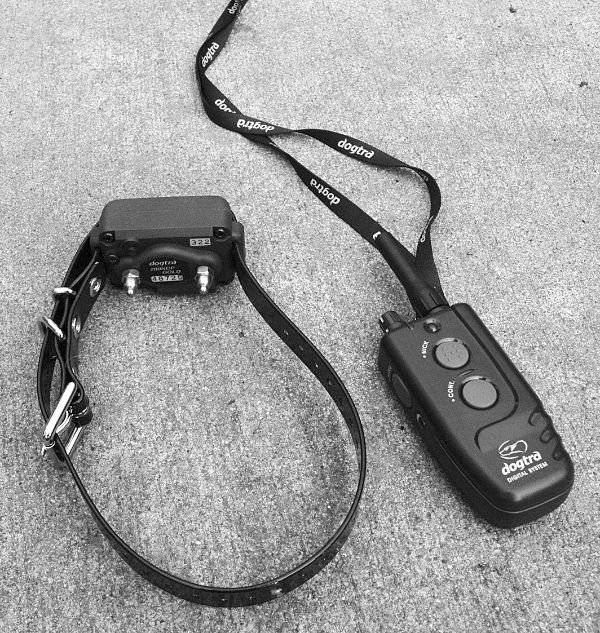
There is a trainer I know who posts a lot of short videos of her own dogs and dogs owned by clients of her board-and-train business. The dogs always look very well behaved and lots of people leave complimentary comments on these posts.
I’ve never seen a comment mentioning the shock collars that every one of the dogs wears. (Or the shock collar combined with a choke chain or pinch collar. Always the shock collar, and often the second pain-inducing collar, too.)
Again, judging by the comments, no one seems to be bothered by the subtle signs of stress and anxiety the dogs in training display. If the dog is “behaving,” the trainer never raises her voice, and the dog’s tail wags at some point, it all looks good to most people (apparently).
Now, it could be that some people DO comment or ask questions about the collars and the trainer deletes them. I would put money on a different possibility, though; I’m pretty sure that this trainer so thoroughly believes in and relies upon the collars that if someone DID comment, she would strongly defend their use.
Quick-fix methods can be seductive, but…
In general, I try to keep WDJ as free as possible from negative appraisals of training techniques and gear that we don’t support. I’d rather that we talk about the many reasons we advocate for the techniques and gear that we love. But I worry sometimes that many people can’t tell the difference between what we would call dog-friendly training and training that’s focused on quick, telegenic results.
I know that quick-fix methods are seductive: “I sent her an unmanageable dog who barked at the door, jumped on everyone, and couldn’t be walked on leash, and two weeks later, now look at him! He’s calm and I can walk him without being dragged down the street!”
But my question is, at what cost? What was that dog’s total experience? A dramatic transformation does not happen that quickly without a certain amount of pain and discomfort and lack of initial comprehension.
Note that I’m not talking about the use of a shock collar to deal with a specific behavior that the owner or training has been unable to stop in any other way, something that may well shorten the life of the dog if the behavior is unchecked, such as taking off after animals (not responding to a recall cue off-leash) or failing to respond to a “leave it” cue in rattlesnake country. That’s a separate debate we could have. But what I’m talking about here is the use of a shock collar to teach dogs to perform every sort of sit, down, stay, come, go to your bed, every-day type of behaviors – the same behaviors we can teach 8-week-old puppies to do on cue with a handful of cookies.
Now, I have to add that this trainer is skilled and experienced. I don’t see the kind of obvious fear that an unskilled force-based trainer induces in his clients’ dogs – the videos posted on social media don’t show dogs who are overtly cringing or flinching. They do show dogs who display more subtle signs of stress: licking their lips, ears back, tucked tails, yawning. In a few videos, it takes a sharp eye, but you can see the reaction a few dogs make when they have hesitated to perform the requested behavior and are being shocked: a long blink or a momentary grimace before they perform the behavior they have been asked for. You can see it, but only if you know what to look for.
I bet her clients are genuinely happy with the results – pleased to discover that their dogs are capable of being calm and compliant and have learned a few behaviors on cue.
Dangers of using shock collars
There is no denying that in the hands of an experienced trainer – an even-tempered person with superior skills at observing body language and good timing – collars that shock or apply painful pressure to the dog’s neck can teach a dog to perform certain behaviors (in order not to suffer a painful consequence) in fairly short order, and without the appearance of violence. But this sort of training is anathema to me, and to most “positive only” trainers, for many reasons. Here are just a few:
- Training methods that use pain can emotionally scar some dogs. Dogs may learn to perform certain behaviors in order to avoid pain, but many lose trust and interest in having a loving relationship with humans.
- There are certain dogs who respond to pain with aggression. You can’t always predict which dogs this will be, but the odds are higher with dogs who are fearful and those who possess more than the average amount of self-preservation instincts. I would argue that from their point of view this constitutes simple self-defense. But the pain-based trainer will respond to the dog’s aggression with greater and greater pain, because if the dog’s aggression successfully (from the dog’s view) ends the training session, the trainer will fail, so the trainer will feel compelled to increase the pain until the dog “submits.” Unfortunately, if the dog’s aggression escalates enough, at some point the trainer is likely to inform the owner that the dog is dangerous and defective and the dog usually ends up dead – euthanized for behavior that was introduced in response to the training method.
- While the trainer might have good timing, observation skills, and judgment, few owners do. When the dog is sent home with his new shock collar and the remote control is now in the hands of his much-less experienced owner, it’s inevitable that the collar will be activated at inappropriate times: when the dog tried to do the wanted behavior but the owner didn’t recognize it as such, after the dog had stopped doing the unwanted behavior but the owner’s timing was delayed, when the owner is angry at the dog for perceived misbehavior, and so on. As the “corrections” make less and less sense to the dog, and he fails to clearly see what behaviors work to stop the pain and which don’t, his “training” will deteriorate – and so will the relationship between the dog and his owner.
In my view, the introduction of a button that is pressed to cause discomfort that will increase compliance from another living being – just this, alone – would indicate to me that the button-presser should spend his or her time with a stuffed or electronic toy dog rather than a thinking, feeling being of another species.
Again, I don’t like to discuss training methods that we would never promote, but I’m not sure that novice dog people are ever told about the potential for harm that quick-fix tools like shock collars can cause. And when a dog owner with an unruly dog sees the “before and after” videos, many happily sign on, without being informed about the potential for fallout. They probably haven’t been told up front that the dog’s seeming calmness and compliance comes with a remote control – one that they will have to learn to utilize in order to maintain those behaviors. Were they asked if they are willing to continue to hurt their dogs into the indefinite future? Or have their dogs learn to associate them with the pain?
The goal of the kind of dog training we describe in WDJ – dog-friendly training, positive-reinforcement-based training, fear-free training, call it whatever you want – is to cultivate communication with and cooperation from our dogs, not just assert control through superior strength or power. Communication and cooperation with other beings is most soundly built on a foundation of mutual comprehension – and this takes a little bit of time! But if the process of learning about each other is rewarding and enjoyable for both parties (canine and human), the bond between them will be strong, even if communication breaks down at times.
Let’s talk about it
*Please note that this place on the WDJ website – the blog spot – is where my personal thoughts are posted. The word “blog” is short for “web log”; it came into being to describe the sort of sites that were devoted to journaling and other personal posts. This isn’t an “article” about the evils of shock collars; it’s where I am trying to work out my personal discomfort with both the use of the tools and the general public’s seeming inability to detect or understand the potential for quite serious fallout from their use and misuse.
Trainers: Do you have personal experience with using shock collars for training garden-variety behaviors? (Let’s confine the discussion to this.) Do you have experience working with dogs who were shocked by different trainers or owners before you were consulted? If so, what can you tell us about these experiences?
Owners: Have you paid someone to train your dog with one of these devices? Were you told up-front that a shock collar would be used on your dog? What has your experience been? Has your dog seemed different in any way?




We thought that it’s just a gentle stimulation like the trainer told us. The trainer demonstrated it on our hands in test mode and it just vibrates so we thought it was fine. We let them train our dog for 1 hr at 12-13 setting. we came home happy with the e collar and thought let’s see how it feels if We set it at 5 which is pretty low. It felt like a sting. A sharp sting at just 5 setting and we saw trainer use up to 12 with our dog. We couldn’t believe we let them hurt our dog based on a lie thatIt doesn’t hurt and just vibrates. We returned it. The dog can’t tell you it hurts. Put it on your neck and press the button and you will know how much it hurts. No it doesn’t build relationship. It will make dog confused as to why their fav person in the world want to hurt them.
I’ve trained my dog to react to the beep on his ecollar. He was only shocked once – on a very low setting – (I’ve even shocked myself on the same level to make sure it was effective and tolerable) and it worked. I literally haven’t had to shock him again. He responds to the beep which is what we need when he wanders on our trail hikes. Shock/ecollars need educated owners behind the button.
For people that don’t under the tool. E collar, you need to educate yourself. I bet you think a hammer is destructive tool . Uninformed ignorant comments.
I recently rescued a Weimaraner that was shocked collar trained. He was given up because he pottied in the house. However, they never had him neutered or had ever taken him to a vet. The rescue had him neutered and I have not had any problems with him at all, adopted him in Feb of 2020. I am thankful to have him away from the formers as this poor dog was afraid to even be a dog! He was afraid to relieve himself, even outside and he was afraid to bark! I believe they abused the collar by setting at a higher level than should have been. When he started barking after I had him a month or so, he would gag and do some really strang things with his mouth and tongue. He is getting better and only swallows oddly when he barks now.
How about rewards with praise and love instead of shocking and pain?
there is absolutely a need and appropriate use for e-collars. But that is not to train/sharpen obedience exercises. I know many top trainers use them for such a purpose but personally I’d rather have a slightly sloppy performance and a happy dog.
Case for e-collars: aggressive or out-of-control dogs. Have a friend who currently has an iffy shepherd. This person should NOT have a large breed of any kind but, well, those puppies in the stall in her friend’s barn were just SO cute! This friend is of the ‘kill ’em with kindness’ mentality – ‘he really doesn’t mean it’, ‘he’s really sweet with my kids and folks who come to the house (doubt that)’. Sorry, lots of damage can be done by ‘he really doesn’t mean it so maybe if I feed him a cookie he won’t throw his 100+ pounds at me with a bite’. Keep in mind that he was barely over 6 months old at the time. At our first meeting this dog was on lead with the owner and lunged for my husband, grabbing his jacket (fortunately it was a heavy one and the bite did no damage). The owner was ‘surprised’ that he would react that way, giggled a little and remarked that the dog is ‘so protective of me’. An e-collar would go far toward improving his attitude in this situation as he would teach himself which behaviors are unacceptable. The owner would use it remotely so when the dog begins to launch into an off behavior – charging the fence – simply tap the collar which breaks his train of thought and also lets him know that behavior is unacceptable. The beauty is that he’s taught himself through repeated ‘hits’ when off behaviors occur what is unacceptable and those corrections are not associated with the owner or any person. I don’t know honestly how ‘off’ this dog is mentally but suspect much of the aberrant behavior is actually caused/supported by the owner. They had another from this same farm/puppy producer, but that one was sweet just really neurotic and eventually lost at 2 to uncontrollable seizures. Eventually I’d likely back off of the shock to just vibration (hey, a shock’s coming if you don’t stop what you’re doing) and once that was ingrained, back off again to just the tone. Unless the dog is incredibly stupid he should be well on the way to offering the correct response and gradually fading the behavior entirely. If he’s truly that stupid he is unpredictable and unsafe to be around so should be humanely put down.
the down side is that anyone with the money can buy an e-collar and use it incorrectly. Have also witnessed horrid cases of misuse. Neighbor’s dog came over to my house (he is always welcome here) and they had an e-collar on him. I walked him down the road toward home and the owner began hitting the collar to ‘teach him not to run off’. No, you’re teaching him not to come home! They just didn’t get it.
as for invisible fences, I’ve hit and killed two dogs at night who were wearing invisible fence collars and had simply run thru the fence chasing something or other. It was dark and I never saw them til I felt the thud. INVISIBLE FENCES DON’T WORK, but the salespeople can do one heck of a selling job! the down side of course is that once your dog runs thru the fence he can’t come back home. Nor can he get away from a stray who happens into his yard for an attack. too many negatives to even consider using one. I can’t believe folks are gullible enough to believe they work.
The “shock collar” brand pictured to my knowledge is not a real shock. It is similar to the little wires my chiropractor
has used on me and all it does is make the muscle twitch. It is very good at getting your dogs attention and does not
work on all dogs due to it’s gentleness. I had one for one of my dogs and i had a professional trainer train him on it
and show me how to use it properly. Proper use is very important. My trainer is against using true shock collars. That is why she recommended the brand name pictured in this article.
Perhaps they do make real shock collars. I have not used one in years but the one i had was not a true shock collar but for muscle stimulation. If you have any concerns try it on yourself. That will answer your question.
I had a very bad experience with a shock collar and an invisible fence. We had decided to put in an invisible fence for Everest, our Bernese Mountain dog. All my neighbors had them on their properties for their dogs and claimed it worked well. Most had golden retrievers.
Anyway, we along with a professional trainer trained Everest with a shock collar and the invisible fence. The only good thing I can say is that he stayed within our property lines. Heres the (very) bad part: Everest developed severe territorial aggression – meaning that if you walked by on our sidewalk (out of bounds of the invisible fence) he’d just sit and watch you. The moment you stepped one inch onto our property, you were toast. He attacked number of people. It was a miracle we weren’t sued. If we had visitors, we had to use a powerful tranquilizer on him along with keeping him physically away from anyone visiting. We tried years to undo the damage to him with countless visits with canine behavioral therapists. After two years of this (and countless sleepless nights wondering when – not if – a lawsuit would come our way along with the possibility of euthanasia) we re-homed him with my father-in-law who had just retired (and whom Everest absolutely adored). It was a match made in heaven and an answer to our prayers. My father-in-law got a faithful companion who never left his side and Everest lived his life unencumbered by the constraints (translation: horror) of our electric fence. (They lived a few miles from us and we saw him frequently). Here’s the interesting part: Everest never bit again because he had no such association with a shock on the perimeter on my father-in-law’s property. He became a wonderful, sweet-tempered pet.
Since Everest, I’ve had numerous other dogs including a Newfoundland. I would never, ever use anything like a shock collar again for any reason. Whatever it did to Everest’s mind, I would not inflict that type of emotional pain again on another dog.
More Research is needed to understand what your talking about. A proper “SHOCK” Collar should not be stronger then a good TENS Unit.
With Respect. Unless you UNDERSTAND The Proper application for E-Collars or Shock Collars You should not be commenting on this issue.
I am a successful 20+ year trainer for Electronic Dog Fences.. I am also a Trained Obedience Trainer
If you want to learn more about this Let Me know I would like to have a respectful conversation.
I will not discuss this option with someone with a closed angry attitude so don’t waste your time responding
Shock Collars will be fine just as soon as trainers/owners who use them wear them. How could anyone tolerate this for their baby!
How do you teach a child to understand the difference between COLD and HOT water? You gently increase the heat of the water over a period on time to help that child LEARN.
Using Shock Is no different. You Start with a Mild Shock that is so low you might feel nothing more then a slight quick Static shock paired with the sound.
Then you increase the level til you get a stress free response like a turn of the neck – “Oh what was that” response Then you use that level for a few days til the pet understand that if the beep starts that Shock response will follow. EVERY ACTION HAS AN REACTION.. Respectfully How Did You train you child?? and to Say “How could anyone tolerate this for their baby!” REALLY “BABY” MY Dogs are naturally instinctive animals. Animals that are unpredictable. EVEN with the best Training. Positive Responses are important, But there are times even a “BABY” needs a Negative experience to learn what not to do.
IMHO – NO LIVING THING WILL LEARN WITH JUST POSITIVE RESPONSES.
I see an ecollar as a long leash more than any thing. It is not to be used to train but reinforce and already learned behavior. I teach my dogs to come to and go away from me and stand still all on leash and then overlay a collar stim that most people can’t feel. This allows me to have my dog be more freedom off leash with knowing I have control. Yes an e collar in the wrong hands is a horrible thing, but I have been training dogs for over 30 years and in the past 10 with all of this postive training, I have seen more fear biters and malajusted dogs because the dogs have no leader and they themselves are not strong enough to lead. Yes I do positive reinforcement to teach my dogs but there has to be consquences when a dog does not respond to commands because it could mean their life in a bad situation. I think it is cruel for people to get a sporting dog or a working dog and keep it in house or in a small yard on a leash all of the time, that is not what dogs were made to do. They were created to work for and with us. If you want a dog to stay on a 6 ft leash it whole life get a dog suited for that like a shih-tzu or a frenchie but don’t get a Weimaraner or a German Shepherd they just won’t be happy living that life. Don’t go and get a dog because you like the looks and then find out you don’t have enough energy yourself to train and exercise it. People are the ones who are letting dogs down by not be able to give them what they need and not wanting to take the time to learn what they need, People want what they want when they want it and if it doesn’t behave perfectly to fit in their lives they look for an easy fix and an e collar is not an easy fix if used correctly but it is a consistant means of communication with your dog that most people can not do with food, especially if your dog is off leash.
Used incorrectly any training devise is a bad thing. I have seen people with dog aggressive dogs feed their dog everytime the dog looks at another dog. With bad timing this is just teach that dog to fixate on other dogs not leave them. I think one of the most dagerous things is someone using an e collar on aggressive or maladjusted dog that should only be done but highly trained dog trainers. And even most people that think they are trained are truly not that train to deal with such a dog.
I Agree with your explanation. You have a great understanding of this option.