

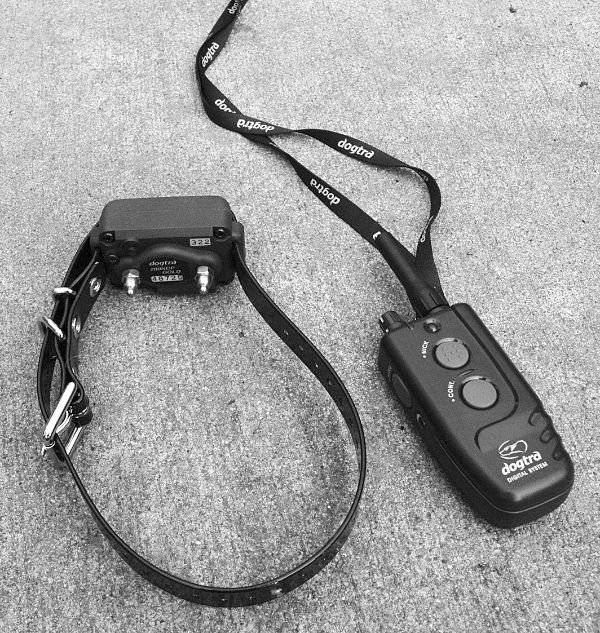
There is a trainer I know who posts a lot of short videos of her own dogs and dogs owned by clients of her board-and-train business. The dogs always look very well behaved and lots of people leave complimentary comments on these posts.
I’ve never seen a comment mentioning the shock collars that every one of the dogs wears. (Or the shock collar combined with a choke chain or pinch collar. Always the shock collar, and often the second pain-inducing collar, too.)
Again, judging by the comments, no one seems to be bothered by the subtle signs of stress and anxiety the dogs in training display. If the dog is “behaving,” the trainer never raises her voice, and the dog’s tail wags at some point, it all looks good to most people (apparently).
Now, it could be that some people DO comment or ask questions about the collars and the trainer deletes them. I would put money on a different possibility, though; I’m pretty sure that this trainer so thoroughly believes in and relies upon the collars that if someone DID comment, she would strongly defend their use.
Quick-fix methods can be seductive, but…
In general, I try to keep WDJ as free as possible from negative appraisals of training techniques and gear that we don’t support. I’d rather that we talk about the many reasons we advocate for the techniques and gear that we love. But I worry sometimes that many people can’t tell the difference between what we would call dog-friendly training and training that’s focused on quick, telegenic results.
I know that quick-fix methods are seductive: “I sent her an unmanageable dog who barked at the door, jumped on everyone, and couldn’t be walked on leash, and two weeks later, now look at him! He’s calm and I can walk him without being dragged down the street!”
But my question is, at what cost? What was that dog’s total experience? A dramatic transformation does not happen that quickly without a certain amount of pain and discomfort and lack of initial comprehension.
Note that I’m not talking about the use of a shock collar to deal with a specific behavior that the owner or training has been unable to stop in any other way, something that may well shorten the life of the dog if the behavior is unchecked, such as taking off after animals (not responding to a recall cue off-leash) or failing to respond to a “leave it” cue in rattlesnake country. That’s a separate debate we could have. But what I’m talking about here is the use of a shock collar to teach dogs to perform every sort of sit, down, stay, come, go to your bed, every-day type of behaviors – the same behaviors we can teach 8-week-old puppies to do on cue with a handful of cookies.
Now, I have to add that this trainer is skilled and experienced. I don’t see the kind of obvious fear that an unskilled force-based trainer induces in his clients’ dogs – the videos posted on social media don’t show dogs who are overtly cringing or flinching. They do show dogs who display more subtle signs of stress: licking their lips, ears back, tucked tails, yawning. In a few videos, it takes a sharp eye, but you can see the reaction a few dogs make when they have hesitated to perform the requested behavior and are being shocked: a long blink or a momentary grimace before they perform the behavior they have been asked for. You can see it, but only if you know what to look for.
I bet her clients are genuinely happy with the results – pleased to discover that their dogs are capable of being calm and compliant and have learned a few behaviors on cue.
Dangers of using shock collars
There is no denying that in the hands of an experienced trainer – an even-tempered person with superior skills at observing body language and good timing – collars that shock or apply painful pressure to the dog’s neck can teach a dog to perform certain behaviors (in order not to suffer a painful consequence) in fairly short order, and without the appearance of violence. But this sort of training is anathema to me, and to most “positive only” trainers, for many reasons. Here are just a few:
- Training methods that use pain can emotionally scar some dogs. Dogs may learn to perform certain behaviors in order to avoid pain, but many lose trust and interest in having a loving relationship with humans.
- There are certain dogs who respond to pain with aggression. You can’t always predict which dogs this will be, but the odds are higher with dogs who are fearful and those who possess more than the average amount of self-preservation instincts. I would argue that from their point of view this constitutes simple self-defense. But the pain-based trainer will respond to the dog’s aggression with greater and greater pain, because if the dog’s aggression successfully (from the dog’s view) ends the training session, the trainer will fail, so the trainer will feel compelled to increase the pain until the dog “submits.” Unfortunately, if the dog’s aggression escalates enough, at some point the trainer is likely to inform the owner that the dog is dangerous and defective and the dog usually ends up dead – euthanized for behavior that was introduced in response to the training method.
- While the trainer might have good timing, observation skills, and judgment, few owners do. When the dog is sent home with his new shock collar and the remote control is now in the hands of his much-less experienced owner, it’s inevitable that the collar will be activated at inappropriate times: when the dog tried to do the wanted behavior but the owner didn’t recognize it as such, after the dog had stopped doing the unwanted behavior but the owner’s timing was delayed, when the owner is angry at the dog for perceived misbehavior, and so on. As the “corrections” make less and less sense to the dog, and he fails to clearly see what behaviors work to stop the pain and which don’t, his “training” will deteriorate – and so will the relationship between the dog and his owner.
In my view, the introduction of a button that is pressed to cause discomfort that will increase compliance from another living being – just this, alone – would indicate to me that the button-presser should spend his or her time with a stuffed or electronic toy dog rather than a thinking, feeling being of another species.
Again, I don’t like to discuss training methods that we would never promote, but I’m not sure that novice dog people are ever told about the potential for harm that quick-fix tools like shock collars can cause. And when a dog owner with an unruly dog sees the “before and after” videos, many happily sign on, without being informed about the potential for fallout. They probably haven’t been told up front that the dog’s seeming calmness and compliance comes with a remote control – one that they will have to learn to utilize in order to maintain those behaviors. Were they asked if they are willing to continue to hurt their dogs into the indefinite future? Or have their dogs learn to associate them with the pain?
The goal of the kind of dog training we describe in WDJ – dog-friendly training, positive-reinforcement-based training, fear-free training, call it whatever you want – is to cultivate communication with and cooperation from our dogs, not just assert control through superior strength or power. Communication and cooperation with other beings is most soundly built on a foundation of mutual comprehension – and this takes a little bit of time! But if the process of learning about each other is rewarding and enjoyable for both parties (canine and human), the bond between them will be strong, even if communication breaks down at times.
Let’s talk about it
*Please note that this place on the WDJ website – the blog spot – is where my personal thoughts are posted. The word “blog” is short for “web log”; it came into being to describe the sort of sites that were devoted to journaling and other personal posts. This isn’t an “article” about the evils of shock collars; it’s where I am trying to work out my personal discomfort with both the use of the tools and the general public’s seeming inability to detect or understand the potential for quite serious fallout from their use and misuse.
Trainers: Do you have personal experience with using shock collars for training garden-variety behaviors? (Let’s confine the discussion to this.) Do you have experience working with dogs who were shocked by different trainers or owners before you were consulted? If so, what can you tell us about these experiences?
Owners: Have you paid someone to train your dog with one of these devices? Were you told up-front that a shock collar would be used on your dog? What has your experience been? Has your dog seemed different in any way?




I can only speak to my experience with my rescued Irish Terrier boy. ITs are generally willful and loving, aggressive toward other dogs and small mammals. I’ve had five, two rescues. My boy had been “trained” with a shock collar and had lived in several homes before mine because of his willfulness, which is a breed trait. It took years for me to be able to touch his head and neck, and the click of his vest harness can still drive him into a spinning frenzy.
Now here’s a thought, and a very pretty thought.
When I’ve run classes for pet dog owners, I find it very very difficult to get through to some of the owners. You can patiently show them again “how to do it’ but there are always some who just don’t seem to get it.
Would you then get these people to wear a device so that you can give them a non-lethal electric shock whenever you see them making a mistake?
Would it turn them into better trainers for their dogs? Do you think it would make these people happier?
Can you think of a better way to ‘train these stubborn people?
Trainers are no different. once they reject a process most refuse to learn more and move further. The object of the shock collar is to teach the dog to respond to the sound. The shock is used to teach what the sound means. Most dogs will rarely need the shock after training. Its a learning process and heavy SHOCK is not needed if you understand the process.
Thank you
Put a shock collar on yourself, wife (husband) and kids and see how everyone likes it. If you use one, then YOU don’t know how to train. Remember: mankind is king of beasts, his brutality exceeds theirs.
REALLY< Have you ever used one?
A very biased report. The author forgot to mention the there are several levels of the electric shock normally up to 7 or 8 levels. She also totally did not mention that a good training collar has 2 more options also with many different levels: the vibrate mode and the acoustic mode to get the dogs attention. Bad biased reporting.
I see your point. BUT I think the gist was not “Do you approve of electrically operated devices?” but “Do you agree that causing pain in training dogs is effective?”
Obviously a device that communicates with a distant or deaf dog is not abusive.
What worries us is the using a a device that causes a dog enough pain to make it stop doing whatever it was doing, in the name of ‘training’.
Now I also have to sadly admit that there are very very many incompetent trainers who THINK they are good because they do not use pain or violence or coercion, when if fact they are merely incompetent.
But better an incompetent trainer who does no harm, than an incompetent trainer who turns dogs into mental disaster.
PS. I sept two miserable years with a Latin Teacher who believed in Corporal punishment ;-(
Since I was not gifted at Latin I decided to give up. If I never did anything at all, I couldn’t be punished for getting it wrong. A detention was better than being rapped over the knuckles with the sharp side of a ruler for making a mistake in the exercises.
So how many of you E-collar users are just like my incompetent Latin teach? Incompetent at training so resort to brute force??
SHOCK COLLARS are not used for Corporal Punishment unless it is abused. Brute Force is not the end result if you understand the process. Have an open mind ask a local e-collar trainer if you can sit in an a training or if they can demonstrate proper use. I have been able to teach many people just by demonstrating on them how it works.
THANK YOU
I AGREE COMPLETELY.. so are most of the responses
THANK YOU
Yes! We used the collars on all our kids, and they are the best kids on the block! I would recommend those collars for every parent who wants the best behaved kids ever…..
I got an electric dog collar and I tried it on myself and that was all I ever did with it .It went in the bin.
I would not put it on my dog because it hurt that much.
Not a way to train a dog
What you got was a cheap piece of crap that is in no way the same as a good quality ecollar. The whole point of modern ecollars is that the levels go so low that we don’t even feel it and the dog barely feels it (it feels like a tickle or a tingle once you do start to feel it).
If the unit you bought didn’t have multi levels and choices then it was a very inexpensive unit. Look into Garman or Dogtra units.. A bit more money but well worth the money, and Look into a professional dog trainer who will show you how to properly use that unit. Yes it will cost you a few bucks but you will be pleased with the results.
Your argument has so many holes I’m not sure where to begin. First you start each argument with an assumption. Second, you speak from a condescending presumption that your better. I noticed that you deal with horses as well. It has been proven that horses are more receptive, intelligent, and empathetic than dogs are. From this point I question your use of electric fences. They emit a higher charge than an e-collar. Are these horses scarred for life? Are you a bed horse owner for putting them in a field with an electric fence? Third, you go to great lengths to point out how horrible e-collar training of a dog is, but you offer absolutely no alternative. Lip service of “positive” training does not answer a single question that you yourself raised. How do you stop an unwanted behavior? I can get a dog to sit with treats. I can get a dog to lay down, roll over, and a lot more, but enlightened me on how to stop the dog from bolting through the door. How to keep it from jumping on someone, or from chewing my shoes? Lastly, every creature learns from pain avoidance. Humans are no exception. Total positive training results in participation trophy type kids. Total negative bares scared withdrawn kids. Same holds for other animals that are not self aware like dogs. The trick, as all developmental psychologists will attest is a well prescribed blend of the two. You say that you’re just journaling to figure all of this out. I applaud you for an actual request to learn. My only concern was the tenor of your writing seemed as if you’ve already had your mind made up. I’d suggest sitting down with said trainer and air your concerns and questions and let her explain her thoughts.
Ric there is punishment that works without being abusive.
On the other hand I try to NEVER use punishment when ‘training’, though I do use it for management.
Dog are annoying the cat — dogs go outside.
Dogs are fighting — they get separated.
Dogs barking at the fence — -dogs get crated (without a biscuit to reward then for going in 🙂
Time out works very well for tired, cranky or frustrated animals. This rime out is usually pretty fogs for tired cranky and frustrated Trainers, too 🙂
Same with children.
Sorry a bout the typos 🙁
This time out is usually pretty good for tired cranky and frustrated Trainers, too 🙂
Mz Haskins, I think we may have a nomenclature issue at hand. The counter to your opening is that there is abuse that can be effective without being punishment as well. You stated that you “try to never use punishment while training”, but you will use it for “management”. Here we have a game of semantics. In behavior science confusion is eased by having two types of rewards, positive and negative. EVERY action/behavior merits a reward, albeit positive or negative. There is no punishment in behavior modification. A+B=C simple and linear, just like a dog’s brain is wired. When we anthropomorphize the dog, we muddy up the conversation. This debate on shock collar training is a victim of said muddy conversation. And sadly, the hostility and vitriol that ensues generally makes both side avoid the conversation all together or worse only speaking with those that agree with whichever side they find themselves on (oddly this is an example of negative reward). Before I go any further, I’d be remiss not to clearly state that I 100% agree with your statement that some either through frustration at best and sadism at worse take negative rewards past the stage of punishment into abuse. And both sides should spend their efforts in banishing these people from not just dog training, but from ownership at all. The shock collar or e-collar is used simply as a negative reward. It is subjective to each animal based on its tolerance. A level 10 stimulus for one dog may be a 100 for another, and a 1 for yet another. Likewise, the animal is in control of said reward with a compliant behavior that has been rewarded several times prior to the introduction of any remote work or negative reward system. Bottom line I assume we ALL want the same end result, a well behaved loyal companion that we trust will do the right thing when needed. And science has proven that a blend of both positive and negative reward systems are the most effective. So my suggestion is live and let live. Do not attack a trainer for using scientifically proven methods. Do not assume that a dog with an e-collar is riding the lightning all the time. Do not assume a dog with a pinch collar that is in a good heal position is in worse shape than a dog that is choking itself pulling on a buckle collar. My normal is not your normal, but it doesn’t make it any less normal for me. I promise not to impose my training methods on you as long as you don’t try to dictate yours onto me. In the end feel free to walk away THINKING to yourself, “What an idiot! I could do so much better.” And I may do the same, but let’s both choose to celebrate each other’s victories and know we both are working on those loses as learning opportunities.
Ric, you make claims about “behavior science” but what you write reveals that you are not clear about what the science is. Training mostly falls under the umbrella of learning theory. “Negative reward” is not a term employed by behaviorists or psychologists. Review BF Skinner and his 4 quadrants of operant conditioning. Positive & negative reinforcement and positive and negative punishment. Of course punishment exists in training.
You also throw in A+B=C. ABC is also a term Skinner coined. It stands for Antecedent, Behavior, and Consequence. Every behavior has a consequence – not a positive or negative reward. Sadly the example you cite of negative reward is simply nonsense – it literally has no meaning.
I don’t know if you are simply a misinformed dog owner or a negligent and unqualified trainer. No professional trainer should have to ask how to use R+ (positive reinforcement) to keep a dog from dashing out of a door or jumping up on a person. Those are among the simplest things to accomplish.
You’re going to ask “how?” Train the dog with R+ to sit as you approach within 3 feet of the door. But really train it. Don’t just do a few reps and expect success. I’ll do 5 reps, stop along with the dog 3′ from the door and treat him upon sitting. I go no further until I have 5 consecutive successes. Then with the dog in sit position I’ll reach for the doorknob and (depending upon the dog’s reaction) I’ll just touch it and treat or I’ll turn it and treat. then we walk away and repeat 5 times. Then I work up to opening the door a couple of inches (or a bit more – again all depending upon the dog’s ability to stay seated). If the dog dashes to the door, I’ll quickly shut it. (That’s an example of negative punishment. I took away his access to the outside. ) Usually, in short order, the dog is sitting nicely while I open the door all the way and walking outside by myself. Of course, it doesn’t always happen that I can do that the first time working on that task. But that’s OK. My job is to train the dog. I don’t mind earning my money.
There is zero excuse for inflicting pain or any uncomfortable physical consequence to a dog for not being able to instantly accomplish a task. We’ve stopped using corporal punishment in our schools for humans, it’s time we did the same for our animal companions.
Scott,
You’re quite adept at Wikipedia and or quite full of yourself, or just overwhelmed with the idea that you can over explain a simple example. Your methodology in fact described Skinnerian theory as I eluded to. Not wanting to take away from your obvious expository writing class, I appreciate your attempt at passive aggressive correction. Either way your description has several flaws in your attempt at virtue signaling positive only training. Simply shutting the door in the dogs face is in fact negative reinforcement. So that is balanced training. As for your quip on corporal punishment, look where that has gotten us. Your participation trophy utopia has failed in nearly every aspect. Yes, we no longer use corporal punishment in schools, basically because the few abusers of it ruined its efficacy. However, the pendulum swinging to your side has had many more dire effects. Again demonstrating the need for balance. A properly fitted good shock collar can offer a milder stimulus than the erroneously used choker chains. For a person that cries for humane treatment, I’d assume the least painful correction would be desired.
If you train your dog right with the e collar it works, and no reason to go up on numbers. I used it at 15 on me and finally felt on my hand, and it was a little tingle . And training numbers on the dogs is very low. I am sure if it hurt my dog , he would of yelped instead of looking around like what was that ? I would never use it for negative reinforcement.
I got a shock collar to use on my Sheltie, a very gentle soul. I’ll never forget the look in his eyes the first time I shocked him. He was confused and puzzled and hurt.
I took it off of him immediately and tried it on myself. It was SO painful. It was awful! I never used it again. I would never subject any of my dogs to it ever again. I consider it cruel.
I know there’s supposedly positive things about them, but animals don’t belong to us. I think these type of punishing tools reflect the cavalier attitude of humans towards other species on the planet. We don’t ‘own’ them.
Cheri, if you felt pain at the lowest level then what you had was a cheap piece of crap and many trainers who use ecollars would still call that s shock collar. A good quality modern ecollar goes to levels so low that we can’t even feel it, and when we do begin to feel it, it feels like tingle, *not* a huge painful shock.
Shelties are very soft dogs and in general I would not recommend an ecollar unless trained by a professional.
Hi, Kat.
Thanks for your reply.
That’s good to know…but I still would never use one.
When you explain all the subtle differences and place the collar on your dog, do they really have the understanding that the collar is for their own good, and not aversive? I find it difficult that the dog would ever be able to understand why you must frighten/ alarm it to get the dog to ‘behave.’ When you understand that dogs do not actually misbehave, that what they do is fail to meet our expectations, then understand that because dogs are a long term commitment, they do nit need to be trained on days, you may become a little more patient and understanding and adjust your training method.
It is not uncommon foe Electronic Collars, or E-Collars, to be referred to as ‘Shock’ collars, however this is not an accurate description of the way these products function. The term “shock collar biases the public and is continually propagandized by people like yourself. E-Collars use electronic stimulation (ES) and NOT electric shock. Electric shock occurs when a living being is grounded and a live electrical current is applied to them. The ES delivered by modern E-Collars is Transcutaneous Electrical Nerve Stimulation (TENS). TENS has no injurious effects and is often used to manage chronic pain in humans. If used correctly only low level settings are used on dogs, however regardless of the setting, ES does not hurt the dog in any way. It feels more like an itch. E-Collars were first developed in the 1970’s and at that time they did deliver electric shock. However, this is not a term which is appropriate to associate with modern E-Collars which have evolved as training techniques have as well.
E-Collars can do much more than just provide ES. The anti E-Collar propaganda that you spread is inaccurate and of your opinion only (e.g. Not based on anything that is real).
In terms of the other things that E-Collars do, they:
* allow you to speak to your dog anywhere up to miles away
* allow you to use a tone or a vibration to get the dog’s attention instead of ES
* allow you to track the geographic location of the dog up to dozens of miles away and show that to you on a unit that looks like an iPhone that the owner carries
* allow you to turn lights on the collar on remotely to make the dog more visible
* provide the ability to draw an enclosure around any geographic area and have it work like a hidden fence
At their core, E-Collars are communications devices. Most commonly they are used at low levels to provide information to the dog. It helps them to understand expectation, where we need them to be, and what we want them to avoid doing – all at a distance.
The E-Collar provides an opportunity to teach a dog reliable off leash behavior. For dogs who are already reliable off leash, they provide a safety net for that unusual situation which always arises. A well trained dog equipped with a tool that allows us to communicate with them at a distance has a lot of value both for us and our dogs.
One exception to this rule is electric collars associated with canine invisible boundaries. These are not illegal provided the canine invisible boundary is used to confine dogs, but only used inside a fence through which dogs cannot pass and that is not less than 1.5 metres high.Jun 24, 2016
Is the use of electronic dog collars legal? – RSPCA Australia …
kb.rspca.org.au/is-the-use-of-electronic-dog-collars-legal_279.html
I would just like to mention that most collars have a vibrate and tone function. You do Not have to use the “Shock” function. I use the tone function. I can’t tell you how many times I have to explain this to other owner/handlers.