

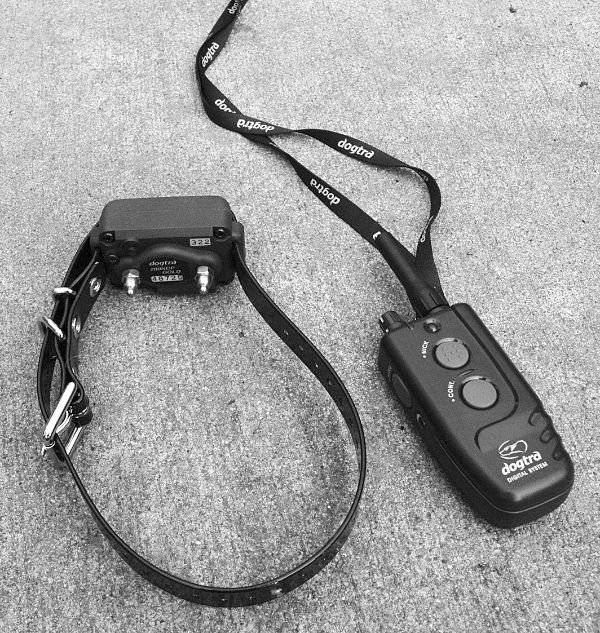
There is a trainer I know who posts a lot of short videos of her own dogs and dogs owned by clients of her board-and-train business. The dogs always look very well behaved and lots of people leave complimentary comments on these posts.
I’ve never seen a comment mentioning the shock collars that every one of the dogs wears. (Or the shock collar combined with a choke chain or pinch collar. Always the shock collar, and often the second pain-inducing collar, too.)
Again, judging by the comments, no one seems to be bothered by the subtle signs of stress and anxiety the dogs in training display. If the dog is “behaving,” the trainer never raises her voice, and the dog’s tail wags at some point, it all looks good to most people (apparently).
Now, it could be that some people DO comment or ask questions about the collars and the trainer deletes them. I would put money on a different possibility, though; I’m pretty sure that this trainer so thoroughly believes in and relies upon the collars that if someone DID comment, she would strongly defend their use.
Quick-fix methods can be seductive, but…
In general, I try to keep WDJ as free as possible from negative appraisals of training techniques and gear that we don’t support. I’d rather that we talk about the many reasons we advocate for the techniques and gear that we love. But I worry sometimes that many people can’t tell the difference between what we would call dog-friendly training and training that’s focused on quick, telegenic results.
I know that quick-fix methods are seductive: “I sent her an unmanageable dog who barked at the door, jumped on everyone, and couldn’t be walked on leash, and two weeks later, now look at him! He’s calm and I can walk him without being dragged down the street!”
But my question is, at what cost? What was that dog’s total experience? A dramatic transformation does not happen that quickly without a certain amount of pain and discomfort and lack of initial comprehension.
Note that I’m not talking about the use of a shock collar to deal with a specific behavior that the owner or training has been unable to stop in any other way, something that may well shorten the life of the dog if the behavior is unchecked, such as taking off after animals (not responding to a recall cue off-leash) or failing to respond to a “leave it” cue in rattlesnake country. That’s a separate debate we could have. But what I’m talking about here is the use of a shock collar to teach dogs to perform every sort of sit, down, stay, come, go to your bed, every-day type of behaviors – the same behaviors we can teach 8-week-old puppies to do on cue with a handful of cookies.
Now, I have to add that this trainer is skilled and experienced. I don’t see the kind of obvious fear that an unskilled force-based trainer induces in his clients’ dogs – the videos posted on social media don’t show dogs who are overtly cringing or flinching. They do show dogs who display more subtle signs of stress: licking their lips, ears back, tucked tails, yawning. In a few videos, it takes a sharp eye, but you can see the reaction a few dogs make when they have hesitated to perform the requested behavior and are being shocked: a long blink or a momentary grimace before they perform the behavior they have been asked for. You can see it, but only if you know what to look for.
I bet her clients are genuinely happy with the results – pleased to discover that their dogs are capable of being calm and compliant and have learned a few behaviors on cue.
Dangers of using shock collars
There is no denying that in the hands of an experienced trainer – an even-tempered person with superior skills at observing body language and good timing – collars that shock or apply painful pressure to the dog’s neck can teach a dog to perform certain behaviors (in order not to suffer a painful consequence) in fairly short order, and without the appearance of violence. But this sort of training is anathema to me, and to most “positive only” trainers, for many reasons. Here are just a few:
- Training methods that use pain can emotionally scar some dogs. Dogs may learn to perform certain behaviors in order to avoid pain, but many lose trust and interest in having a loving relationship with humans.
- There are certain dogs who respond to pain with aggression. You can’t always predict which dogs this will be, but the odds are higher with dogs who are fearful and those who possess more than the average amount of self-preservation instincts. I would argue that from their point of view this constitutes simple self-defense. But the pain-based trainer will respond to the dog’s aggression with greater and greater pain, because if the dog’s aggression successfully (from the dog’s view) ends the training session, the trainer will fail, so the trainer will feel compelled to increase the pain until the dog “submits.” Unfortunately, if the dog’s aggression escalates enough, at some point the trainer is likely to inform the owner that the dog is dangerous and defective and the dog usually ends up dead – euthanized for behavior that was introduced in response to the training method.
- While the trainer might have good timing, observation skills, and judgment, few owners do. When the dog is sent home with his new shock collar and the remote control is now in the hands of his much-less experienced owner, it’s inevitable that the collar will be activated at inappropriate times: when the dog tried to do the wanted behavior but the owner didn’t recognize it as such, after the dog had stopped doing the unwanted behavior but the owner’s timing was delayed, when the owner is angry at the dog for perceived misbehavior, and so on. As the “corrections” make less and less sense to the dog, and he fails to clearly see what behaviors work to stop the pain and which don’t, his “training” will deteriorate – and so will the relationship between the dog and his owner.
In my view, the introduction of a button that is pressed to cause discomfort that will increase compliance from another living being – just this, alone – would indicate to me that the button-presser should spend his or her time with a stuffed or electronic toy dog rather than a thinking, feeling being of another species.
Again, I don’t like to discuss training methods that we would never promote, but I’m not sure that novice dog people are ever told about the potential for harm that quick-fix tools like shock collars can cause. And when a dog owner with an unruly dog sees the “before and after” videos, many happily sign on, without being informed about the potential for fallout. They probably haven’t been told up front that the dog’s seeming calmness and compliance comes with a remote control – one that they will have to learn to utilize in order to maintain those behaviors. Were they asked if they are willing to continue to hurt their dogs into the indefinite future? Or have their dogs learn to associate them with the pain?
The goal of the kind of dog training we describe in WDJ – dog-friendly training, positive-reinforcement-based training, fear-free training, call it whatever you want – is to cultivate communication with and cooperation from our dogs, not just assert control through superior strength or power. Communication and cooperation with other beings is most soundly built on a foundation of mutual comprehension – and this takes a little bit of time! But if the process of learning about each other is rewarding and enjoyable for both parties (canine and human), the bond between them will be strong, even if communication breaks down at times.
Let’s talk about it
*Please note that this place on the WDJ website – the blog spot – is where my personal thoughts are posted. The word “blog” is short for “web log”; it came into being to describe the sort of sites that were devoted to journaling and other personal posts. This isn’t an “article” about the evils of shock collars; it’s where I am trying to work out my personal discomfort with both the use of the tools and the general public’s seeming inability to detect or understand the potential for quite serious fallout from their use and misuse.
Trainers: Do you have personal experience with using shock collars for training garden-variety behaviors? (Let’s confine the discussion to this.) Do you have experience working with dogs who were shocked by different trainers or owners before you were consulted? If so, what can you tell us about these experiences?
Owners: Have you paid someone to train your dog with one of these devices? Were you told up-front that a shock collar would be used on your dog? What has your experience been? Has your dog seemed different in any way?




We have been trainers for 35+ years. We do not use harsh devices in our training nor are we treat based trainers. We believe in relationship training using a wide (1-2″ ) collar which is the gentlest you can use and a regular flat lead. We don’t believe in relying on anything but you – your touch, tones, love, emotions, body language etc. You might guess we aren’t big fans of choking, pinching, hanging or shocking animals to gain compliance. I have been brought to tears witnessing what happens to dog who received shocks. One Golden refused to leave the 2nd floor of the house for a week because the ‘invisible fence’ person didn’t know what they were doing. One pup we trained after the shock collar trainer had the dog would have projectile diarrhea upon seeing the collar head his way. It’s just insane. I can’t help but get angry at the people who promote such a terrible way to train as harmless. If you know anything about training a dog then why do you need anything but you and the dog? Even trainers who go overboard with treats frustrate me but for a whole other reason. I have seen dogs removed from their homes because the treat training basically got out of control and now the dog was lunging at their people’s hand aggressively for more food. Not so good for the elderly couple and their very assertive Malamute. Or the very nice lady whose 4 month old puppy is growling at her whenever he doesn’t want to do something and now she is afraid of him. All because her prior trainer just kept tossing food in his direction as a deterrent, but did nothing to teach him manners. Now the pup thinks ‘growl and I get a treat’. Anything that swings the pendulum too far in any direction isn’t balanced. Of course now even that word has been ruined by trainers who think being harsh is just fine so long as you give them lots of treats too. Where’s the skill? Where’s the understanding of dogs? Where is the middle ground? How about teaching people to read their dogs, to understand their dogonality, to know what an eye blink means, a heavy sigh, an ear flick…it all has meaning. People need to learn to speak dog and practice it everyday. That creates a relationship built on love, trust and respect. You don’t build trust with pain or fear, and it can be tough to foster respect without rule and boundaries. Rarely do we have to worry about the love part – thats easy.
Hi, I was not going to respond to this article only because of those who are not hunting enthusiasts.
The people here that do not understand the proper use of an E-collar, almost make it a political correctness attitude.
Gun dogs are a essential part of our society and need a little extra vibe to help them sometimes.
I agree with Sandy and Lauri, safety and training gun dogs has to be precise. I never had to use it for basic commands and once my dogs had the hunt down, I didn’t need the vibe any longer, only for tracking purposes.
Lets face it there are coyotes, wolves, mountain lions and such, of witch you need to know where your buddy is at all times.
So for all you haters out there who prefer not to use the E for basic commands, bravo. I wish you all the park walking in the world.
Oh, let me not forget about the rattle snakes. My dogs were trained in live rattlesnake avoidance and if you care to do it without an E, more power to you, but don’t criticize those of us that choose to go that route, because I guarantee, you would not like the photos of dogs that have been bitten my rattlers.
So, if you don’t know how to properly use an E, I recommend not using it, but don’t judge the rest of use that go beyond the outdoor norm.
I’m not even going to get into hunting feral pigs with dogs.
It’s so nice to be able to voice an opinion without haters chasing you down.
Hi, I was not going to respond to this article only because of those who are not hunting enthusiasts.
The people here that do not understand the proper use of an E-collar almost make it a political correctness attitude.
Gun dogs are and essential part of our society and need a little extra vibe to help them sometimes.
I agree with Sandy and Lauri, safety and training gun dogs has to be precise. I never had to use it for basic commands and once my dogs had the hunt down, I didn’t need the vibe any longer, only for tracking purposes.
Lets face it there are coyotes, wolves, mountain lions and such of witch you need to know where your buddy is at all times.
So for all you haters out there that prefer not to use the E for basic commands, bravo. I wish you all the park walking in the world.
Oh, let me not forget about the rattle snakes. My dogs were trained in live rattlesnake avoidance and if you care to do it without an E, more power to you, but don’t criticize those of us that choose to go that route, because I guarantee, you would not like the photos of dogs that have been bitten my rattlers.
So, if you don’t know how to properly use an E, I recommend not using it, but don’t judge the rest of use that go beyond the outdoor norm.
I’m not even going to get into hunting feral pigs with dogs.
It’s so nice to be able to voice an opinion without haters chasing you down.
Exactly! My dogs are both obedience trained dogs who have titled in both Obedience and Rally disciplines. When we go out to explore (off-lead) the areas around us in North Western Nevada, I equip them with an e-collar. In 4 years, I have only had to use the shock feature once, when my female Golden Retriever encountered a rattlesnake. While she has been “rattlesnake-aversion trained,” the correction may have saved her life. I have NEVER used an e-collar for regular obedience training. I have found that there are much more compassionate and effective methods. That said, I choose to cause a moment of discomfort to my dogs than to have them chase a rabbit in front of a logging truck, or get bitten by a rattlesnake.
It is never acceptable to inflict pain on your dog. It is never acceptable to let others inflict pain on your dog.
If you let a trainer do that, shame on you! The animal might learn something but will loose trust on you.
A good trainer can teach with pain. The method of teaching with pain is antiquated and frankly does more harm than good!!!!
Never acceptable for any obedience training. I did use one to stop my very athletic rescued Doberman from jumping the fence many years ago. It was a hard decision but it was a safety issue. Other than something like that, they are unacceptable.
If I used one on my current dogs, both with varying degrees of anxiety, I would destroy them.
I recently found a young little pit mix running loose in the woods. She had one on. I was not pleased to see it but nothing I could do. However, when I had leashed her and was trying to decide what to do with her, she shrieked. I realized the owner must be near and had zapped her. So, I took it off and threw it into some bushes. Owner came, nice lady. I said nothing about the collar. She noticed it was “missing”. I had the opportunity to explain how they created behavior issues, etc. she listened, hopefully it helped and she did not buy another. I ended up picking it up and bringing it home to dispose of. Not nice maybe, but maybe it helped her understand how they can create more problems than you originally had.
I would never use them for training, but I do use (rarely) on 1 high prey dog (in a 3 dog pack) when off leash hiking in the spring, due to the newborn fawns being very vulnerable. My dog has a great recall almost all of the time, and I carry high value treats when hiking and training. However, I know he might find the temptation of a fawn irresistible, and an attack on one would be lethal. The collar has tone and shock, and he responds well to the tone. I can’t recall the last time I used the shock, but it was likely at least 2 years ago.
My guys all have the rattlesnake vaccine, but with this current crew we haven’t yet seen a snake. However, decades ago one of my dogs was struck by a rattler, and required immediate veterinary care.
No way, no how. Put the collar in the i-juit that would do that to a dog.
I’ve been training professionally for 22 years. I’m greatly saddened by the numerous “trainers” in my area using shock collars. From my observations, people want their puppies and adolescent dogs to act like well trained adult dogs. Many don’t want to spend the time and energy to train them so off they go to board/train shock collar people. I absolutely see the subtle signs of stress on the videos. I can’t even watch them.
I told my husband he could use one on our dog, if first I could use it on him. I think he was joking, but I wasn’t!
An aside note: Autistic children will often bang their head on the floor, even concrete and they do it with force. Detached retinas often occur. The only proven method of stopping this behaviour was shock. The ignorant do-gooders got wind of it and managed to get it outlawed. The operation was done by trained professionals. The last time I checked (35 years ago) they were making the children wear helmets . The professional were using B.F. Skinner’s positive & negative reinforcement and that worked! I am a 93 year old retired psychology professor.
Umm. Gordon. Did you ever get to know these kids later???
I was a head banger as a child, IF anyone had zapped me for that I would probably have gone totally berserk.
Did you ever try to discover what it was that was CAUSING the head banging??
It is not fun as a child to feel totally isolated and constantly criticised.