

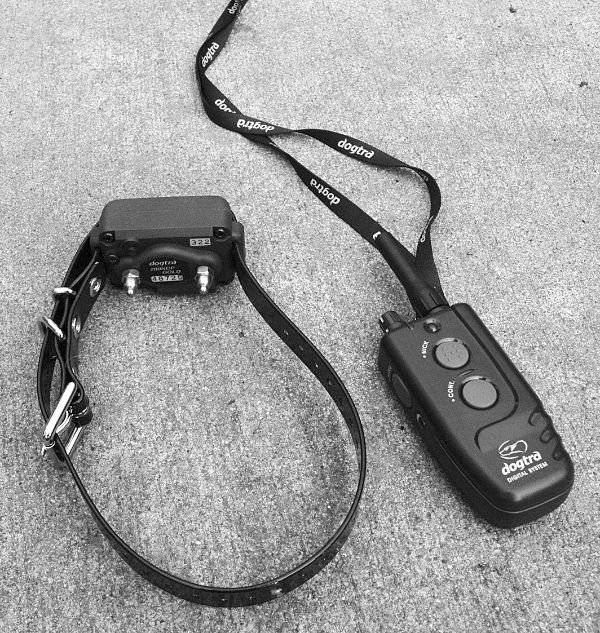
There is a trainer I know who posts a lot of short videos of her own dogs and dogs owned by clients of her board-and-train business. The dogs always look very well behaved and lots of people leave complimentary comments on these posts.
I’ve never seen a comment mentioning the shock collars that every one of the dogs wears. (Or the shock collar combined with a choke chain or pinch collar. Always the shock collar, and often the second pain-inducing collar, too.)
Again, judging by the comments, no one seems to be bothered by the subtle signs of stress and anxiety the dogs in training display. If the dog is “behaving,” the trainer never raises her voice, and the dog’s tail wags at some point, it all looks good to most people (apparently).
Now, it could be that some people DO comment or ask questions about the collars and the trainer deletes them. I would put money on a different possibility, though; I’m pretty sure that this trainer so thoroughly believes in and relies upon the collars that if someone DID comment, she would strongly defend their use.
Quick-fix methods can be seductive, but…
In general, I try to keep WDJ as free as possible from negative appraisals of training techniques and gear that we don’t support. I’d rather that we talk about the many reasons we advocate for the techniques and gear that we love. But I worry sometimes that many people can’t tell the difference between what we would call dog-friendly training and training that’s focused on quick, telegenic results.
I know that quick-fix methods are seductive: “I sent her an unmanageable dog who barked at the door, jumped on everyone, and couldn’t be walked on leash, and two weeks later, now look at him! He’s calm and I can walk him without being dragged down the street!”
But my question is, at what cost? What was that dog’s total experience? A dramatic transformation does not happen that quickly without a certain amount of pain and discomfort and lack of initial comprehension.
Note that I’m not talking about the use of a shock collar to deal with a specific behavior that the owner or training has been unable to stop in any other way, something that may well shorten the life of the dog if the behavior is unchecked, such as taking off after animals (not responding to a recall cue off-leash) or failing to respond to a “leave it” cue in rattlesnake country. That’s a separate debate we could have. But what I’m talking about here is the use of a shock collar to teach dogs to perform every sort of sit, down, stay, come, go to your bed, every-day type of behaviors – the same behaviors we can teach 8-week-old puppies to do on cue with a handful of cookies.
Now, I have to add that this trainer is skilled and experienced. I don’t see the kind of obvious fear that an unskilled force-based trainer induces in his clients’ dogs – the videos posted on social media don’t show dogs who are overtly cringing or flinching. They do show dogs who display more subtle signs of stress: licking their lips, ears back, tucked tails, yawning. In a few videos, it takes a sharp eye, but you can see the reaction a few dogs make when they have hesitated to perform the requested behavior and are being shocked: a long blink or a momentary grimace before they perform the behavior they have been asked for. You can see it, but only if you know what to look for.
I bet her clients are genuinely happy with the results – pleased to discover that their dogs are capable of being calm and compliant and have learned a few behaviors on cue.
Dangers of using shock collars
There is no denying that in the hands of an experienced trainer – an even-tempered person with superior skills at observing body language and good timing – collars that shock or apply painful pressure to the dog’s neck can teach a dog to perform certain behaviors (in order not to suffer a painful consequence) in fairly short order, and without the appearance of violence. But this sort of training is anathema to me, and to most “positive only” trainers, for many reasons. Here are just a few:
- Training methods that use pain can emotionally scar some dogs. Dogs may learn to perform certain behaviors in order to avoid pain, but many lose trust and interest in having a loving relationship with humans.
- There are certain dogs who respond to pain with aggression. You can’t always predict which dogs this will be, but the odds are higher with dogs who are fearful and those who possess more than the average amount of self-preservation instincts. I would argue that from their point of view this constitutes simple self-defense. But the pain-based trainer will respond to the dog’s aggression with greater and greater pain, because if the dog’s aggression successfully (from the dog’s view) ends the training session, the trainer will fail, so the trainer will feel compelled to increase the pain until the dog “submits.” Unfortunately, if the dog’s aggression escalates enough, at some point the trainer is likely to inform the owner that the dog is dangerous and defective and the dog usually ends up dead – euthanized for behavior that was introduced in response to the training method.
- While the trainer might have good timing, observation skills, and judgment, few owners do. When the dog is sent home with his new shock collar and the remote control is now in the hands of his much-less experienced owner, it’s inevitable that the collar will be activated at inappropriate times: when the dog tried to do the wanted behavior but the owner didn’t recognize it as such, after the dog had stopped doing the unwanted behavior but the owner’s timing was delayed, when the owner is angry at the dog for perceived misbehavior, and so on. As the “corrections” make less and less sense to the dog, and he fails to clearly see what behaviors work to stop the pain and which don’t, his “training” will deteriorate – and so will the relationship between the dog and his owner.
In my view, the introduction of a button that is pressed to cause discomfort that will increase compliance from another living being – just this, alone – would indicate to me that the button-presser should spend his or her time with a stuffed or electronic toy dog rather than a thinking, feeling being of another species.
Again, I don’t like to discuss training methods that we would never promote, but I’m not sure that novice dog people are ever told about the potential for harm that quick-fix tools like shock collars can cause. And when a dog owner with an unruly dog sees the “before and after” videos, many happily sign on, without being informed about the potential for fallout. They probably haven’t been told up front that the dog’s seeming calmness and compliance comes with a remote control – one that they will have to learn to utilize in order to maintain those behaviors. Were they asked if they are willing to continue to hurt their dogs into the indefinite future? Or have their dogs learn to associate them with the pain?
The goal of the kind of dog training we describe in WDJ – dog-friendly training, positive-reinforcement-based training, fear-free training, call it whatever you want – is to cultivate communication with and cooperation from our dogs, not just assert control through superior strength or power. Communication and cooperation with other beings is most soundly built on a foundation of mutual comprehension – and this takes a little bit of time! But if the process of learning about each other is rewarding and enjoyable for both parties (canine and human), the bond between them will be strong, even if communication breaks down at times.
Let’s talk about it
*Please note that this place on the WDJ website – the blog spot – is where my personal thoughts are posted. The word “blog” is short for “web log”; it came into being to describe the sort of sites that were devoted to journaling and other personal posts. This isn’t an “article” about the evils of shock collars; it’s where I am trying to work out my personal discomfort with both the use of the tools and the general public’s seeming inability to detect or understand the potential for quite serious fallout from their use and misuse.
Trainers: Do you have personal experience with using shock collars for training garden-variety behaviors? (Let’s confine the discussion to this.) Do you have experience working with dogs who were shocked by different trainers or owners before you were consulted? If so, what can you tell us about these experiences?
Owners: Have you paid someone to train your dog with one of these devices? Were you told up-front that a shock collar would be used on your dog? What has your experience been? Has your dog seemed different in any way?




The only time any of my dogs were trained with a shock collar was for Rattlesnake avoidance. Living in Arizona, this is a very large concern, especially when I have had them in my dog yard, I researched trainers to see which one best fit my +R training philosophy. I saw no difference in my dogs after the training session. Although my one dog needs to go back for refresher training because his prey drive over shadows his fear of discomfort.
This is one of the worst articles that I have ever read by the whole dog journal. It appears to have been written by someone who clearly does not understand the proper use of an ecollar. Ecollars are not used to intimidate or hurt a dog when used properly. Granted, the average person should not use one unless under the guidance of a good trainer. There are plenty of dogs out there that do great with theses collars when used properly. There are also dogs out there that should never use one. Good trainers know the difference. I’d like to see an article by someone who clearly knows the use of this tool. As for negative reinforcement, you do know that merely withholding a treat or food from a dog when training is also a form of negative reinforcement.
I agree. The article seems to be written by someone that does not have a clear understanding of the ecollar. It is not used to train any command. It is used to catch the dogs attention, in order to follow a command that the dog already knows. Preferably used for critical situations like recall, when lack of response could be detrimental. It IS NOT a punishment device. More like a tap on the shoulder, or “hey, pay attention”. Timing is critical. Used only when you can see the dog and you know the dog heard a known command. Last, there are 125 (give or take) settings on good collars. Typically, you should be able to work in 8-15 range, even with a thick coated dog. Try it on yourself, before you judge. I’ve never used a setting on my dog that I didn’t first try on myself.
For those posting that the shock collars only “get a dogs attention” or “don’t bother my dog at an 8 because I tried it on myself and it didn;t hurt”…humans and dogs process
differently what their perceived “pain” and “feelings” mean. A human can not define pain or a feeling for a dog because it is not experienced the same. A shock or vibration may not be “painful” for a human, but it is unpleasant or worse, painful, to the dog. If the shock or vibration didn’t cause some sort of discomfort, then it would never get your dog’s
attention or work. Plus, the problem is that when you shock yourself, you
have control over when the shock happens and at what level. Take that power away from a human and the feeling towards the shock can be very different. The dog does not know when the shock is coming (it is unexpected) and has no choice or power over it. The unexpected shock can cause fear in dogs. Discomfort and pain cause anxiety in dogs. Anxiety and fear are not healthy mindsets for dogs. The bottom line is that shock collars are punishers and they carry dangerous fallout for dogs because they have deliver some sort of threat, pain or irritation to be effective.
IS there ever a ‘proper use’ for an ‘e-collar?
And Michele ‘withholding a treat’ is not negative reinforcement.
Using electric shocks so the dog can avoid them by behaving the way the humans want it to is negative reinforcement. Correctly described as ‘removal of an aversive’.
If your dog is totally expecting a reward and it fails to get it, it is more correctly described as negative punishment.
Negative is something taken away. Positive is something added.
Positive reward — you give the subject something it likes/wants/needs. eg a treat, a game.
Positive punishment — you add something the dogs wants to avoid. eg being yanked on a collar, being zapped by an electric stimulus
Negative reward — you take away something the dog wants to avoid or is unpleasant. eg you loosen the prong collar, use turn of the electric current.
Negative punishment — you take away something the dog likes/wants /needs. eg usually something like going in to the cate/ being sent of of the room.
Michele and Jenny, you are both off the mark. The terms “positive reinforcement” and “negative reinforcement” have specific scientific meanings when used by knowledgeable trainers. They refer to one of the four quadrants of operant conditioning. The order of how a trainer who follows LIMA (Least Intrusive, Minimally Aversive) would employ them are: R+ or positive reinforcement; P- or negative punishment; R- or negative reinforcement; and P+ or positive punishment.
Jenny, you’re correct about the use of positive and negative (either adding or removing something. But “reward” is not a term that is used. It is either “reinforcement” if you want the subject to DO the target behavior, or “punishment” if you want the subject to STOP the target behavior.
While we agree with not using shock collars for obedience training, we have used perimeter containment collars with 3 of our former dogs with great success with no apparent behavioral issues. We have a very large yard which would be cost prohibitive to hard fence. We are about to upgrade our containment system to the Invisible Fence for use with our 2 new Labradoodles. These are big dogs which need a lot of exercise. We feel that it is more humane to use these collars rather than keep them on a short leash all their lives. The fact is, once our other dogs got use to the boundary, we turned off the shock anyway and the dogs never left the yard. With the new Invisible Fence system, we will have the option for a “tone only” correction as well.
I use this containment system as well, and it works great with tone only. Took a very short time for our dogs (mini poodle and mini poodle mix) to understand the tone alone means stop. We also have a large yard and want our dogs to be able to run freely within the boundaries. We are always outside with our dogs, we don’t just let them out, but even with that they would ignore recall cues if they spotted something they wanted to chase and would leave the yard, which puts all dogs at risk from cars of course. Our area also has coyotes. I would prefer a fully fenced yard, because it keeps other dogs from entering the yard, (another reason they don’t go out alone) and it will be a very large future investment someday. Shock collars for training are a different kind of thing, as the shock would become associated with the owner, and I don’t want that type of relationship with my dogs. That being said, while stubborn at times, my dogs have learned what is acceptable behavior without too much difficulty. Maybe some dogs are stubborn enough to get themselves killed.
A lovely lab at our marina started humping my Akita/German Shepherd youngster. After watching the lab turn into a cringing mess as his owner increased the shock level to finally make the dog stop, I swore I’d never ever use a shock collar. Then I watched my lovely Shepkita kill a fawn. He’s 100+ pounds of muscle; I am no match in strength. I’m grateful we live where I can walk him off-leash in private field and forest. (He is excellent on-leash in urban environments.) My husband decided an e-collar might help us train him not to chase/kill deer. Chosen collar beeps, vibrates or shocks at selected strength. Husband tested the charge sensation settings on himself. One very light shock and “STOP” was all it took. With no further shocks, pup’s learned to STOP or WAIT on voice command. Beep is occasionally required if prey is in sight. He watches deer. Squirrels and rabbits are still fun to chase tho’ they cannot be caught: they have trees and brambles. Pup is a happy lovely friendly waaaaay too smart 3 yr old. Is the e-collar just our remote clicker?
Krol, No! The remote collar reminds him to behave or there are unpleasant consequences if he doesn’t.
A clicker tells the dog it has done something you like and it is going to get a reward.
At least that is how it is normally…
My boy died in January. He was almost 10. Got him when he was only 10 weeks old and started him with puppy training and using e-collar training. He was great with the collar. Always excited when I would get his collar out. Never had to put the collar on a higher setting number than 10, out of the 220 settings that were on the unit. All the people in our training classes swear by these collars as I do. Best friend trained hers that way and we both get and got many praises on how our dogs behaved. By the way, they did not always have their e-collars on all the time after they were trained. If a person is trained properly with the collar, there is no reason to have a sad dog! Or even train a dog which everyone should do!
I know a woman that owns a chocolate lab, mine is a cream. Both are pedigrees. However she uses a prong collar and a shock collar. I do not believe in using anything but a collar and some treats. Her dog just lets out a scream when she presses that button on the shock collar and I noticed the change in him no happy go lucky like he use to be before those two collars. She has been using these 2 collars for 3 yrs now. My lab is 18 months younger than her dog, she walks this dog each day for 8 or more miles with those collars. I have shown her that lab are smart they do not need a shock collar or prong together it makes me so angry why people cannot take the time and train their dog. She cannot believe my dog is well behaved.
I have had a rescue lab mix from 8 weeks old (he’s now 6 years old). I took him to several obedience classes and he learned sit, stay, etc. But, for walking he would pull me down the street and once pulled me prone on the ground. One trainer suggested the prong collar. We do fine now. He only wears it for walks and sits enthusiastically to put it on. He also was very aggressive (insane) at the door. I hired a private click trainer. He would go to his mat and stay UNLESS someone came to the door. I just lock him in my bedroom now if someone comes over. He is fine within two minutes but he is big and barking and it scares people so I just remove him.
I understand the “remove” him from the situation BUT the removing does NOT socialize the dog with other people. I did that exact thing with a chocolate lab mix rescue & by doing that and not teaching her that other people are good – she spent time in my room on her bed – way too much time by herself. She never got to be around other people – just shut in her room. She was 13 when I had her put to sleep – and I still feel so guilty that I didnt do right by her. Believe me I’m not advocating either a prong collar or e-collar at all, but I do believe a good trainer using positive reinforcement, working WITH you – could change the whole picture.
Thank you for writing about this! I have known several people who have sent their dogs away to board and train programs, some of them using e-collars, and I have always had misgivings about these programs, particularly with the send away and electronic collar aspects of them. In my work training my own dogs, I’ve had as much or more to learn as my dogs. I think of training as teaching and learning for dogs and people, and relationship building along the way. If my dog has two weeks of training and I have 1/2 hour follow up to learn what happened, there’s a disconnect there.
Some questions:
1. Are e-collars and shock collars the same thing?
2. People have told me they have used the e-collar on their own arms and it felt painless. Is this “painless” experience what’s actually happening to their dog during board and train?
Thanks again.
On most of my dogs, I have not used the e/shock collar. However, there is one dog that brought me to my knees–not listening, lunging at other dogs, not coming when called, etc. I tried every trick and every class available in our area, not to mention the fact that I have trained many dogs myself and competed in AKC Obedience trials over the years. This one dog, however, seemed to be truly untrainable, and so when he was about 18 months old, I finally resorted to attending two private sessions with a professional e-collar trainer. At the beginning of the first session, before the collar was on, the trainer watched in horror as my dog lurch and pull me to the ground. She told me that if we didn’t get him under control someone could be very seriously injured. After the first session we had what amounted to a “brand new” dog. The second session was for tweaking, and now he’s a pleasure to live with. Certainly, most dogs don’t need this method. However, when it comes to the people’s safely and the future of the dog, this type of training is a godsend!
Yes! This! We have an 18 month old bloodhound who became extremely reactive. We did many trainers. NOTHING WORKED! He is almost 6 feet tall on his hind legs and lunged over a fence and bit a man full on on his shoulder. The man was there trying to pet our other dog with my Dad on the outside of the fence. The man had no time to react. After ha sank in all 4 canines and almost climbed over the fence while holding on to the guy. I made it out side to grab him. He bolted past me into the house and ran to the front door, our storm door has a lever type handle on it and he knows how to open it. He was trying to open the door to get outside to the man to attack him again. Thank God the storm door was locked. After that we found a reputable trainer in our area that boarded and trained him for three weeks and have also been working with us on how to use his ecollar in high value reactive situations. Yes I’ve tried it on myself up to level 50. It doesn’t shock, per say. But it is almost like pins and needles. Gets you attention and brings him out of his attack mode. He works on a level 7. Twice I’ve turned it up to 14. Never had to.do it again. Now just use vibration or the tone and he stops immediately. This tool has save him and kept us from having to worry so much about him harming people or other dogs. I know eventuallwe may not even need it but I’ll keep it on him for the just incase situation that could mean he’d hurt someone bad enough to be euthanized. He has now learned after being trained properly bya good trainer to be confident and comfortable in situations that use to scare him and elicit his fear based aggressive behavior. They only corrected with the collar if the commands of leave it etc weren’t able to break his spellso to speak. He’d literally be so hyper focused on attacking we couldn’t break it with commands. Walking away etc. He’d find a window another door anything to go back after what set him off! It was scary and training with this tool has saved his life.
We did use one at our house due to an upsetting situation. We brought in a new puppy and our older, very sweet dog started attacking him. We had to separate the dogs and it looked like we might have to get rid of our puppy. We brought in a trainer who trains therapy dogs, and dogs for victims/ptsd. It was a very professional group that worked with my older dog. He did use an ecollar very gently on my older dog, who caught on very quickly. He then put it in our hands. When he went to attack our puppy, we used the ecollar. It took two times and it never happened again. Now, three years later, they are great pals and we can live peacefully together. They don’t like to be apart. I think that sometimes there are very extreme behavioral issues with dogs that it can help with. I have known owners to give their dogs away or put them down because of issues. For us, it offered us the ability to keep our puppy and for that i am grateful. i think in the wrong hands it is not good. We had a professional trainer, and used it a few times to correct a bad behavior that fortunately helped our family.
I’m old. When I trained my first dog in a community class, we all learned to pop our choke collars.
My third dog was fear aggressive- a cupcake with friends & family, a terror with strangers/strange dogs. I took him to dog school ( 6 classes at once on a big parking lot) every Saturday for 10 years. Sad to say, back then we were instructed to get pinch collars for our reactive dogs.
My dog was perfect at off leash work, until he saw a dog he didn’t know, even 100′ away. He would try to take off & attack.
My dog was also incredibly reactive if he saw another dog when inside the car. The teacher wanted to try a shock collar on him, in the car. I didn’t know better. She had the collar turned all the way up, and my dog didn’t even notice.
After this dog passed, I volunteered at SPCA for a few years. Jean Donaldson’s Academy for dog trainers was based there. I learned so much, & would never again use any kind of pain inflicting collar.