

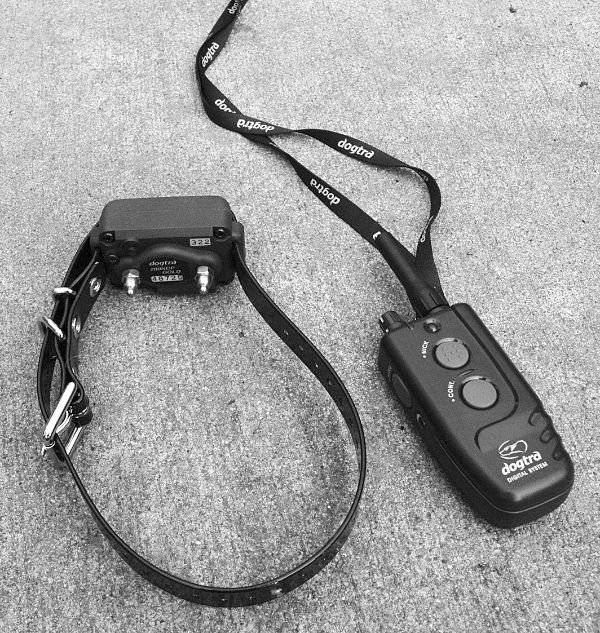
There is a trainer I know who posts a lot of short videos of her own dogs and dogs owned by clients of her board-and-train business. The dogs always look very well behaved and lots of people leave complimentary comments on these posts.
I’ve never seen a comment mentioning the shock collars that every one of the dogs wears. (Or the shock collar combined with a choke chain or pinch collar. Always the shock collar, and often the second pain-inducing collar, too.)
Again, judging by the comments, no one seems to be bothered by the subtle signs of stress and anxiety the dogs in training display. If the dog is “behaving,” the trainer never raises her voice, and the dog’s tail wags at some point, it all looks good to most people (apparently).
Now, it could be that some people DO comment or ask questions about the collars and the trainer deletes them. I would put money on a different possibility, though; I’m pretty sure that this trainer so thoroughly believes in and relies upon the collars that if someone DID comment, she would strongly defend their use.
Quick-fix methods can be seductive, but…
In general, I try to keep WDJ as free as possible from negative appraisals of training techniques and gear that we don’t support. I’d rather that we talk about the many reasons we advocate for the techniques and gear that we love. But I worry sometimes that many people can’t tell the difference between what we would call dog-friendly training and training that’s focused on quick, telegenic results.
I know that quick-fix methods are seductive: “I sent her an unmanageable dog who barked at the door, jumped on everyone, and couldn’t be walked on leash, and two weeks later, now look at him! He’s calm and I can walk him without being dragged down the street!”
But my question is, at what cost? What was that dog’s total experience? A dramatic transformation does not happen that quickly without a certain amount of pain and discomfort and lack of initial comprehension.
Note that I’m not talking about the use of a shock collar to deal with a specific behavior that the owner or training has been unable to stop in any other way, something that may well shorten the life of the dog if the behavior is unchecked, such as taking off after animals (not responding to a recall cue off-leash) or failing to respond to a “leave it” cue in rattlesnake country. That’s a separate debate we could have. But what I’m talking about here is the use of a shock collar to teach dogs to perform every sort of sit, down, stay, come, go to your bed, every-day type of behaviors – the same behaviors we can teach 8-week-old puppies to do on cue with a handful of cookies.
Now, I have to add that this trainer is skilled and experienced. I don’t see the kind of obvious fear that an unskilled force-based trainer induces in his clients’ dogs – the videos posted on social media don’t show dogs who are overtly cringing or flinching. They do show dogs who display more subtle signs of stress: licking their lips, ears back, tucked tails, yawning. In a few videos, it takes a sharp eye, but you can see the reaction a few dogs make when they have hesitated to perform the requested behavior and are being shocked: a long blink or a momentary grimace before they perform the behavior they have been asked for. You can see it, but only if you know what to look for.
I bet her clients are genuinely happy with the results – pleased to discover that their dogs are capable of being calm and compliant and have learned a few behaviors on cue.
Dangers of using shock collars
There is no denying that in the hands of an experienced trainer – an even-tempered person with superior skills at observing body language and good timing – collars that shock or apply painful pressure to the dog’s neck can teach a dog to perform certain behaviors (in order not to suffer a painful consequence) in fairly short order, and without the appearance of violence. But this sort of training is anathema to me, and to most “positive only” trainers, for many reasons. Here are just a few:
- Training methods that use pain can emotionally scar some dogs. Dogs may learn to perform certain behaviors in order to avoid pain, but many lose trust and interest in having a loving relationship with humans.
- There are certain dogs who respond to pain with aggression. You can’t always predict which dogs this will be, but the odds are higher with dogs who are fearful and those who possess more than the average amount of self-preservation instincts. I would argue that from their point of view this constitutes simple self-defense. But the pain-based trainer will respond to the dog’s aggression with greater and greater pain, because if the dog’s aggression successfully (from the dog’s view) ends the training session, the trainer will fail, so the trainer will feel compelled to increase the pain until the dog “submits.” Unfortunately, if the dog’s aggression escalates enough, at some point the trainer is likely to inform the owner that the dog is dangerous and defective and the dog usually ends up dead – euthanized for behavior that was introduced in response to the training method.
- While the trainer might have good timing, observation skills, and judgment, few owners do. When the dog is sent home with his new shock collar and the remote control is now in the hands of his much-less experienced owner, it’s inevitable that the collar will be activated at inappropriate times: when the dog tried to do the wanted behavior but the owner didn’t recognize it as such, after the dog had stopped doing the unwanted behavior but the owner’s timing was delayed, when the owner is angry at the dog for perceived misbehavior, and so on. As the “corrections” make less and less sense to the dog, and he fails to clearly see what behaviors work to stop the pain and which don’t, his “training” will deteriorate – and so will the relationship between the dog and his owner.
In my view, the introduction of a button that is pressed to cause discomfort that will increase compliance from another living being – just this, alone – would indicate to me that the button-presser should spend his or her time with a stuffed or electronic toy dog rather than a thinking, feeling being of another species.
Again, I don’t like to discuss training methods that we would never promote, but I’m not sure that novice dog people are ever told about the potential for harm that quick-fix tools like shock collars can cause. And when a dog owner with an unruly dog sees the “before and after” videos, many happily sign on, without being informed about the potential for fallout. They probably haven’t been told up front that the dog’s seeming calmness and compliance comes with a remote control – one that they will have to learn to utilize in order to maintain those behaviors. Were they asked if they are willing to continue to hurt their dogs into the indefinite future? Or have their dogs learn to associate them with the pain?
The goal of the kind of dog training we describe in WDJ – dog-friendly training, positive-reinforcement-based training, fear-free training, call it whatever you want – is to cultivate communication with and cooperation from our dogs, not just assert control through superior strength or power. Communication and cooperation with other beings is most soundly built on a foundation of mutual comprehension – and this takes a little bit of time! But if the process of learning about each other is rewarding and enjoyable for both parties (canine and human), the bond between them will be strong, even if communication breaks down at times.
Let’s talk about it
*Please note that this place on the WDJ website – the blog spot – is where my personal thoughts are posted. The word “blog” is short for “web log”; it came into being to describe the sort of sites that were devoted to journaling and other personal posts. This isn’t an “article” about the evils of shock collars; it’s where I am trying to work out my personal discomfort with both the use of the tools and the general public’s seeming inability to detect or understand the potential for quite serious fallout from their use and misuse.
Trainers: Do you have personal experience with using shock collars for training garden-variety behaviors? (Let’s confine the discussion to this.) Do you have experience working with dogs who were shocked by different trainers or owners before you were consulted? If so, what can you tell us about these experiences?
Owners: Have you paid someone to train your dog with one of these devices? Were you told up-front that a shock collar would be used on your dog? What has your experience been? Has your dog seemed different in any way?




Thank you for your reasoned thoughts on this. As a trainer, I have indeed encountered your observations about dogs trained to perform behaviors with shock collars that really are equally well trained (in terms of getting the performance of the behavior) but force- and pain-free methods. Of course there have been dogs who are overtly stressed, but there are also dogs that exhibit more subtle signs, especially if they were trained skillfully. One of the biggest challenges I find is helping these dogs learn how to learn again, especially for complex behaviors. Typically shock teaches a bit by process of elimination, by punishing wrong choices in hopes of making the correct choice clear. Personally I find being very specific about WHAT exactly the correct choice is. communicating that effectively, and reinforcing it to the exclusion of alternatives is a faster option (and of course less risk of fall out). It can be difficult to get dogs trained on ecollars for simple behaviors to offer up or exhibit novel behaviors we try to train because they seem to hesitate that and stress that they risk being wrong, and being wrong hurts in their experience. Knowing the debilitating effects of chronic, low-grade stress in humans (not to mention high-grade!), I am convinced any perceived trade-offs in speed of acquisition or reliability are not worth the costs. As a breeder of gun dogs, I can also say my European husband notices significant costs in ecollar trained behaviors where they are not needed. An example is pointing dogs. Pointing is in large part an instinctual behavior pattern based in genetics. We can actually observe this behavior being seemingly disturbed when we ecollars are used to train steadiness in the face of flushing birds or gunfire. Dogs lose focus on the bird and a pointing stand to opt for warily eyeballing the trainer and in worst cases cowering (which seems to me to have contributed to the myth in the USA that pointing dogs shouldn’t be taught to sit!). While there may be a role for life safety issues for skillful ecollar use, it seems to me that concern and caution is well-warranted for the vast majority of training. With recent studies demonstrating that shock in particular can cause inheritance of debilitatingly maladaptive traits such as fear in a single generation (Dias and Ressler 2013), it seems to me increasingly clear shock has limited to no use or place in 99% of training from a risk-benefit or canine welfare analysis.
My Aussie Doodle was a terror until he had in board training at the age of 10 months. I too never liked the thought of shock collars but when I saw the outcome it was amazing. At Vinny’s graduation from training they taught us how to use the collar (which also has a vibration feature) and had us test it on ourselves. We went over 20 on our palms (this device goes to 100) before we stopped and probably could have gone higher but we knew Vinny was trained on the level 8 and that is were we keep it. A few times went as high as a 12 only because he was excited and very distracted while chasing a squirrel. He seems to dislike the vibration feature more than the mild shock. We rarely use the device anymore and need only to have the control in our hand for him to behave and that is also a rarity. He is a happy but still mischievous ( in a fun way) but well behaved boy (1 1/2 yoa) now. I am a true believer as long as this device is used correctly and not to used to hurt the dog.
I have the same experience as Sandi – I’ve been successfully using the collar on my rescue dog that has a very strong hunting instinct and prey drive. He’s a very happy and healthy dog who has great recall when he’s not in the thrill of the hunt. The collar acts as a reminder to pay attention to me – it breaks the spell – and he comes trotting back no worse for wear. It allows him freedom off leash (in safe places) to run and play so he’s a very fit and fulfilled guy. I’m having to use it less and less often because now he knows that if he doesn’t come after I call him twice that he’s going to get a reminder. He’s a scrappy little dog and isn’t bothered by it. So it just depends on the dog and its temperament and how you use the collar. I would never use it on my other dog who’s very sensitive (she also isn’t a hunter), or on my previous border collies who would have completely shut down emotionally. And I’m the nicest dog person you could ever meet, with happy dogs :))
I have had success with the collar as well for the same reason Shelagh explains. My first Brittany did not have the strong hunting drive that my current one has. The collar breaks the spell/the chase. I live in a mountain area and this has worked well for me. I went to a trainer for proper use of the tool and use it when not in the neighbor of off leash areas I go to. Lots of wildlife around and I want to keep my dog and the critters safe. The setting is always relatively low but he gets the message and returns to me. He is also a therapy dog at the local elementary school (prior to COVID) and so sweet.
Good article. A lot of the folks who oppose shock collars are inexperienced. They have never had a dog that needed one. I say “needed” in the sense of keeping the dog safe. A prompt recall can save a dog’s life. They should be used sparingly and with instruction. Never for house manners!
Thank you for writing this article. You mention that you try not to write about training techniques and gear that you don’t support, but i think it’s important to explain why these things are not OK, so please keep it up! Especially when aversive techniques are so widely used. Sometimes people just don’t know better, including me 10 years ago when I first got my dog. Now that I know about positive reinforcement training and the downfalls of aversive techniques, I’m so ashamed of how I trained my dog. But without knowing why something is wrong, it can be hard to convince people to change, especially when the alternative may take a lot more time and effort.
How many of you that would never use an e-collar would use an electric fence for a horse?
But, Sandi, If you are still putting the e-collar of your dog, you are still maintaining behaviours through ‘threat’ of pain. aka punishing.
That is NOT training, any more than an electric fence is training stock to stay in their paddock. You are using management.
OK – THAT reference is ridiculous! Not everyone can afford to build a wooden fence nor to use the now synthetic fences! For crying out loud, horses, and livestock arent going to stay in a pasture with no boundaries and those boundaries have to be firm enough to keep them there! And no, have never used any type of e-collar on my dogs.
The major difference is that in the electric horse fence, the animal gets the shock only when they touch the fence. They learn quickly not to touch the fence. A shock collar provides the choice to the neck and they may or may not know why it went off. We had an invisible fence, much against my wishes. My dog knew that when he was wearing his collar, he would get shocked at the boundaries. But take the collar off and he could go wherever he wanted. In my opinion, he was not trained to stay in the yard, he was trained to avoid a shock, not the same thing.
Thanks for your post. I have never used these collars. Would I? The key words to me are absolute last resort in a life or death situation. I feel fortunate that so far, I haven’t come to this situation.
Will not use shock collars on my dog’s love them too much they are my babies who ever use it they are crazy!!!
At the risk of getting attacked for my opinion, I use an e-collar and I have for years on all of my dogs. If you use it properly you are not “shocking” or “punishing” the dog. In fact, I can’t remember the last time I used the stimulation mode. I use the vibrate mode and the tone signal. You need to understand that in many cases, with hunting dogs, their life depends on being trained efficiently enough to leave a bird and come back upon command. This is what retrievers were born to do, retrieve. And for them to be in the moment, it’s often hard for them to switch gears and turn off the adrenaline rush and leave the bird without a reminder of what their job is. In a field with humans and guns, it is much more important they obey then if you are at a park. So I believe you have to consider the application. I read the article and understood it to be in reference to simple, everyday obedience training. In which case, no, you should not shock your dog for not sitting! I do, however, have the e-collar on my dog at all times. And I would be happy to show you a video of how excited they are in the morning to put the collars on because they know we are going to go something fun. (In this case it is just them going to work with me – but still fun for them). They are not cowering or stressed.
I am in total agreement with you! I also have hunting dogs and my dogs are excited when their e-collars come out. We use them daily on our field runs and when training. I look at them as an extension of the leash and their safety.
I am perpetually worried as to WHY people want to make a dog go out ‘hunting”.
On the other hand people who get their jollies by killing other animals probably do not really consider their dogs’ feelings at all — just so long as they behave like as well adjusted robot and do as asked.
You don’t “make” a dog bred to hunt go out hunting-it’s what they are hardwired to do! They follow their instincts, doing what dogs have traditionally done for their humans for very long time. Shock collars are commonly used as training tools in the hunting world.Like any tool, they can be misused. Like others have said, dogs are thrilled to be outfitted in what they consider their adventure gear, they are not fearful.
So then , since it is what they do, why do you ever NEED a shock collar?????
I can’t understand people who consider it evil to use e-collars to correct a negative behavior but think it is fine to kill the poor dog instead.
Put a shock collar on yourself, wife (husband) and kids and see how everyone likes it. If you use one, then YOU don’t know how to train. Remember: mankind is king of beasts, his brutality exceeds theirs.
I agree with you about the dangers of shock collars, but there are some extreme cases where they may be a last resort when it comes to keeping the dog and others safe. We had exhausted every training method and diligently worked with three trainers and still we had a rescue with severe fear aggression, while an absolute dream dog with us and small children, he would rage and attack other dogs and men. Finally, after a dog attack, we were faced with the real possibility that we had to do the responsible thing and put him down. It was heartbreaking. But then we found a compassionate trainer that suggested we allow him to train him for three weeks with a shock collar. His training sessions were filmed and we watched an amazing transformation. I truly believed that our dog learned that so long as he was with us/the trainer and following recall, sit, down commands, he was safe. In other words, while engaged with us, there was no need to attack. Our dogs entire demeanor has shifted and while he’s not perfect and we still must be responsible and diligent, we can recall him if he chases and put him in a calm sit/down when we encounter another dog. Prior to this he would blow up into a full blown and uncontrollable rage. I don’t “like” shock collars and hope to never have to use one again, but this was truly matter of life and death for this dog (and the safety of others) and I would hate to think what would have had to happen had we not tried this one last thing.
Shawn, I witnessed the same transformational response in a dog which had fear aggression. The shock collar made all the difference.
Many thanks for sharing your story. I was headed to put my dog down. I’ve had him since a pup for 7 years. I lived alone until I married last year. My husband has 2 dogs and 3 teenagers. My dog has not adjusted at all. He bit my oldest step daughter. A slight nip but a completely unexpected behavior. Then because he has keen interest to dominate the other male dog my husband moved separate them and yanked my dog when he failed to listen. My dog reacted and bit him. He needed 5 stitches. Months later we are exhausted and at wits end. Much attention was given to keeping the dogs separated, and keeping my dog under close supervision as the kids enter and leave the house. All 3 dogs bark when anyone enters or leaves. My dog is the most aggressive and jumps. He displayed none of these behavior prior to the drastic changes in our environment and we have taken this into account. I can’t allow him to harm another person, and I don’t profess to be a dog whisper. The shock collar will be our last attempt before he is put down. This was the hardest decision I’ve ever had to make.