

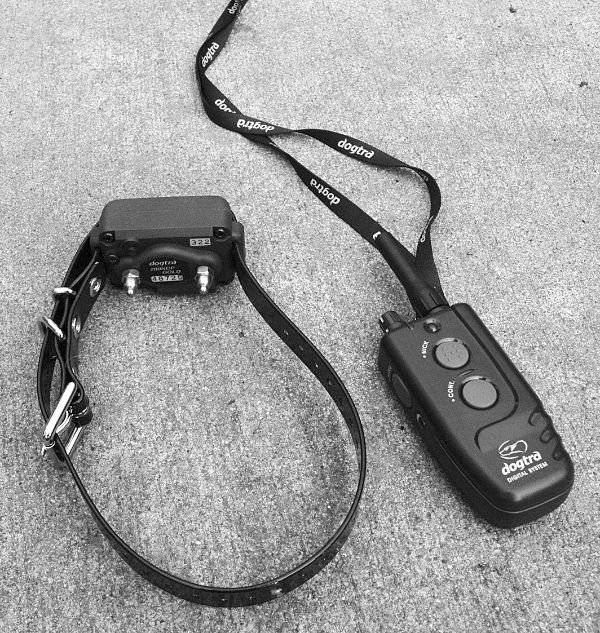
There is a trainer I know who posts a lot of short videos of her own dogs and dogs owned by clients of her board-and-train business. The dogs always look very well behaved and lots of people leave complimentary comments on these posts.
I’ve never seen a comment mentioning the shock collars that every one of the dogs wears. (Or the shock collar combined with a choke chain or pinch collar. Always the shock collar, and often the second pain-inducing collar, too.)
Again, judging by the comments, no one seems to be bothered by the subtle signs of stress and anxiety the dogs in training display. If the dog is “behaving,” the trainer never raises her voice, and the dog’s tail wags at some point, it all looks good to most people (apparently).
Now, it could be that some people DO comment or ask questions about the collars and the trainer deletes them. I would put money on a different possibility, though; I’m pretty sure that this trainer so thoroughly believes in and relies upon the collars that if someone DID comment, she would strongly defend their use.
Quick-fix methods can be seductive, but…
In general, I try to keep WDJ as free as possible from negative appraisals of training techniques and gear that we don’t support. I’d rather that we talk about the many reasons we advocate for the techniques and gear that we love. But I worry sometimes that many people can’t tell the difference between what we would call dog-friendly training and training that’s focused on quick, telegenic results.
I know that quick-fix methods are seductive: “I sent her an unmanageable dog who barked at the door, jumped on everyone, and couldn’t be walked on leash, and two weeks later, now look at him! He’s calm and I can walk him without being dragged down the street!”
But my question is, at what cost? What was that dog’s total experience? A dramatic transformation does not happen that quickly without a certain amount of pain and discomfort and lack of initial comprehension.
Note that I’m not talking about the use of a shock collar to deal with a specific behavior that the owner or training has been unable to stop in any other way, something that may well shorten the life of the dog if the behavior is unchecked, such as taking off after animals (not responding to a recall cue off-leash) or failing to respond to a “leave it” cue in rattlesnake country. That’s a separate debate we could have. But what I’m talking about here is the use of a shock collar to teach dogs to perform every sort of sit, down, stay, come, go to your bed, every-day type of behaviors – the same behaviors we can teach 8-week-old puppies to do on cue with a handful of cookies.
Now, I have to add that this trainer is skilled and experienced. I don’t see the kind of obvious fear that an unskilled force-based trainer induces in his clients’ dogs – the videos posted on social media don’t show dogs who are overtly cringing or flinching. They do show dogs who display more subtle signs of stress: licking their lips, ears back, tucked tails, yawning. In a few videos, it takes a sharp eye, but you can see the reaction a few dogs make when they have hesitated to perform the requested behavior and are being shocked: a long blink or a momentary grimace before they perform the behavior they have been asked for. You can see it, but only if you know what to look for.
I bet her clients are genuinely happy with the results – pleased to discover that their dogs are capable of being calm and compliant and have learned a few behaviors on cue.
Dangers of using shock collars
There is no denying that in the hands of an experienced trainer – an even-tempered person with superior skills at observing body language and good timing – collars that shock or apply painful pressure to the dog’s neck can teach a dog to perform certain behaviors (in order not to suffer a painful consequence) in fairly short order, and without the appearance of violence. But this sort of training is anathema to me, and to most “positive only” trainers, for many reasons. Here are just a few:
- Training methods that use pain can emotionally scar some dogs. Dogs may learn to perform certain behaviors in order to avoid pain, but many lose trust and interest in having a loving relationship with humans.
- There are certain dogs who respond to pain with aggression. You can’t always predict which dogs this will be, but the odds are higher with dogs who are fearful and those who possess more than the average amount of self-preservation instincts. I would argue that from their point of view this constitutes simple self-defense. But the pain-based trainer will respond to the dog’s aggression with greater and greater pain, because if the dog’s aggression successfully (from the dog’s view) ends the training session, the trainer will fail, so the trainer will feel compelled to increase the pain until the dog “submits.” Unfortunately, if the dog’s aggression escalates enough, at some point the trainer is likely to inform the owner that the dog is dangerous and defective and the dog usually ends up dead – euthanized for behavior that was introduced in response to the training method.
- While the trainer might have good timing, observation skills, and judgment, few owners do. When the dog is sent home with his new shock collar and the remote control is now in the hands of his much-less experienced owner, it’s inevitable that the collar will be activated at inappropriate times: when the dog tried to do the wanted behavior but the owner didn’t recognize it as such, after the dog had stopped doing the unwanted behavior but the owner’s timing was delayed, when the owner is angry at the dog for perceived misbehavior, and so on. As the “corrections” make less and less sense to the dog, and he fails to clearly see what behaviors work to stop the pain and which don’t, his “training” will deteriorate – and so will the relationship between the dog and his owner.
In my view, the introduction of a button that is pressed to cause discomfort that will increase compliance from another living being – just this, alone – would indicate to me that the button-presser should spend his or her time with a stuffed or electronic toy dog rather than a thinking, feeling being of another species.
Again, I don’t like to discuss training methods that we would never promote, but I’m not sure that novice dog people are ever told about the potential for harm that quick-fix tools like shock collars can cause. And when a dog owner with an unruly dog sees the “before and after” videos, many happily sign on, without being informed about the potential for fallout. They probably haven’t been told up front that the dog’s seeming calmness and compliance comes with a remote control – one that they will have to learn to utilize in order to maintain those behaviors. Were they asked if they are willing to continue to hurt their dogs into the indefinite future? Or have their dogs learn to associate them with the pain?
The goal of the kind of dog training we describe in WDJ – dog-friendly training, positive-reinforcement-based training, fear-free training, call it whatever you want – is to cultivate communication with and cooperation from our dogs, not just assert control through superior strength or power. Communication and cooperation with other beings is most soundly built on a foundation of mutual comprehension – and this takes a little bit of time! But if the process of learning about each other is rewarding and enjoyable for both parties (canine and human), the bond between them will be strong, even if communication breaks down at times.
Let’s talk about it
*Please note that this place on the WDJ website – the blog spot – is where my personal thoughts are posted. The word “blog” is short for “web log”; it came into being to describe the sort of sites that were devoted to journaling and other personal posts. This isn’t an “article” about the evils of shock collars; it’s where I am trying to work out my personal discomfort with both the use of the tools and the general public’s seeming inability to detect or understand the potential for quite serious fallout from their use and misuse.
Trainers: Do you have personal experience with using shock collars for training garden-variety behaviors? (Let’s confine the discussion to this.) Do you have experience working with dogs who were shocked by different trainers or owners before you were consulted? If so, what can you tell us about these experiences?
Owners: Have you paid someone to train your dog with one of these devices? Were you told up-front that a shock collar would be used on your dog? What has your experience been? Has your dog seemed different in any way?




Isn’t it amazing how people love to call shock collars by some other name — ecollar, stim collar, remote trainer, etc.
I have worked with many dogs that had been previously been trained with a shock collar. The fallout I see most often is fear and unintentional associations that often manifest in shows of aggression. I recently worked with a dog that had associated the discomfort of the shock with a neighbor and the previously friendly, boisterous dog began to aggress towards the neighbor. I am strongly against them.
I have not used and would never use a shock collar for training. I was surprised to learn that my sister and Brother-in-law did when she got their first dog (to train basic commands as a puppy).
Their dog still displays classic perpetual anxiety and her symptoms are severe (jumps back to heed a command, tail tucked, yawns, licks lips, separation anxiety, submits on her back almost immediately when she comes near a human, and is fearful of dogs she doesn’t know- literally scrambling under something to get away if the dog wishes to play or even sniff). She does listen to any human, though, as you said. Unfortunately, they just tell strangers she is a „big baby“ and sing her praises to everyone for being „well-behaved“.
There is a reason why shock collars and fences (for training and otherwise) are illegal in most European countries.
I admit I was given advice after I rescued an adult dog who pulled at the start of pur walks to get a pinch collar. I did but after a short time I decided put it on to understand the experience and I felt like I was choking -even though only briefly if done with a quick release afterwards as intended. That was the end for us. I felt horrible knowing that I was not simply giving a poke to get her attention but literally constraining her breathing for a short time. Fortunately, I turned back to positive training techniques like those you promote and I did with my first puppy. It worked well. Soon thereafter I learned of your magazine and was forever grateful.
Until we learn otherwise, we are owners sometimes take bad advice based on others‘ experiences. So, thanks for all you do to educate us. I wish we would ban their use in the US but I doubt that will happen.
THANK YOU for posting. Shock collars/ecollar are the same thing- work on the basis of positive punishment.
People need to know that 99% of behaviors can be solved using positive reinforcement.
Thanks for posting such a well-written analysis of how the use of quick-fix shock collars is devoid of the relationship-buidling aspect that makes training a dog so meaningful. There are many force-free methods for teaching a dog not to jump and bark that also build their confidence about how to behave around humans that it’s hard for me to imagine why anyone would use aversive methods at all. The use of force and pain is never necessary in dog training, and the general public just has no clue that shock collars are archaic and cruel. In my opinion, if a person cannot take the time to train their own dog, then maybe they should get a pet who requires less attention! In Switzerland, people have to take a compulsory training course before getting a dog to learn about their care and training, and I think this is necessary in the US considering how many dogs get abandoned at shelters when people realize how much of a commitment having one entails.
I agree. I think there should be compulsory training before anyone can get a licence to have a dog. It would be so much better for the dogs.
As for working with dogs that have been trained with a shock collar, yes, sadly I have worked with many. Most are fearful and shut down, afraid to do *anything*. Doing nothing may look like the dog is behaving, but it’s not. The dog does nothing because doing *something* might get them shocked.
If a professional dog trainer needs a shock collar to teach sit, down, stay, come, and go to your bed then they were probably fired from their burger flipping job.
I have an uber reactive 82 lb Black German Shepherd who, unbeknownst to me when I bought her, has a HEAVY working line pedigree. She’s my first GSD and I didn’t “know better” when I bought her. ALWAYS check that pedigree! My girl got between me and anyone else at 12 weeks old and would growl. Cute then…now, not so much. BUT, I trained her with the help of a trainer who trained me. That’s what ultimately works. It creates a bond between you and your dog. Having someone else train a dog doesn’t give you that bond that training together does. My dog is still reactive in certain situations, but I have also learned her triggers and her “tells”. She just turned 4 and I can’t imagine my life without her. I opted NOT to train her with fear. A fearful dog can be a very dangerous dog. We were in obedience classes for 4 months and practiced daily. I feel like if you’re not willing to invest the time, you should get a cat or a pet rock. I was fortunate enough to find a trainer that trained until he was comfortable that we had control of our dogs and knew what to do. I live alone so having a dog that looks and sounds like she’d take your throat out isn’t a bad thing. She did get out of the door once when I was talking to someone in the front yard and charged the man and his older, overweight Black GSD. However, as fierce as she looked and sounded, she didn’t touch either one of them and I wrangled her back into the house (she wears a collar now when I’m home JUST in case) and when we got inside she was fully aware that she did something that was undesirable to me. She’s never known a harsh word or a hard hand. She was trained with food and praise and even at 4 years old, we still run drills for about 5 minutes every day. Heel, sit, down, come…its a game for her and she gets a little pinch of a yummy treat and lots of “good girl” from me. I personally don’t believe instilling fear in a dog is a good method of training. It may “work” for some people, but to what end? I don’t have a nervous dog or a dog that fears every time we put on her collar or harness to go for a walk. If I see something that I know will trigger her, we move an appropriate distance away and when she doesn’t react, she hears “good girl!!” Surprising what a little love will do.
Thank you for sharing your story!
We adopted a (somewhat) reactive GSD&Husky mix from a shelter a year ago and still going through some tough time trying to get her not to react as much.
She is our world. She is the sweetest. We work with her for whatever her past we did not know and try to keep her as calm and safe as possible. We live in an apartment and there are dogs everywhere. She growls and lounges at them sometimes even if they are across the street. We are in the process of working to get her attention when other dogs are near. It is hard. It works sometimes. But I will never add more fear to hear by using a shock collar. I see the progress. It is slow, but every day and every situation is different and I am just so proud of her.
Love this! Thank you for sharing!
This reply is such a pleasure to read, I was reading an article recently that in the fifties experts were given the task of placing Dog breeds in categories. The experts placed the German Shepherd Dog in the fearful group, Germany rejuvenated the decision stating that nothing coming from Germany is fearful. Having Herman Shepherds for many years including a working line, I definately would agree they are are very sensitive breed.
I have never used a shock collar on any of my dogs. I have used in a beeping bark collar briefly on one dog. We only used it for a few days and then we took the battery out. It’s association still kept my dog’s bark level down.
I do not believe in negative training. To me if a dog is being sent home with a shock collar, there should be a requirement that the owner has to put the same collar on their neck and be shocked. Possibly to even work for a whole day and be corrected for different things.
I do understand though where a shock collar would come in handy for the recall. A friend of mine lives in a cul-de-sac right off is very busy street and her dog occasionally gets out and runs straight for the street. I can see how a shock collar would help get her dog’s attention.
There is room for subtlety in this part of the discussion, but in general I would tend to look at things like this as follows: Why would I punish a dog for my failure to train it properly, or for my failure to keep it safe while training is in process? Maybe I deserve the collar, and the dog the button.
And practically speaking, keeping the batteries charged and the transmitter turned on and in the right hands to do the stopping is likely to fail. If I can go to that much fuss, I can more kindly and easily clip on a leash or long line before opening a door for gate. If the dog is just escaping, the squeal of tires will (probably, hopefully) be heard before the button sitting on the “where did my husband put that damn thing this time?” is located and activated. And there’s still no guarantee it’ll stop the dog. Many bolt faster when surprised by the nip at their necks.
Ask a municipal shelter worker. Lots of strays come in wearing shock collars.
KimberlyO, I have used electronic collars for 15 years and probably not recommend an e-collar for your neighbor’s dog. The reason being that they probably wouldn’t pay any more attention to proper use of the collar than they do keeping the dog on their property.
A second fence, a baby gate at the door, a double gate if they leave a front gate ajar…these would be much better. If a dog hasn’t had tons if practice for a good long time with a skilled E collar user, giving the dog a correction at the wrong time or level could cause the dog to run even faster in the direction it’s going to get away from the discomfort. Some dogs will just ignore the stimulation and go chase whatever it is they are after.
I always recommend preventative measures and lots if recall practice, boundary training, waiting at doors etc over an e-collar and only train a dog for an e-collar if I think the owner is responsible enough to use it properly and practice sufficiently.
Lauren, for a true breakdown, Leerburg has some interviews/discussions on YouTube. Basically, an e-collar is still technically a shock collar. But that’s like saying the giant bricks people used to carry as a brief case is a cell phone. The good modern e-collar has levels so low that humans and many dogs don’t even feel them, and a wide range of levels so that they can be fine tuned to each dog. Most good e-collar training uses these extremely low levels and dogs are *taught* that it means something, it’s not a random painful thing that is just blasted on your dog.
If your dog is happy and healthy and you find yourself using that button less and less (the goal is to not need to push it) then trust yourself and your dog.
I would never use one of those horrible devices on my dog and here’s why – I had an acquaintance who, as a joke, put her dog’s shock collar on. The ensuing shock knocked her on her butt. Not something I would ever think about doing to my dog!
I’m an owner. We sent our dog to a trainer for e-collar conditioning and behavioral training. I’m hesitant to reply with any greater detail until I understand your use of the term “shock collar,” as opposed to an e-collar because the two are very different things.
We “sent” our dog….that says it all. E collar is great marketing for a pain inducing device to train. Don’t fool yourself
You are correct, Lauren. Shock collars and e-collars are completely different things. E-collars are typically given out by a veterinarian to keep a dog from biting, licking, chewing at areas on the body that need to heal. Shock collars (often renamed a host of other “softer” names to make them sound less invasive (e-collar, stim unit, stim collar) but are, in fact, all still shock collars if they emit an electrical static shock to the dog.
SI have a bachelor’s degree in animal science and behavior and your pure positive bullshit does not work I’m gonna hand you my Belgium🇧🇪 and you use all your freaking hot dogs and your gentle leaders be my guest and try to get that dog to even come near you without ripping your juggler out..
Just saying good luck I got 2 of those I have a lab who is a service dog but who also does protection and bite work and will bite the shit out of you too and I use E collar on every single one of my dogs my client’s dogs I have been in business for over 30 years and I have never had any problems when you know how to iutilize what’s called an E color not a shock color so that tells me you have no education in an E collar category you need to come to my class and learn about it and stop writing bullshit articles like this that are not factual…
I’ll call you out on your BA due to lack of punctuation and sentence structure. And it’s Belgian, not Belgium — which is a country, not a dog.
There are collars that emit a static shock and newer collars that emit electrical impulses directly to nerves/muscles. This type of electrical stimulation is used therapeutically by physical therapists, chiropractors, etc. This has become a selling point for the collars—because it’s used for healing, it can’t be bad.
But if you’re using it to punish or negatively reinforce behavior and you get the desired behavioral change, by definition the electrical stimulus is aversive. It is something that causes the dog enough discomfort (pain and/or fear) that it is willing to alter its behavior to end or avoid the electrical impulses.
If you’ve ever used a TENS unit (sane technology), you know that it will cause painful stinging and very uncomfortable muscle contractions at a high level of stimulation. This is what the collars do to the dog’s neck
“If you’ve ever used a TENS unit (sane technology), you know that it will cause painful stinging and very uncomfortable muscle contractions at a high level of stimulation.”
I have used a TENS unit and they can be quite uncomfortable. I can’t imagine getting the shock (and yes, it is a shock) they create unexpectedly.
I’m disgusted by people who try to use deceptive terms and justifications for using this clearly aversive method.
E-collars work as a form of negative reinforcement, so it means that a behavior is strengthened by removing a negative outcome. Even a vibration can cause a stress response and cause shock to a dog. It’s a tool used by trainers who haven’t studied modern Canine Science and haven’t got the skills to train dogs using their brain and natural behaviours. Equipment should never replace training and more often than not, quick fixes like this are detrimental to the dog and cause long term damage.
E-collars are the same thing as a shock collar.
I am in need of some advice. I have a 7 month old, high drive, large mut whonis the sweetest thing and I have managed to train her with all the basics (i.e. sit, stay, lay down, leave it, come, etc). She is a first time listener when she is in home, in her element. However, we own a farm and she has an affinity for the geese and chickens. We’ve had her since 8 weeks old and it’s something that we’re still struggling with. She takes after them, chasing until she gets to them, at which point she will kill. She’s gotten to one and killed it. I’ve tried clicker, 30 ft long leads (this is currently what I have her on with me when we’re outside…. I can’t take more chances), regular leash, cooked meat as a distracting treat, you name it! She WON’T LISTEN, tunnel vision. I don’t see the point in muzzling her while off leash as this doesn’t help with the chasing aspect of it. Our yard is not fenced and juts up to a 4 lane highway, I fear that one day she will chase after a chicken and go right into harm’s way. I would hate to have to keep her on leash her whole life.
Without judgement, I would love some advice on a training method that may work for this specific behavior.
I have free range birds too..all of my dogs are “prey driven” dogs..and I am not saying given a chance to go after neighbours chickens ( if left to their own devices, which they are not of course) but with our birds, they know they are “off limits”, I did this humanely, every single day from a puppy, they were on leash and did “chicken chores” with me. They came out to feed and put them away last thing at night. They were allowed to look but not touch, I had them tethered around my birds while I was there. If they responded negatively towards the birds, they were told to “leave it”..stern voice..I did this until I thought they were ready to be “off leash” around them. this has worked for all of my dogs over the years. Would I leave me dogs alone with my birds? no, they are still dogs/animals and birds move quickly..but my dogs are off leash with me and my birds now trust my dogs..so there is no excited flapping.
Lauren, for a true breakdown, Leerburg has some interviews/discussions on YouTube. Basically, an e-collar is still technically a shock collar. But that’s like saying the giant bricks people used to carry as a brief case is a cell phone. The good modern e-collar has levels so low that humans and many dogs don’t even feel them, and a wide range of levels so that they can be fine tuned to each dog. Most good e-collar training uses these extremely low levels and dogs are *taught* that it means something, it’s not a random painful thing that is just blasted on your dog.
If your dog is happy and healthy and you find yourself using that button less and less (the goal is to not need to push it) then trust yourself and your dog.
Well said. Good explanation.
There are multiple levels and many types of stimulus on an e-collar/shock collars. Some vibrate, some beep, and some give an electrical stimulus that if turned up to “high” can feel like an electrical shock. Some lower levels can barely be felt. There are also people that know how to use these collars and those that don’t.
I find it interesting that this blog was introduced as wanting to hear other opinions (maybe the positive part?) of the use of e-collars. Even though the author stated she herself didn’t believe in the use of them, I still thought there may be some interesting/polite input. But, after reading these posts, most people are pretty quick to condemn “anyone” that ever used an e-collar! I sure don’t feel like “jumping in” with my e-collar training opinions.
I don’t think many of the commenters understand current e collar training.
Please explain the difference in detail.
They are exactly the same, just trying to hide with a new name.
EXACTLY. Use of the word “shock collar” demonstrates such ignorance it’s hard to take these concerns seriously.
Something that vibrates is not the same as a shock. I do not use one but, I do know that pain is not the way to train any animal.
Agree. I’ve used TENS devices before on areas that needed recovery, back and leg muscles. Now common sense will tell you setting the device to the upper levels will absolutely produce a painful effect on the body. But that pain is just nerve sensation impulses. It is painful though. Using the device on the lower levels produces sensations like tingling, tickling, and uncomfortable sensations that could border on pain feelings. But regardless, it works on healing that specific area.
An e collar in the hands of someone not educated on it could create painful sensations for a dog just like the upper levels on a TENS device. Lower levels on an e collar produce a very mild sensation when tried on yourself. I’ve used it to the point where I started to feel what I’d call too much pain. Just like the TENS unit. It’s the same idea. In fact using an e collar on the lowest level that the dog will feel will produce a safe conditioning effect. Again however, it has to be used in the right circumstances, the right time, and with clear cut vocal commands. The device simply reinforces what is being trained. The collar is not meant to be the main device for “punishment” or create a feeling with the dog that it’s primarily for the sake of punishment and not education training for the dog. I believe the collar is not right for every dog and every situation. More aggressive and uncontrollable dogs especially in situations that endanger themselves or their handlers could benefit from this. Simply as a means to refocus and regain control of the situation. And the word control is not negative when considering the chance of leaving the dog as is and using “traditional” methods that show no progress and improvement while the dog continues to lunge, react and is aggressive and predatory outside when encountering squirrels or something.
One other thing I just want to address. We hear it over and over, that the “pressure” is like a Tens and having tried it on ourselves we know what it feels like. The problem with this analogy, is, we are not dogs? we do know that dogs are very stoic and do not show pain like humans do, so are you being deceived into thinking that the dog only feels a little ‘tingle”? Most people put he collar on their forearm. this is nothing like a neck with all the nerves and other anatomy of the dog depending on where it is put. I suggest you put the collar around your neck tight, then turn it up to a “working” level. What is that? all depends on how each dog can tolerate it..see how high you can turn your dial before you cannot take it anymore. Also, just another thought here, Tens machines are not strapped around the from or rarely on your neck at all, because of large blood vessels ( major) and your C spine..
They are the same collars..it is like saying “Choke” chain vs “Check” chain. It is an e collar that is used to control dog’s behaviours. The dogs are given a “shock” or “stim” if you would prefer, it is just different words for the same thing.
If you need a shock collar to train a dog to sit, down, stay, come, and go to your bed you really suck as a dog trainer.
Yep!
If I ever had a dog that ‘needed’ any device to administer an electric impulse to its skin. I would have that poor dog put out of its misery.
PS Electric shock collars do NOT train — they are used to control. There are other more humans ways to control a dog.
If you dogs has a behaviour problems caused by traumatic brain injury, either help it with medications or help it out of its misery.
I am very glad to live in an enlighten State in an enlightened County that bans these things
I worked for a trainer who used shock (or “stim”) on a R- /P+ basis. She really didn’t understand the tool she used or how operant conditioning works, and couldn’t recognize even obvious displaced behavior from the dogs. In her mind, the dogs enjoyed the challenge of turning off the collar. She felt she was saving lives by training dogs and fixing behavioral problems. And she made big money doing this, her clients love her and are willing to spend thousands of dollars on it. I quit after 3 weeks, it was too sad.
I think a lot of shock collar trainers have the attitude of “the end justifies the means.” From what I’ve seen, a lot of that is tempered with a lack of understanding or a want of lack of understandung of basic behavior and learning theory. It’s harder to justify the means when you can see all the stress and anxiety it causes the dog.
What about bitework? Service work? Guide work? Rescue work? Working dogs rely on these collars for cut clear communication. Not for some silly tricks.
So how do you suggest those trainers manage to train their dogs in countries where these collars are banned?
The service dog trainers I’ve known use clickers to shape behaviors, not shock collars. Same for the folks I’ve known who do search dog training withe their dogs.
Guide dogs for the blind doesn’t use shock collars…at all.
I once had a self proclaimed “expert trainer” suggest to put a prong or shock collar on my dog, I suggested he would have 5 seconds to run or I would be going to jail and his widow would be going to identify his remains
I agree! I had English bulldogs and never used shock collars. I hate them.