

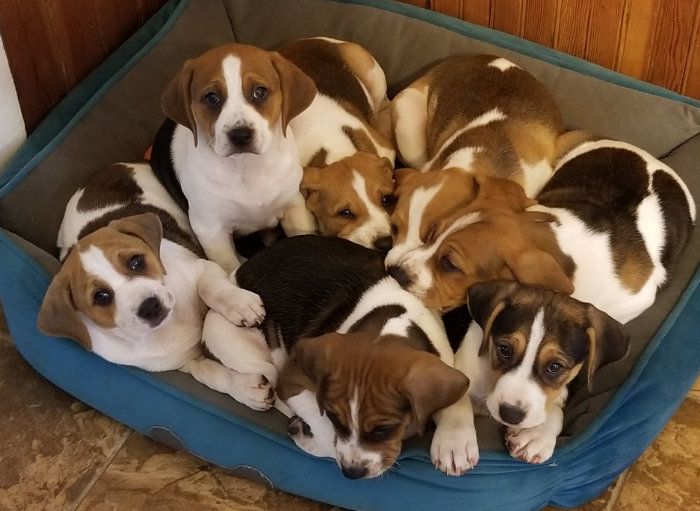
I’ve been fostering dogs and puppies for my local shelter for 15 years. Wow! Time flies – until I thought about it, I didn’t realize it had been that long.
Recently I was talking to another long-time foster provider, Kathy Callahan, trainer and author of 101 Rescue Puppies. I shared with her that, on the day I brought my most recent litter of puppies that I had been fostering for my local shelter back to the shelter to get spayed/neutered and adopted, someone who had seen me crying my eyes out over bringing the puppies back to the shelter said to me, “I could NEVER go to a shelter, it’s too sad!” Well, this snapped me out of that crying spell; I whisked over to “furious” in just a few seconds!
“Sad?!” I snorted. “I’ll tell you what’s sad: The fact that too many people would rather ‘rehome’ their intact dogs or ‘accidental’ puppies to other individuals, who fail to spay, neuter, or contain THOSE dogs, so the cycle goes on. It’s not ‘sad’ if puppies in shelters ALL get vaccinated, neutered, microchipped, and placed in a screened home, it’s SUPER HAPPY NEWS.” Whew! I was seeing RED.
I got hot again when recounting this conversation to Kathy, and fortunately she laughed wryly, completely understanding my emotional whiplash. She said, “I’ll tell you what makes ME see red…” and within the space of a few minutes, we had a Top Five Stupid Things People Say to Foster Providers.
We agreed that number 1 is this: “That puppy/dog loves you so much! You HAVE to keep him/her!” (Rebuttal: One of our most important jobs as a foster provider is to help the dog or puppy/puppies learn to love and trust humans. If they love me and the other people in my fostering circle, they should be able to learn to love and trust other humans, too. Plus, if I keep this one, my fostering days are likely over. You see, I have only so much time, money, and energy for my dogs. One more dog at home will max out one or more of those limited resources, but if this dog gets placed in a loving home after growing to an adoptable age/recovering medically/improving behaviorally, then I can help several more dogs this year!)
A close second: #2 is, “Those two dogs/puppies love each other so much! They HAVE to get adopted together!” (Rebuttal: Usually, when two puppies or dogs are super tightly bonded, this affects their ability to bond to the humans in a household. Tightly bonded pairs tend to look to each other for support, comfort, and direction, and avoid the less-familiar attention of the humans they just met. Separating them may seem harsh for a day or two, but they will almost always start to pay more attention to and seek attention and comfort from humans once they are separated. Only then can real work begin to get them socialized and happy with humans – a prerequisite for finding “forever homes.” It’s far, far more difficult to find families who will take two dogs than one, and almost impossible to find families who want two dogs who want little to do with humans.)

Number 3 is the first one that Kathy first shared with me: “I love dogs too much to foster! I would want to keep every one!” (Rebuttal: Our love for dogs is exactly why I and Kathy foster: We want to help as many dogs and puppies as possible learn the social skills they need to succeed in homes and then find good homes. The idea that someone who doesn’t foster loves dogs more than us is ridiculous. We love dogs so much that we want to see as many of them in homes as possible.)
My trainer friend Sarah Richardson, owner of The Canine Connection in Chico, California, offered #4 and #5: “You’ve put so much work and training into that dog, don’t you just want to keep him/her?” and “It seems cruel to send that dog to another home, now that he/she is so comfortable with you!”
Sarah has had some very long-term foster dogs, including one that she took on from my local shelter following an environmental disaster (the collapse of the Oroville Dam spillways). This dog was on the list to be euthanized by the shelter, likely right after all the evacuated animals were returned to the shelter – but this particular dog (and about 15 others) happened to be taken in by Sarah, who had volunteered her facility as a temporary safe space while the shelter had evacuated due to the potentially collapsed dam. The dog had massive, serious health and behavior issues – and she also loved humans with a joyful spirit that just grabbed at Sarah’s heartstrings. Sarah dedicated herself to saving this foster dog’s life, and spent literal years and thousands of dollars solving the dog’s physical and behavioral issues – and keeping her either safely away from other animals (since predation and dog-aggression were her most serious issues) and happily engaged with enriching toys and activities, to maintain her mental health.
Since Sarah has several of her own dogs, keeping a dog-aggressive dog means neither her own dogs nor the foster dog can ever be completely relaxed and comfortable – or enjoy full, free access to Sarah’s entire home. But letting the dog-aggressive dog be placed in a home with other dogs (or other small animals) sets up that dog for inevitable failure. And so it took years to find a safe, suitable, only-dog home for that dog. Anyone else would have lost hope for finding that dog a home and given up; Sarah was a superhero for holding the line at finding the dog a genuinely qualified spot, and keeping her own dogs and the foster dog as safe and happy as possible until that happened – but she did it. That dog finally found a home with people who love and appreciate her affectionate, playful, joyful spirit and perfect leash manners.

(So, the rebuttal: “When I foster, my goal is not to just get rid of the dog as quickly as possible, it’s to equip the dog with the skills and health he/she needs to succeed for the rest of her life in a home, to help find a home that can meet the dog’s unique needs, and to help the dog and the family learn to love and trust each other. When I foster dogs with significant health and/or behavior problems, accomplishing these goals can take a long time – sometimes, much longer than I had planned or hoped. But it makes no sense to settle and rush the dog into a placement that is likely to fail. And when the right adopter comes along, someone who is ready and able and excited about providing everything the dog needs, it makes all the time and money and energy worth it. And then I can go back to enjoying my own dogs full time, without guilt over the one who was euthanized because no one cared enough to put in the work she needed.”)
Do you foster? What’s the stupidest thing someone ever said to you about fostering? Or, have you inadvertently said something stupid to a foster provider? Spill it, and we can likely rebut it for you. 😊



I’ve been in rescue, volunteer Executive Director of a shelter, for twenty years. My concern is often as rescuers/fosters we forget other people are unable to draw from an experience. They base their opinions solely on emotion. What I perceived to be true twenty years ago is very different than what I see as truth today. My experiences have shaped me closer to reality.
I’ve had the luxury of accumulating years of experience that has made me see the path to animal care different from those on the sidelines. I see my job as educator for those who don’t understand.
Over the span of two decades I must say I’ve met and dealt with many angry and jaded rescue people who have done extreme damage to the world of adoption. They have alienated adopters and sent them into the waiting pockets of puppy mills or Craig’s list.
Yes, the public can be frustrating and maddening but I find more often than not they can be educated. I say take those five items and turn them around. For the ones you cannot – let it go.
I’m not fostering nor was my recent dog fostered. But I can see it as a direction I may eventually take.
My first dog, Diana pawPrints was rescued from a shelter along with her Mother and siblings and put into one of the rescue’s foster families. They did a great job. After weaning Mom was adopted out and at 8 weeks so were the puppies. They did a great job with Diana, she was socialized and up on all her vaccinations and spayed (although I now am more in favor of waiting for spaying regarding medical studies.) She was well on her way to house training, even at 8 weeks.
Freyja was rescued from the same shelter directly by me purely by luck. If she had been fostered she would have been adopted out to an appropriate family. However she was not and was returned twice for destructive behavior, the second time within 24 hours, and was red carded to be euthanized when I spotted her on their website. Diana and I drove 3 hours to pick her up. She loves people and is fine with Diana. However, she has separation issues and was likely left alone all day, which is likely the root of her destructive behavior in her two previous adoptions. When she is bored or anxious she destroys things. She was originally picked up off the street so likely survived on garbage. I have to keep my cans lids secure or she will get into the trash. I am retired and home all day and when I go out it usually isn’t for more than 2-3 hours and usually not more than once or twice a week. Once Freyja learned the routine of the house she settled. There has been no more destruction except a few things in the yard; sticks, a few cardboard boxes she managed to get into. She has learned to play from Diana and both will spend time on their beds tearing their toys apart, which is perfectly acceptable behavior. That is what they are for. Or they will chew on sticks or revisit some bones. They are each given a raw bone once a week. I like to think between the raw bones, bully sticks, chicken strips and Milk Bones she has learned that this is a pretty cool place with a human always around and it has settled her.
By adjusting to Freyja’s behaviors and preferences she has become a lovely companion. She has always been very affectionate but now she feels settled and confident. She has learned to wait until the alarm goes off before waking me up. Car rides are now fun instead of “I’m going back to the shelter.” Same with the once a month groomer. If she had been fostered so her personality and behaviors had been identified and then adopted out to a home that matched her needs she never would have been returned to the shelter or put on the short list for euthanasia. She was lucky I spotted her and was willing to drive the 3 hours to rescue her. She has no idea how lucky she is.
I have no idea what mental damage those two failed adoptions may have on her in the long run, but had she been fostered and properly matched with a family, I wouldn’t have to be doing the extra work with her, but I am more than happy to do it. She is a wonderful dog and every time I look at her I am grateful I saw her in time. She is likely to be my last dog, outliving Diana pawPrints.
I’ve thought about what I will do after Freyja is gone as I will be in my late 70s by then and a bit too old to be adopting a puppy. I have thought about fostering. I have a fenced and secure yard and while I don’t want to adopt a dog that might outlive me, fostering would allow me to still have dogs, work with them, enjoy them, until they find their forever homes. I don’t know how many years I would be fostering but I wouldn’t have to worry about leaving a dog behind after I pass. After close to 40 years living with dogs it would be difficult for me to live in such a quiet house alone. Fostering would allow me the companionship and interaction with dogs without having to make a commitment that might outlast my lifespan.
Okay, let me just start by saying right up front – some people are better at fostering and letting go than others. It makes no sense to get “red flaming angry” because another person stated what is true for them (though projected onto you) – they could not foster because they fear they might fail. Possibly because they know they would love too deeply to let go or maybe their own insecurities make them believe they would fail the dog. Whatever the reason, wouldn’t it be better to educate rather than get up on a soapbox and condeem?
I have adopted most of my dogs from shelters in the past and taken in some sad cases over the years. Yet each dog, with proper care, understanding, training and love, became a wonderful companion. Now for the last 10 years, thanks to meeting a breeder by chance, I have adopted giant hounds.. At first I worried that the dog would not adjust to a new home, new family, new lifestyle, yet each one developed a close bond with me and my family despite being adults as old as five.
I also know the basic reason that scares most people away from this breed and that is the short lifespan. Whenever I am out with one of my dogs, upon asking a few questions, such as “You must have a big house, They must eat you out of house and home, Do you have a saddle for the horse, Aren’t you afraid they’ll eat you, (seriously?) then people will often remark, “Oh, I could never have one, they live such a short time. I couldn’t stand the pain of losing it.” That’s okay, I understand, not everyone has the capacity to love a dog or human while knowing death is eminently close. My response is often, “Yes, I know it is hard on my heart but every minute of joy and love is worth the multitude of tears”. I still weep for those I lost when FB brings up a memory or I stumble upon a forgotten toy. In fact, I’ve known people who had just one of this breed and then never had another because their grief was too deep. Still, for me and many others who help this breed, life without one would be a far greater pain. I lost six of my dogs in the span of three years. They were as young as 5 and as old as 10, but I still jump at the opportunity to bring another into my home. The breed is not for the “faint of heart”, but it can be a wonderful experience for the brave of soul and spirit.
So, when someone makes what you consider a “stupid” remark about fostering, try to remember that that person may be speaking from their own inner feelings about a fostering situation. Educate where you can and acknowledge his/her fears about foster failures and the dog’s ability to adapt to a new home. Explain that the next home, because of your work has a 99% chance of being that dog’s loving forever home’ Explain the work you put in is to guarantee the dog will be a healthy, well-behaved dog that brings joy and love to a new person/family/child.
This email newsletter came at a curious time for me. I’m about to take in a foster who is extremely shy was dumped at a Walmart in the Central valley of California and sat in a corner outside the building for seven days. So I’m sure this girl needs consistency and learning to trust people again. And love. Everyone I’ve talked to has said “oh you’re going to be a foster fail.”
This will be my third foster. My first foster went to a girlfriend of mine who the minute she met the dog announced she wanted the dog. Fortunately we were able to make a smooth transition after about a month and that dog is now 14 years old and living a fabulous life. My 2nd foster took a couple months to find the right home for him, but I did.
It truly is sad how many people say they couldn’t possibly foster because they couldn’t let the dog go. While I enjoyed those two foster’s in my life while they were here, my job was to make them good citizens of the world and more easily adoptable.
My husband and I have agreed that we really want to keep our dog family to two which is what we currently have. Both rescues that I fostered to adopt. The first rescue required a two week foster/trial period before adoption. I love that requirement. My second girl was so emotionally shut down and afraid of the world that when I offered to foster to adopt the group jumped at it. She then came home with kennel cough which she then gave to my other dog so we had about a 3 to 4 week period to really assess her and see how she was going to fit into our family. I personally didn’t consider I was fostering my two girls. When I met these dogs I knew they were the right fit for us and I was right.
I meet Emma tomorrow and as Tina Frost so beautifully stated, I have butterflies.
How lucky are we to get to foster! I’m grateful I have the time and resources and a supportive husband. Also grateful for the rescue group who is allowing me to foster Emma. I trust this woman completely and I know she has the dog’s best interest at heart and my best interest at heart.
When people insist I am going to be a foster fail because I care so much for my charges.
I have failed before and I have not failed. I don’t like the assumption I will fail. I am eager for the animals that come my way to find a great forever home — one I helped prepare them for.
I take behavioral fosters, adults only. Problem is I work at the shelter where the culture is “I have a little more room.” I cringe when I hear the word “only”.
“You’ve *only* got 3.”
Yeah, and at any point if I screw up my management, I’ve *only* got 3 dogs, all over 60#, resource guarding food, water, toys, treats, the couch, my fiancee, me, their crate, my bed… So no, 3 is *enough*.
Then there’s the overworked fosters who “only” have a litter of puppies, a litter of kittens w/ mama cat, a medical/special needs long-term foster dog, and their own “foster fails”. Everyone’s tolerance and abilities are different, but where’s the line between “Not right now, my hands are full,” and caving in to peer pressure, and will people respect it?
I am so grateful for people like you who put dogs first over uneducated people. I know many people who think of dogs as “things” and not “beings” and therefore are disposable if they don’t fit the behavior that the people prefer. I have two siblings that I absolutely fell in love with when I adopted them from a woman who fosters. In hind sight I wouldn’t adopt siblings again but at the time it was adopt them or have them put down as our county is horrible about enticing spay/neuter clinics. They are wonderful dogs because of the fostering mom, with the exception of our male who is as sweet as sugar until he sees the little girl next door who, when she was 4 years old, threw rocks at him when he was only 6 months old. I have tried everything but he absolutely hates her even though it has been 5 years now. The most difficult thing I run into isn’t training and working with the dogs, it’s working with people who think dogs should just “get over it” when it comes to these kinds of traumatic events. The girl’s mother still blames the dog for reacting to her daughter. There are dog people, there are those who are NOT dog people and those who are indifferent. People are STILL more difficult to socialize than dogs. 🐾 And I still like my dogs more than them.
My only add to the list is when people say they are “rescuing” a dog when they adopt from me. Um, NO!!!!
We did the rescue part already. We went into the shelter where you won’t even step a foot, took a filthy, flea ridden, sick dog to the vet. We spent lots of money to get them healthy, free of parasites, spayed or neutered, vaccinated, microchipped, probably treated for heartworms, through kennel cough, etc. Adopters get to take home a cute, clean, fully vetted, well socialized, healthy dog who is now house broken, crate and leash trained.
You deserve all the credit in the world for the work you do. Most people have no true understanding of how much work and money it takes to get a filthy, sick, flea ridden dog with behavior problems to a point where they are ready for them to take home. Yes, you’ve done the hardest part.
But give them credit for adopting a shelter dog instead of from a pet store or puppy mill. When say they are “rescuing” a dog, they aren’t wrong, even if they don’t fully understand your part. They are finishing off the rescue process that you and the shelter started (and yes, did the hardest part on), and are making a long term commitment that enables rescues to happen. If there weren’t people “rescuing” by adopting from a shelter, there would be no place for the dogs to go to.
The old adage `If you can’t say something nice, don’t say anything at all’ applies here. People are frequently uncomfortable with certain topics, like death, suffering, poverty, etc. and blurt a comment designed more to reduce their own discomfort than to contribute anything positive. This phenomenon also happens to parents of disabled children, and the bereaved. It’s quite possible these people go home and kick themselves for 3 days straight over their thoughtlessness.
Awesome article, as we’ve come to expect from you.
I have come to believe that animal fosters are superhuman and you have my wholehearted respect and thanks for all the little lives you nurture and prepare for the rest of us “normal” pet people ❤️