

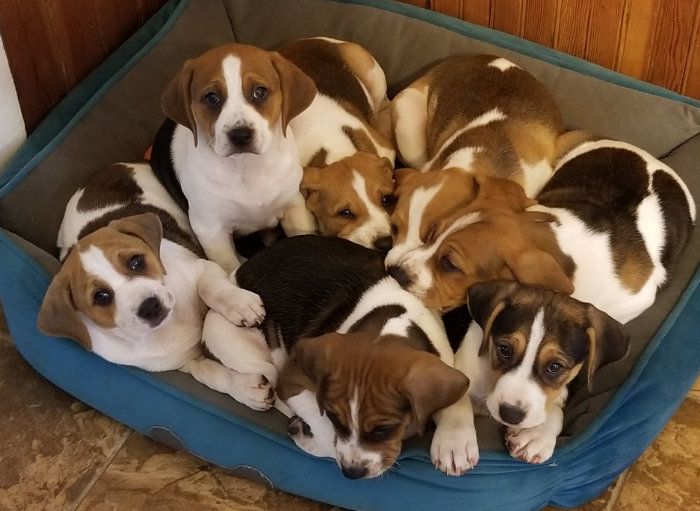
I’ve been fostering dogs and puppies for my local shelter for 15 years. Wow! Time flies – until I thought about it, I didn’t realize it had been that long.
Recently I was talking to another long-time foster provider, Kathy Callahan, trainer and author of 101 Rescue Puppies. I shared with her that, on the day I brought my most recent litter of puppies that I had been fostering for my local shelter back to the shelter to get spayed/neutered and adopted, someone who had seen me crying my eyes out over bringing the puppies back to the shelter said to me, “I could NEVER go to a shelter, it’s too sad!” Well, this snapped me out of that crying spell; I whisked over to “furious” in just a few seconds!
“Sad?!” I snorted. “I’ll tell you what’s sad: The fact that too many people would rather ‘rehome’ their intact dogs or ‘accidental’ puppies to other individuals, who fail to spay, neuter, or contain THOSE dogs, so the cycle goes on. It’s not ‘sad’ if puppies in shelters ALL get vaccinated, neutered, microchipped, and placed in a screened home, it’s SUPER HAPPY NEWS.” Whew! I was seeing RED.
I got hot again when recounting this conversation to Kathy, and fortunately she laughed wryly, completely understanding my emotional whiplash. She said, “I’ll tell you what makes ME see red…” and within the space of a few minutes, we had a Top Five Stupid Things People Say to Foster Providers.
We agreed that number 1 is this: “That puppy/dog loves you so much! You HAVE to keep him/her!” (Rebuttal: One of our most important jobs as a foster provider is to help the dog or puppy/puppies learn to love and trust humans. If they love me and the other people in my fostering circle, they should be able to learn to love and trust other humans, too. Plus, if I keep this one, my fostering days are likely over. You see, I have only so much time, money, and energy for my dogs. One more dog at home will max out one or more of those limited resources, but if this dog gets placed in a loving home after growing to an adoptable age/recovering medically/improving behaviorally, then I can help several more dogs this year!)
A close second: #2 is, “Those two dogs/puppies love each other so much! They HAVE to get adopted together!” (Rebuttal: Usually, when two puppies or dogs are super tightly bonded, this affects their ability to bond to the humans in a household. Tightly bonded pairs tend to look to each other for support, comfort, and direction, and avoid the less-familiar attention of the humans they just met. Separating them may seem harsh for a day or two, but they will almost always start to pay more attention to and seek attention and comfort from humans once they are separated. Only then can real work begin to get them socialized and happy with humans – a prerequisite for finding “forever homes.” It’s far, far more difficult to find families who will take two dogs than one, and almost impossible to find families who want two dogs who want little to do with humans.)

Number 3 is the first one that Kathy first shared with me: “I love dogs too much to foster! I would want to keep every one!” (Rebuttal: Our love for dogs is exactly why I and Kathy foster: We want to help as many dogs and puppies as possible learn the social skills they need to succeed in homes and then find good homes. The idea that someone who doesn’t foster loves dogs more than us is ridiculous. We love dogs so much that we want to see as many of them in homes as possible.)
My trainer friend Sarah Richardson, owner of The Canine Connection in Chico, California, offered #4 and #5: “You’ve put so much work and training into that dog, don’t you just want to keep him/her?” and “It seems cruel to send that dog to another home, now that he/she is so comfortable with you!”
Sarah has had some very long-term foster dogs, including one that she took on from my local shelter following an environmental disaster (the collapse of the Oroville Dam spillways). This dog was on the list to be euthanized by the shelter, likely right after all the evacuated animals were returned to the shelter – but this particular dog (and about 15 others) happened to be taken in by Sarah, who had volunteered her facility as a temporary safe space while the shelter had evacuated due to the potentially collapsed dam. The dog had massive, serious health and behavior issues – and she also loved humans with a joyful spirit that just grabbed at Sarah’s heartstrings. Sarah dedicated herself to saving this foster dog’s life, and spent literal years and thousands of dollars solving the dog’s physical and behavioral issues – and keeping her either safely away from other animals (since predation and dog-aggression were her most serious issues) and happily engaged with enriching toys and activities, to maintain her mental health.
Since Sarah has several of her own dogs, keeping a dog-aggressive dog means neither her own dogs nor the foster dog can ever be completely relaxed and comfortable – or enjoy full, free access to Sarah’s entire home. But letting the dog-aggressive dog be placed in a home with other dogs (or other small animals) sets up that dog for inevitable failure. And so it took years to find a safe, suitable, only-dog home for that dog. Anyone else would have lost hope for finding that dog a home and given up; Sarah was a superhero for holding the line at finding the dog a genuinely qualified spot, and keeping her own dogs and the foster dog as safe and happy as possible until that happened – but she did it. That dog finally found a home with people who love and appreciate her affectionate, playful, joyful spirit and perfect leash manners.

(So, the rebuttal: “When I foster, my goal is not to just get rid of the dog as quickly as possible, it’s to equip the dog with the skills and health he/she needs to succeed for the rest of her life in a home, to help find a home that can meet the dog’s unique needs, and to help the dog and the family learn to love and trust each other. When I foster dogs with significant health and/or behavior problems, accomplishing these goals can take a long time – sometimes, much longer than I had planned or hoped. But it makes no sense to settle and rush the dog into a placement that is likely to fail. And when the right adopter comes along, someone who is ready and able and excited about providing everything the dog needs, it makes all the time and money and energy worth it. And then I can go back to enjoying my own dogs full time, without guilt over the one who was euthanized because no one cared enough to put in the work she needed.”)
Do you foster? What’s the stupidest thing someone ever said to you about fostering? Or, have you inadvertently said something stupid to a foster provider? Spill it, and we can likely rebut it for you. 😊




I spent 15 years fostering dogs for a service organization. Some of the dogs were from shelters.
Many people asked how I could give these wonderful animals up. I told them it was not about me, but about the positive impact to the dogs and to the handicapped individuals that receive them. But of course, I did reap great rewards also. I really felt that I was giving back to my community in an important way. I also learned a lot about dog behavior and training from my mentors at Paws for a Cause.
I agree whole heartedly with Mike Wolf, and Nancy McDonald. Unfortunately, folks are uneducated about many things; I hike regularly and see dogs out in blazing heat with people who have no clue that the dog could collapse – their response to my pointing out the dog’s distress is “oh I have water for the dog.” In truth, I’m continually surprised that no one has punched me yet because I’m so upset by this behavior that I sometimes descend into name-calling, e.g. “you’re an idiot.” OK, so my bad. 🙂
I too have an intensely reactive dog, but I bred him myself, so he’s my responsibility. Unfortunately, he was with a house sitter much of his really early puppy-hood because a serious family illness (cancer treatments) kept me away from home and kept him not very well socialized, except to his other dog siblings. I have worked tirelessly and with the help of wonderful vets and trainers to get him to a place where he can even tolerate going outside our house and seeing other dogs at a distance. He’s now almost 10 years old and when the day comes that he passes on to the Rainbow Bridge, I will be right there in line to foster other puppies and give them the best start possible so that none of them has to endure the same challenges he has.
Regarding fostering, I tell people that I get a lump in my throat when a foster gets a good home, then I get butterflies in my stomach going to pick up the next foster. It is worth it to see the animals out of the shelter, into a home and then into the loving arms of a family.
In January 2021 one of my foster dogs (Lab/Pit mix 57 pounds) pulled me down and I broke my humerus and tore my rotator cuff. I was miserable and in pain and my neighbor said “you should get rid of that dog”. In her defense she did adopt my foster pony 7 years ago and has given her a great life….I told her I take responsibility for my own klutzy self. I am 71 years old and apparently it does not take much to knock me off balance these days. I will find a great home for Harper.
Thank you Nancy McDonald, from this onetime editor and now R+ trainer, for sifting out the important difference in word choice here. I agree that all these comments *seem* “stupid,” but they’re clearly just based in ignorance (and the long held, Hollywoody myths that perpetually complicate the human side of force-free training).
I will probably spend the rest of my life trying (and not quite succeeding!) to find the right balance between stern wording aimed at helping propel a dog guardian’s thinking in the right direction and the understanding that humanity at large has been mostly misled about dogs and behavior. (Not to mention humans and their behavior.)
Thanks also to the author/editor and their fostering comrades for doing what may be the hardest work, emotionally or otherwise, in the entire Dogosphere.
I foster senior and hospice care giant dogs, from both shelter and private owners, and often hear: “oh I could never do that Knowing that they were dying or not going to be with me long” really? Because you’d rather see them in the shelter dying alone in a cage?? You could look into that pathetic animal s’ eyes and leave them?? I have a really hard time doing that. No matter how long I have them, they bring such joy and they appreciate so much, It is always worthwhile.
This is 100% something I really want to do if I’m allowed to work from home permanently (it’s on the table, I know). I love old dogs and I’d LOVE to give them a safe place to land for however much time they have.
Sheila,
Once I get to quit work and own two hospice fur kids that is what I want to do. I am a true LOVER of senior dogs and nothing could make me happier in life than knowing I gave them love at the end of their lives.
Bless you 🙂
I have two comments:
First, THANK YOU SO MUCH for all you do. We have two dogs that came from a shelter and we love them dearly. One is OK but the other sure would have benefited from a loving foster parent who knew how to handle his problems.
Second, please stop viewing those comments as stupid. They are simply uneducated. People don’t mean to be ignorant, they just ARE, until someone teaches them better. Clearly you like dogs better than you like people (me, too), but even if we don’t like humans much, we should give them a chance to learn before dismissing them as stupid.
I agree, but one needs to have what it takes.
Time, patience’s, and the knowledge of the dog or it’s background.
Knowing the breed is helpful and it’s antics.
It’s now 40 years later just rescued another terrier a year ago. She is now a different dog, still curious bitchy and smart as terriers are.
Didn’t want to break her spirit just worked with it .
Stupid people tips:
You should not foster that dog, it is too agressive and should be put down.
Uhm ,hello, i am fostering this dog becuase people have let him/her down. She/he needs someone to give them a chance at a health happy life.
This is a wonderful article and you are a true hero. I fostered puppies only once and the only thing my neighbors said to me was that it was a lot of work, which indeed it was. I became the typical failed foster parent because I kept one of the puppies.
My real comment, however, is about Sarah Richardson and the work (and money) she put into one dog. I adopted my first dog decades ago and she had behavioral problems. (After being bounced around among four or five homes, I think anyone would develop problems). The dog bit everyone. I returned her to the shelter, thought better of it, and brought her home again. I worked with a number of trainers and it took a year-and-a-half for her behavior to improve. One trainer told me that the dog should be euthanized because I was spending too much time and money on her and there were plenty of good dogs waiting in shelters. I knew that was true, but I just couldn’t give up on the dog. I learned a tremendous amount about animal behavior in that time period and that dog became one of the best dogs I have ever known. Even though I ended up with a wonderful companion and I adored her, I remain conflicted about that trainer’s comment.
Peggie,
I love your story!! Good for you hanging with your dog until she worked out her issues!! More people should do that. That’s wonderful!