

Ask a dog trainer to tell you one of their biggest pet peeves about their training clients, and they will almost always mention the fact that the average dog owner almost seems to actively resist the concept of “high-value rewards.”
I’ve sat in on a lot of different trainers’ classes, and during the first session, all trainers make an effort to describe the treats they want to see their clients bring to puppy kindergarten and beginning dog training classes: extra-special treats, such as fresh meats and tiny cubes of fragrant cheeses. Extra-high-value treats are needed, it is explained, because the group-class environment is so exciting and distracting to the dogs and puppies who are new to this, that the owners will need reinforcers of the highest value to the dogs, to capture and hold their attention in a highly distracting environment. (A training center can also be very stressful for shy, undersocialized, or fearful dogs.)
I’ve heard trainers go on and on, for 10 minutes at a time, about the need for really succulent foods to be used as treats (not just dried treats or kibble, no matter how food-motivated the pup or dog is at home), not feeding the dogs before class (so the pup won’t be full of food already and unable to physically eat much more), cutting the treats into tiny bits (so many of them can be fed in a class), including a variety (not just one type, so the dog doesn’t get bored), and bringing more than the owner thinks she might possibly need, because you will be using many, many tiny treats in a 50-minute beginning dog-training class.
Trainers make such a fuss over the value and type and variety and amount of treats because, again and again, owners arrive to class and are shocked—SHOCKED!—to discover that:
- Their dogs are too distracted or stressed to take any but the most over-the-top delicious treats in the class setting.
- Their dogs completely disregard the owners’ pouches full of cut-up hot dogs and, instead, go bananas for the trainer’s samples of stinky cheese, tuna bits, roast beef, and freeze-dried liver.
- By the end of the class, when the trainer is saying, “Yes! That was great! Mark and reward that behavior!” and the owners often reply, “But I’m out of treats!”
To defend their choices, almost all owners will say, “But he works for kibble at home! I thought hot dogs would be ‘high-value’ enough! And I cut that hot dog into 20 pieces!”
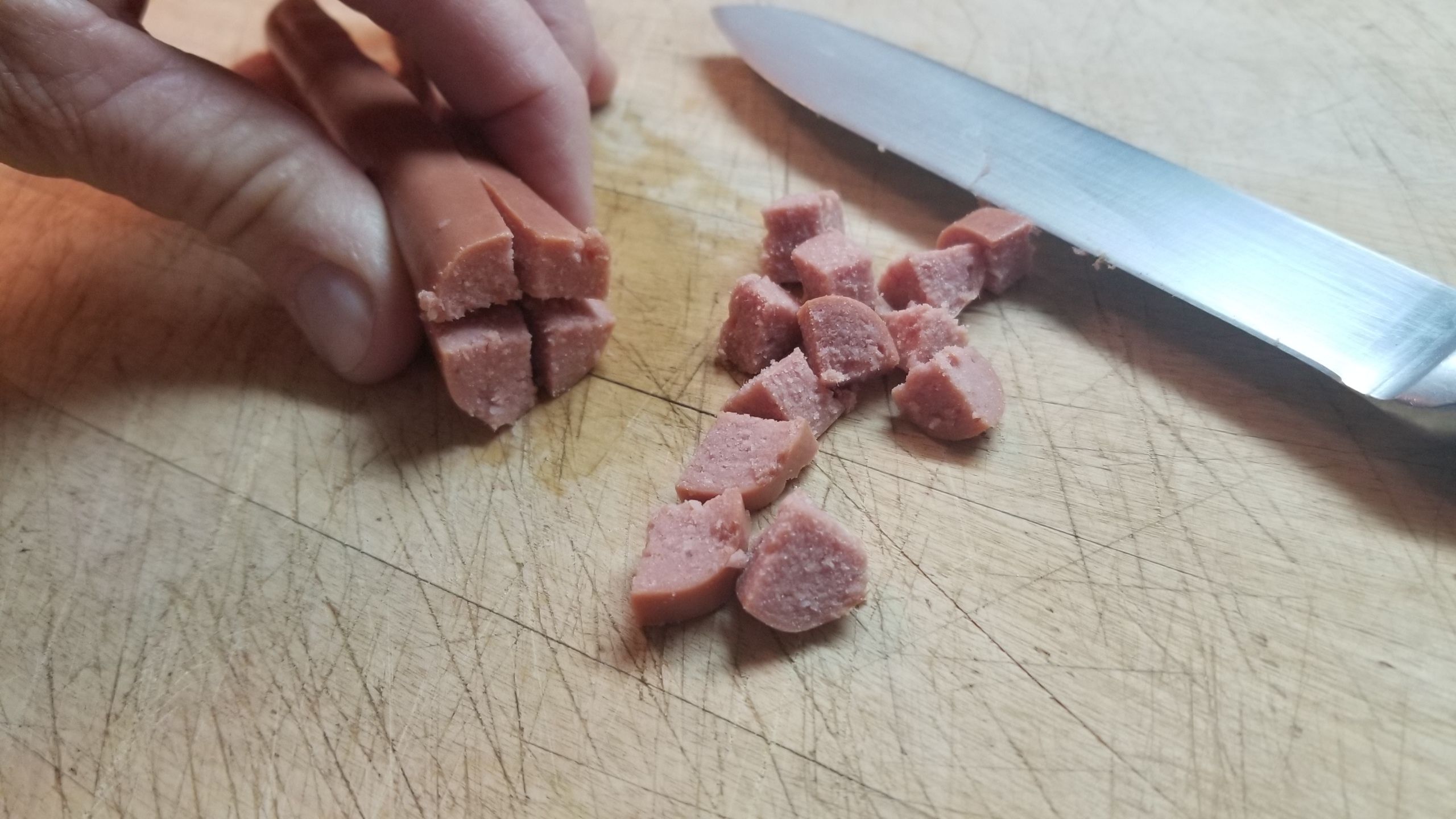
(For what it’s worth, when I use hot dogs as training treats, I cut each one into about 64 pieces: Slice them lengthwise, roll it over halfway and slice it lengthwise again, so you have four long, skinny pieces. Then, holding it together, slice it across, about 16 times, so you end up with 64 or so tiny treats.)
By the end of a six-week class, though, any trainer worth her salt should be able to peek in every student’s bait bag and see a wide variety of scrumptious meats and cheeses and treats, all cut into tiny bits. Success!!
The best and highest-value treats
One of the main points that trainers will make during their first-class discussion is that owners should be prepared with a toy or food treat that is THE MOST valuable to the dog, for reinforcing behaviors that are particularly difficult for the dog, or for when the dog performs extraordinarily well in the face of a particularly difficult distraction.
I recently got a great reminder of how well it works to use especially yummy treats for behaviors that are especially critical.
I used to bring the dogs with me to an office about five miles from where I live; we drove into town most mornings. Last September, my husband and I completed construction of a small outbuilding on our property and then sold the house in town that I had been using as an office (and renting rooms to students) for the past eight years or so. Since then, the dogs and I commute about 50 yards from my back door to my new little office building. It’s great! And I love the new routine—with the exception of how it sometimes clashes with the routine of one of our neighbors.
We’ve been having an ongoing issue with a guy who lives up the road and walks his dog past my property every morning. For what reason, I do not know, but he stops at a certain spot by the fence in my front yard every day without fail, fishes a treat out of his pocket, and feeds it to his dog. And then he stands there for a minute or two, just hanging out. (We’ve introduced ourselves. He’s not just hanging out because he wants someone to talk to because sometimes he is chatty and sometimes he’s not. He sometimes will indicate he is listening to something with his earphones and just wave.)
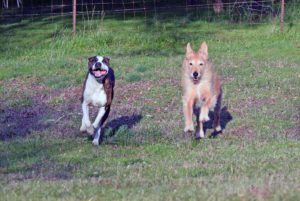
I don’t know whether it’s just the fact that he stops there (instead of walking or jogging or biking by, like most people do, unremarked upon by my dogs), or something about his dog, the treat-feeding, or the guy himself, but when my dogs are outside and they see him coming along down the rural road I live on, they immediately start barking and run to the fence. Something about his walking/stopping habit drives them nuts.
If no one were to respond to them, my dogs would undoubtedly run, barking, along every inch of the 600 feet or so of the fence line that the guy walks by. But this is a behavior I can’t live with (and don’t want them to practice), so the dogs are never outdoors without someone being alert and ready to call them back to the house at the very first bark we hear. I’m telling you, I don’t so much as step into the bathroom in the morning without calling the dogs indoors first—that’s how much I don’t want them to have a chance to practice charging toward the fence!
On the days that they happen to be outside when “the guy with the dog” comes along, I always call them in, and then give them something to reinforce their prompt response. Sometimes I have treats handy, but sometimes I might have to look in the fridge for some cheese or something. They have even gotten just plain old kibble a time or two.
But after we reviewed canned dog foods for the December issue, I had a small mountain of cans of delicious foods on hand. And if I heard the dogs alert, I whistle or call them, and run for the canned food stash. It didn’t take them long to learn to run from wherever they are on our two acres to where I am in less than the time it takes to pop the lid off a can when they hear one of my two recall cues. And their recalls were already pretty prompt! A consistent super reinforcer has resulted in a super duper recall. Best yet, now, though they still let out a few woofs when the see “the guy with the dog” coming down the road, they usually woof as they run to find me and my super high-value canned food reinforcer. This stuff really works!


The author makes a common mistake thinking that what works for their dog(s) means it’s a rule for all dogs. Dogs vary so much based on breed, personality and their experience, that these “easy rules for dogs” just don’t work. I’ve had dogs that would work for any treat, or no treat or very specific “succulent” treats. There are no easy answers — just work with your dog and realize that some are smarter than others and some have preferences and some just love “any” food.
I use a lot of food R+ in training so I make my own nutritionally-dense treats in bulk. I combine 10+ lb of meat and bone with organ meats, eggs, and vegetables, grind it, and bake at a very low temp until mostly dried but still soft. Very inexpensive and nutritious, compared to store-bought treats or hot dogs.
Kim – your recipe sounds great! I make a similar recipe to feed raw, but I like the idea of making (and handling!) baked treats. Do you make a “meatloaf “ type, or a looser crumble in a shallow pan? Or?
Please share
My dog got sick from high value treats during class. He was pretty motivated with regular treats. But when he is distracted by more than one stimuli, the preference to bark furiously at the neighbor dog or as happened a few times, took off on me, no level of treat was enticing enough.
I had someone in a puppy class feeding a Pug with large treats that were bigger than I would feed my adult Kerry Blue terrier! I think this is especially important when you consider how many Pugs are obese.
I think the variety of treats is important too.
LOVE, LOVE, LOVE THIS ARTICLE!
Every word, true.
Sharing!
Interesting that you mentioned changing the treats. I have a Beagle who will eat any and every thing available. He never refuses any treats, but if I want his best performance in a sport, I change the treats. This applies to all sports and he does 8 different canine sports. Sometimes, I do need to use kibble to calm him down a bit. He has been known to offer behaviors and go crazy for prime rib and salmon. Those I save for obedience jackpots because that behavior is high value for me. 😉
With regards to using hot dogs, pre-made frozen meatballs, etc., what about the onion and garlic powder content? I know trainers who use processed foods that contain onion and garlic powder (aka concentrated alliums). The response I usually get when I bring this up is “it’s not enough to hurt them,” but from some research I have read that the toxic compounds can build up and cause serious health problems. I am not vet or health expert. Does anyone have any further information on this? I usually just make my own training treats from chicken, or I make my own dog-friendly meatballs. Am I over-worrying or is this a real concern?
I would always favor home-made training treats to store-bought, because we know precisely what’s in anything we make. If buying something commercially made, I would choose products without strong seasoning. I doubt there is enough garlic or onion to be problematic for medium or large dogs, but very small dogs? Better safe than sorry.
I was in a training class and one couple of Beagle owners brought cheese cubes that were the size of dice. They were packaged human snack cubes! The dog got one whole cube each time. Not only did they run out of treats, that dog was probably pretty uncomfortable for a couple of days!
I have finally found something of high enough value for agility training class, so that my girl will come back to me, instead of racing out of the tunnel over to the other dogs in class. Pork Rinds! And puff cheese balls. But, since the cheese balls are a mess to handle and not so great for them, I prefer the puffed rinds. Has to be amazing to get her back to me!
This is silly.
You need a treat “of sufficient value”… when we were training a rescued bulldog how to UNLEARN bad behaviors, and listen, YES, we needed the highest value treats… freshly poached chicken (no seasonings) to get his attention.
My mastiff, on the other hand, happily works for bites of regular old dry kibble. Anything of much higher value, and she is totally distracted by the smells, and forgets to listen – she just jumps around (all 160lbs of her) trying to get to the treat.
If I offered a 1/64th piece of hot dog to her, I would lose my hand, as that bit would be completely invisible to her. Might as well use a “lick-stick”.
Know Thy Dog.
Agreed about “sufficient value”! Sometimes, you may even need to lower the value of the reinforcer, if the dog is food-obsessed. And of course, if you have a giant dog, treats of a larger size will be appropriate. A lick-stick works great in many cases! I tell older people with small dogs to smear peanut butter or cream cheese on a wooden spoon, and lower it to allow the dog to get a quick lick as a reinforcer. Those squeeze tubes used for camping are great for this, too. Fill them with a smooth canned food and squeeze a bit out, allowing the dog to lick it from the end of the tube.
So agree TinaT, “Know Thy Dog”, that is the best wisdom, and love what you shared Nancy Kerns.
I have a beagle mix who is now six years old. We rescued, or he rescued us at the tender age of 6 months old. After several training classes, trainers, reading tons (I needed it as he is my first dog as an adult), “Know Thy Dog” is truly the best wisdom. Experiencing what I have with my lovely hound, hindsight being the great teacher, I personally would cut back on treats as a whole, high value or not, and focus more on positive re-enforcement and connecting with ones dog, which we are currently doing. I feel and have seen food motivated dogs can become a bit obsessed with treats, though sometimes it is the only way to get their attention. Life is chock full of experiences and lessons. I’m not an expert by any means, though living in NYC near Central Park, a dog utopia in and of itself, I have witnessed, observed and experienced a ton. What I have come to, is, yes, know thy dog, know thyself, get some wise training yet trust your intuitive guidance and do the best ya can. We are all similar yet different, and with love and patience we discover what works best for our individual circumstances.