

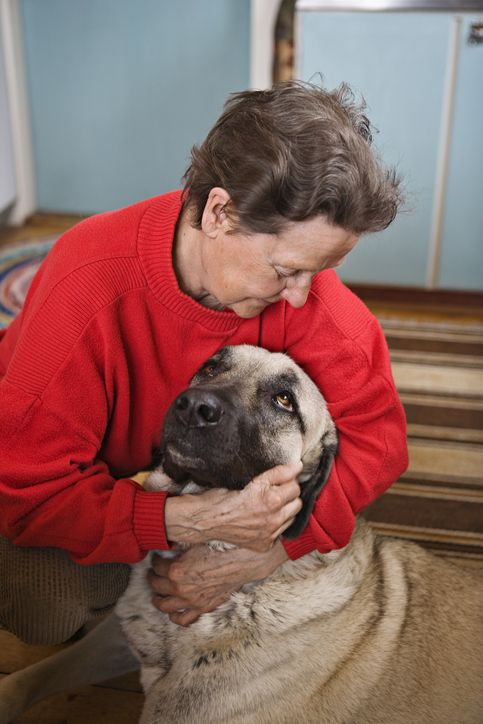
I was volunteering at my local animal shelter one day when the loudspeaker in the kennel area blared, “Kennel attendant for a dog adoption tour, please.” I went to the lobby and was introduced to a couple who, I’m guessing, were in their mid- to late 70s. I was told that they were there to meet a couple of the younger German Shepherd Dogs we had on the adoption row.
My expression probably froze for a moment, but then I put a smile on. “We have a bunch of German Shepherds and GSD-mixes right now,” I told them. “But every single one of them is a big, untrained adolescent! Are you sure you want to deal with such a big, bouncy dog?” I said it with as light a tone as I could muster, but I was concerned. These people did not look particularly strong or agile.
The husband barely acknowledged me, but the wife smiled and said, “Oh yes. We’ve had nothing but German Shepherds our whole lives. We love the breed, and want to help one who needs a home.”
I showed them the various candidates in the adoption kennels, and then a shelter employee took over, taking various dogs to meet them in the big runs outside. I left soon after, so I don’t know which – if any – of the big, strong dogs we had available for adoption they took home. But I’ve thought about the encounter many times over the past few years. It struck me as very unwise, and not particularly self-aware, that the couple would be seeking the same sort of dog they had owned throughout their younger years. I’m super experienced with stressed, large, untrained dogs who haven’t gotten out of their tiny kennels for a week, and, at 20 years younger than the couple, even I get knocked around a fair amount by those dogs in the first sessions we spend together. Even on the occasions when I’ve taken a big rowdy adolescent dog home to foster, it can take weeks or even months to teach them to control their exuberant bodies in the face of exciting stimuli.
When I admitted, a year ago, that one of the reasons I was hesitating over the decision of whether to adopt my youngest dog, Boone, when he was an adorable but thick-legged, big-pawed foster puppy of completely unknown parentage, this encounter with the senior couple was on my mind. I’ll be 60 years old this year – and, with luck, will be 75 or so when the puppy is a senior dog. I had to think about it long and hard: Did I really want to age into my retirement years with another dog who might mature into 70 or more pounds? (Of course, I did adopt that adorable puppy – and, fortunately, it looks like he will top out at about 50 pounds. I can still lift 50 pounds fairly easily, so if he’s ever sick or needs to be lifted in and out of the car, after ACL surgery, say, I can do that!)
Managing the physical size and exercise needs of a big dog is not the only potential challenge for older people adopting a dog. It’s tough to think about, but it’s a reality that people in their senior years are more prone to illnesses or injuries that render them unable to care for their dogs than younger adopters. If you inquire at your local shelter, I will bet folding money that they can point out several dogs who are there solely because their owners passed away without making arrangements for someone else to take the dogs in. In my opinion, it’s irresponsible and selfish to adopt dogs without having a backup plan – and perhaps even money set aside – for our dogs in case of our deaths.
The worst-case scenarios involve dogs whose owners died without making “in case of my death” arrangements for them, and who are completely unprepared for life in any other home. At the shelter, I’ve cared for several dogs who had never been off their property or been touched by humans other than their original (now deceased) owners. The shock and grief experienced by these dogs is awful to witness – and made worse by the fact that, in their shocked and shut-down state, it’s difficult to find someone who will give them another chance at a happy life and adopt them.
Don’t get me wrong: I can’t imagine living without a dog, ever. And I am not saying that we shouldn’t have dogs in our senior years, or even our very last days. I’m just saying that we owe the dogs we take responsibility for the same care and consideration that an owner of any age should have for their dogs. We need to have a solid plan in place for who will take them in the event of our deaths – and perhaps even a backup plan in case the first plan falls through. And we need to be able to fully care for, exercise, and train them, so that, if we are suddenly called away from this earth, our beloved dogs are healthy, socialized to others, and well behaved, so they will be welcome and cherished, not unhappy burdens, to their new owners.




My current dogs, both PBGVs (around 30 lb each) are getting older and I’m in my mid-70s with some mobility issues. (I was an avid cyclist and didn’t count on the issues I now have which prevent biking.) I figure these were the last puppies (they’re now 9 and 11) I’ll get. But after one of these passes I hope I’ll be able to get an older dog as I’ve found that having two dogs makes them much happier. After all, I may try hard with them, but I can’t be a dog!
Thank you. I am 77, have a partner 74, and a 3 year old small corgi–23 lbs, that we lift in/out of her car crate, carry down the 70+ steps to our beach. We walk with her 2+ miles a day, have dog romps with another corgi her age, which saves all of us, and have trained her to a whistle recall reliable enough she is allowed to run on sand flats and chase the willing/taunting sea gull. This is the edge of what we can manage with a canine family member… grateful for the ways she keeps us active and agile–we are down on our knees in play posture as well as yoga. She’s in the will with $ attached and we have younger friends that she knows, visits overnight, and who adore her. Still, it’s a risk as well as a joy. So far, we’re good. I appreciate the article and the commentary.
Thank you for this article, Nancy.
I’ve had large/giant breeds my whole life. German Shepherds, Great Pyrenees, Great Dane, a Rottie, etc. My last dog was an English Shepherd who wasn’t very large – he was about 65 lbs. But tragically, he developed degenerative myelopathy, and I had to lift him into my SUV and up stairs a bit before I had to have him euthanized. I was able to do that but I’m also in my sixties and considered whether or not I could care for a large dog in the future as we aged together. So I opted to adopt my wonderful hound-mix Ranger, who weighs in at 41 lbs.
If I am ever faced with replacing him in my life, I will absolutely adopt a senior dog. I’m a dog trainer and it always distresses me when I see thoughtless and selfish older people bringing home active puppies or dogs that physically overwhelm them.
I have had 8 Border Collies and have fostered 82 dogs so far. I don’t agree with the majority of this article, which suggests seniors aren’t capable of handling a dog. Apparently any dog because of age. Younger folks are just as likely to take a dog to a shelter than everyone else. Look at what happened during the pandemic. Shelters are over-burdened with dogs turned in by owners going back to work. Seniors have time to care for a dog, who also, incidentally prolong the senior’s life and quality of it. Years of experience in dog handling shouldn’t be ignored. These are the very people who benefit from the companionship if a dog. Never just a person by age. They are likely to have more experience and time. Not all seniors are frail and nearing death’s bed. Good grief!
You clearly didn’t read the article carefully. She specifically said that seniors should have dogs, but they should leave a plan in place in the event they can no longer care for them, whatever the reason. I totally agree. When my mother passed, there were a number of options for her dog, but I decided to keep him since I had cared for him the last few months of her life. And as the author also stated, EVERYONE really, young AND old, should have a plan in place for their dog (or cat) just as they would their children, should something happen.
Actually, Grace, fair point! I did drift a little from my first point which is that I wish people were being realistic and really thought through the size and temperament of the dogs they adopt in their senior years. I don’t think those folks who were looking at adolescent GSDs were going to be able to handle them with any joy. At best, the dog might end up with a home — but where he was outdoors 24/7, and without training that would help him become an enjoyable companion. If they had gone to GSD rescue looking for a middle-aged or senior dog, that would have made more sense to me. Or if they had been looking to adopt a smaller dog — it needn’t be a small one!
I do think we need to look at our capabilities realistically and not just keep trying to do what we’ve always done with our dogs, because we might not be as good at handling them as we were when we were younger and stronger. Volunteering at the emergency animal shelter during the Camp Fire that burned down the town of Paradise, California, we took in DOZENS of dogs belonging to seniors (Paradise was well known as a retirement community, though of course many families lived there as well) whose dogs were undersocialized (fearful of people), overweight, had grossly long nails (could barely walk), and were filthy (had been relegated to a life outdoors); clearly their owners couldn’t really handle them anymore!
But in contrast, I recently met some neighbors who are in their early 70s, and during the pandemic they bought a standard Poodle puppy who has developed into a very challenging big dog. But they have enrolled him in multiple classes with a positive-reinforcement-based trainer, they drive him 25 miles to a top-notch daycare so he can have regular “get it all out of your system” playdates with other dogs, and while he’s a huge handful, they are strong and active enough (they are skiiing with their grandkids as I write this!) to handle him. While he’s “more dog” than they were hoping for, handling him is well within their capabilities and they are dedicated to helping him develop into a well-mannered dog who would be very easy to re-home if anything happened to them.
I just wanted to say, we need to be realistic when adopting — and we ALL do need to have a plan for our dogs in case of our loss.
My husband and I are almost 70 and lost out 12 yr old dog to cancer. We have had herding dog mixes most of our married lives. We took many of these ideas into consideration before adopting Cody- he was supposed to be a Heeler/BC mix according to the rescue. At 4 months and 40 pounds we questioned his parentage. We have since discovered he is both those breeds plus Golden Retriever. He is now 7 months and attending training classes. Other than bruising issues when he had his puppy teeth he has been an easy dog to train. We walk several times a day, have a large fenced yard and a dog door. He can come and go as needed. We have an 11yo dog who plays with him and helps to correct him as needed. We work with Cody on watching our feet as we walk and on stairs he must go down before us on command. Our dogs and horses will be taken care of should we pass before them but at this time, I absolutely love having an energetic puppy in the house. He has helped our older dog get over his depression of losing his lifelong friend. I wouldn’t hesitate to bring another smart dog into our home.
Great article. WDJ has previously published a related article that discusses many options for senior dog owners. Search the site for “Spending the Golden Years with Dogs.”
It is tragic that pets who have known a loving home all their lives end up in shelters when the owner dies or becomes incapacitated. Note that all it takes is a car accident to create this scenario with a younger pet owner. I think many people are so averse to facing their own mortality, they refuse to consider the possibility and don’t plan for it. Tragically, senior pets end up spending their remaining lives in a cage, with no treatment for their senior ailments, because so many adopters are reluctant to adopt senior animals.
100% agree!
All of my pets are in my will (I confirm with their potential care givers every year). Each pet comes with funds for their care and I keep detailed veterinary records.
Thank you for writing this very important article!
Your article makes important points, and I’m glad WDJ is raising the issue. A follow-up article might cover possible options for people to consider. And, for younger folks, remember that things happen. You’re never too young for “legacy” planning for pups!
I recently turned 70. My current small dog is 13 yo. I have money set aside in my will for her and with no dog lovers in my family, I have arranged for her to go to her foster mom (who is now about my age) should I pass before her. None of this feels ideal. I would love a WDJ article outlining various care options for seniors wanting to do right by their dogs. Important topic, thanks for bringing it up.
Yes, great idea for a future article. One of the rescue agencies in my town lists adoptees as available with “vet care for life.” Information on how to do this would be welcome.
I 100% agree with this article.
Totally.
Know of an older (late 70’s)single woman planning on two standard size poodle puppies because she’s ‘always had them’. Argh. Recipe for disaster but no way to reach her, she’s determined. So upsetting.
I totally agree. I had friends who were in there 80’s when they decided to look for a German Shepard because they had always had one. I asked them how would they handle such a large dog but they were determined. I took them to see a two year old and had them both walk the dog. It became apparent that the wife was not going to be able to handle him as she was going to be the main caretaker. They decided not to take the dog.