


There’s an old joke about if there’s one thing that two dog trainers can agree on, it’s that the third one is doing it wrong. But if you know me at all, you know I hate online squabbles; I don’t participate in digital fights about training methods or tools. That said, I think I’ve found something that very nearly ALL dog trainers agree on, and that I will defend anywhere, anytime, and it’s this: Retractable leashes have no place in dog training.
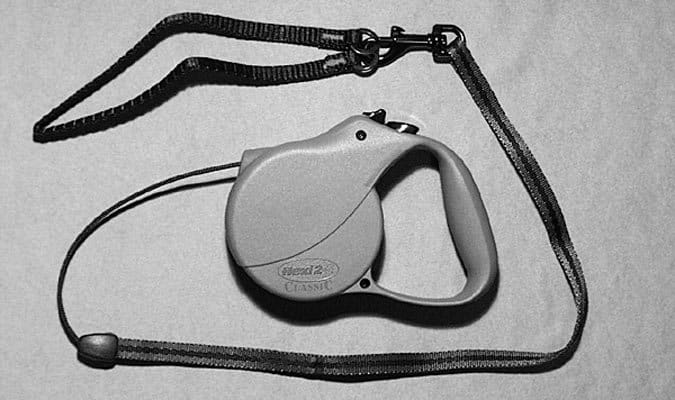
It almost reaches the level of a joke: If you go to a dog park or almost any gathering of dog people and their dogs, the worst-behaved dogs will be the ones on retractable leashes. It’s sort of a chicken or the egg thing: What came first, the poorly behaved dog or the leash that teaches him nothing?
I get how convenient it is to be able to walk along with your dog on leash and have your dog stop for a moment to smell something or take a quick pee, and you only have to slow your pace for a moment, rather than stop dead. When he’s through or he hits the end of the retractable line, he can trot to catch up, and you don’t have to scoop up all that line the way you would with a long leash, you can just allow the spring-loaded retractable thingie to wind it up.
However, what do you do when your dog is at or near the end of the line and:
- You are suddenly confronted by a loose dog, looking a little aggressive, coming your way, fast.
- Someone walks quickly out of a storefront, in between you and your dog.
- Your dog suddenly sees a squirrel on the ground across the street and bolts into the street in an effort to reach the squirrel.
The biggest problem is with these and countless other situations, when your dog is more than a couple of feet from you, there is nothing you can do very quickly to get him back to your side. The products can retract only when there is not tension on the line. As you know if you’ve ever used one, you really cannot grab the part of the cord that retracts into the handle and pull even a smallish strong dog back toward you. About the only way you could pull a dog to safety would be to mash the lock button down, while quickly turning in the opposite direction and trying to call or drag your dog in the other direction – depending on whether you’ve trained him to do emergency U-turns or whether he’s engaged already with the other dog or still on the hunt for the squirrel.
And to retract the slack when there is a chaotic situation brewing, like when that loose dog – or even one on leash! – is squaring off with your dog, and they are spinning around? Lock to prevent the dog from getting farther away, release to retract, lock, release, lock, release . . . it’s darned hard to do in calm circumstances.
When I want a dog to explore his environment without taking him off leash, I use a long line – a 20 or even 30-foot leash. I only use a tool like this in an environment where there are NO other people or dogs who might get tangled up with us, and the line is as smooth and easy to handle as my leash; I can easily grab anywhere on the line and manually reel in the dog if I have to.
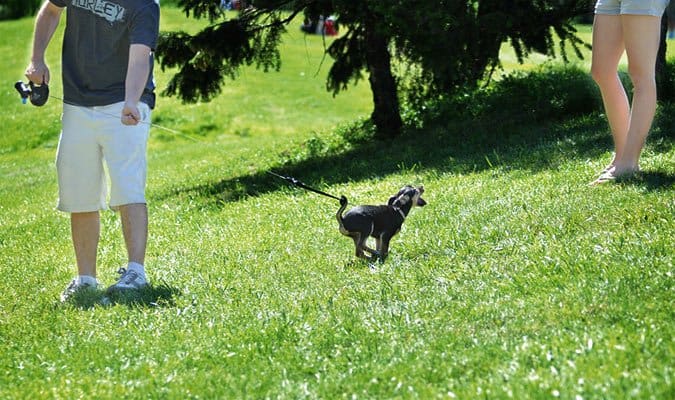
And what about the many cases in which someone accidentally dropped the handle, which started dragging on the ground and clattering loudly behind the dog, and spooked him into running in a blind panic into traffic?
We don’t even have to discuss emergency situations to get most trainers to chime in about how useless these tools are. They more or less train dogs to pull against pressure, by rewarding/reinforcing the dog when he pulls against the product’s spring (there is always some tension, even when the operator isn’t pressing the lock button) in order to reach something he wants to investigate. Getting to sniff something he was curious about is a reward – and behaviors that are rewarded get repeated. Simple as that.
Yes, a person can lock the handle and prevent the dog from pulling the line out of the device, preventing him from getting this reward. But then, you may as well just have a fixed-length leash.
As a final point against them, all I can say is, when this blog gets posted to the WDJ Facebook page, go ahead and post your photos of the deep, slashing cuts that you or someone you know has received when a retractable cord got wound around their leg when a dog was going nuts. That should give a little credence to the warnings against these products.
Can anyone honestly make a case for the responsible use of retractable leashes?




Why do people always bash retractable leashes? It’s just a tool! If a carpenter built something for you and did a lousy job, would you blame the hammer?? If people don’t train their dogs it doesn’t matter what kind of leash they use. Retractables have a lock on them for a reason – people are just to lazy or ignorant to use them properly. It’s NOT the leash, it’s the handler/owner.
There may be some people who use retractable leashes appropriately (although I have not seen them in my own experience). I work with a rescue group for Great Danes and Irish Wolfhounds. Yes, we have very large dogs up for adoption. We go to Meet & Greets often. I absolutely hate it when some itty-bitty dog (don’t get me wrong, please–I like small dogs, too–we have a small dog) comes around the corner on a retractable leash with no owner in sight. Itty-bitty sees scary huge dogs and starts barking, growling, and acting like he’s going to try to eat our rescues. We try very hard to ensure all the dogs we take to Meet and Greets are pretty “bomb proof” and won’t react to barking dogs, dogs coming up to them (even if not invited), etc. We try very hard, but I always worry that itty-bitty dog will bite one of the rescues and then all bets are off–huge dog may object to that (and I don’t blame them–I object to being bitten by a dog) and may hurt itty-bitty dog (even if not meaning to). We are always getting complaints from itty-bitty dog on retractable leash’s owner about having our “vicious” big dogs in the store or park or wherever. Excuse me! Really! My huge dogs are just lying there minding their own business and your dog comes up and is behaving in an aggressive manner toward them? And my dogs are vicious and shouldn’t be allowed in public? If you use retractable leashes, please do so responsibly and don’t allow your dog to go out of your sight. You don’t know what your dog will encounter. I don’t blame the unsocialized itty-bitty dog (I blame the owner who failed to socialize them to large dogs), but if your itty-bitty attacks a huge dog and the huge dog tries to defend him- or herself, your itty-bitty doesn’t stand a chance of escaping without injury (usually serious). If you’re out on a trail in the wilderness, itty-bitty dog may face a predator who thinks itty-bitty dog is a perfect meal. If you use them, please use them responsibly.
What advice do you have for people like me who have arthritis in their hands and find that flexi handles are the least painful and offer the most secure grip compared to non-flexi leashes?
No, it’s not always operator error. There are built in problems the best handler cannot always manage..
A trainer, instructor, and exhibitor, I’m old enough to remember when the original retractable leads were sold ONLY to dog professionals by our newly opened mega pet supply store. (No flat ribbon cord then available; it doesn’t help anyway.) I personally know of some fairly severe injuries from retractables. We also had someone in our breed originally endorse the newly available retractable for herding training. That disaster definitely didn’t last long, disappeared to be replaced by a warning when the inevitable unfortunately happened.
Yes, there are better and worse ways and places to use a retractable. The problem arises when unexpected things occur. (You were sure there were no other dogs, no people, no small animals, etc., anywhere near. Ha!) At that point your retractable becomes a negative factor and can lead to injury or even death. Sound extreme? Maybe, but it’s not.
Use a short lead or a long line, folks!
I live in a condo community and rescued a wonderful lug of a black lab a year ago. At 5 yrs old, she’d never played or had the chance to run and chase a ball. Ellie Dee has been loving chasing a ball (or a snowball) with me using a
retractable lead. I’ve had dogs my entire life, and this is my first retractable. I’d throw the ball and we’d run after it together, so that the ribbon wouldn’t run out. 7 weeks ago today we were playing this game. While we were running toward the ball, Ellie was just catching up to it, and she accidentally kicked it farther away. This was thrilling to her, and all of her 55 lbs bolted after it. She got to the end of the leash, (still running) and I (100 lbs) went sailing into the air and crashed on my humerus, which broke. My arm is still in pain, but healing, and the retractable leash is gone from our lives. A very valuable lesson was learned.
One Christmas morning my husband Dick was on a wide and busy street, walking our 12-year-old cairn terrier Arlo on a short leash. When he saw a couple with a German short-haired pointer coming toward them on the sidewalk, Dick moved with Arlo into the bike lane, which was separated from the sidewalk by a parking lane, in order to allow plenty of passing space between the two dogs. But the pointer was on a retractable leash and lunged at Arlo, picking him up in her mouth and shaking him, resulting in serious injuries for Arlo and an angina attack for my husband. Fortunately, both survived the trauma—Arlo, thanks to the doctors at the veterinary emergency hospital where the three of us spent most of the rest of Christmas Day, and Dick, thanks to nitroglycerin. Since then, including once last week, I have experienced large dogs on retractable leashes trying to get to my three small dogs while I was walking them. It’s scary.
It’s the owner not the leash. Duh!
I don’t like the leads myself and don’t like the handles that I could easily drop. I have seen many people with these types of leads who think they can just let their dog roam up to mine before Evan asking permission. I also new someone who line snapped with a big dog .
I remedied the dropping after a couple of times with a Nylon paracord loop attached to the handle.
Also, I had one of the little ones years ago and never had confidence in it, so I’m not surprised to hear about the incident when it broke. The I used one in my earlier comment, I got the Flexi Giant with an 8 meter 3/4″ wide flat nylon lead. That’ll probably handle most anything!
I’ve been using retractable leads almost daily since they first became available and have never suffered a burn – because I always use them correctly and carefully. I live in the city, have a small yard and multiple dogs so we do a lot of walking. I lead train my dogs using a 6 foot obedience lead and all have good lead manners, but retractable leads used correctly allow my dogs to get more exercise that my old legs can manage. Dalmatians trot faster than my fastest walk, and trotting is good for dogs. Used properly, we can maximize our walks, and for conditioning show and performance dogs retractable leads are very helpful. My daughter walks her three dogs on Flexis with no problem, although I rarely walk more than one of mine at a time. Retractable leads should never be used in stores, or crowds or where you are likely to encounter other dogs, and you need to pay constant attention to what is going on around you. A pocket full of treats and a good recall allow you and your dog to stay out of trouble. That being said, I wish dog owners had to take a class and pass a test to buy one, and all stores and vet offices need to have a sign that says retractable leads are not acceptable. Like everything else, the leads are not the problem. It’s always “operator error”.
I agree that retractables can be very dangerous and have limited application in training. After a few negative experiences mine sat dormant for years, until recently. It has become a very useful tool for guiding my now very elderly shepherd mix who spent most of his life either being well behaved on a short leash or running off-leash. We live in the country, and as his attention and/or hearing fail it gives him a sort of illusion of freedom to explore smells and things along the way while giving me a more reliable recall from bad choices. He still loves the stimulus of checking things out and I feel that keeping his world a little bigger while having a way to reel him in when necessary has been a positive compromise. Retractables do require good leash skills and owner judgement calls more than a standard lead.
I have found an extra-long retractable leash to be a valuable tool for teaching two persistent leash pullers to relax and walk on a slack leash. My experience with traditional long lines has been abysmal. Like others have said, a retractable leash is simply a tool. The retractable also gave enough room for a rescue Dutch Shepherd to eliminate at a comfortable distance from me (a dog who for a couple of years would not relieve himself on a 6’ leash). Each of the dogs I have used the retractable with have turned out to be “best dogs in the world”. There are times and places where these tools are a godsend, just as there are times and places they are completely inappropriate. And in the wrong hands, as with any tool, they can be disaster. But to say they have no place in a trainer’s toolbox I think is a mistake. Disclaimer: I am not a “trainer”, simply a responsible dog owner who has always taken manners and training seriously. I am sorry to read these tools have been banned in some towns (although my leash of choice in town is still a sturdy 6’ leather leash), because that means it won’t be long until they are banned everywhere. Instead, I wish we could simply ban fools!