


There’s an old joke about if there’s one thing that two dog trainers can agree on, it’s that the third one is doing it wrong. But if you know me at all, you know I hate online squabbles; I don’t participate in digital fights about training methods or tools. That said, I think I’ve found something that very nearly ALL dog trainers agree on, and that I will defend anywhere, anytime, and it’s this: Retractable leashes have no place in dog training.
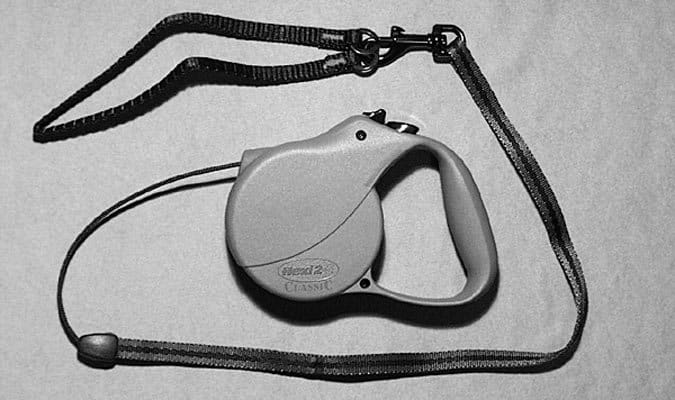
It almost reaches the level of a joke: If you go to a dog park or almost any gathering of dog people and their dogs, the worst-behaved dogs will be the ones on retractable leashes. It’s sort of a chicken or the egg thing: What came first, the poorly behaved dog or the leash that teaches him nothing?
I get how convenient it is to be able to walk along with your dog on leash and have your dog stop for a moment to smell something or take a quick pee, and you only have to slow your pace for a moment, rather than stop dead. When he’s through or he hits the end of the retractable line, he can trot to catch up, and you don’t have to scoop up all that line the way you would with a long leash, you can just allow the spring-loaded retractable thingie to wind it up.
However, what do you do when your dog is at or near the end of the line and:
- You are suddenly confronted by a loose dog, looking a little aggressive, coming your way, fast.
- Someone walks quickly out of a storefront, in between you and your dog.
- Your dog suddenly sees a squirrel on the ground across the street and bolts into the street in an effort to reach the squirrel.
The biggest problem is with these and countless other situations, when your dog is more than a couple of feet from you, there is nothing you can do very quickly to get him back to your side. The products can retract only when there is not tension on the line. As you know if you’ve ever used one, you really cannot grab the part of the cord that retracts into the handle and pull even a smallish strong dog back toward you. About the only way you could pull a dog to safety would be to mash the lock button down, while quickly turning in the opposite direction and trying to call or drag your dog in the other direction – depending on whether you’ve trained him to do emergency U-turns or whether he’s engaged already with the other dog or still on the hunt for the squirrel.
And to retract the slack when there is a chaotic situation brewing, like when that loose dog – or even one on leash! – is squaring off with your dog, and they are spinning around? Lock to prevent the dog from getting farther away, release to retract, lock, release, lock, release . . . it’s darned hard to do in calm circumstances.
When I want a dog to explore his environment without taking him off leash, I use a long line – a 20 or even 30-foot leash. I only use a tool like this in an environment where there are NO other people or dogs who might get tangled up with us, and the line is as smooth and easy to handle as my leash; I can easily grab anywhere on the line and manually reel in the dog if I have to.
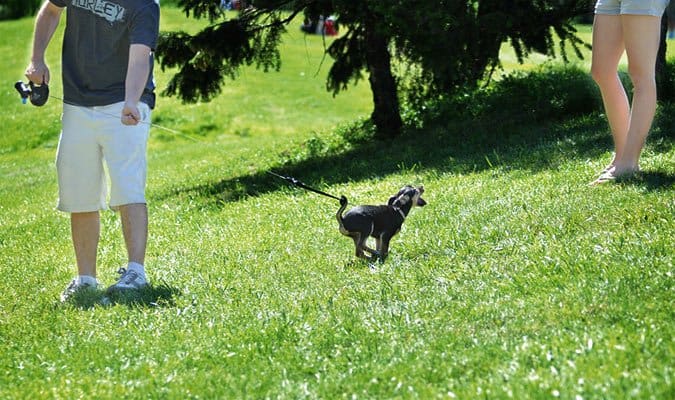
And what about the many cases in which someone accidentally dropped the handle, which started dragging on the ground and clattering loudly behind the dog, and spooked him into running in a blind panic into traffic?
We don’t even have to discuss emergency situations to get most trainers to chime in about how useless these tools are. They more or less train dogs to pull against pressure, by rewarding/reinforcing the dog when he pulls against the product’s spring (there is always some tension, even when the operator isn’t pressing the lock button) in order to reach something he wants to investigate. Getting to sniff something he was curious about is a reward – and behaviors that are rewarded get repeated. Simple as that.
Yes, a person can lock the handle and prevent the dog from pulling the line out of the device, preventing him from getting this reward. But then, you may as well just have a fixed-length leash.
As a final point against them, all I can say is, when this blog gets posted to the WDJ Facebook page, go ahead and post your photos of the deep, slashing cuts that you or someone you know has received when a retractable cord got wound around their leg when a dog was going nuts. That should give a little credence to the warnings against these products.
Can anyone honestly make a case for the responsible use of retractable leashes?




Yes, I honestly make a case for the responsible use of retractable leashes, with emphasis on “responsible.” The thing is that the user needs to understand that the only time to unlock it is when they want to temporarily go on on a controlled “off-leash.” In my case, it was even a useful training tool.
I used an eight meter-long Flexi Giant for a while when Daisy Mae (Lab) was still in basic training and bolted after a squirrel I didn’t see before she did had me in the emergency room with a fractured ring finger when my 6′ leather leash became inadvertently looped around it. I kept the Flexi locked at about six feet except when we went into a wooded park nearby and released it for anticipation of surprise encounters with critters. She still followed close to me, but when she’d bolt, the unreeling Flexi gave me time to call out “steady” before she hit the end. She quickly learned the “steady”command meant stop and learned to resist chasing after them at all, so I retired the Flexi went back to the leather leash.
Back in the olden days of dog training, we used 20 foot cotton leads. I tossed my retractable lead when it was yanked out of my hand and my setter ran off with it bouncing behind him. And after a friend almost had her finger amputated when her Rottie whipped around her and she tried to stop her by grabbing the line.
And, as a veterinary clinic receptionist I’ve seen two dogs get bitten when their unconscious owner sent them in ahead of them on a 16 foot flexi lead and they ran into the faces of other dogs. MANY people do not know how to retract the lead, let it dangle dangerously around the dogs feet, and too many try and walk two dogs on two different flexies!!
I agree that the problem is with the handler, not the tool. I have used them safely as a trainer and dog walker for decades. I teach my clients that they need to teach proper leash walking on a regular leash, and only use retractables in certain situations (if at all). They are not a safe option for walking along streets, bike paths, or other places where the dog can suddenly be in danger or endanger someone else. But for parks, swimming, and exploring in open areas, they can be an appropriate tool. Taking along a 25′ longline in addition to a regular leash is a hassle, when you’ve got the rest of your training gear with you. And I had a dog swimming on a longline once and the line drifted and got caught on something so that the dog couldn’t get back to shore til I swam out and freed it. Wouldn’t have happened on a retractable. And many of the dangerous situations described below would also have happened on a long line because the handler was not PAYING ATTENTION and allowed their dog to be too far from them–it wouldn’t have mattered what kind of leash was involved. If you are not aware of your surroundings and paying attention to your dog and the environment, a long line will not save you. It absolutely requires attention to what you’re doing. However, a long line can be more forgiving of handler mistakes, and people who are not paying attention (75% of the dog-owning public, often because they are looking at their phones) should not use a retractable. Period. But that’s different than saying that retractables should never be used by anyone. I do agree that retractables should be labeled with instructions and warnings.
yes, yes and yes!
Retractable leash’s and elevators, don’t mix. In my apt building, 2 dogs almost strangled because the owners were slower than their dogs or they were to busy gabbing to pay attention to their dog getting off or in the elevator. Even worse, they were friends so often together. You’d think one would have learned from the mistakes of the other. The other bought her dog a harness. So instead of hanging by her collar, she was hanging on a harness!! And, a different woman let her dog pee as soon as they went onto our rooftop garden. We have a place for the dogs to go. Her excuse, “he goes in the garden because I can’t stop him”! THAT IS WHY OUR DOGS HAVE TO BE ON THE LEASH!! She has moved, so they can destroy another garden. When she first got the leash, she had no concept on how to use it!
I have to disagree. This is a people training issue and a little common sense. I have two dogs that are both on retractable leashes – high vision florescent yellow cord or ribbon style with reflectors on casing. I like the “controlled” freedom this allows for them and me. I also use them wisely and am very aware of my surroundings. If anyone is within 50ft of us, they are reeled in and put to a heel. They are at a heel on sidewalks next to roads and lawns but I let them wander on pathways, green spaces and parks. If a cyclist lets me know they are going to pass me on a pathway (they need to take responsibility of their actions too!!), I reel them in asap (I’ve trained them to come and not doddle) so as not to interfere with the cyclist. I never wear headphones either. There are proper ways to use these leashes as a tool. Why not teach that as part of your training instead?
I was tangled around a retractable lead with a Great Dane on the other end. I held my Chihuahua over my head as I hollered at the owner to get control of her dog. The dog was bigger than me. It was very scary.
The owner never even apologized!
I recently fell because I was caring for a small dog and all I had to walk him was a retractable lead.He pulled and I fell over. I have the cut and bruises to show for it.
The leashes should be against the law!
No dog needs to be far from it’s owner.
Retractable/No Retractable. We still have neighbors that allow their dogs to relief themselves in our yard. The dogs are either let out of house to run free or has owner walking them on a (regular) leash. How do you teach those people? These are adults too, not kids!
We have found these poohs in the front yard – wherein our dogs use only enclosed, fenced in backyard. I’ve seen the one neighbors who allow their dogs to roam free and act like they don’t see it even though they are in front doorway/on their porch. Adults can act like children. 😡
I have found a retractable leash very useful in a few isolated circumstances. However, for general use I think they should come with a disclaimer that they are only for use by experienced handlers and well trained dogs. Otherwise, they are an accident waiting to happen.
I have a well-trained shepherd – standard poodle mix at 11 years and 60 lbs who has been on a retractable leash almost her entire life. It’s not the device – it’s how you use it. I have modified it with a wrist cuff so that there is a fail-safe if my grip slips. I keep a thumb on the trigger and she is closely attuned to it clicking tight, and she stops when I trigger it. She is only ever at full length when we are on the bike path with little traffic, or in the woods where she can walk single-file ahead of me. In crossing streets, approaching other dogs on-leash or off, or in heavy bike or pedestrian traffic she is directly at my side where I can also lift her harness to control her movement. The leash gives us both some freedom, her to sniff, me to swing arms walking without affecting her gait. But thumb on trigger, always, and it doesn’t take me more than 2-3 seconds to go from full extension to full retraction.