

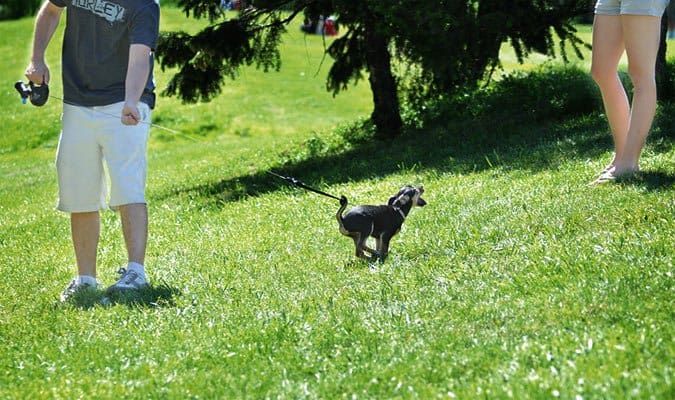
There’s an old joke about if there’s one thing that two dog trainers can agree on, it’s that the third one is doing it wrong. But if you know me at all, you know I hate online squabbles; I don’t participate in digital fights about training methods or tools. That said, I think I’ve found something that very nearly ALL dog trainers agree on, and that I will defend anywhere, anytime, and it’s this: Retractable leashes have no place in dog training.
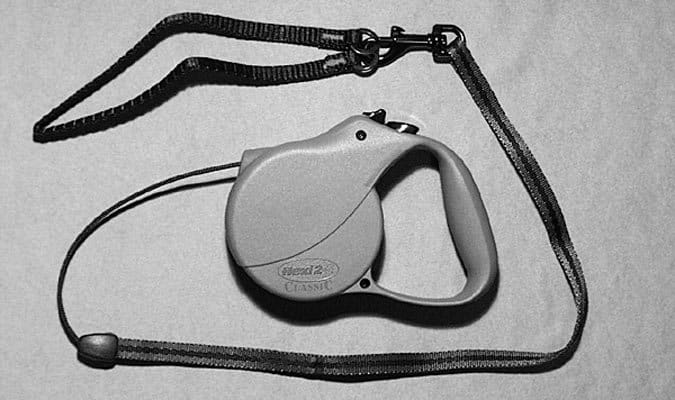
It almost reaches the level of a joke: If you go to a dog park or almost any gathering of dog people and their dogs, the worst-behaved dogs will be the ones on retractable leashes. It’s sort of a chicken or the egg thing: What came first, the poorly behaved dog or the leash that teaches him nothing?
I get how convenient it is to be able to walk along with your dog on leash and have your dog stop for a moment to smell something or take a quick pee, and you only have to slow your pace for a moment, rather than stop dead. When he’s through or he hits the end of the retractable line, he can trot to catch up, and you don’t have to scoop up all that line the way you would with a long leash, you can just allow the spring-loaded retractable thingie to wind it up.
However, what do you do when your dog is at or near the end of the line and:
- You are suddenly confronted by a loose dog, looking a little aggressive, coming your way, fast.
- Someone walks quickly out of a storefront, in between you and your dog.
- Your dog suddenly sees a squirrel on the ground across the street and bolts into the street in an effort to reach the squirrel.
The biggest problem is with these and countless other situations, when your dog is more than a couple of feet from you, there is nothing you can do very quickly to get him back to your side. The products can retract only when there is not tension on the line. As you know if you’ve ever used one, you really cannot grab the part of the cord that retracts into the handle and pull even a smallish strong dog back toward you. About the only way you could pull a dog to safety would be to mash the lock button down, while quickly turning in the opposite direction and trying to call or drag your dog in the other direction – depending on whether you’ve trained him to do emergency U-turns or whether he’s engaged already with the other dog or still on the hunt for the squirrel.
And to retract the slack when there is a chaotic situation brewing, like when that loose dog – or even one on leash! – is squaring off with your dog, and they are spinning around? Lock to prevent the dog from getting farther away, release to retract, lock, release, lock, release . . . it’s darned hard to do in calm circumstances.
When I want a dog to explore his environment without taking him off leash, I use a long line – a 20 or even 30-foot leash. I only use a tool like this in an environment where there are NO other people or dogs who might get tangled up with us, and the line is as smooth and easy to handle as my leash; I can easily grab anywhere on the line and manually reel in the dog if I have to.
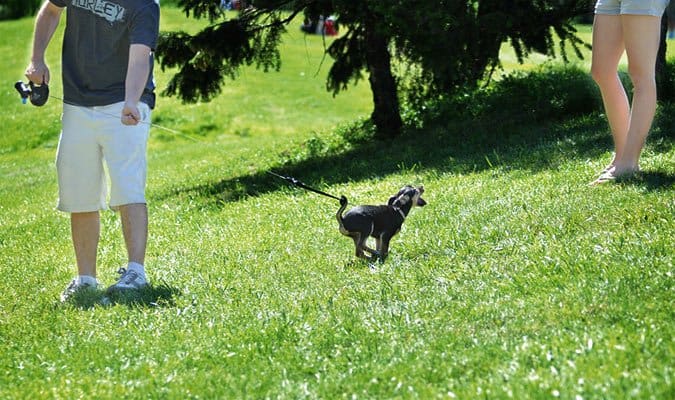
And what about the many cases in which someone accidentally dropped the handle, which started dragging on the ground and clattering loudly behind the dog, and spooked him into running in a blind panic into traffic?
We don’t even have to discuss emergency situations to get most trainers to chime in about how useless these tools are. They more or less train dogs to pull against pressure, by rewarding/reinforcing the dog when he pulls against the product’s spring (there is always some tension, even when the operator isn’t pressing the lock button) in order to reach something he wants to investigate. Getting to sniff something he was curious about is a reward – and behaviors that are rewarded get repeated. Simple as that.
Yes, a person can lock the handle and prevent the dog from pulling the line out of the device, preventing him from getting this reward. But then, you may as well just have a fixed-length leash.
As a final point against them, all I can say is, when this blog gets posted to the WDJ Facebook page, go ahead and post your photos of the deep, slashing cuts that you or someone you know has received when a retractable cord got wound around their leg when a dog was going nuts. That should give a little credence to the warnings against these products.
Can anyone honestly make a case for the responsible use of retractable leashes?




I agree with all the arguments against retractable leashes. I use one only when I am in an area where my dog can have more freedom, and I bring my dog close to me to pass other dogs. And when I walk my dog on a 6′ leash, he doesn’t pull. One more story about retractable leashes. The posted leash law in a nearby county park is maximum 6′ leash. Many people walk their dogs on retractable leashes, and do not limit their dog to 6′. Yet, at this same park, I have known people who were training their dog on a long line, and the rangers stopped them for breaking the leash rule. Frustrating!
I have both a retractable and 2 6’ leash’s. I use the retractable leash but never extend it over 6’. The retractable is more manageable for me and set at a fixed 4-6 ft and with an attached wrist strap it controls my little 20# Schnauzer quite well. I allow my little dog the opportunity to “smell the roses” on our daily 1-2 mile walk … exercise is not the only reason my dog needs to leave the house. She is a terrier and needs exploration opportunity’s, but only when I allow with a key word or hand signal … otherwise she walks beside me or slightly in front with a slack leash. She knows that poop or pee time is on the median between sidewalk and street. I have a 3 poop bags attached to the leash handle and visible so everyone knows I will pick up after her. I usually have 1-2 bag in my pocket as so many other owners seem to “forget” their bag … I give them one. I use the non-retractable leach to take her to the vet or store. Responsible dog owners can use a retractable leash and keep it short or lengthen slightly to accommodate the given exploration opportunity’s …but she is never over 6’ for from me.
In my opinion, Stuart, above, says it all. I do agree with others that it is not a Training Tool! Training needs to be done first, not only basic training but leash (of all kinds training), and after that, it is a great tool for both dog and handler … however, there are places it should never used.
Ever. Dog shows of any kind, when doing any sort of work with/around elderly or disabled or small children, etc. A little sense is wise and necessary, and being aware of where you are and your surroundings is a good idea even if you are out and about even alone.
As said by another, retractable leashes are a tool. With awareness and forethought, they can be used responsibly. My dogs are trained on a short leash before allowed on a retractable and they are never allowed to pull, no matter what. I use a retractable as you would a long line. When something unexpected comes up, the leash is retracted and locked, and therefore acts as a short leash. The flexibility of the retractable is really nice in the right situations and a lot handier than a long line. Untrained dogs and their irresponsible owners give retractable leashes a bad name.
While I agree that retractable leashes are an accident waiting to happen when used by pet dog owners, to say “Retractable leashes have no place in dog training” is a mistake. Most of us who train obedience use them to help teach the retrieve and to avoid having the dog make a mistake in some of the other exercises. Go to an OB trial and you’ll see the Utility level handlers using a retractable to warm up their dog. I also use my retractable in nosework training. Though frowned upon by some of the old-school trainers who favor your long line suggestion, I’ve seen far many dogs get tangled and pulled off working odor while their handler disentangles them. There is a place for long lines; in tracking and in teaching circle work in agility are just two examples. Likewise, there are also good reasons to use retractables.
Thank you John Zappe, I was going to use these training examples as an appropriate use of the flexi, but you beat me to it and explained it quite well.
A second use I have for a flexi is when letting my almost 15 year old Golden have some sniffing/walking time in the grassy field at my house – the flexi helps since it’s much easier to allow her to go slow and take her time sniffing.
She is however a trained dog and so elderly that she doesn’t run around on it or cause any possible danger.
However, as a professional dog trainer I do let my clients know how dangerous they can be.
I also abhor retractable leashes. Here’s two more reasons to add to the list:
1) When I lived in California, one of my customers was walking on a paved road with her small dog at the end of a twenty foot flexi and had the poor thing snatched by a coyote. The leash was ripped right out of her hand. The coyote didn’t even break stride she said. Had the dog been closer, it is less likely that the coyote would have been brave enough to try. A wider leash might have allowed her to hang on, saving her dog’s life.
2) Bike paths are often used for dog walking as well. I approach dogs on leashes cautiously anyway because I’m a fast moving object and dogs sometimes don’t like cyclists. I approach retractable leashed dogs with extreme caution – even more caution than when approaching parents walking with their kids on bikes with training wheels! Even if I call out “on the left”, people underestimate how long the line is, can’t get it retracted because the dog is solidly planted sniffing some ‘peemail’, can’t get it retracted because the dog is trying to get ME or just plain can’t hear because of the darn ear buds they’re wearing. I’ve had to stop completely while an owner struggled to pull their dog back to their side. And if the dog has problems with bicycles, the ensuing leash-wrapped-around-legs-yap-fest, while slap stick comedy worthy, is so dangerous for owner and dog. I’ve had owners apologize profusely as they struggle to get things under control, but most of the time they snark at me for scaring their dog. I know it’s because they are embarrassed but it really tics me off.
The inventor of these contraptions should be covered in honey and left on a fire ant mound.
Geez… this article makes it sound like retractable leash owners are all idiots. I’ve used one for over 20 years without a single incident. I guess it must be a case of using common sense.
BINGO!
THANK YOU! We have an 80 lb. English Lab/Mastiff mix and we use a retractable leash all the time. He’s very non-reactive. He does want to greet people, but he’ll ask for my permission before going up to them and sitting, waiting to be petted (he’s not a jumper). If I do sense a potential problem, I lock the leash so that he can’t get away from me. I also use a harness.
I’ve seen dogs on regular leashes act all the ways stated in the article. It’s a matter of training.
Seems to me that the problem is less a retractable leash and more the owner.
Totally agree with L. Cole. I’ve used one with my dog for 14 years without issue. Just because others can’t use it without problems doesn’t mean no-one can. Until my choice affects YOU, leave me alone. Freedom of choice is a good thing and yes, most of the time it’s the owner that is the problem, not the type of leash.
I will make a case for responsible, practical and very successful use of a retractable leash. Two years ago, I adopted a Shiba Inu who had gone from puppy mill, to “luxury” NYC pet store, to living in a crate 24/7 in his new home where his guardian thought he was a fox hybrid and lost interest in him quickly when he wasn’t affectionate with her. She also seldom fed him or provided water. He was 10lbs at 2 years old when rescued, and obviously suffered from lack of socialization and distrust of people and novel things. He loved his new life and being able to go for walks, but he spent most of these walks desperately trying to escape from the human on the other end of the leash and even high value treats could not convince him it was a good idea to walk tethered to a human. I decided to work with him on our property using a long line, but this poor boy also suffers from level 3 luxating patella, and the training lead wrapped around his leg once while he was running and he ended up hurt and limping, and subsequently afraid of the long line. So, I got a 21 ft retractable lead made for a large dog, with the ribbon instead of the string, and I belted the handle loosely around my waist so it cannot be dropped but I can still hold it and manage it. This attached to his Ruffwear padded harness (initially Webmaster and then switched to Frontrange). We started off working on cues — “that’s it” meant he’s getting close to end of the line, “wait” meant he should stop until I caught up, and of course a recall. With his new “freedom”, he finally began to work with me and would even choose to walk closer at times, and periodically choose to check in with me. Once we built a good relationship and he was more trusting, we began work again on 6 ft lead and walks around the neighborhood. But, he’s been with me for 2 years now and every day we do still play in the yard with the retractable on a belt so he can run, play, climb the rock wall, jump back and forth over the stream, etc. I am SUPER cautious with this tool and agree — it is NOT for use by most. But I’m glad it exists because this turned out to be the best solution for our unique training problem.
I used to have a Greyhound who when on a normal lead or off lead would stick his nose either in my hand or pocket, put him on an extending lead and he would investigate everywhere, he needed the tension that is on these leads.
2 years ago, next month a woman who didn’t know how to use these leads caused me to fall breaking my femur, I was 75 years old and my femur was smashed, I had a 3 hour operation to sort my femur out including a large plate and donors bone. I was in hospital for 6 weeks and should have been on a Zimmer frame when I came out but being very stubborn, I worked hard enough to come out on crutches, one of the rare occasions I did as I was told :).
I had 5 dogs at that time, being a pensioner, I don’t have a lot of money, thankfully I have good friends who do home boarding and have a doggie day care which my dogs love. 2 of my dogs were young, high energy dogs, my 3 girls were a lot calmer, so they came home quicker than my 2 boys. I have been disabled for quite a few years and have a mobility scooter to exercise my dogs which helped.
My dogs are all on a short lead, approximately 30ins, when I am exercising them, anything longer is very dangerous especially an extending lead, dogs go in front of a mobility scooter no matter how well they are trained and sometimes the lead doesn’t lock when we put it on. Even though I am disabled my dogs have been taught a good recall so can go off lead and I know that they will come when called unlike most dogs with owners who are not disabled, my dogs show them up.
No matter what we put on our dogs, or horses for that matter, if used properly there is no danger, extending leads should only be used on an open field, I prefer long lines as there is no tension on them, so my dog feels free. An extending lead always has tension on the dog, and they should NEVER be clipped to a collar, dogs’ necks are similar to ours and can be broken if they charge off and get to the end of the extending lead. They should NEVER be used walking along a road especially at the end of the lead, if they see something on the other side they can try to run across, many dogs have been run over like this.
It is the same old story, people don’t bother to teach their dogs what they should do, they depend on force to control them, confining a dog on a lead is force but necessary when walking along a road. Many people don’t bother to teach their children how to behave so what chance do dogs have being taught this.
I use both. A retractable when walking around the neighborhood or the park, and a standard when we go anywhere there will be people, or I’m just taking her for a ride. I’ve been using retractable on my dogs for decades. Never a problem, and retracting is not difficult. My thumb stays on the brake, and if my dog starts to run, she only gets about 2 ft before I stop her.
I agree with (Stuart), it’s not the leash that’s the problem, it’s the people using them.
Instead of bashing a perfectly good product, why not teach people how to correctly use them? We are talking about trainers afterall, right? This is as bad as bashing Tesla, because some drivers don’t pay attention when auto-pilot is on, or putting restrictions on doctors because too many people are dying because of illegal fentanyl.
Oh, one last thing: I have a retractable that has a dial to set total length, anywhere from 1 ft to 15 ft. Good for any situation.
And to (Mary), where’s my dog supposed to urinate when we walk? She won’t go on pavement or the sidewalk. And she will always need to pee.
We live in a community with no fences, lots of lawns, lots of open space and mulch. Out of a sense of etiquette, I do not allow our dog on anybody’s loans. She can do her business in the mulch, or in the open spaces. This includes always, always picking up after her. It also includes picking up after others to help maintain the good reputation of dog people!
your yard would be a good start. The dog park or apartment complex if you have no yard. Non dog people don’t want your brown spots or in some cases unretreived poop. Is is afterall private property
If you can’t handle your dog you shouldn’t have one, if you can’t or won’t train your dog you shouldn’t have one, stuffed toy dogs are more suitable for you. Many trainers don’t understand a dog’s body language, they don’t know how to train a dog, in fact, it is the owner who should be training the dog not the trainer, the trainer is supposed to be teaching the owner but how can they when they don’t know how to? I am not a trainer but I understand dogs a lot better than a lot of trainers.
@randall McKenzie…that’s YOUR dog YOUR problem…Mary’s lawn is NOT there for YOUR dog to mess on..Seriously? it’s private property for FFS..do you think people with lawns owe your dog a place to piss or dump?? Learn some etiquette & manners..
About Mary’s lawn… I never really considered it until our neighborhood group started talking about it. I always pick up after my dog, I don’t let her go more than 3ft into anyone’s un-fenced yard areas (even when on her 15ft retractable), and I don’t let her stop at the yard with all the “I hate dog poop” signs.
But one dog trainer in our area has actually trained his dog to only go at home, not while on leash walking.
This would be a problem for us, as we go camping and hiking all the time… so… she needs to be able to go when NOT at home. She does have a “potty” command, but sometimes, when you gotta go, you just gotta go!