


There’s an old joke about if there’s one thing that two dog trainers can agree on, it’s that the third one is doing it wrong. But if you know me at all, you know I hate online squabbles; I don’t participate in digital fights about training methods or tools. That said, I think I’ve found something that very nearly ALL dog trainers agree on, and that I will defend anywhere, anytime, and it’s this: Retractable leashes have no place in dog training.
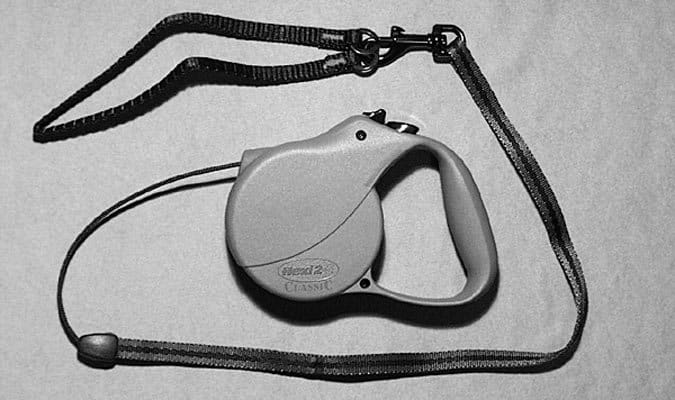
It almost reaches the level of a joke: If you go to a dog park or almost any gathering of dog people and their dogs, the worst-behaved dogs will be the ones on retractable leashes. It’s sort of a chicken or the egg thing: What came first, the poorly behaved dog or the leash that teaches him nothing?
I get how convenient it is to be able to walk along with your dog on leash and have your dog stop for a moment to smell something or take a quick pee, and you only have to slow your pace for a moment, rather than stop dead. When he’s through or he hits the end of the retractable line, he can trot to catch up, and you don’t have to scoop up all that line the way you would with a long leash, you can just allow the spring-loaded retractable thingie to wind it up.
However, what do you do when your dog is at or near the end of the line and:
- You are suddenly confronted by a loose dog, looking a little aggressive, coming your way, fast.
- Someone walks quickly out of a storefront, in between you and your dog.
- Your dog suddenly sees a squirrel on the ground across the street and bolts into the street in an effort to reach the squirrel.
The biggest problem is with these and countless other situations, when your dog is more than a couple of feet from you, there is nothing you can do very quickly to get him back to your side. The products can retract only when there is not tension on the line. As you know if you’ve ever used one, you really cannot grab the part of the cord that retracts into the handle and pull even a smallish strong dog back toward you. About the only way you could pull a dog to safety would be to mash the lock button down, while quickly turning in the opposite direction and trying to call or drag your dog in the other direction – depending on whether you’ve trained him to do emergency U-turns or whether he’s engaged already with the other dog or still on the hunt for the squirrel.
And to retract the slack when there is a chaotic situation brewing, like when that loose dog – or even one on leash! – is squaring off with your dog, and they are spinning around? Lock to prevent the dog from getting farther away, release to retract, lock, release, lock, release . . . it’s darned hard to do in calm circumstances.
When I want a dog to explore his environment without taking him off leash, I use a long line – a 20 or even 30-foot leash. I only use a tool like this in an environment where there are NO other people or dogs who might get tangled up with us, and the line is as smooth and easy to handle as my leash; I can easily grab anywhere on the line and manually reel in the dog if I have to.
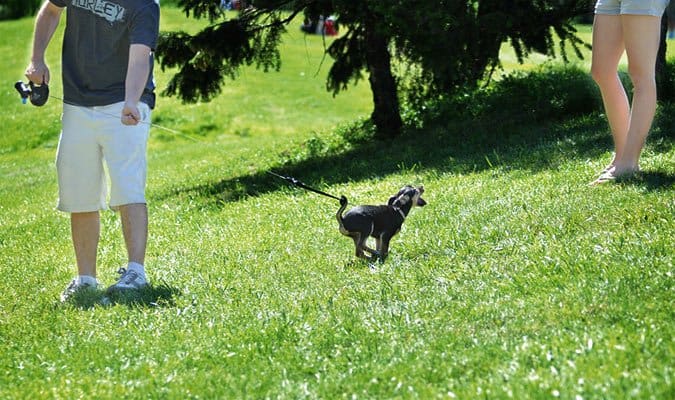
And what about the many cases in which someone accidentally dropped the handle, which started dragging on the ground and clattering loudly behind the dog, and spooked him into running in a blind panic into traffic?
We don’t even have to discuss emergency situations to get most trainers to chime in about how useless these tools are. They more or less train dogs to pull against pressure, by rewarding/reinforcing the dog when he pulls against the product’s spring (there is always some tension, even when the operator isn’t pressing the lock button) in order to reach something he wants to investigate. Getting to sniff something he was curious about is a reward – and behaviors that are rewarded get repeated. Simple as that.
Yes, a person can lock the handle and prevent the dog from pulling the line out of the device, preventing him from getting this reward. But then, you may as well just have a fixed-length leash.
As a final point against them, all I can say is, when this blog gets posted to the WDJ Facebook page, go ahead and post your photos of the deep, slashing cuts that you or someone you know has received when a retractable cord got wound around their leg when a dog was going nuts. That should give a little credence to the warnings against these products.
Can anyone honestly make a case for the responsible use of retractable leashes?




I use a retractable leash to walk my dog that is so well trained that he could have been off leash the whole time, but the law demands a leash. He is a mature dog, is not dog-reactive, and when we meet another dog, he will come to heel on his own choice because he knows that is the best place for him to be. (He is intimidated by larger dogs, and knows I will keep him safe.) It took YEARS of training to get him to this point. I do NOT use the retractable leash when I take him into a store, or in an urban setting, or going to the vet, or to a dog sport event we are to participate in. I ONLY use it to walk in the local forest park. ONLY when he could have been off leash, and I WOULD have trusted him to be off leash… but then there is the leash law.
When I first got my puppy I thought using a retractable leash was the best way to go. I soon learned that, that was not the case. My puppy is also very energetic and playful and chews through everything, she loves to play and run around so this wasn’t a good idea. I then ordered some other regular leashes which work a lot better. These are better because I have a better grip on it and I can control her when we are out better. I definitely think that retractable leashes are not the best and people shouldn’t buy those especially if their dog is playful and as energetic as mine.
Hello readers, it has been over a year that my beautiful best friend was killed in front of me as I walked her on a retractable. I had walked both of my dogs for 10+ years, many times a week, on a retractable leash. Nobody could have told me I would some how lose control of the leash as it extended out. One day I did lose control, as it began to rain while we were half a block from being back home. I found this site in search of people who may have sadly gone through a similar experience as it is still incredibly painful and trying to cope with the tragedy of being connected to her death. I wish I knew then what I know now, and hopefully someone reading this will change their mind to change their leash.
I own retractable leashes and I use them when appropriate. I also have a dog bungee that attaches between the retractable leash and my dogs harness to have some give when he reaches the end of the line. It is illegal for my dogs to be off leash where I am and there are a lot of areas where there are open fields. I use them there so my dog can still run without being confined to a 6′ leash. I do NOT use them with people or their animals around. I think that when used in an appropriate place (in a store or neighborhoods is not the best place) and used the right way it can be very effective.
There is nothing worse than a dog coming toward your dog on a retractable leash. It’s very hard to get away from them.
Retractable leads actually were designed to take the place of a long line, in training the Recall exercise. A handler puts the dog into a Sit Stay, then goes to the end of the line, and holds the handle either at waist level, or between the knees – and calls the dog. A trained dog will come zooming in, and the tool retracts as designed, without the dog getting tangled in a trailing string. Similarly, a retractable lead can be useful in proofing the Utility Directed Retrieve (gloves),Open Retrieve on the Flat, and potentially Utility Scent Articles – all exercises where a dog dragging a long line, might create problems. Any other exercises are best trained and worked on leashes between 3 to 6ft, or worked off leash inside some kind of separate locale where escape is not an option. Unfortunately, most owners are not competitive Obedience or Rally trainers, and see a retractable lead as “freedom” for their buddy, rather than the danger this tool poses when used for ANYTHING other than formal training exercises.
I don’t use a retractable for training but I sometimes use a retractable leash to take my dog outside for her last potty break of the night in order to let her have some room to roam while being able to prevent her from going after any critters including skunks that sometimes also roam in my fenced backyard at that time of night. I have also used it when I have wanted to stand out of the rain in my garage while letting her go potty in the front/side yard – although she has a good recall there are times I don’t want to test it.
A retractable leash is very bad for a dogs neck. The constant tension can damage the neck, including causing ruptured discs in the neck. If you don’t think so, try putting the collar with the leash attached on your own neck and have someone hold it at the distance you stand from your dog holding the leash with the tension on. Not long til your neck hurts and you start getting a headache. Just one more strike against this type of leash. I’ve also seen owners that use a retractable leash meant for a 80lb. dog on a 12 lb. dog because they liked the bigger handle! The force of the tension caused the damage mentioned above.