

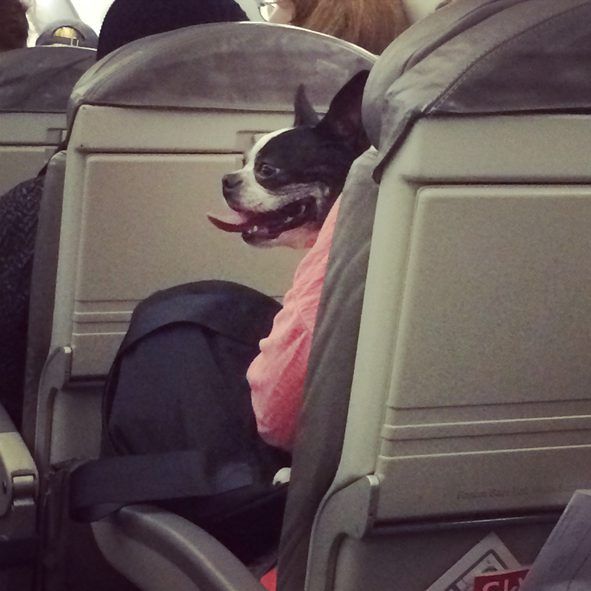
If you have flown anywhere lately, you are likely aware that there are many dogs flying with their owners these days. Take a stroll down any airline terminal, and you will see a number of dogs strolling on leash with their owners—and quite a few behaving in ways that are quite uncharacteristic of trained service dogs. I’ve seen dogs relieving themselves in airline terminals, barking or growling at other dogs, pulling on their leashes, and panting and showing other signs of stress.
I have chalked all of this up to the fact that so-called Emotional Service Animals (ESAs) were permitted to fly with their owners on airplanes for free, and that more and more people were willing to call their pet dogs an emotional service animal. But I was unaware until recently that in March 2021, after a lengthy public comment period and analysis, the Department of Transportation (DOT) changed the rules in its Air Carrier Access Act (ACAA) concerning emotional service animals (ESAs) on airplanes. At least when it comes to air travel, ESAs have been reclassified as pets, with no greater rights or privileges on airplanes as any other pets. Today, only service dogs—dogs who have been individually trained to do work or perform tasks for the benefit of a person with a disability—can fly with their owner outside of a pet carrier.
Undoubtedly, some owners who previously claimed that their dogs were emotional service animals are now claiming that their dogs are service dogs, trained to perform specific tasks if they detect their owner is having or about to have a psychiatric challenge or crisis. Owners of a psychiatric service dog must now submit forms to the airline they plan to travel with, attesting to their service animal’s health, behavior, and training.
As daunting as that may sound, a person who just really wants to fly with their reasonably well-behaved dog in the cabin with them will not find it difficult to lie on these forms—though I must mention that the forms state at the top, “It is a Federal crime to make materially false, fictitious, or fraudulent statements, entries, or representations knowingly and willfully on this form to secure disability accommodations provided under regulations of the United States Department of Transportation.”
I love seeing calm, well trained service dogs in public—and I hate seeing stressed dogs who are clearly being pushed past their comfort zone being dragged through public places. I find it hard to believe that there at genuinely that many people with trained psychiatric service dogs traveling by air, but maybe I am just flat wrong.
What’s your experience with dogs in airports and on airplanes?




The psychiatric Service Dog must be well trained, and as such will not pull at the leash, obeys commands, ignores other dogs, etc. just like any other service dog. Perhaps when an airline employee asks “what is the dog trained to do for you?” (the only question allowed) the airline employee thinks that dog is an emotional support dog. A letter from an M.D. and the required Dept. of Transportation form helps, even if it is a nuisance. I have a service dog for my neurodegenerative disorder and have never had anything but total acceptance on the airlines. My dog, Abby, has had 82 airplane flights. She is a yellow Labrador and they always seat us in “preferred comfort” seats, where she can lie down comfortably in front of me.
I do agree that an “almost fully trained” service dog SHOULD be able to fly.
My frustration is as a puppy raiser for Guide Dogs. 5-10 years ago I would routinely bring puppies in training on work trips requiring air travel. Of course this was towards the end of the dogs’ time with me, as they were reliable and comfortable with most situations. Air travel was one that is not easily simulated in any other way and there was a noticeable increase of comfort from the first trip to the 3rd or 4th. Currently the TSA paperwork requires a signed affadavit that the dog is a ‘fully trained service animal’ and I can’t attest to that since the dog is technically in training, so the last 2 years I have not brought dogs on the plane with me. How is a dog supposed to get exposure? There is always going to be that first trip, and better that any problems arise prior to working with a handler who has an impairment. It’s always wonderful to walk off of a plane, or out of a restaurant, when someone comments ‘I had no idea that dog was with you’ because they were so well behaved. There has to be an answer. I just don’t know what it is!!
Nancy with all due respect I think your blog both hits a vein a further stigmatizes guardians that require service dogs. Based on the comments my thought is your blog both requires retraction/correction and those with unseen disabilities. Why narrow it down as you have done!
The Department of Justice administers the Americans with Disability Act. That’s where the rules and regulations can be found. The rules were SPECIFICALLY written to avoid both breaches under HIPPA and DO NOT allow questions as to the handlers disability.
Two questions and two questions only are able to be asked:
1) Is the dog a service animal required because of a disability?
and
2) What work or task has the dog been trained to perform?
That’s it. There is no paperwork, registry, vest, or anything else required. The airline rules are a separate topic for the DOT/FAA and are more restrictive.
I agree with your thoughts. A trained service dog is expected, by the general public, to behave in a certain way. If it is unrulely or behaving inappropriately it is either not a trained service dog or needs further training. I once saw a “trained” hearing dog try to bit a person walking by him. To me that dog was not a properly trained service animal.