


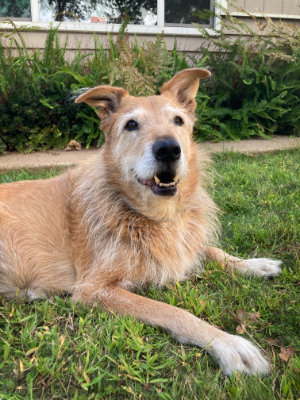
It’s at this time of the year that my dog Otto’s health insurance company sends out a renewal letter. And, of course, the older he gets, the more the annual premium goes up.
It only makes sense. He just turned 14 years old. His healthcare costs have increased. In addition to twice-annual well-dog visits, he gets an annual chest x-ray and abdominal ultrasound; he’s had benign growths removed from his liver, and had (a few years ago) a nearly symptom-free case of pneumonia, so we monitor abdomen and organs (for abnormal masses) and his lungs (to make sure they are clear of excess fluid). Plus, I give him a very expensive daily pain-relief medication for his osteoarthritis; it’s metabolized in a way that stresses the liver less than other nonsteroidal anti-inflammatory drugs, so it supposedly helps with his slightly compromised liver function. (It works, so I’m not messing with it, no matter its cost!)
But, yikes! Today, I had to do some math to see if the increasingly high cost was still worth it. I looked at what I spent this year as a guide:
Total cost of Otto’s vet bills in 2021: $3,025.00
What I actually paid:
| Total cost of Otto’s insurance premiums in 2021: | $2,557.37 |
| Deductible: | $250.00 |
| 10% of costs (insurance reimbursed me for 90%): | $302.50 |
| Total cost (so far*) in 2021: | $3,109.87 |
*This includes the cost of his daily medication and the premiums for the entire year, and presumes we have no more vet visits through the end of the year.
If we make no more visits to the vet this year, I will have paid $84.87 more with insurance than if he had not been insured. But, as everyone knows, just one emergency vet visit, with, say, just one blood test and a prescribed medicine or two, can easily cost $500 or more. If Otto has to go to the vet once more this year for even something quite minor, the insurance will have been worth the cost.
But the peace of mind of knowing that, no matter the cost, I could likely afford 10% of nearly any bill that he might incur… that’s priceless.
The fact is, knock wood, 2021 was one of our most event-free years in a while. The insurance paid off in a major way in the previous two years, when he needed more medical care.
In 2020, Otto incurred $4083.17 worth of veterinary care (including two major dental procedures). I spent $2,252.27 on his insurance premiums, $250 on the deductible, and paid just $408.32 for all those vet bills, because the insurance reimbursed me for 90%. My total was $2,910.59; insurance saved me more than $1,000.
2019 was the year when he had his liver surgery, with two nights spent at the specialty hospital where he had surgery. His total veterinary expenditures that year came to $7,152.45. I spent $1,745.27 on his insurance premiums, $250 for the deductible, and $715.30 for the vet bills (the insurance reimbursed me for 90%) for a total of $2,711.57. Having him insured saved me more than $4,400 that year.
Funny/not funny: Because of the rising price of his insurance premium each year, in 2021, even though he received less medical care than in either of the two previous years, I’ve spent more than in either of those years.
But if Otto hadn’t had insurance in either of those years, I might still be paying off credit card bills!
The increase in the annual premium has gone up steeply; in 2018, the monthly premium for Otto’s coverage was a full $100 less than I’ll be paying in 2022. The difference is more than what I was paying for my younger dog’s coverage.
Yes, I just used the past tense. Despite what I’ve just said about the clear benefit of having Otto insured, two years ago, I actually stopped paying for Woody’s health insurance. (This added to the cost of Otto’s coverage, as I had been getting a multiple-pet discount of 5% prior to cancelling Woody’s coverage.)

I’m taking a calculated risk with this tactic. I first bought health insurance for Woody when he was just a pup, and it was a good darn thing. He was an accident-prone adolescent, and I’ve lost track of exactly how many emergency vet visits he had in his first three years (I can think of five off the top of my head, though I think there must have been more). But after he turned about 3 ½, his medical visits reduced sharply (so far! knock wood!). His annual well-dog visit is pretty minimal, and he hasn’t needed a dental yet.
If I had been paying insurance premiums at the current rates for both dogs over the past three years, it would have tipped the balance; I would have been paying more for the insurance than what the two of them have incurred in costs. But, like I said, it’s been a calculated risk. If Woody had suffered from bloat, a torn ACL, or some other major health problem, then I would have been better off with insurance for both dogs.
When Otto dies, I’ll for sure buy health insurance for Woody again; he’s getting to the age that he’ll need a dental and should start having more tests at his annual vet visits.
As much of a fan if pet health insurance as I am, I can’t imagine affording health insurance if I had three or more pets; even with the multiple-pet discounts, it would add up to a lot. At that point, I’m guessing that most people would be better off saving money each month in an account dedicated for direct health care costs.
What accommodations have you made concerning health insurance for your dogs? Has it been worth it? Not worth it?




My dog is just 2 years old. I got her insured shortly before she turned 1. Shortly after that she developed a chronic cough that didn’t respond to treatment, and she was referred to an Internal Med specialist for bronchoscopy. Altogether with xrays, meds and bronchoscopy her bills topped $4000. I was reimbursed just under $3000. Just a week ago she sustained a fracture of the distal radius. We’re still waiting for the radiology report, but it’s likely she will need surgery by an Orthopedic surgeon. So again I think her insurance is a godsend. That said when she is older and the premiums skyrocket I’m unsure how I’ll pay for them. The peace of mind is priceless, but the premiums still have to be paid…
I always tell people to get pet insurance because of my experience. My rescue dog Cassie, who was 6 years old when I adopted her, ended up with cancer two years later. If I had not purchased pet insurance, she would most definitely be gone. She is 12 and has been cancer free for 4 years! The whole cost was close to $10,000 which I would not have been able to afford. Last year I had to cancel her pet insurance because the policy that I had selected (due to limited funds) pays to a maximum of $10,000 so with the deductible and the co-pay, I only had about $2,000 coverage left and the monthly cost was not justifiable. The cost of insurance seems to be more expensive in Canada. If I adopt another dog in the future, I will definitely get pet insurance dependent on what coverage I will be able to afford.
I absolutely swear by pet insurance and wouldn’t have a pet without it. For years I thought my friend crazy for having it. In 2015 one of my dogs ate an acorn. He had a surgery to remove it and unfortunately the surgeon messed up the surgery and the dog ended up septic. Although we lost Tobin, it wasn’t for lack of trying. The “good” part was money was never even thought of, we did what we had to for my dog. I have another dog who has maxed out his policy for two consecutive years. Much to my surprise our premiums didn’t sky rocket, just normal yearly increases. I tell everyone to get insurance. I insure my cars, house, boat etc. why wouldn’t I take that level of care in the animals I love?
please can you share what company you are using???
I got pet insurance for my now-nearly-15-year-old girl when she was just a puppy, solely because the vet included a pamphlet in her first wellness visit folder. It was the best decision I ever made. She too was accident prone in her younger years. In middle age, she needed a double TPLO surgery, and now in her later years, she has chronic pancreatitis and diabetes. Because we saved so much money with insurance, I got it for our coonhound mix when we rescued her at age 3. That amazing dog had nearly no medical needs other than her preventatives and wellness visits until she died of hemangiosarcoma at age 13. Over the decade we had her, we paid way more in insurance for her than we ever got back, but I’m sure between the two dogs, the investments balanced each other out. Plus, like you said, the peace of mind of knowing I can afford to provide my dogs with any treatment they need is worth it! Also – I’m curious about the arthritis pain med you give Otto. I too don’t want to strain my girl’s liver and am wondering how long Dasuquin will continue to be enough for her! I’d love to ask my vet if what Otto gets might be an option for her.
I’m also curious about the arthritis pain medication that Otto gets. My nearly 10 year old girl is on Galliprant – which is not an NSAID – for her arthritis/hip dysplasia pain. It has helped her tremendously since we started her on it a few months ago. I don’t recall the exact cost, but it’s all that expensive considering she gets it daily.
I consider peace of mind a critical item in a world full of chaos.
When something occurs I am not in the place of deciding do I go see the vet or wait. (In the world of insurance either pet or human this is the major problem).
My math over the decades with same company and one dog, tells me I come out ahead in the early and late years.
The company comes out ahead in the middle years. In the end I basically break even. I believe that is how all insurance should work. (Now for humans cost of administration and profit seem higher than for other animals).
So in the end I feel like I am buying peace of mind and have the ability to provide as needed.
Their service of a 24 hour vet on call has been great too.
Which pet insurance company do you use?
I stopped buying pet insurance a few years ago when I found out that they were no longer covering breeding expenses.
I now put what I would have paid for insurance for each dog in a high yield savings account and have a credit card tied to that account. it’s worked so well, that I was able to pay for a very expensive fence repair out of that account, and still have enough left to cover a major bill.
I found your pet insurance interesting. I took pet insurance out for peace of mind on my then 6 year old spayed female. For me, it was not a good move financially. They did cover her wellness exam, but but it seemed they were very quick to deem all other bill submissions as preexisting conditions, which I nor the vet deemed to be, and refused to pay. After one year, I decided the arguing with them and my time was just not worth it. Needless to say, I did not renew the policy.
You had poor insurance coverage. Mine has never seen anything as preexisting when I got insurance right at puppyhood
Obviously you fail to understand the issue at all ‘Happy’: getting the insurance at puppyhood is exactly what many comments are suggesting needs to be done because if you try and get it after the dog is over a few weeks old there will be vert notes insurance companies will use to preclude every last condition claiming it’s “pre-existing”. Hope you finally understand now.
My own experience with pet health insurance was that one has to get it for puppies. If you take good care of your dogs and take them into the vet when they have ailments or when you’re worried they might, then by the time they’re adults there’s too much medical history for them and *everything* is a pre-existing condition. I tried getting coverage for both of my dogs (5 and 7) and over a year’s time, there was nothing that didn’t have some sort of indication in their medical history.
We had considered getting pet insurance for our critters BUT decided to instead set aside what the premium might cost us and put that in a savings account. For the most part, our furries have been pretty healthy. (Except for the two free kittens that we spent around $10,000 on for vet bills due to feline leukemia and they both passed before their second birthday – as did their other four siblings that my friends had.) Kind of like… once our cars are paid for, we continue to put the same amount into another savings account so that we have a decent down payment for the next vehicles.
Although if you KNOW your pet will incur big expenses, then the pet insurance makes more sense. For all of my dogs, they’ve been healthy so I’d almost have been throwing away money with pet insurance that wasn’t being used. It’s kind of a toss up – save money for unplanned expenses or spend money on insurance to avoid spending as much should something happen. I could see health insurance being REALLY beneficial if, within the first couple of years of being insured, your dog is diagnosed with something.
Kind of like people insurance. I know I have health issues, so we go with my health insurance “Buy Up” plan for better coverage. (But my hubs is healthy so he’d probably be just fine on the “Base Plan”.)
Your reasoning on Woody is quite sound; however, no U.S. pet insurer covers pre-existing conditions so if he develops a chronic issue, that will not be covered when it comes time to shop around for pet health insurance. That’s a bit of a risk that should be taken into consideration, and knowing you as I do, I know you have.
Full disclosure: I am a veterinary medical writer for a pet health insurer. My own personal advice (not speaking for the company) is to get a plan with a very high or no annual/lifetime limit, no wellness coverage (budget for that, instead), as a high a deductible and co-pay as you can stomach. That will keep the policy cost down, but still give you protection from a serious illness or accident.
NB: Rates are going up because people are opting for higher levels of veterinary care (CT scans, radiology, etc.). It’s not the veterinary prices are going up comparing apples to apples, but rather that there are now oranges that were an option a a couple decades ago.
Excellent advice all around. I insured my current boy when he was 5 months old and even though his vet visits at that point were minimal, all it took was a casual vet note about one gunky ear when he was a baby to exclude him from all coverage of allergies for life (he developed full blown environmental allergies at about 1 y/o and it now costs me about $1,200 a year to manage that condition alone). We were also almost excluded from eye issues and skin cancers due to some very poor/vague other notations by a different vet… After great effort and reevaluation I was able to successfully contest the determinations by the insurer, but the whole experience made me realize the enormous pitfalls in insuring a dog with ANY existing medical history. I always recommend people get a thorough medical history review done before committing to a policy, so they are 100% aware of what the insurer will consider pre-existing for their dog (and what that could mean in terms of excluding related problems).
That said, getting insurance on my current pup was quite literally the best thing I’ve ever done – in his short 4 years I’ve already been reimbursed over 10K for assorted illnesses (some of which are now chronic and will require pricey lifelong monitoring). I’m not looking forward to shelling out for his premiums in a few years, when they’re in the multiple thousands of dollars, but in our case, it’s worth every. single. penny: the piece of mind I have knowing that my medical trainwreck of a dog will always have the care he needs, no matter the cost, is absolutely priceless.
So true..
This is the way we are proceeding–no wellness care; vet visit isn’t covered, just the treatment; pretty high deductible. Even with that, our oldest dog doesn’t have insurance–he is a healthy 17, but most insurers declined to carry coverage on a dog that old. In fact, we adopted him when he was 4 1/2 and the coverage then was already astronomical. When we get another dog, we’ll start coverage for him.