

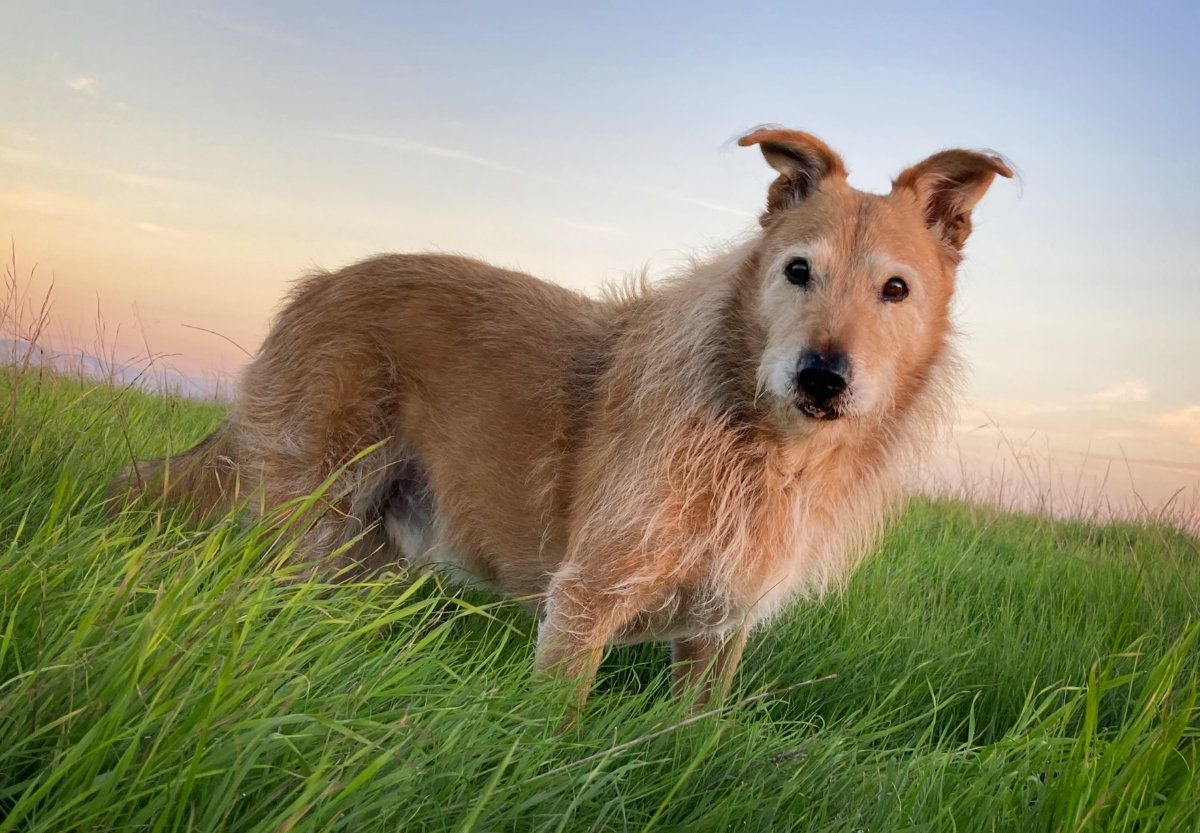
My 14-year-old dog Otto is starting to show signs of age-related dementia. While there are all kinds of ways dementia in dogs can manifest, his symptoms are most similar to what’s often called “sundowning” – where elderly humans seem pretty much okay in the early part of the day, but show increasing confusion, anxiety, and/or restlessness in the later afternoon and evening. It’s not been fun, but my husband and I are trying to adapt and accommodate his need for attention and comfort – but also meet our own needs for sleep!
It started in early November. A couple nights in a row, Otto woke me up in the middle of the night by coming into my bedroom (he and my 6-year-old dog Woody usually rotate between sleeping on the giant dog bed and the couches in the living room). On those nights, Otto approached my bed, panting loudly and clearly in distress. He’s done this dozens of times before, but always for one of a few reasons:
- He heard a car backfire or gunshot or firework and he got scared.
- His digestion was upset and he needed to go outside to relieve himself.
- He heard cats screaming, or people walking on our rural road (odd in the middle of the night), or smelled deer walking around; he urgently wanted to go outside to sound the alarm and investigate.
But in the case of these nights in early November, he wasn’t trembling in fear, the way he does if he hears fireworks or other loud BANGs, and when I got up to let him outside, he didn’t run off to relieve himself OR go charging off into the night barking, as he would have if had detected suspected intruders on or near our property. He just went outside and stood there, looking around, and then came back inside. And then just stood there, looking at me intently. When I told him to “Go to bed! Go lie down!” he did, but a few minutes later was back in my bedroom, panting loudly in my face, wanting … something! But what? Not food, not water, not to go outside. It seemed like he just wanted attention.
To allow my husband (at least) to get some sleep, I took a blanket to the couch and encouraged Otto to lie down next to the couch (he doesn’t like being on the couch as the same time as anyone else, human or canine). He would be calm as long as I was petting him and rubbing his neck and especially behind his ears (his long-time favorite spot), but if my hand would stop moving as I was falling back asleep, he’d loudly start panting and/or get up and start pacing around the house again.
That happened two nights in a row, and then for several nights, Otto was quiet all night. Then I left town for a few days, and on the last night I was gone, Otto’s nighttime restlessness returned. This time, my husband had to deal with it all alone. He, too, resorted to sleeping on the couch with one hand on Otto, but didn’t get much sleep. We discussed it when I returned the next day, and I called around to see if I could get Otto seen, soon, by any one of the three veterinarians I am currently using (last week, I described my three-vet regimen here).
The first vet who could see Otto suggested we run tests on his blood and urine, to look for clues of anything physical that might be amiss. Only one thing was out of whack, and it was a head-scratcher: Otto had a urinary tract infection (UTI). While these are common in older female dogs, it’s a bit unusual in male dogs. We added a urine culture test, to determine which specific bacteria was in Otto’s urine, and, while waiting for those results (which take a few days), we started him on a course of plain-Jane antibiotics.
The veterinarian also thought it was possible that the non steroidal anti-inflammatory drug (NSAID) that Otto receives wasn’t doing enough to relieve his arthritis pain, so we added gabapentin to his medication list.
When the urine culture came back, it showed that the bacteria in Otto’s urine was e. Coli – the most common culprit in canine UTIs, but again, much more common in females than males. He finished his antibiotic– unfortunately, without any appreciable change in his anxious nighttime behavior. We waited a week after that, and then I took him back to the vet to have his urine tested again. He still had bacteria in his urine! So we started him on another, more aggressive antibiotic,and the vet suggested I make an appointment with our vet who is board-certified in internal medicine, and perhaps do an ultrasound on his abdomen and particularly his prostate. Apparently, bacteria that gets into the prostate of older male dogs can be difficult to budge, and if this was the case, Otto’s prostate would have been inflamed and enlarged.
Nope, the ultrasound found nothing unusual. As before, he finished the prescription, we waited another week, and tested his urine yet again. Thankfully, this time, the infection was gone – but his nighttime restlessness was still present, even with the addition of gabapentin (and an increased dose).
It was then that I remembered I had a copy of a great book about canine cognitive dysfunction. Remember Me?: Loving and Caring for a Dog with Canine Cognitive Dysfunction (2016, Bright Friends Productions), was written by Eileen Anderson, an award-winning dog blogger who writes about canine behavior and learning theory (and a contributor to WDJ). I pulled the book off of my shelves and read the book cover to cover. It helped me realize a few key things:
While Otto is certainly showing some symptoms of this disorder, and while his frequent nighttime perambulations are disruptive, these behaviors are not as severe as they can become. As Anderson describes in the book:
The types of problems associated with canine cognitive dysfunction are often represented clinically by the acronym DISHA. DISHA stands for:
Disorientation
Interactions with people and other pets that have changed
Sleep-wake alterations
House soiling
Activity-level alterations
Anderson included a link to a website she maintains for sharing information about canine dementia. On the site is a long checklist of symptoms that dogs with dementia can display; visitors to the website can print out the list and check the symptoms their dogs are having. This can help the dog’s veterinarian understand the full array of behaviors a dog is exhibiting.
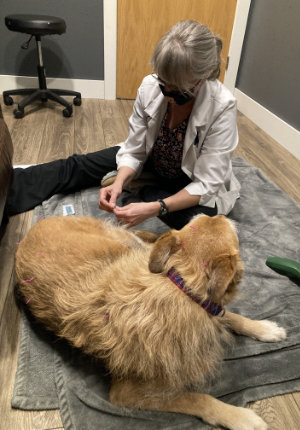
As yet, Otto is exhibiting only a few of these behaviors, and only at night – and none of the ones that seem like they would be making him suffer (such as getting “lost” in our home, “stuck” in corners, being unable to eat or drink, or falling off of things). I’m talking to my veterinary team about what sort of enrichment, foods, supplements, and/or medications we can try to preserve his brain function, and have taken him to see our third veterinarian for some acupuncture.
If your dog is elderly and exhibiting signs of dementia, I’d strongly recommend Remember Me? as an information resource.


Nancy, so sorry to hear that Otto is having this problem. My senior Collie developed this problem and I had amazing results by giving her the supplement SAM-e. You can buy it specifically for dogs (people take it too). It really helped her perk up and also start eating again. After a few months I raised the dose a little and she continued to do well. My vet approved of using this. It might be worth a try.
Hopefully, you’ll try some of the brilliant ideas they have for Otto, he deserves it. You should post and keep us updated. We’re invested in the poor guy now 🙂
I went through this with my 13 yo GSD for several months trying many different treatments. Some helped for a week or two. Rx Trazadone was the medication that allowed US to get sleep after 10 months of very little sleep & “sleeping” on the sofa next to her. Wish we had tried this sooner. I did purchase the book early on. So heart breaking to see them having difficulty. In the day time she was her normal self. So sorry about your precious Otto, hope you find something that brings some peace for all.
Nancy, I am sooo sorry to hear about Otto! Fortunately, I have never had to deal with any of this with any of my elderly dogs, but my current boy is 9 … Thank you for taking the time to write this very informative article for us (which in turn resulted in a lot more good information in the comments).
Sending positive thoughts to you, hubby, and Otto …
maybe you and hubby can take turns at night sleeping on the couch so the other can sleep. that’s what me and my husband did. no sense complaining about lack of sleep when the alternative is worse. i hope you try some of the reader’s suggestions…
i agree with the person who wrote about uti’s in adults. because of some dementia and alzheimer’s my elder aunt can’t voice how she feels but we can tell by her mood. do a urine culture and sure enough, uti. after a couple doses of antibx she’s back to her happy self. you described otto’s meds as plain-Jane antibiotics, i find that very offensive. as a woman and someone who knows janes who were called that growing up.
I gave my 15 year old American Water Spaniel melatonin at bedtime and SAM-E for his sundowning. It seemed to calm him down. He still legitimately had to be let out at least once a night to relieve himself and would come right in. Otherwise, he’d had a few episodes of wandering aimlessly in the yard, which prompted me to try the supplements. His vet approved.
Starting to see this in my 13 1/2 year old English Cocker as well. I switched him to ProPlan’s Bright Minds, and it’s definitely helped! Also going to look into CBD oil for him.
My heart goes out to you as you care for Otto! It is never easy to care for an older dog, and we who love them more than life itself suffer the most. Please take care of yourself, too.
Like so many others I will save this blog and comments as I suspect my beloved Shiloh is approaching the time I will need it. I Am so sorry about Otto… enjoy every day you can.
One tip … I have found that a night light in our bedroom (where he sleeps next to my side of the bed) has made a huge difference and helps him settle. Not a tiny nightlight, ours is a Himalayan salt night light, we can sleep but he is reassured and barks and paces less.
Hope this helps you too!
I am so sorry Otto is going through this. I know you will do your best for him.
I suspect this may have happened to Goliath when he was around 10. He should stand and stare off into space or circle around. He also became annoyed with a new puppy (I had recently lost my other dog and I thought Goliath was lonely as he had lived with Caesar his entire life) but his snarling escalated and Goliath retired to live with my parents. The vet warned he might get worse, moving from other animals to people. When my parents told me he was starting to snap at people he had known for a long time we decided it was time for him. After the tranquilizer he went into a seizure so I know it was the right thing to do for him. I wonder if he might have had a brain tumor rather than dementia but I’ll never know.
Thankfully Ramses passed before his dementia got very bad. He was just starting to show signs but he also had cancer and a potassium imbalance that would eventually give him heart failure. His last few months he had started to sleep with me on the bed again and that is where he passed peacefully. He also had arthritis and some bad discs in his back so increasing his pain medication did a lot to relieve many problems.
Diana pawPrints and Freyja Grey are both very young right now but I am better prepared to give them the care they need as they age. With every dog we learn and gain experience.
Hold Otto close. (And give him a kiss from me.)