

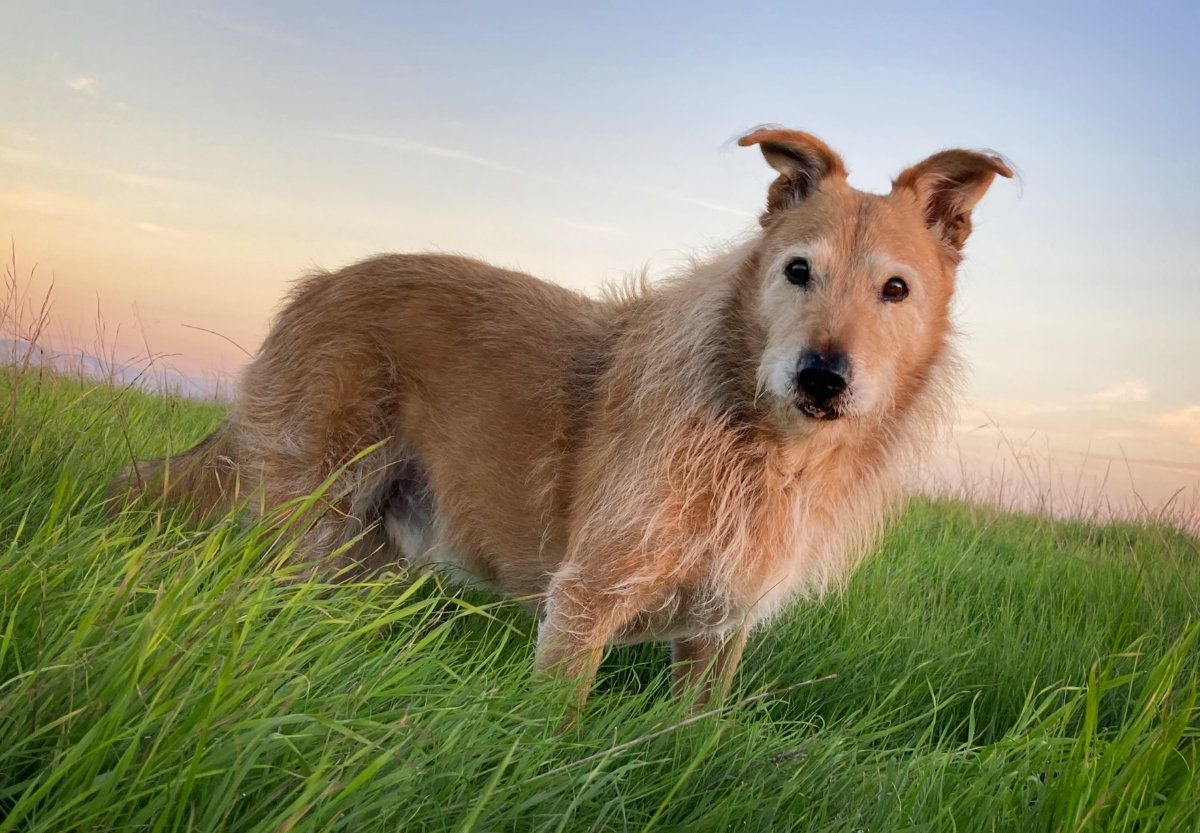
My 14-year-old dog Otto is starting to show signs of age-related dementia. While there are all kinds of ways dementia in dogs can manifest, his symptoms are most similar to what’s often called “sundowning” – where elderly humans seem pretty much okay in the early part of the day, but show increasing confusion, anxiety, and/or restlessness in the later afternoon and evening. It’s not been fun, but my husband and I are trying to adapt and accommodate his need for attention and comfort – but also meet our own needs for sleep!
It started in early November. A couple nights in a row, Otto woke me up in the middle of the night by coming into my bedroom (he and my 6-year-old dog Woody usually rotate between sleeping on the giant dog bed and the couches in the living room). On those nights, Otto approached my bed, panting loudly and clearly in distress. He’s done this dozens of times before, but always for one of a few reasons:
- He heard a car backfire or gunshot or firework and he got scared.
- His digestion was upset and he needed to go outside to relieve himself.
- He heard cats screaming, or people walking on our rural road (odd in the middle of the night), or smelled deer walking around; he urgently wanted to go outside to sound the alarm and investigate.
But in the case of these nights in early November, he wasn’t trembling in fear, the way he does if he hears fireworks or other loud BANGs, and when I got up to let him outside, he didn’t run off to relieve himself OR go charging off into the night barking, as he would have if had detected suspected intruders on or near our property. He just went outside and stood there, looking around, and then came back inside. And then just stood there, looking at me intently. When I told him to “Go to bed! Go lie down!” he did, but a few minutes later was back in my bedroom, panting loudly in my face, wanting … something! But what? Not food, not water, not to go outside. It seemed like he just wanted attention.
To allow my husband (at least) to get some sleep, I took a blanket to the couch and encouraged Otto to lie down next to the couch (he doesn’t like being on the couch as the same time as anyone else, human or canine). He would be calm as long as I was petting him and rubbing his neck and especially behind his ears (his long-time favorite spot), but if my hand would stop moving as I was falling back asleep, he’d loudly start panting and/or get up and start pacing around the house again.
That happened two nights in a row, and then for several nights, Otto was quiet all night. Then I left town for a few days, and on the last night I was gone, Otto’s nighttime restlessness returned. This time, my husband had to deal with it all alone. He, too, resorted to sleeping on the couch with one hand on Otto, but didn’t get much sleep. We discussed it when I returned the next day, and I called around to see if I could get Otto seen, soon, by any one of the three veterinarians I am currently using (last week, I described my three-vet regimen here).
The first vet who could see Otto suggested we run tests on his blood and urine, to look for clues of anything physical that might be amiss. Only one thing was out of whack, and it was a head-scratcher: Otto had a urinary tract infection (UTI). While these are common in older female dogs, it’s a bit unusual in male dogs. We added a urine culture test, to determine which specific bacteria was in Otto’s urine, and, while waiting for those results (which take a few days), we started him on a course of plain-Jane antibiotics.
The veterinarian also thought it was possible that the non steroidal anti-inflammatory drug (NSAID) that Otto receives wasn’t doing enough to relieve his arthritis pain, so we added gabapentin to his medication list.
When the urine culture came back, it showed that the bacteria in Otto’s urine was e. Coli – the most common culprit in canine UTIs, but again, much more common in females than males. He finished his antibiotic– unfortunately, without any appreciable change in his anxious nighttime behavior. We waited a week after that, and then I took him back to the vet to have his urine tested again. He still had bacteria in his urine! So we started him on another, more aggressive antibiotic,and the vet suggested I make an appointment with our vet who is board-certified in internal medicine, and perhaps do an ultrasound on his abdomen and particularly his prostate. Apparently, bacteria that gets into the prostate of older male dogs can be difficult to budge, and if this was the case, Otto’s prostate would have been inflamed and enlarged.
Nope, the ultrasound found nothing unusual. As before, he finished the prescription, we waited another week, and tested his urine yet again. Thankfully, this time, the infection was gone – but his nighttime restlessness was still present, even with the addition of gabapentin (and an increased dose).
It was then that I remembered I had a copy of a great book about canine cognitive dysfunction. Remember Me?: Loving and Caring for a Dog with Canine Cognitive Dysfunction (2016, Bright Friends Productions), was written by Eileen Anderson, an award-winning dog blogger who writes about canine behavior and learning theory (and a contributor to WDJ). I pulled the book off of my shelves and read the book cover to cover. It helped me realize a few key things:
While Otto is certainly showing some symptoms of this disorder, and while his frequent nighttime perambulations are disruptive, these behaviors are not as severe as they can become. As Anderson describes in the book:
The types of problems associated with canine cognitive dysfunction are often represented clinically by the acronym DISHA. DISHA stands for:
Disorientation
Interactions with people and other pets that have changed
Sleep-wake alterations
House soiling
Activity-level alterations
Anderson included a link to a website she maintains for sharing information about canine dementia. On the site is a long checklist of symptoms that dogs with dementia can display; visitors to the website can print out the list and check the symptoms their dogs are having. This can help the dog’s veterinarian understand the full array of behaviors a dog is exhibiting.
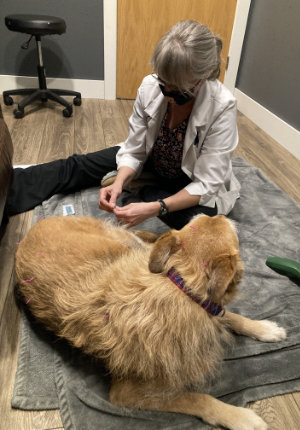
As yet, Otto is exhibiting only a few of these behaviors, and only at night – and none of the ones that seem like they would be making him suffer (such as getting “lost” in our home, “stuck” in corners, being unable to eat or drink, or falling off of things). I’m talking to my veterinary team about what sort of enrichment, foods, supplements, and/or medications we can try to preserve his brain function, and have taken him to see our third veterinarian for some acupuncture.
If your dog is elderly and exhibiting signs of dementia, I’d strongly recommend Remember Me? as an information resource.


So sorry you are dealing with this difficult situation with Otto. Of all the dogs we have had, our sweet Baxter (tibetan terrier mix) was the only one with dementia, while he was going blind and deaf at 14. He circled for hours in the evening, got stuck in corners and under furniture and fell in the pond and was unable to hold himself up so I went in after him. We did our best for about six months until our holistic, intuitive vet told us, he is ready to go – not having fun any more. It was a great comfort to know the decision to let him go was when he was ready.
Hi Nancy. At NaturVet we work a lot with holistic veterinarians. Dr. Ihor Basko formulated Emotional Support which you can administer every 6 hours to Otto. It can be fed long term and also improves cognitive function in senior dogs. This is not a commercial for NaturVet, I just want to help Otto. And you.
My 14 yr old Westie is going through this. He sleeps in the living room, when I start getting ready for bed he gets Anxious.I leave the t v on with a timer and down low and a lamp dimmed to low.this helps him dose off.I also started putting a diaper on him as he is starting to wet the floor at night. So far this is working.he has congested heart failure too , I give those meds at night to help him sleep.
My 14 year old easy-going Miniature Schnauzer has become anxious since he developed a seizure disorder. My vet suggested that we try a CBD chew Chroniquin. It was tremendously helpful, and the only time he shows anxiety now is during those “bang” times — fireworks on July 4, etc. And surprisingly, referee whistles during sports really freak him out, so I mute my tv then. My vet helped me get a supply, but Texas law doesn’t allow vets to dispense CBD products. Since California is a more sane state, you might check with your vet to see whether it’s available there. A last comment: I found that my dog didn’t need the full dose that matched his weight. The package calls for him to take 1.5 chews a day, but for my guy, 1 chew was enough. Good luck with Otto!
Why not try an herbal or aromatherapy remedy that helps with sleep? I’m not sure what works for dogs, but herbal remedies for people include valerian. For aromatherapy, you need to use a smaller amount because of dogs’ heightened sense of smell or dilute it with a carrier oil. Lavender is the first one I’d try (maybe a drop on his collar about 15 minutes before you go to bed).
There is also the pherome Adaptil Calm collar, which I’ve used with my Great Dane successfully. This is worn all the time and she is more relaxed and calm.
Would a regimen of Lions Mane help? I understand it is a downhill slope but at this point what would you have to loose? Does the brain chemistry actually change with dementia? I am going through this with my elderly parents. Good luck.
Selegiline really helped our dog Maxwell who was dealing with this. It gave him another year or so of quality life. He transitioned from 1 am barking marathons to sleeping peacefully for a number of months.
Eventually his night terrors returned, and mobility challenges and pain management all added up to our decision to euthanize him at ~14 years of age. But Selegiline bought him some time and peace for the whole household!
Herbal remedies can be very helpful with Canine Dementia. I have used California Poppy, Passion Flower and Chamomile quite successfully.
Nancy, so sorry that Otto and you, by extension, are experiencing distress. Weirdly, UTIs in senior humans are well known for inducing temporary dementia, which clears up after treatment of the UTI. My senior German Shepherd who passed last year at 15, was pretty frail, and deaf, but not at all senile, thankfully. She continued to accompany me on hikes, although I did put her back in the car after 30 minutes, while the younger two and I completed a longer hike. I thought the exercise was good for her brain as exercise oxygenates the blood.
Thinking of possible accommodations, I wonder if confining Otto to a kennel on a trunk or something right next to your bed (so that he can see and smell you) might help contain his apparent anxiety at night, and daytime exercise might help him relax. With my old girl, she lagged behind off leash at a slower speed than the younger ones, but she still was game. We stayed on the same route to reduce any possibility of her getting lost.
Poor dear Otto! I do hope he gets better! I do hope you’ll be able to get enough sleep somehow. I’m so useless when I don’t get enough sleep.