

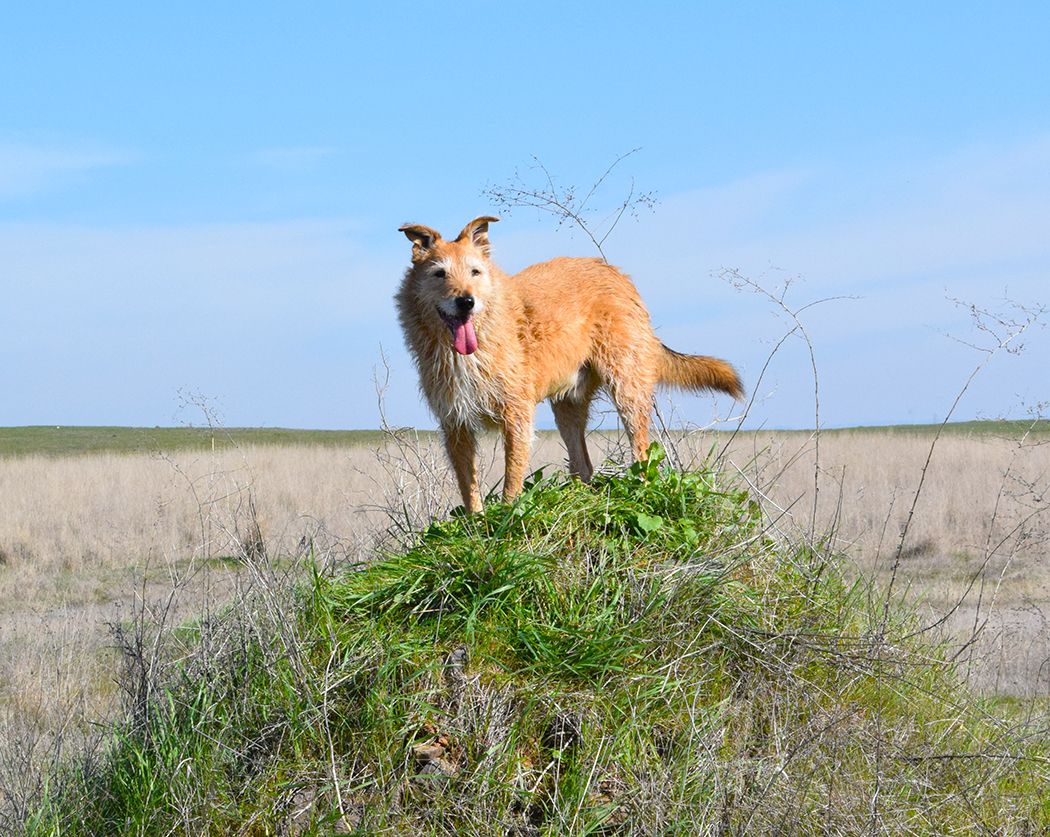
It never fails: Every time I take my senior dog Otto into public, people ask what breed he is. And I have to smile and shrug. My standard answers:
“He’s a Disney dog!”
“He’s an Oroville Chickenhound!” (He was found as a stray pup, about four months old, in someone’s chicken coop, and brought to my local animal shelter. When I adopted him at the estimated age of 7 months, I couldn’t believe that such a cute pup had been languishing there for three months. It may have had something to do with the fact that his cage card indicated that he killed chickens.)
Mostly what I say is, “He’s very mixed.”
However, this tend to make people ask “Why don’t you get one of those DNA tests that tell you what he is?”
And I have to say, “I have! Five times! And the results are mixed!”
Otto’s DNA Journey
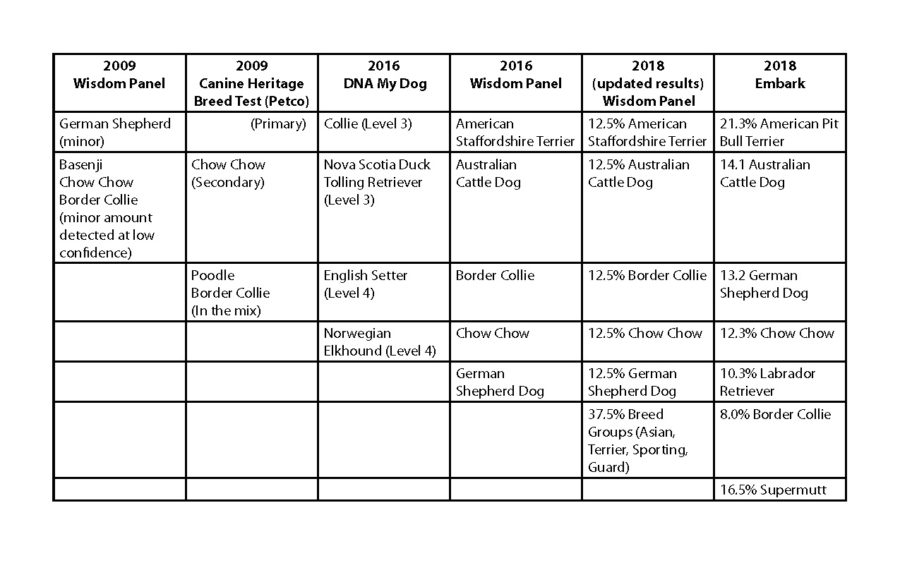
In 2009, I sent Otto’s DNA to the two companies that seemed to be the most reputable at the time, Wisdom Panel and Petco’s Canine Heritage. The technology was new and the results were a sketchy on details, but both companies detected Chow Chow and Border Collie. Wisdom Panel thought there was also German Shepherd and Basenji; Canine Heritage thought there was also some Poodle. I thought any of that was possible, with the exception of Basenji.
In 2016, I planned to write an updated article about DNA tests, and I again sent Otto’s DNA off to two companies that offered mixed-breed identification, just to see what they had to say.
One of the companies was DNA My Dog. Its results agreed with my “very mixed” assessment, but the breeds they suggested that might be present bordered on ludicrous: Collie, Nova Scotia Duck Tolling Retriever, English Setter, and Norwegian Elkhound. Given the rural and economically depressed area in which Otto was found, I think it’s unlikely that any of those four breeds have ever set foot in the area—or at least not in the same generation!
The other company I sent a sample to in 2016 was Wisdom Panel. Shortly after the company received the sample, I received a message indicating that they recognized that they had tested the same dog previously, and that they would test the new sample anyway. Cool! That lent the endeavor credibility.
Wisdom Panel’s 2016 results offered a lot more detail than in 2009. “Basenji” had disappeared (it had been pretty unlikely), and the previously detected Border Collie, Chow Chow, and German Shepherd were still present. However, topping the list were two breeds that had not been reported by any of the companies previously: American Staffordshire Terrier and Australian Cattle Dog. At that time, the company didn’t offer estimates of the contributions of potential ancestors by percentage; instead, it offered a theoretical family tree. Otto’s showed no possible purebred ancestors until at least the great-grandparent level.
I think I might have written a blog post about the results, but I know I didn’t get around to writing a feature article about DNA that year.
Some New Information
In 2018, I asked one of our contributors to write an updated article, instead. I revisited the Wisdom Panel website, knowing that they promised to occasionally “refresh” their results as their technology improved. I also sent a sample of Otto’s DNA to a new player on the mixed-breed identification block, Embark.
In 2018, Wisdom Panel was expressing the contributions of various breeds in the dogs’ DNA as percentages. All of the results in Otto’s 2016 report were the same, but percentages had been added. They indicated that there were about equal amounts of Am Staff, Cattle Dog, Border Collie, Chow, and German Shepherd in Otto.
This was very interesting in light of the results I received from Embark’s 2018 test of Otto’s DNA. Its results were very similar—with a notable exception. Embark identified Otto’s bully breed ancestor as American Pit Bull Terrier, and also indicated that he was more APBT than anything else, as much as 21.2%! This company also found Cattle Dog, German Shepherd, Chow, and Border Collie in Otto, but added some Labrador.
While I have to admit that I’m looking forward to any future testing or updates available, I’m going to stick with calling Otto “very mixed.”
Has anyone else had your dog tested by different companies? How did your results vary?

One caution: dogs that share water bowls may cross-contaminate swabbed samples, leading to some confusing conclusions on heritage.
We recently rescued a senior “mutt” from a shelter who had been picked up as a stray. He was described as a “terrier cross” and looks exactly like a neighbor’s purebred rat terrier. We sent in his DNA to Wisdom Panel and it came back 3/4 chihuahua and 1/4 mixed groups of hound, terrier and Asian. It also claims there is 1 purebred dog in his heritage (terrier). I am definitely questioning the legitimacy of these results as to be 3/4 of anything, wouldn’t one dog have to be a purebred? And chihuahua is NOT a terrier Further, he is an underweight 15#; at healthy weight will likely be 18-20#. I want to order a test from a different company, and would like to know which is the most reliable (without breaking the bank).
That sounds like a likely mix.
Those pure breds would be up in the Great Grandfather range. Many dogs identified as rat terriers are really chiuahuas. And chihuahua crosses are almost as prolific as pit bull mixes.
You can get a 50,25,25 mix with two parents that are half of the same thing. So a Lab/golden and a Lab/Shepherd can result in a dog that is half lab, but didn’t have a pure bred parent. If three of the grandparents were each half chihuahua, you might get 75% chihuahua with no pure bred until up in the great grandparents. And one of those great grandparents could be a terrier. Maybe even a rat terrier.
All of the family trees are best guesses. The percentages can be off a bit, but for the most part are close. The technology is getting better every year.
Effie is fifty pounds short legged big frame dog with a long haired blond coat. Appearance of a giant Cairn Terrier. Wisdom panel said 25% each German Shepherd Whippet Siberian Husky 12% chow. No terrier. She is beautiful and the subject of many comments and questions when we walk. She was a rescue from a shelter near Los Angeles so we think someone was breeding dogs fo tv commercials or the movies
I had my mixed breed dog done by two different companies. I can’t remember who they are now. I believe thaqt one was the Wisdom panel. That one was the most accurate, I believe. y dog came back as up to 75% Maltese, up to 25% Chihuahua and up to 25 % Border Collie. My Brendan almost looks like a Westie if you don’t really know what a Westie looks like. He has a white coat (Maltese), The ears and tail are Chihuahua. He weighs 17 pounds so how can he be those breeds? The 17 pounds come from the border Collie. He also herds me when he comes in from outside. I cal him my Malchibor!
Or a Colltesehua.
Have never done it, probably never will. I have one who is a total mutt, every one who meets her is convinced she must be part… “insert breed of your choice” here. I always just say that I have the ultimate designer dog, one of a kind, okay more like one out of 5, she did have siblings that were all rescued together, Regardless, her mama was spayed and so the mold was broken and there won’t be any more like her. . My second dog is a terrier mutt, maybe I’ll have it done on him just for fun.
I”m considering a DNA test for my rescue dog who looks pure Airedale but Sheds like a Golden. Any suggestions?
Currently it appears Embark is leading the way in accuracy.
I would also recommend Embark.
If you can afford it, get the full medical.
My boy, Tango, was tested by 2 companies, one which was totally in left field and later admitted they did not have enough samples to test what I needed for a hound dog. However, I used Wisdom Panel in 2012 and in 2017 and they changed their assessment to what I think is believable. They always found Border Collie and American Foxhound. The former year they also said two other breeds, Dachshund and Smooth Fox Terrier. I found the Weiner dog impossible to believe. However, in 2017 they came back with only 2 breeds, 50% each, American Fox Hound and Border Collie. I tend to believe this result. Of course I will never know the truth but this is what I go with. Tango is 10 now. I doubt I will ever do another test for him. But I hope the science gets more accurate in the future as I am sure it will. I find it extremely fascinating.
a huge ssue with DNA tests for dogs is that most breeds ARE composites of other breeds ( for example, a purebred Great Dane IS a dog who originated from Mastiffs and greyhounds…so a mixed breed dog who has , say, a Dane grandfather might test as having Mastiff and Greyhound instead of Great Dane.
That said I have two very mixed Brazilian mutts — one is probably a 100th generation all-mutt and I’d be curious to see what they come up with, but just don’t have the disposable income.
I have a dog, Dolly, who is a “purposefully bred” mixed breed. I lost my two beloved English Mastiffs to cancer at 6 and 7 so I opted for a “designer Mastiff” a cross of 62.5% Boerbel (sp?) 12.5% Great Dane, 12.5% Dogo and 12.5% Anatolian Shepard.
We have a small horse ranch in the country with little contact with neighbors so a livestock guardian/working dog seemed perfect. She is healthy at 4.5 years but is very strong willed and very independent…not very trainable. Last winter we had a cougar attack on a horse and multiple days with fresh cougar tracks near the horses and goats. The attack occurred at night when Dolly was sleeping by my bedside. I remember her barking in the middle of the night and telling her to be quiet…. I let her out eventually and she ran into the dark barking all of the way. The next morning one horse had large scratch marks across her face and on her rump but was otherwise okay.
I haven’t decided if my nearly 200 pound designer mutt dog is from heaven or hell… but I do love her, and feel safe when she is with me out in the bush.
Kathleen – she sounds like a great dog to have on an isolated ranch! Glad your horse survived. As you know the percentages of breeds in her, it would be very useful to have her tested by multiple companies to see how accurate their testing is. Wonder if Whole Dog Journal or someone else could fund the testing as it is pricey and then do an article/review. Comparing a known mixed breed to their analysis would be very instructive.
I like “Disney Dog”.