

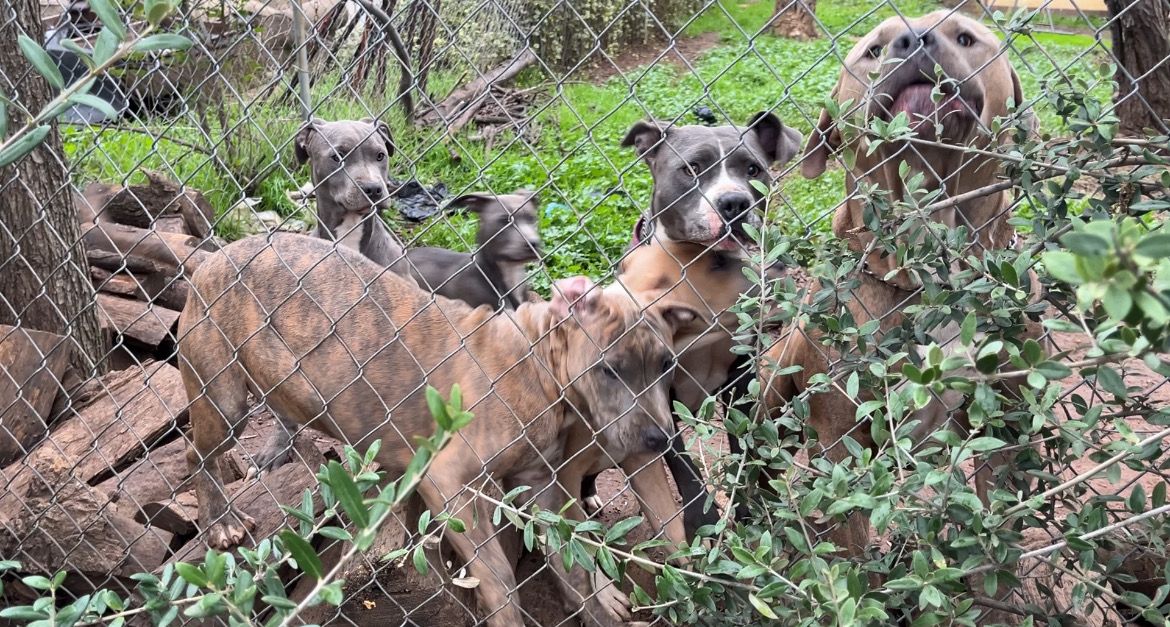
A few weeks ago, I went to a local park to watch a flag football tournament that my 11-year-old grandson was playing in. It was being held in a park in a residential neighborhood; the boundary fences of two sides of the park are also the fences of houses’ back yards. I couldn’t help but notice that whenever someone at the tournament went down the park sidewalk by one house’s back yard, a cacophony of barking and snarling would arise – a concerning sound, coming from a location with a couple hundred kids and families present, separated by a single fence. Between games, I wandered over to take a look.
Yikes! It was worse than I imagined. In a muddy, junk-filled back yard, I counted six bully-breed dogs: four pups, about 4 or 5 months old; a gigantic intact male, and a smaller female who was, judging by her elongated nipples, the mother of the pups (and likely not her first litter). There wasn’t a shred of bedding or even the tiniest bit of shelter in the yard. As I approached, the mother dog barked and lunged and bit at the chain-link fence – and, occasionally, as the puppies joined her in barking, she attacked one of them, eliciting violent snarls and skirmishes among all of them in a classic mess of what behavior professionals call “redirected aggression.” Arousal plus frustration equals attack anything that moves. Oh boy.
I scrutinized the fence; it seemed adequate for holding the dogs. But there was some firewood and some other junk stacked against it – and a really motivated, athletic dog could certainly climb or jump to the top of the junk and scale the fence. I walked around to the front of the house, took down the address, and then went back to where my husband and grandson were waiting for the next game to start. (I also texted information about the situation and the address to a friend who is one of our town’s animal control officers; he promised the department would follow up with a welfare check.)
For over five hours – the length of time we were at the park – I listened intently every time I heard the dogs erupt in barking, and each time, it devolved into snarling and fighting sounds and gradually stopped.
Am I the only person who starts wondering what I would do if an aggressive dog (or dogs!) appeared on the scene and started attacking people – or attacking me, or my dog? I have witnessed a couple of dog fights (which were broken up fairly quickly) and one terrible incident in which a bully-breed dog attacked a small cattle dog (which took forever to separate the aggressor from the screaming victim dog). At my local shelter, I once saw a dog who was being held for the duration of an investigation into the mauling of an elderly woman, who was nearly killed in the attack (and actually had her lower leg amputated due to the severity of the injuries she suffered to her foot and ankle).
But I’ve never seen a dog attack a human, and every time I read or hear about a human victim of a dog-mauling, I wonder: Would I fare any better? Would I know what to do?
I thought about this again after viewing a TikTok video in which a dog trainer discussed an incident in which an owner was mauled by his own dog and had to be rescued by passers-by. The trainer commented, “In my professional opinion, if you choose to own a large, powerful breed, especially one that is bred for aggression, be it guarding behavior, be it protection, be it a dog bred with dog aggression – you need to be able to physically disable that dog if it decides to attack someone or something. You should know the techniques and you should have the physical strength to do it…”
I agree; all dog owners, but especially people who own large, strong dogs should know what to do in case their dog attacked someone (or themselves) and be capable of doing it. But what about the general public? Would anyone at the park where I watched kids playing flag football know what to do if one (or more) of those frustrated, neglected dogs got out and attacked someone?
We’ve published just a couple of articles over the years about defending yourself (or your dog) if you or your dog were attacked by a dog (here and here). I didn’t find any perfect videos or other sources of good information on this topic elsewhere; this video is probably the best thing I found (besides the articles in WDJ!).
Maybe it’s a weird thing for a dog lover to be thinking about during a nice day in a park – or for a couple of weeks afterward. What do you think? Have you ever wondered how or whether you could defend yourself against an attacking dog? Or have you had to do so?




I have been attacked twice by loose dogs while out on a leashed walk with my #26 happy go lucky dog. The first attack I had enough time to get us in between two parked cars thus limiting the attacks from the two dogs from two areas. I tried the low commanding “no” voice but the dogs were to aroused. I alternated large aggressive steps back and forth between the two dogs at the front and rear of the cars. They had always been aroused when we walked by before, much like the dogs in the blog article. The owner came over after a long 1-2 minutes and chased them off but couldn’t secure the dogs.
The second time a loose dog was clearly making a straight line towards my dog. I again tried the strong “no” in the few seconds I had before contact was made. There was no hesitation on the aggressor dog and I step in front of my dog hoping for a “matador” effect on the loose dog. What happened was I was now not in a strong footing position and the charging dog hit me just above the knee, leaving a bruise, and knocked me with enough force I tripped over and slammed my head hard enough on the pavement I was knocked out. Thankfully a friend was with me who carried a walking stick and she was able to bang the stick between us and the aggressor dog. I ended up being bitten and spent 3 days in the hospital with complications from a skull fracture.
I now carry 3 forms defense. The long range defense is a 1 mile storm whistle. On that lanyard I have clipped pepper spray as my mid-range defense, and my close in defense is a trekking pole. I have had to use these on a few occasions. The whistle combined with a solid “don’t mess with me” posture worked on a few occasions. It made one dog think about its next move and spraying the pepper spray across the dogs intended path made it keep its distance even though it followed us for a short time. I think a less harsh chemical spray wouldn’t have had the deterrent effect I would have wanted.
This tools have to be accessible in a matter of seconds if needed. I tuck the pepper spray in my pocket with the whistle hanging out so I can grab and engage it within 2-3 seconds. This also allows me, if I have the time or need to quickly transition to the pepper spray if it is useful / needed.
The best information I have seen about how to handle these situations is a free webinar from a professional trainer who specializes in dogs with aggressive behaviors, Michael Shikashio. Go to aggressive dog.com hit the dog owners tab, hit webinars, scroll down to the emergency defensive dog handling webinar.
I hope this helps someone else to learn from my encounters and from a professional trainer to avoid injury to themselves and their dogs.