

On March 2, 2021, USA Today published an article about the Seresto collar, originally developed and brought to the market by Bayer Animal Health in 2012 (the product was purchased by Elanco Animal Health in 2020 and has been manufactured by Elanco since then). The article highlighted the fact that the United States Environmental Protection Agency (EPA) had, at that time, received nearly 1,700 reports of animal deaths associated with use of the collar. Worried pet owners began flooding their veterinarians’ offices with calls about whether to remove their pets’ Seresto collars.
On June 15, 2022, the U.S. House of Representatives Committee on Oversight and Reform, Economic and Consumer Policy Subcommittee held a hearing about Seresto collars. Following publication of the USA Today report in 2021, the Subcommittee had been investigating reports of adverse effect incidents and pet deaths potentially related to the Seresto collar. Last week’s hearing, the Subcommittee described, “will examine the EPA’s failure to regulate the Seresto collar as well as Elanco’s refusal to take action to protect pets and their owners from the collar’s harm.” (A link to video of the 3 ½-hour hearing is available here.)
A number of witnesses testified in favor of demands that Elanco voluntarily recall the collar and the EPA cancel the product’s registration. These included owners of dogs who died after wearing the Seresto collar, the Environmental Health Science director of the Center for Biological Diversity (a nonprofit membership organization known for its work protecting endangered species through legal action), and a retired scientist/communications officer who previously worked for the EPA.
Defending Seresto’s efficacy and safety record to the Subcommittee was the President and CEO of Elanco. The company said the rate of complaints is a fraction of the overall sales – which have surpassed 34 million in the past decade – and that the rate has declined over the years. It also said that most incidents are classified as “minor” or “moderate” and that the pet did not suffer “any significant or permanent harm.” A link to Elanco’s complete statement is here.
No representative for the EPA appeared at the hearing, but the EPA submitted a statement (linked here), which explained that, following publication of the USA Today report in 2021, the EPA asked Elanco and Bayer, as the current and former registrants of the Seresto collar, to provide EPA with additional data on reported adverse effects of the collars. This information was received in May 2021, and is being analyzed by EPA, with additional help from the Food & Drug Administration’s Center for Veterinary Medicine (FDA/CVM). According to an excerpt from the EPA’s statement, “With the consultative assistance of FDA, EPA expects to finish its scientific review of incident data and other studies by fall 2022. Upon completing its analysis and assessment, EPA will determine whether these pet collar registrations can still be used safely according to the instructions on the label or if additional safety measures or cancellations are needed for these products.”
Benjamin Disraeli is often quoted, “There are three types of lies – lies, damn lies, and statistics.” Ideally, the adverse event reports for every pesticide and drug would be 100% available to the public to review. Without the ability for independent researchers to analyze these reports – as well as verify sales numbers for pesticide products – it’s hard to know how real the threat to any individual dog might be. We will be looking forward to seeing the EPA’s promised report this fall.
How to minimize your dog’s risk of adverse events
Dog owners need to be keenly aware that every effective pesticide will cause adverse effects in some animals; that’s the nature of products that are meant to kill parasites. There are health risks associated with every single pesticide on the market. Every time you apply a topical pesticide to your dog, or have him injected with a medication or feed him a medication that will kill fleas and ticks, you take the risk that your dog will have an adverse response to that pesticide or medication. We recommend that these pesticides and medications are reserved for use only on healthy dogs when specific need for their use arises and their potential benefits outweigh their potential risks. In our opinion, these should never be used without a pressing need.
What is a pressing need? Exposure to tick-infested environments or a flea infestation that persists beyond immediate and less-harmful removal tactics (such as bathing with a regular detergent [such as Dawn dish soap] and flea-combing). If you don’t walk your dog where there are ticks, and haven’t had any issue with fleas, there is no reason to start using a Seresto collar or administer any other flea- and tick-killing treatment to your dog!
Fleas and ticks also pose real and potentially life-threatening dangers to dogs, so if one or both of these parasites are an actual danger to your dog, you will have to decide whether your dog is healthy enough to risk potential side effects of a treatment. Fortunately, there are a number of things you can do to reduce the potential for harm to your dog from pesticides and flea/tick-killing medications:
- Use an integrated pest management (IPM) plan to control persistent flea infestations, so you can use pesticides less frequently in the future. This link provides a good source of information on how to do that.
- If the pets in your home repeatedly get infested with fleas, try to identify the source of reinfestations. Indoor/outdoor cats are often the culprits, as they may rest in places frequented by flea-infested mice, rats, squirrels, or chipmunks, picking up fleas there and inadvertently bringing them back home to reproduce.
- If you have used a particular flea/tick-control product and your dog had an adverse reaction to that product, note the information in any place that will help remind you to avoid that product or its active ingredients in the future.
- Take immediate action if you notice any sign of an adverse response to any flea/tick-killing pesticide or medication. If you applied a Seresto collar, remove it and give your a series of baths to help eliminate all of the pesticide that was not yet absorbed into his skin. Same goes if you applied a spot-on topical pesticide; give him a series of baths with a detergent such as Dawn dish soap.
- If your dog has chronic health problems, such as cancer, seizures, thyroid problems, diabetes, liver or kidney disease, etc., we’d avoid using any topical or oral pesticides. We wouldn’t recommend giving dogs with cancer or those who suffer from seizures any pesticides whatsoever. Instead, we’d use whatever IPM tactics were at our disposal to control fleas if necessary, and would avoid tick habitats at all costs.
- If you have used a particular pesticide product on your dog with great success (fleas disappeared, walks in areas known to be infested with ticks did not result in any or just a few tick-attachments) and without any adverse events, stick to that pesticide if you need one in the future. Don’t introduce an entirely new pesticide that may pose potential side effects for your dog without a solid reason to do so.
- If your dog suffers any sort of health problem within a few days or weeks of administering a new pesticide or flea/tick-killing medication, REPORT IT. Use the information at this link: https://www.epa.gov/pesticide-incidents/report-pesticide-exposure-incidents-affecting-pets-or-domestic-animals
Fleas and ticks cause harm, too
It’s easy to forget what life was like before we had effective, relatively safe, long-lasting pesticides to kill fleas and ticks on our dogs. Many dogs suffered much more than their modern counterparts. Tick-borne diseases kill many dogs annually, and make many more suffer from chronic effects; without the measure of control offered by pesticides, these numbers would be much higher. Also, prior to the modern age of pesticides, it was very common to see dogs whose front teeth were worn to the gums from just chewing their own bodies in an effort to relieve the horrible itching caused by flea bites. While we would like people to use pesticides more sparingly and carefully, we wouldn’t like to go back to having none of these substances at our disposal.
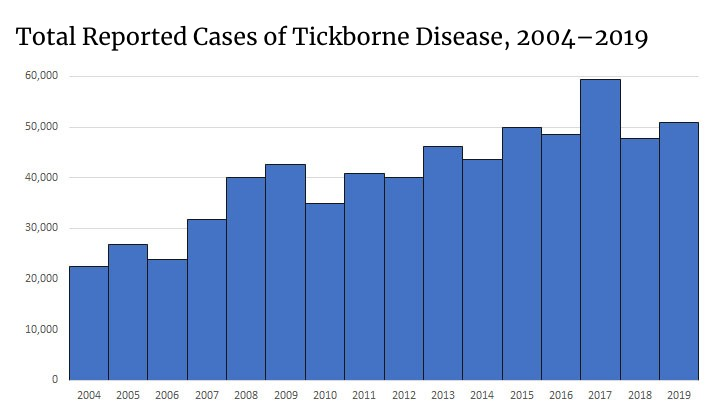
In recent years, 20,000 to 30,000 confirmed cases of Lyme disease alone (in humans) per year have been reported to the Centers for Disease Control and Prevention, and that number is growing, as climate change is expanding the geographical range where ticks can survive. More than 50,000 cases of tick-borne diseases (including Lyme as well as anaplasmosis, ehrlichiosis, babesiosis, spotted fever, and tularemia) are reported in humans annually – but guess what? That’s a drop in the bucket compared to the number of cases of tick-borne diseases reported in dogs each year.
According to the Companion Animal Parasite Council, the number of canine Lyme disease cases increased from 245,971 in 2015 to 336,200 in 2019. Increases in the numbers of other tick-borne diseases were also reported, including canine anaplasmosis, up from 117,203 in 2015 to 207,825 in 2019, and canine ehrlichiosis, up from 107,985 in 2015 to 186,075 in 2019.
I’m not adding those statistics in order to promote pesticides – far from it. But as your dog’s owner and protector, you have to weigh the relative risks of the pests and the pesticides, and do whatever you can to protect your dogs from both.




I have used Cedarcide (from Texas) on my dog (in the past – she has since died), and in the house and laundry when we had an infestation from a new kitty. We live in Maine and have more ticks and fleas then you can shake a stick at! Works well on us as well and no DEET. I have MS and can’t afford anything that may mess with my immune system. I use natural cedar mulch in our gardens and our landscaper is always amazed at how she leaves with no ticks. I used Sorrento a few times on my Golden Service Dog at the end and she got Lymphatic Cancer and pasted. Don’t know if it was anything to do with the collar, but always wondered. That said, I TOTALLY AGREE WITH THE NEED FOR A STRONG IMMUNE SYSTEM.
I used Sorrento collar and my dog got sores all over his body and it cost me thousands of dollars and I can almost die
Seresto Collars. Collar was put on our 18 month old, male Chesapeake Bay Retriever (Chessie named Sun Dance or SD) on June 10, 2020. On June 18, 2020, SD suffered his first seizure. We were totally surprised!/shocked. Not connecting the seizure with the Seresto Collar, we left the collar on SD. Despite seizure medication, prescribed by VM Neurologist, over time, the seizures continued and the time between of each seizure decreased plus he began to have multiple seizures at one time. Finally, November 15, 2020 SD had a total of 11, back to back seizures. It was beyond heart breaking as we loved him so very much; not only a wonderful family dog but also an incredible retriever on upland game plus waterfowl.
It was no longer possible to keep SD.
It was only after this time that I first read any reference to the Seresto Collar causing seizures. As soon as I read the reference, it immediately became clear to us that this collar had caused the seizures.
So sorry to hear about your dog. What’s especially tragic is that no one thought to check to see if there was any connection between the collar and the dog’s seizures. It would have been so easy to test — and then you could have learned whether the seizures were perhaps genetic in origin or if he truly was hypersensitive to the pesticides in the collar. As they say, correlation does not prove causation.
For a dog with seizures, I’d be trying to reduce any and all chemical exposures, from pesticides to floor cleaners to yard pesticides or fertilizers to air fresheners to laundry additives and to any commercial diet. But I’d definitely start with removing all pesticides.
I’ve lost two Chessies require euthanasia under strange circumstances with both having prolonged exposure to Sorestro collars. The first had a habit of chewing plastic water and soda bottles and he began having seizures. I realized the connection and kept him from engaging in his favorite pastime and the seizures disappeared. Four years later he became totally lame and was diagnosed with DM. He lasted about two months until his quality of life was not worth his suffering. My second experience was three months ago and the process was greatly accelerated, less than a week. He went lame virtually overnight. They were from diverse bloodlines and the second one never chewed plastic and never had a seizure. The only thing in common was wearing the collars.
Any thoughts on heart worm preventative? My toy poodle, Andre, had a terrible reaction to Heartgard plus. Now I’m afraid to use anything, and just as afraid not to.
I was advised to use the Seresto on my Jack Russell. He was chewing and licking, vet said fleas although I found no sign of fleas or “dirt” on my Jack. The Seresto collar stopped the chewing and licking quickly. At the expiration date, I removed the collar and sure enough, he started chewing and licking again. New collar, success. Jack has been wearing his last Seresto collar for 3+ years with no chewing or licking. I have no explanation for this, I’m happy he gets relief even from an “expired” collar.
Yes, I do understand conflict about using toxic chemicals on my dog OR using natural pesticides.
Many years ago, I used Frontline on my 90 pound dog without any issues; then he had a seizure a day after application. We went to the emergency center, which was useless, and the vet on duty said she had never heard of seizures related to Frontline., oh, and watch him if it happens again.
I went home and Googled Frontline and dog seizures, and guess what; you got it, some dogs had seizures!
When I went to my regular vet the next day, the tech said to use Seresto; if there was a problem, I could remove it as opposed to having something absorbed into the skin.
Six years later, and a few ticks found, there haven’t been any problems, thank goodness.
We walk in the woods daily, and even in NYC, the local parks have tick problems.
When I order the collar from Chewy, a reputable source, I always air it out for one full month before putting it on my dog.
I don’t understand how Seresto can make a collar that would be toxic to little dogs and just quite not enough for large breeds.
We need SOMETHING that will not cause harm to our beloved pets.
I was waiting to hear from WDJ on this topic. I have used Seresto collars on both of my dogs since the summer of 2015 after a lot of research – questioning dog owners and vets. I didn’t like giving them spot on products, especially after Orion had two mast cell tumors removed (I didn’t think spot ons caused the tumors, I just didn’t like something going into their systems). Neither of my dogs ever had a reaction to the collars, and the only time one of them had a tick was the first summer after the pandemic, when we weren’t going out much and I hadn’t bought the collar. I lost Orion (unrelated) almost three years ago, but I never questioned the safety or efficacy of the Seresto collar. Even in high tick areas, my dogs never got a tick or fleas while wearing the collar. I got one for my cat recently when we had to take him with us on vacation. If you look at the numbers, the risk of an adverse event is very low, the risk of death is less than 1/2 of a percent. I don’t like the idea of giving my dog a product like the chews or pills available now that I can’t do anything about if he has a reaction to it. Thank you WDJ for being a voice of reason.
We live in an old house on 17 wooded acres. We lost our Great Dane to Lyme (kidney damage) several years ago. I mow 6′ wide paths for walking and we do tick checks after walking. We cannot use pesticides because I am auto-immune. We use the natural herbal products and hope for the best.
But I do have several suggestions for fleas that work well.
1 – Get rid of carpeting in your house. Doing this seems to help more than any other action.
2 – Of course, vaccuum frequently, preferably daily. Then empty your vaccum into a sealed container or put it in a sealed trash bin.
3 – Use flea traps (sticky paper under a small 4 watt bulb). Buy or make your own. These have the added advantage of catching spiders, ants, moths, and other bugs that have wandered into your house. Use one in every room and put one by each dog cage. Change the sticky paper when it is about 3/4 full of bugs.
Best wishes, everyone.