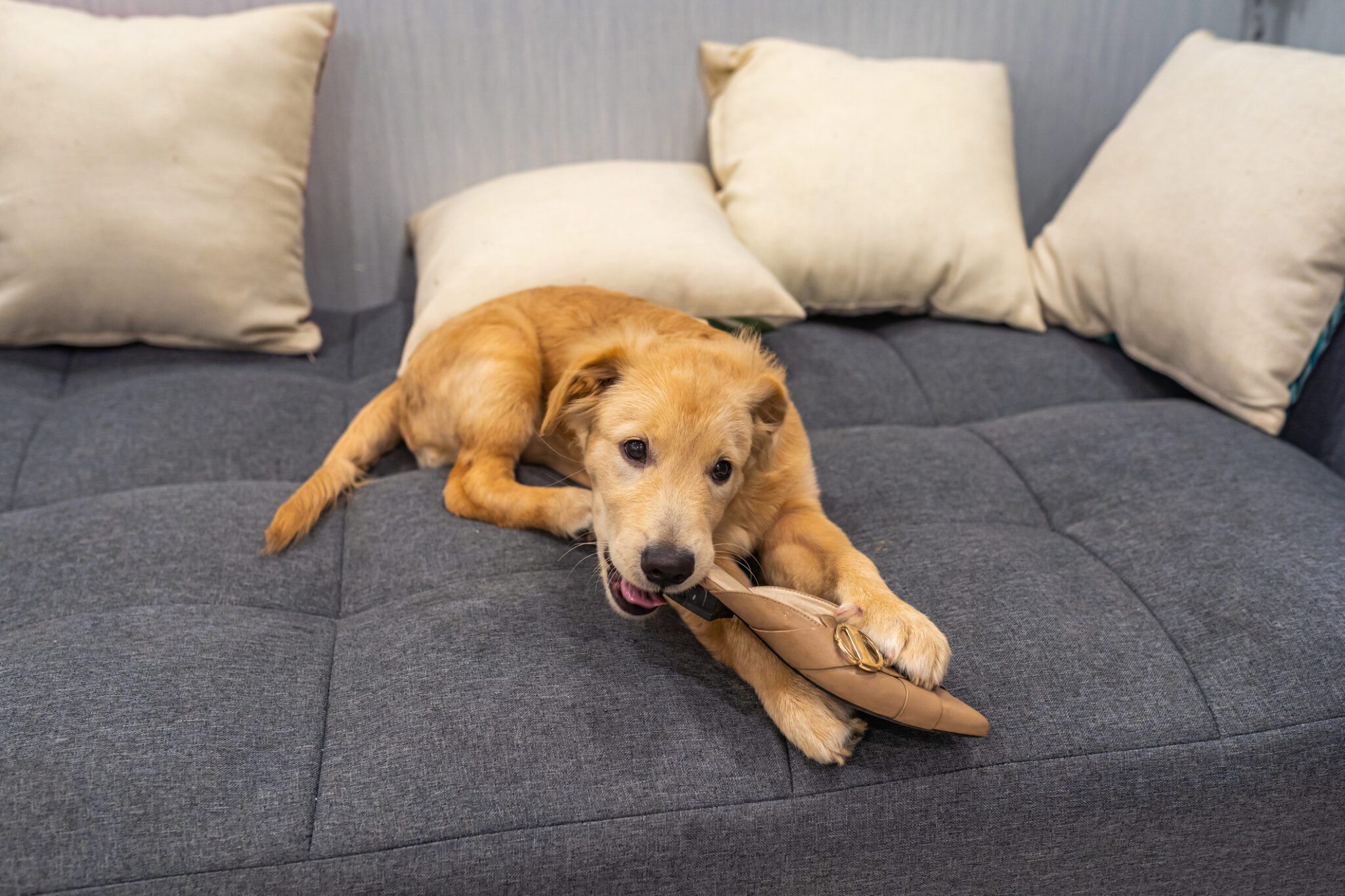
As much as you love your dog, it’s frustrating to return home to discover shoes torn apart, sofa cushions destroyed, bedspreads shredded, and the list goes on. As difficult as it is to live through your dog’s destructive chewing, it’s important to remember that chewing is an essential, natural, biological instinct. It’s not malicious behavior.
Dogs chew for several reasons, ranging from basic biological instincts to self-regulating behaviors to separation anxiety to medical issues. To help navigate this frustrating canine habit, we talked to three experts to understand the reasons dogs chew, how chewing regulates your dog’s emotional state, and how to spot subtle medical red flags.
Teething: You Can’t Stop Puppies Chewing
Dogs come out of the gate ready to chew. Just like babies, puppies will teethe. A free-range puppy will find things to teethe on, but “teething and chewing aren’t the same thing,” according,” says Chris Loverseed, a trainer and founder of Positive K9 Training. The teething stage doesn’t last for all of puppyhood (i.e., at least the entire first year of life). “Most puppies have their adult teethe by around 7 months, so the physical teething stage should be over, but they can still enjoy chewing and may have got very good at finding things to chew by then.”
Boredom vs. Separation Anxiety in Dogs
After the teething phase ends, the causes behind destructive chewing generally fall into three categories: boredom, an emotional outlet, or separation anxiety. But how do you tell the difference?
Context is key, says Dr. Jamie Richardson, chief medical officer at Small Door Veterinary. “A bored dog may chew a variety of objects throughout the home, particularly when they don’t have other outlets for exercise and mental stimulation. Separation-related destruction tends to be much more specific. Owners may see destruction concentrated around exit points: doors, doorframes, windowsills, or areas where the dog tries to escape.”
The best way to diagnose the cause is to see what happens after you close the front door. “For me, the most useful thing while the owner is out is a camera,” says Loverseed. “You may see a dog have a bit of a chew and then go to sleep. You may instead see panting, pacing, crying, or the dog trying to get through the door, and that is a very different problem.”
One way to assess potential separation anxiety through his stomach. “If a dog who normally loves a stuffed food toy won’t touch it after the owner leaves, it tells me the dog may be too anxious to eat,” says Dr. Anna Larson, a Connecticut-based veterinarian.
Chewing as a Reset Button
Beyond teething, addressing boredom and coping with separation anxiety, chewing also acts as a soothing purpose. For an over-aroused, frustrated, or stressed dog, the act of gnawing alone serves as a powerful emotional regulator.
“Chewing gives your dog an appropriate outlet for some of the energy and emotional tension they’re experiencing, and the repetitive nature of chewing can be calming,” says Dr. Richardson.
“Think of it as an activity that can help shift a dog from a highly aroused state toward a more settled one. That’s one reason I like incorporating appropriate chewing opportunities into a dog’s daily routine, not just using them as something to give the dog when they’re already misbehaving,” Dr. Richardson says
When Chewing Requires Medical Intervention
When a home camera captures separation anxiety, behavioral management tools like food puzzles or crate training your dogs are not only ineffective: They can be dangerous.
“A food toy, sniffing work, and a proper chew can help a dog that needs more to do, but they aren’t going to fix panic,” says Loverseed. “I wouldn’t put a panicking dog in a stronger crate either. That is where the vet or veterinary behaviorist needs to be part of the plan, including any conversation around medication.”
Dr. Larson agrees that confinement often backfires during panic. “Some dogs panic more when confined and may injure their teeth, nails, or paws trying to escape. A dog-proofed room, gated area, sitter, or daycare may be safer while a treatment plan is developed,” she says.
For dogs experiencing moderate to severe anxiety, medication provides the physiological foundation needed for learning to occur. “Behavior modification is the foundation of treatment, but medication can be an important tool for some dogs,” says Dr. Richardson. “In moderate to severe cases, medication can reduce the intensity of the dog’s anxiety enough that they are actually able to learn and benefit from the behavioral work.”
Rule Out Dental Pain
Before labeling a sudden onset of destructive chewing as boredom or anxiety, it’s important to first rule out medical causes. Dogs instinctively hide physical discomfort, but sudden chewing may be due to hidden pain.
“With any behavior change, make sure the dog is not trying to tell us something physically feels wrong,” says Dr. Larson. “Dental pain would be high on my list. We see dogs with fractured teeth, advanced periodontal disease, and objects lodged in the mouth. Dogs are very good at hiding oral pain, and many will continue eating even with a painful tooth.”
Digestive issues can also trigger excessive licking, chewing, or eating nonfood items “Nausea and gastrointestinal discomfort can also cause unusual licking, chewing, or swallowing,” Dr. Larson says. “If a dog is eating socks, fabric, wood, or other non-food objects, I would ask about the dog’s diet, medications, and digestive history. Anemia, malabsorption, and certain metabolic diseases can sometimes contribute to pica.”
Pica is a medical term for persistent craving, chewing, and ingesting nonfood items like socks, rocks, plastic, or even drywall. Typically, a dog gnaws, shreds, or tears an object to satisfy a physical or mental drive. However, the dog typically spits out the pieces. In contrast, a dog suffering pica swallows and consumes non-edible items, shifting the issue from a behavioral or training topic to a serious veterinary concern.
If your adult dog suddenly begins eating household items—especially if accompanied by drooling, blood, vomiting, or changes in eating habits—your first, and immediate, step is a veterinary and dental examination.
Selecting Safe Chews: Deploy the “Thumbnail Rule”
If you have a heavy chewer, your first instinct may be to buy the hardest, most indestructible products on the market. Unfortunately, durability can come at the expense of dental health.
“A lot of people go for the hardest chew because they think it will last. I wouldn’t,” says Loverseed. “If I can’t make a mark with my thumbnail, or it has no bend at all, it is too hard. Antlers, hooves, bones, and some hard nylon chews can fracture teeth, and anything breaking into chunks may be swallowed.”
Dr. Larson echoes this caution from a dental perspective. “The large premolars in the back of a dog’s mouth can fracture when the dog bites down on something that is harder than the tooth.” Like Loverseed, Dr. Larson employs the thumbnail rule to determine if a chew or bone is too for the dog’s teeth.
To keep your dog’s teeth intact while satisfying her urge to gnaw, follow these tips:
- In the pet store, press your thumbnail firmly into the chew. If it leaves no indentation or offers zero flex, move on to another option.
- Opt for natural rubber toys, pliable dental chews, or stuffed frozen rubber cones.
- Select chews large enough that your dog cannot swallow them whole, and inspect them regularly for fragments that may have broken off
Despite your best intentions, it’s easy to fall into these training traps:
- Depending on Bitter Sprays
Taste deterrents may temporarily protect furniture or doorframes, but they don’t address the underlying issue. “Bitter spray can put a dog off one spot, but it doesn’t teach the dog what to do instead,” says Loverseed. Adds Dr. Larson: “They will not fix dental pain, nausea, or separation anxiety, nor do they eliminate a dog’s basic need to chew.” - Punishing After the Fact
Dogs associate feedback strictly with their immediate action, so discovering a chewed item and scolding your dog hours later does no good. “Telling the dog off when you get home is far too late,” Loverseed says. Dr. Larson concurs: “With anxiety-related chewing, punishment can make the situation worse. The dog is already distressed when left alone and may then begin to worry about what happens when the owner returns.” - Sack the Shoes or Socks
Giving a dog an old sneaker creates confusion and poses medical risks. “We understand that one shoe has been designated as a toy, but the dog doesn’t understand why that shoe is allowed while the nearly identical one beside it is off-limits,” says Dr. Larson. “Fabric items also concern me because socks are common causes of intestinal obstruction requiring emergency surgery.”
Tips to Satisfy and Stay Safe
Managing chewing is based on satisfying the drive before your dog seeks out household furniture.
- Enrichment: Food-stuffed frozen rubber toys, snuffle mats, scatter feeding in the yard, and scent games provide mental workout routines.
- Supervision: For dogs driven specifically by tearing textures, provide safe, supervised outlets, such as letting them tear apart cardboard boxes, provided they do not ingest the material.
- Boundaries: Baby gates, tethers, and dog-proofed safe zones prevent access to inappropriate items while building solid habits.
By pairing household boundaries with safe chewing options—and consulting your veterinarian at the first sign of pain or panic—you can satisfy your dog’s natural urge to chew while keeping your belongings and your dog protected.