

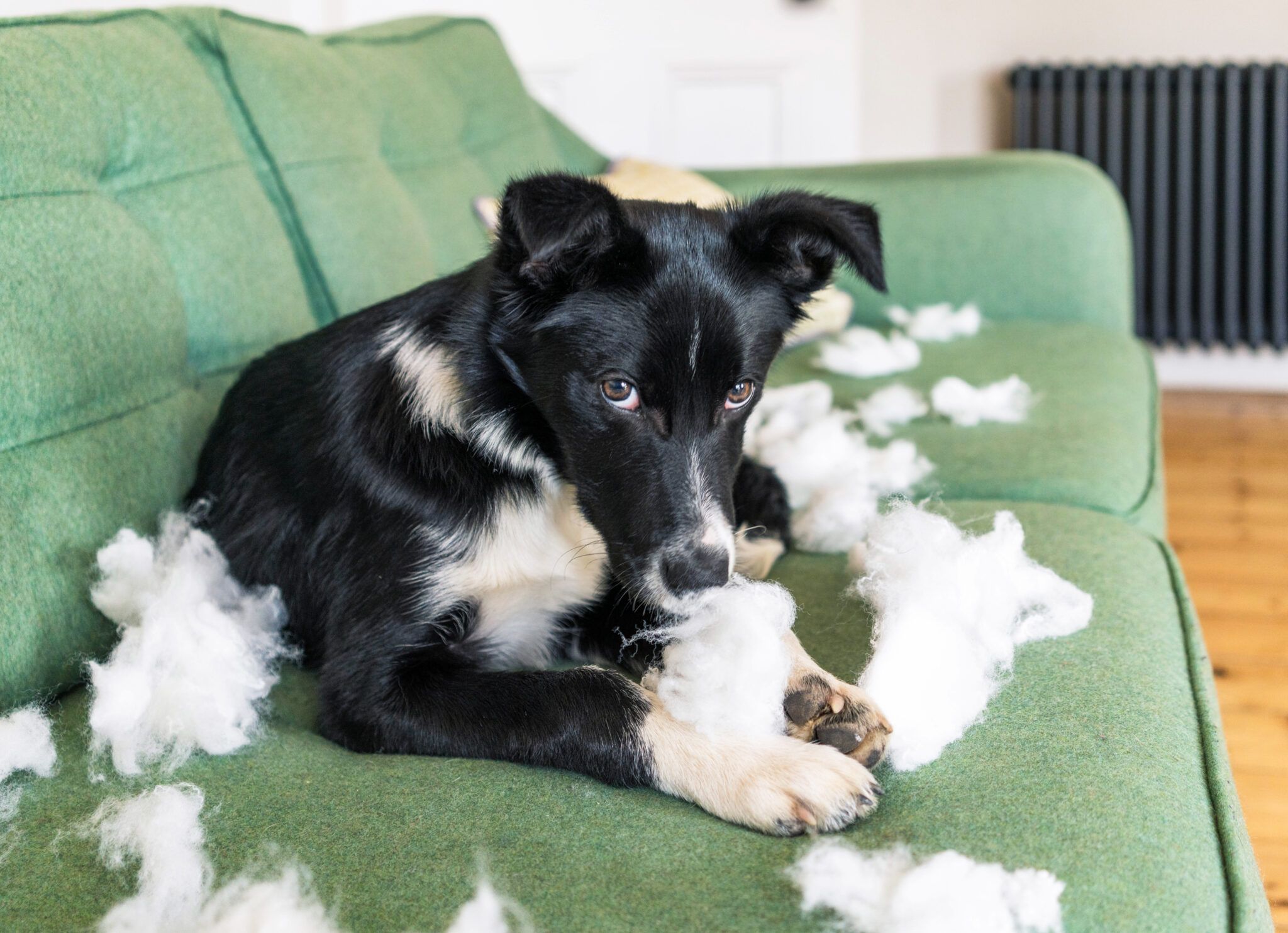
Have you ever come home to discover your dog has shredded your favorite cushion, piece of furniture or pair of shoes? Your dog slinks towards you with the head lowered, ears back and their eyes averted, looking guilty and as if they know they’ve done the wrong thing. But do they?
The question of whether or not dogs feel guilt is one of the most hotly debated topics in animal behavior science. And the answer might surprise you. Understanding what the “guilty look” means can fundamentally change the way you respond and ultimately lead to a happier, less anxious dog.
What Science Says: Do Dogs Actually Feel Guilt?
There’s no denying that dogs are emotional animals and research has confirmed this. Dogs feel emotions including joy, fear, love and anger (Panksepp, 2011). While dogs live rich emotional lives, their ability to feel guilt in the same way that humans do is a different matter altogether.
Guilt, in the psychological sense, is a self-conscious emotion. It requires the ability to reflect on one’s own actions, recognize that a rule has been broken, and feel remorse about it. This kind of moral self-awareness is a cognitively complex process tied to higher order thinking.
A landmark study on this very topic by cognitive scientist Alexandra Horowitz at Barnard College. In her 2009 study published in Behavioural Processes, Horowitz set up a series of trials in which dog owners either correctly or incorrectly believed their dog had eaten a forbidden treat. She found that dogs displayed guilty behaviors (e.g. lowered heads, flattened ears, averted gazes) based on how the owners behaved, not on whether the dog had actually eaten the treat. Dogs who were innocent but scolded showed just as much “guilty” behavior as dogs who had done the wrong thing (Horowitz, 2009).
The results of this study suggest that what we interpret as guilt in our dogs probably isn’t at all.
What about shame? Guilt and shame are separate emotions in humans. Shame is about the self (“I am bad”) while guilt is about the act (“I did something bad”). Neither are supported by current evidence as an experience dogs consciously have. What they do experience, researchers suggest, is something more immediate and reactive: a response to social cues in their environment (Hecht et al., 2012).
The Dog Guilty Look Explained: What’s Really Going On
If your dog isn’t actually feeling guilt then what’s going on? It turns out there’s a well-documented explanation based on dog communication and stress behavior.
The classic “guilty look” involves a combination of behaviors: flattened or pinned back ears, lowered body posture and head, a tucked tail, lip licking, yawning, whale eye (where the whites of the eyes are visible) and deliberate avoidance of eye contact. To a dog owner these behaviors are often read as remorse. To an animal behaviorist they are read quite differently: as appeasement behavior.
Appeasement behaviors are a dog’s way of communicating they don’t pose a threat and are seeking conflict de-escalation. They are deeply ingrained social behaviors inherited from wolves used to help manage relationships and reduce social tension (Rugaas, 2005). When a dog senses their owner is stressed, angry, or tense the dog uses these signals in an attempt to calm the situation.
Dogs are incredibly skilled at reading human body language, facial expressions, and tone of voice. Indeed, research has found they are better at it than our closest primate relatives (Hare & Tomasello, 2005). When you walk into a room and your body language shifts—your shoulders tense, your brow furrows, and your tone of voice deepens—your dog notices straight away. The guilty look is their response to you, not what they did.
Why Does the Guilty Look Develop in Dogs?
So if the guilty look is an appeasement behavior, why does it develop in the first place? The answer lies in classical and operant conditioning; the same learning mechanisms that underpin most dog behavior.
Dogs are pattern-recognition experts and over time they learn to associate certain events with specific outcomes. A dog who’s been scolded after their owner came home to discover something chewed to pieces will begin to associate their owner coming home and something destroyed with a negative reaction. The dog isn’t connecting their earlier behavior with the punishment, they’re connecting the current environmental context with what typically follows.
This is supported by our current understanding of dogs’ capacity for deferred learning. Studies on canine cognition suggest that dogs have a limited ability to connect a consequence with an action that occurred more than a few seconds earlier. The scold that happens two hours after the cushion was chewed is not linked to the behavior of chewing in the dog’s mind. Rather, what the dog does learn is that when the owner comes home and certain conditions are present (i.e. a chewed cushion), an unpleasant interaction often follows.
Over time and with repetition a reliable conditioned response: the guilty look develops and is used pre-emptively when the dog sees the conditions that historically predict the owner’s displeasure regardless of whether the dog has actually done anything wrong.
Do Dogs Know When They’ve Done Wrong?
The answer is: probably not in the way we tend to assume they do.
Dogs live in the present moment. Although they can have impressive memories for certain things like people, places, and trained behaviors, their ability to consciously reflect on past actions and apply a moral framework to them is not supported by current evidence. A dog who chewed a shoe two hours ago isn’t sitting in the corner feeling bad about it.
This has important practical implications. When an owner scolds their dog long after an incident has occurred, the dog has no way of understanding what the scolding is for. Research on dog training outcomes has shown that punishment-based methods are associated with increased anxiety, fear, and aggression without resulting in reliable improvement in the unwanted behavior (Herron et al., 2009).
The scolding doesn’t teach the dog not to chew shoes. It teaches the dog that their owner is sometimes unpredictably scary, which is the opposite of what most people what from their relationship with their pet.
How Owners Can Respond More Effectively To Unwanted Canine Behaviors
When you understand that your dog is cowering due to a stress response rather than an admission of guilt, you can respond in a way that actually helps.
Focus on Management
If your dog is getting into things they shouldn’t, try to prevent access to those things. Crate training, baby gates, and removing temptations from reach can help address the problem at the source. Dogs can’t destroy things they can’t access.
Only Intervene if You Catch Them in the Act
The two-second rule is a helpful guide: if you see it happen and you can’t interrupt it in the moment, let it go. Redirecting a dog mid-behavior by offering an appropriate toy to chew and rewarding chewing on the toy is far more effective than after-the-fact correction.
Reinforce What You Want to See
Positive reinforcement (rewarding desired behavior with treats, praise, or play) is the most effective and least harmful method of shaping dog behavior. Rather than focusing on what your dog did wrong, focus on building the habits you want them to have.
Stay Calm When You Discover a Mess
It can be difficult to suppress frustration when you come home to destruction. Try to remember that your emotional response is what your dog is responding to. A calm, neutral response prevents the appeasement cycle from reinforcing itself and avoids adding anxiety to the situation.
Know When To Seek Help
Persistent destructive behavior can be a symptom of separation distress; a treatable condition that benefits from professional guidance. A certified applied animal behaviorist or veterinary behaviorist can provide a tailored management and treatment plan.
What We Know About Dog Guilt
So, do dogs feel guilt? Based on the best currently available science the answer is: not in the way we experience it. What looks like guilt and remorse is actually a learned social response—your dog reading your emotional cues and doing everything in their power to de-escalate the situation. Dogs are not weighing right and wrong. They are highly social creatures deeply attuned to us and motivated to maintain harmony.
Next time you walk into a room to find that guilt face looking up at you, take a breath and try to respond in a way that nurtures your relationship.
References
Hare, B., & Tomasello, M. (2005). Human-like social skills in dogs?. Trends in cognitive sciences, 9(9), 439-444.
Hecht, J., Miklósi, Á., & Gácsi, M. (2012). Behavioral assessment and owner perceptions of behaviors associated with guilt in dogs. Applied animal behaviour science, 139(1-2), 134-142.
Herron, M. E., Shofer, F. S., & Reisner, I. R. (2009). Survey of the use and outcome of confrontational and non-confrontational training methods in client-owned dogs showing undesired behaviors. Applied Animal Behaviour Science, 117(1-2), 47-54.
Horowitz, A. (2009). Disambiguating the “guilty look”: Salient prompts to a familiar dog behaviour. Behavioural processes, 81(3), 447-452.
Panksepp, J. (2011). The basic emotional circuits of mammalian brains: do animals have affective lives?. Neuroscience & Biobehavioral Reviews, 35(9), 1791-1804.
Rugaas, T. (2005). On talking terms with dogs: Calming signals (2nd ed.). Dogwise Publishing.




My dog certainly feels something. I can have absolutely no clue that he has done something wrong until I see his face and then I know I better check things out because somewhere there will be a surprise waiting for me. He’s a 14 year old Border terrier and he is truly a very good boy. He has rarely been scolded for anything except when he was a puppy. On the very rare occasions that he does something he shouldn’t, he definitely knows it. He pooped on the deck last week, apparently because the yard was too wet for his liking, something he never does. I knew something was up, just didn’t know what or where. He sure had a guilty look on his face and it didn’t go away until I finally found it and cleaned it up without saying a word about it and his worried (guilty) look went right away.
My pit bull definitely feels something. He gives himself up as soon as I walk in the door. Instead of being happy and excited I’m home, he greets me scared and shaking all over. One time he got sick and had an accident in the kitchen and he was so upset yet i didn’t know why until i followed him to the accident. He wasn’t reading my body language because I was clueless. I assured him it wasn’t his fault but he was very upset.