

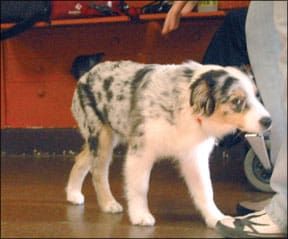
Dog growling is a valuable means of communication, something that we humans need to appreciate and respect rather than punish. Of course, we don’t want our dog to growl at us, but neither do we want him to fail to growl if something makes him uncomfortable; that’s very important information in a successful canine-human relationship.
It’s quite common for people to punish their dogs for growling. Unfortunately, this often suppresses the growl—eliminating the dog’s ability to warn us that he’s about to snap, literally and figuratively. On other occasions, punishing a growling, uncomfortable dog can induce him to escalate into full-on aggression.
So, if you’re not supposed to punish dog growling, what are you supposed to do? The next time your dog growls at you, try this:
1. Don’t push your dog over his tolerance threshold. Whatever you’re doing, just stop.
If your dog’s growl threshold is near his bite threshold – that is, if there’s not much time between his growl and his bite, get safe. If his growl doesn’t mean a bite is imminent, stop what you’re doing but stay where you are. Wait until he relaxes, then move away, so you’re rewarding the relaxed behavior rather than the growl.
2. Analyze the reason for dog growling
Why is your dog growling? Does he growl when you touch or groom him? Growling when restrained? Does your dog growl when making direct eye contact? How about when you take something away from him? Or making him do something? If your dog is growling at you all of a sudden, try to determine what has changed in your shared environment.
3. Explore ways to get your dog to do something that does not elicit aggressive communication.
Try to get your dog to behave without eliciting a growl. Lure him rather than physically pushing or pulling him. Have someone else feed him treats or use a Licki Mat while you touch, groom, or restrain him. If you don’t have to do whatever it was that elicited the growl, don’t – until you can convince him that the activity in question is a good thing rather than a bad thing.
4. Evaluate the stressors in your dog’s world and reduce or eliminate as many of them as possible.
For example, if your dog is unaccustomed to strangers, then having your sister and her husband and three kids as houseguests for a week would undoubtedly stress your dog. Noise-phobic dogs might be under a strain if city crews have been digging up a nearby street with heavy equipment or there was a thunderstorm last night. The vacuum cleaner is a common stressor for dogs. A loud argument between you and your spouse could stress your dog as well as you, and your stress is stressful to your dog. Harsh verbal or physical punishment, an outburst of aroused barking at the mail carrier, fence fighting with another dog. The list could go on and on.
Keep in mind that stress causes aggression, and stressors are cumulative; it’s not just the immediate stimulus that caused your dog to growl, but a combination of all the stressors he’s experienced in the past few days. This explains why he may growl at you today when you do something, but he didn’t growl last week when you did the exact same thing. The more stressors you can remove overall, the less likely he is to growl the next time you do whatever it was that elicited the growl this time.
5. Institute a behavior modification program for your dog to change his opinion about the thing that made him growl.
One way to do this is to use counter-conditioning and desensitization to convince him the bad thing is a good thing (see “Reducing Your Dog’s Anxieties,” April 2007 WDJ).
Another way is through the careful use of negative reinforcement as in a Constructional Aggression Treatment (CAT) program to teach him a new behavioral strategy when presented with the discomfort-causing stimulus. (For much more detail about CAT programs, see “Modifying Aggressive Behavior,” May 2008 WDJ.)
If you need help to create and implement a behavior modification protocol, contact a qualified behavior professional who is experienced and successful in modifying aggressive behavior with positive, dog-friendly techniques. Good places to start your search are https://www.petprofessionalguild.com/Zip-Code-Search, ccpdt.org, or my own trainer referral lists at peaceablepaws.com.




I agree with all that say that you need to excuse the dominance. Obviously there is a fine line with that- as you want to still respect your best friend. However, as with all families- there must be a consequence for a voluntary not-nice reaction. Also- if anyone wants to see how the actual moms and dads deal with aggression in their pack- go on you tube and watch how the mom dogs deal with their misbehaving children. Spoiler Alert: They don’t give them treats. Haha
If you think it’s ok for your dog to growl at you your out of your mind. You need to be the boss whatever it takes. Growl back.
Just got a dog yesterday from the shelter. She did good with the whole family. She hasn’t shown any aggressive behavior. Tonight she just started growling and barking at me and was getting ready to pounce on my bed. I don’t know what has changed with her and it’s beginning to worry me since I have a 5 year old brother. What should I do?
This article is the opposite of what you should do! Stop what you’re doing when you dog growls. So you’re basically letting the dog train you! From early on if my dog does something he shouldn’t I wouldn’t stop challenging him until he is doing things correctly. I control dinner times, I control walks, I control his interactions. I want him calm 95% of the time. The 5% is when he is playing with me.
Poodles, in general, are known to be highly sensitive, intelligent and loyal. Aggression, if it ever occurs, is more common among toy poodles than miniatures and standards. You mentioned that he is obedient but growls when you stroke him. Have you taken him to his vet to examine this issue?
It seems that perhaps something irritates him or is possibly painful when you stroke him. Does he growl if you touch him anywhere on his body? The most commonly guarded body area is a dog’s hindquarters. Does he growl mostly when you stroke him on his lower back or rump?
Perhaps he is guarding his body, either because he is sensitive or in pain. If you haven’t yet done so, take him to his vet to find the source of the problem before using obedience methods to curtail his growling.
If there is no evidence of a physical problem, then “systematic desensitization” behavioral training would gradually extinguish the unwanted behavior. Research the term if you’re unfamiliar with its meaning. Good luck to you and your poodle!
I have a 2 yr old Toy poodle. He is SO well behaved – he’s never gone to the toilet in the house, never chewed anything, incredibly obedient etc. But he growls ALL THE TIME! If I stroke him he shows his teeth and growls. The only times he doesn’t growl is when I’m commanding him (because he knows he’s getting a treat), playing fetch or going to walk him.
I’ve invested more money than I have with this dog – had a behaviourist for weeks etc. But no improvement! It says in the article to Identify what makes the dog growl. My dog growls when you stroke him!! So now what?
I saved up for a year to get a dog for company and he’s SOO unpleasant. What is the point in having a lap dog that you can’t cuddle or stroke?
I’ve had German shepherds and a bichon frise in the past and they would NEVER growl at me. Is this normal with toy poodles?
He is very attached to me – follows me everywhere etc.
I have a petty mixed we have had him for 4 years we got a new puppy for him to have a friend he was ok with puppy then he was playing with the puppy they seem to be getting along fine they were playing in the yard yesterday I heard the puppy crying loudly zi go out get puppy check him out he’s fine my potty goes inside so I say Bandit what did you do he growled at me never done that before today he was growling at me while sitting with my husband ??? And now he growling and barking???? What is the problem? I thought maybe the new puppy? He has been our only baby for 4 years!!!
My 4 yr old Cavapoo literally growls and licks me at the same time when I try to pet him first thing in the morning g or at night. It’s totally maddening, and it’s getting worse and worse. It’s like he knows he’s being bad, but can’t help it, so he’s trying to show me that he’s mad, but we’re still friends. He also does it with a bone, so he’s not allowed to have those any more 🙁
Worst advice. Ever. Didn’t read rest of comments because don’t want to growl at anyone but omg. No. Do not listen to this. Person.
My husband teases our Havanese which has caused some behavioral problems. The worst though is when he wants to brush her, usually in the a.m., she will growl when he attempts to pick her up. Growling increases but usually settles down. This a.m., however, she almost bit him as he was picking her up. Naturally, HE felt he was wronged, etc. by her! My explaining how he was crossing her boundary fell on deaf ears….literally! How do I help him understand that he must respect her boundaries and listen to her messages? She does like him and allows him to touch her frequently. She does NOT like him to get close to me, especially if I’m resting, reading or doing my own private thing in the house. She watches closely to alert me that he is headed my way and barks at him, runs into the room where I am and runs to me while she’s barking.