Training with treats is great—right up until the moment your dog seems to become a starving land shark and you encounter teeth as you deliver the treats. Ouch!
Sound familiar?
Why Dogs Snatch Treats from Your Hand
Dogs who take treats roughly, or who have what trainers call a “hard mouth,” aren’t doing so maliciously. It’s more likely that they lack impulse control and are simply reacting to wanting something in the moment.
How To Teach Your Dog to Take Treats Nicely
Here are some tips to help save your fingers and teach your dog to take treats gently.
Practice Impulse Control
Helping your dog manage his desire for instant gratification will prove beneficial in many situations. The following methods will help your dog learn to control himself around food.
Zen Cookie Training is a great way to get started. This teaches your dog that to get the treat, he must leave the treat.
To begin, close a low-value treat up tight in your hand and present your fist. Ignore your dog’s efforts to lick, paw and otherwise get you to open your hand. Watch for the moment where he stops actively trying to get the treat. (Even if the pause seems to be him thinking, “What the heck, this is weird!”) Mark his lack of pursuit with a “Yes!”, “Good!”, or a click if you use a clicker. Then present the treat in your flat palm at his chin and invite him to “get it.”
Build up to watching your dog intentionally pause or even lean away from the food before you mark. If your dog attempts to snatch the cookie during your delivery, say nothing, close your first and try again.
As your dog gets good at the game, start presenting the cookie in an open palm, closing your fist if he reaches for the cookie without being invited. You can even work up to your dog both backing away from the treat and offering a moment of eye contact before releasing him to the treat.
Pro Tip: Don’t think of this as a formal “leave it” behavior. This technique works best when the cookie itself is the cue. We want the presence of food to mean, “be patient,” not you hearing you say, “leave it.”
Working on impulse control in other settings can also be helpful, as it disrupts the habit of “act first, think later.” Teaching your dog to pause at the door, hold a sit-stay while you place the bowl on the floor or to relax on a mat can help reinforce the general idea that, “rushing gets me the opposite of what I want.”
Pay Attention to How You Deliver Treats
Presentation and timing matter, especially if your dog is still learning impulse control. Pinching the treat between two fingers is like dangling a worm in front of a fish—it makes it more likely your dog will want to snap-and-grab the treat. Similarly, if you’re slow to deliver the treat, an excited dog is likely to jump for the food and catch your fingers in the process.
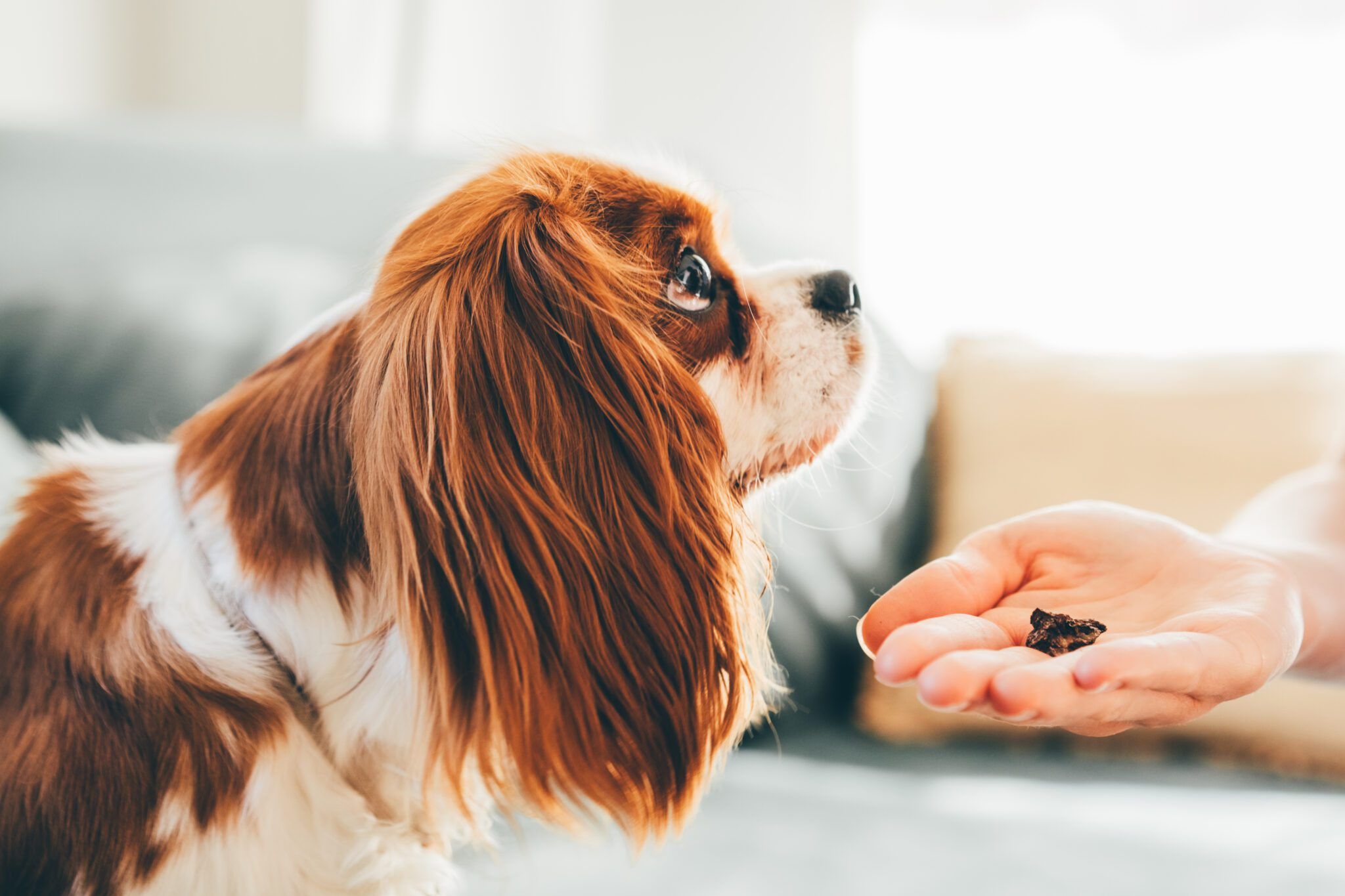
What to try: Instead of pinching the treat between two fingers, place the treat at the edge of your palm, secure it with the inside edge of your thumb and quickly present the treat below the dog’s chin.
Use Lower Value Treats
Like people, dogs have preferences. Treats with an especially meaty small, or treats that don’t come out that often can be especially exciting, and that excitement can lead to a hard mouth.
What to try: Experiment with different treats to find what your dog is willing to work for, but that doesn’t send her into as much of a food frenzy. Some dogs will work for a piece of kibble. Other dogs prefer to train for novel treats.
Treats don’t need to say “dog treat” on the package. Design a taste test to see where different treats rank. For example, if you line up a piece of kibble, a dry Cheerio and a small piece of carrot on the floor, does your dog eat them all? If so, in what order? Run the test a few times to see if the suggested ranking holds up. The last-to-be-eaten item is on your dog’s lower-value-treat list.
Be Aware of Your Dog’s Emotional State
Dogs often take treats roughly when they’re overly excited and at risk of going over-threshold. “Over-threshold” is when the brain is flooded with adrenaline and cortisol, and the part of the brain that controls learning temporarily goes offline. A dog can’t make good choices when he’s over-threshold.
My dog Saber came to me as a “fence fighter” in his first home. While we don’t have dogs as fence neighbors, we pass dogs behind fences on walks. With a lot of work, we can usually pass calm dogs behind fences without incident. But sometimes, when I reward him for not trying to throw himself at the fence, he’s much more intense with the treats and I feel his teeth.
Competition can also increase your dog’s tendency to snap for treats, especially in mixed company when everybody wants their fair share of the resource. Teaching impulse control around food is especially important in multiple-dog households.
What to do: If you notice your dog starting to take treats with a harder mouth, recognize it as a sign that your dog might be struggling and take action to help him deescalate. If you’re training or playing, take a break. If you’re on a walk, make a point to move farther away from things in the environment to which your dog might react.
Manage the Situation When Necessary
Sometimes we just need to avoid the challenging behavior. For those moments, delivering lickable treats from a tube or the end of a wooden spoon, or even dropping the treat on the floor works to save your fingers. Some people wear gloves. These management tactics won’t actively teach your dog to be gentle, but they can minimize our discomfort in the moment.
As with any training, it’s important to be patient, be consistent and keep things positive. With practice, even the sharkiest canine companion can learn to take treats in a more civilized manner. Happy training!