Vitiligo is a genetic condition in dogs that affects skin and hair color. With vitiligo, the melanocytes—the cells that produce pigment—degenerate or die off, leaving behind white skin and white hair. For some dogs, this is due to a genetic predisposition. For others, vitiligo cases are caused by autoimmune problems that attack melanocytes. An injury can also temporarily damage the melanocytes. Regardless of why your dog has spots of white hair, vitiligo itself is not dangerous.
Vitiligo is different from the graying that many dogs develop as they age. Graying due to age tends to be slowly progressive and often starts with the muzzle. Some dogs will get “frosting” early, but it often does not progress to whole body. Other breeds will get white hairs uniformly over the body. Vitiligo tends to stand out because it usually appears as bright white patches.
Breeds predisposed to vitiligo include Rottweilers, Belgian Tervuren, Belgian Sheepdogs, and Doberman Pinschers as well as Dachshunds and German Shepherd Dogs. Some dogs are adults when vitiligo becomes obvious and may have already been bred, possibly spreading the gene without the breeder considering it.
When Does Vitiligo Start in a Dog?
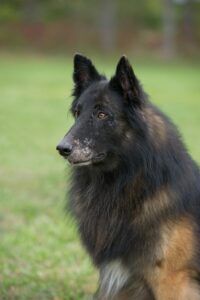
Credit for photo 2 (headshot): Courtesy of Beth Adams
A puppy predisposed to vitiligo is born with normal coloration, but as he grows, the melanocytes die off and white hair replaces the normal color. The age of onset can vary. The face is often the first area that is affected, but it can progress all over the body and even onto the footpads. Focal cases have specific areas, usually the head or even just the nose and lips affected. Generalized cases may have patches of vitiligo all over. Most cases stabilize after six months from the start of signs but not always.
Many dogs will have white hair grow in after an injury (the scar will be covered with white hair). This is not vitiligo. In this case, the melanocytes for that area were destroyed by the injury. Sometimes the hair will grow back in normal color after a shed or two if the melanocytes were damaged but not destroyed. My male Belgian Tervuren, Doc, stuck his nose in a nest of yellow jackets (very aggressive ground wasps). For almost a year, he had multiple white spots on his muzzle where he had been stung. Eventually color came back.
Does My Dog Have Vitiligo?
The diagnosis of vitiligo is generally based on history and physical exam. If there are signs of other skin conditions, your veterinarian may want to do a skin scrape, a biopsy, and/or test for autoimmune problems.
You may have read that supplements such as omega 3 fatty acids or vitamin C will reverse or at least slow the progression of vitiligo. None of these claims are proven effective by research. If your dog is one of the less common cases with an underlying medical problem, treating the problem may reverse the skin coloration.
Dogs with generalized vitiligo and short hair, like a short-hair Dachshund, may benefit from dog-safe sunscreen when they go out and general precautions against sun exposure.
While vitiligo is not desirable, remember that it is purely cosmetic, unless it is associated with an autoimmune disease (and then there are other symptoms). Your dog will have a “unique look,” but he won’t suffer.