


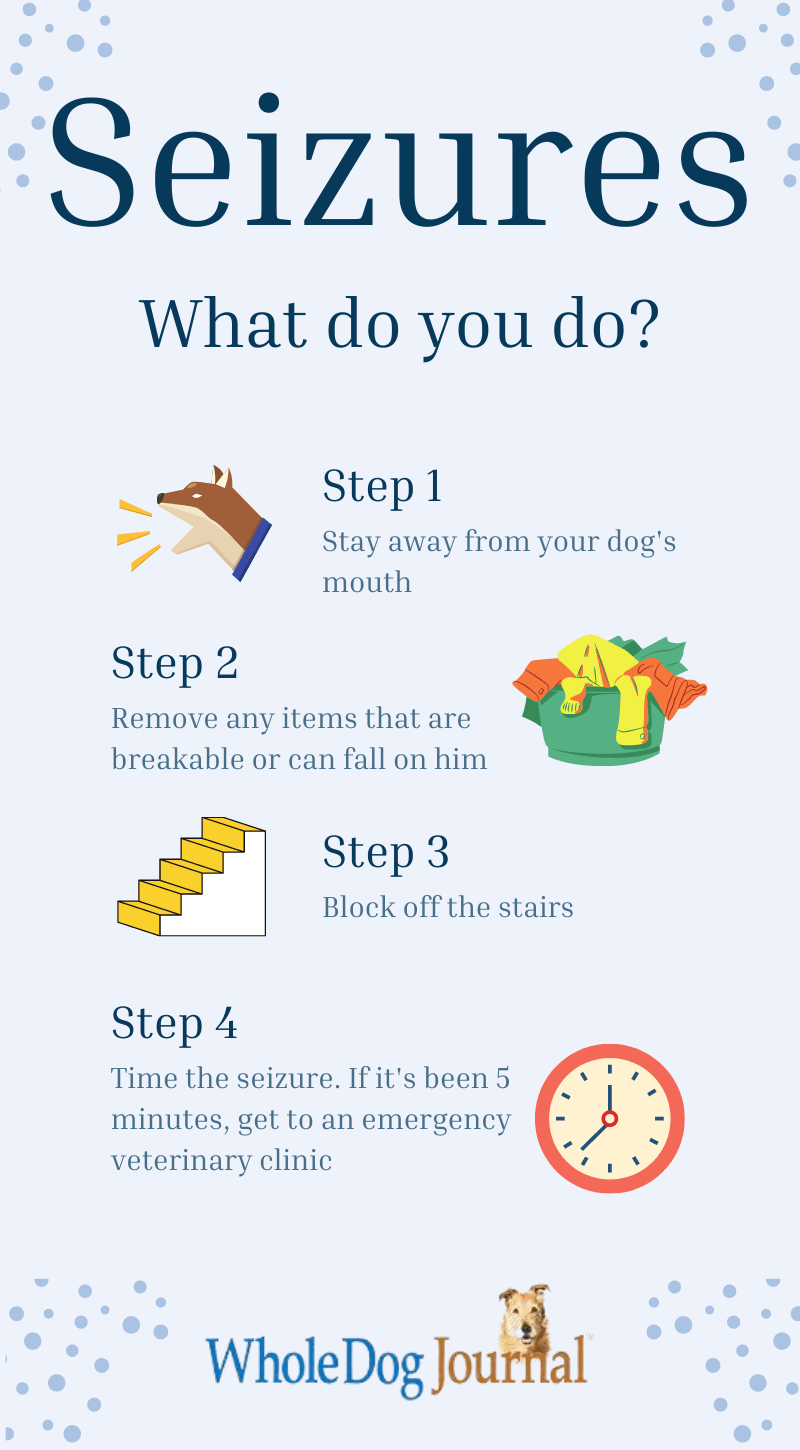
If your dog is showing signs of a seizure, stay calm and work to keep both of you safe. Here’s what to do if your dog has a seizure:
Stay away from your dog’s mouth to avoid inadvertently being bitten. The natural tendency is to want to comfort your dog by hugging and/or stroking his head. But your dog is not aware during a seizure, nor is he in control of his violent jaw movements.
Remove any items near him that are breakable or that may fall on him.
Keep him away from stairs. If he is near the top of stairs, try to move below him on the stairs so you can prevent him from falling, if you are safely able to do that.
Time the seizure. First, you need to time the seizure because of the possibility of a life-threatening condition called status epilepticus, which is a seizure that doesn’t self-resolve. A good rule of thumb is that if a dog has been seizing for five minutes, you need to get to a veterinary clinic. Call the office tell the staff you are on your way (more on status epilepticus below). Second, you want to keep track of your dog’s seizures in a log or journal. This will be used to determine when the seizures are becoming more severe or more frequent.
Note: In the minutes to hours after a seizure, called the post-ictal phase, your dog may be disoriented or demented, which can be expressed as aggressive behavior, even rage. You need to be careful both during the seizure and in the aftermath.
Video the event, if you can. Capturing the seizure on video is immensely helpful to your veterinarian because it helps him or her ascertain that the event was indeed a seizure. The biggest differential for a seizure episode is a cardiac event. If a dog suffers an intermittent cardiac arrhythmia, it can result in confusion, weakness, and collapse, which can sometimes be mistaken for seizure activity. Generally speaking, cardiac collapse tends to be softer than seizure activity, more like fainting, and the dog usually recovers much more quickly.
Recognizing and Recording Signs Your Dog May Be Having a Seizure
Try to document what you see when your dog is having a seizure. This may help the veterinarian determine what type of seizure the dog may have experienced.
The grand mal seizure is a generalized seizure with widespread excessive, aberrant electrical activity occurring in both sides of the brain. Also known as tonic-clonic or convulsive seizure, these dog seizure symptoms include:
- Suddenly falling over
- Violent, jerking spasms of all four limbs
- Paddling
- Frothing at the mouth
- Losing control of bladder and bowels
- Full loss of consciousness
Jump to: Causes | Medication
Life-Threatening Seizures: When to Seek Emergency Veterinary Care
As noted above, if a dog is in status epilepticus for too long, he will die, much the way he would die from heat stroke. There is so much intense, violent physical activity going on that the core body temperature rises to life-threatening levels. Status epilepticus requires emergency veterinary intervention with an intravenous medication, usually a benzodiazepine like diazepam (Valium), to break the ongoing seizure.
If he is still seizing when you get to the veterinary clinic, he is in dire need of emergency help. If the seizure resolves while you are on your way and the dog remains quiet, the life-threatening status epilepticus emergency is over.
Understanding the Different Types of Dog Seizures
In addition, to the seizures mentioned above, generalized seizure types include:
- Tonic (stiff, extended limbs that don’t move or jerk)
- Clonic (hyperflexed, non-jerking limbs)
- Myoclonic (jerking limbs)
- Atonic (dog standing, staring, non-responsive)
- Focal seizures (this occurs when the abnormal electrical activity is localized to just one spot in the brain, can look like a lot of different things)
- “Fly-biting” (this is a classic one, where the dog looks like he is seeing and repeatedly snapping at flies)
- “Chewing gum fit” (the jaw repeatedly clacks; a focal seizure might just be repeated twitching of an eyelid, lip, or ear. There is not necessarily loss of consciousness)
These types of seizures rarely present a big problem and usually don’t require treatment. A focal seizure, however, can segue into a generalized seizure, so be sure to keep a close watch until it passes.
- Ask your veterinarian about dispensing a dose of diazepam (Valium) that you can keep on hand at home, for rectal administration in the event of a seizure. This will be dispensed to you in a syringe with a rubber tube attached. All you need to do is introduce the tip of the rubber tube about an inch into the rectum and dispense the medicine. This will often shorten and lessen the severity of the seizure.
- If your dog is prone to cluster seizures while on an anti-convulsant, ask your veterinarian about keeping a supply of levetiracetam (Keppra) on hand. A few doses of this short-acting anti-convulsant can be given after a seizure to prevent a cluster.
- Stimulating your dog’s vagal nerve may help lessen the duration and severity of a seizure. If you can safely do this, gently push on your dog’s eyes, with closed lids, for 10 to 60 seconds. This can be repeated every five minutes. If you recognize your dog’s pre-ictal signs, you may even be able to stave off a seizure with this maneuver.
- Traditional Chinese Veterinary Medicine (TCVM) can be used adjunctively, either to improve seizure control for dogs with refractory seizures in spite of anti-convulsant medication or to help lower the dose of anti-convulsant medications. Acupuncture and Chinese herbal medicine are the mainstays of this approach, which require a trained specialist.
- Consider feeding your dog Purina Pro Plan Veterinary Diet NeuroCare (NC), especially if your dog has refractory seizures in spite of anti-convulsant medication. This unique diet uses medium chain triglycerides (MCTs) as a fat source. MCTs are known to block one of the receptors in the brain responsible for seizures. Studies have shown a significant reduction in seizure activity when epileptic dogs are fed this diet.
What Causes Seizures in Dogs?
Reactive seizures are caused by metabolic disorders like hypoglycemia (low blood sugar), hypocalcemia (low blood calcium), liver disease, liver shunts, and kidney disease. In these cases, the brain itself is normal, and if the metabolic disorder can be corrected, the seizures go away. Some drugs can cause seizures by lowering the seizure threshold in the brain. Discontinuing the drug resolves these reactive seizures.
Toxins can cause seizures. Culprits include dark chocolate, caffeine, xylitol (sugar-free sweetener), ethylene glycol (anti-freeze), bromethalin (rat poison), and ethanol. Removing and treating for the toxin eliminates the seizures.
Abnormalities in the brain can result in structural seizures. The may be brought on by tumors, head trauma, inflammatory diseases like granulomatous meningoencephalitis, and infectious diseases like rabies and canine distemper.
Congenital defect. This is an abnormality that develops during gestation.
Epilepsy Is the Most Common Cause
Epilepsy is defined as seizures of unknown origin, which means no structural lesions in the brain, no infections, metabolic disorders, drugs, or toxins are to blame. A diagnosis of epilepsy is typically made after every other possible cause of seizures has been ruled out.
In addition to a normal physical exam, neurological exam, and bloodwork, the age at onset of seizures may help your veterinarian diagnose epilepsy. Epilepsy usually starts between 1 and 6 years of age.
Dogs less than 1 year old are more likely to have either a congenital defect, an intoxication, or an infectious disease like canine distemper. Dogs who are more than 6 years of age when they have their first seizure are more likely to have a metabolic disorder or a structural brain lesion like a tumor.
Breed predilection toward epilepsy is another clue. Schnauzers, Collies, Bassett Hounds, Cocker Spaniels, Labrador Retrievers, and Golden Retrievers are over-represented among dogs with epilepsy.
Should You Medicate a Dog for Seizures?

Will your vet recommend that your dog be medicated in an effort to reduce or eliminate his seizures? It depends.
If your veterinarian agrees it was a seizure, she will conduct a physical exam and a thorough neurological exam. Baseline bloodwork should be done to rule out metabolic causes of seizures. Further diagnostics may be recommended from there and could include infectious disease testing, CT scan, or MRI.
Let’s say your dog is between 1 and 6 years of age, all testing is normal, and a diagnosis of epilepsy is made. Most veterinarians agree starting anti-convulsant drug therapy is generally not indicated after just one seizure. However, the following are exceptions to this rule:
- Cluster seizures, described as more than three seizures in a 24-hour period, warrant treatment
- If the seizure was particularly violent, or if it lasted a long time (5 minutes or more) treatment should be considered right away
- Certain breeds are notorious for having difficult-to-control seizures (German Shepherd Dog, Border Collie, Irish Setter, Golden Retriever, Siberian Husky, Keeshond, and Saint Bernard)
For all the others, keep a seizure log where you write down the date and time it happened, now long it lasted, how severe it was, and any other information you think might be pertinent. This log will be used to determine when it might be time to start anti-convulsant therapy.
Why wouldn’t you just start your dog on anti-convulsants? After all, you don’t want him to have another seizure. But consider this: Your dog may never have another seizure! Or he may have a mild one once a year. You don’t know until you see how it plays out. And once an anti-convulsant is started, it is generally necessary for life.
If your dog is one of those epileptics who only has a rare, occasional seizure, you are taxing his body with a medication he really doesn’t need, and you are paying for it! Not to mention that well-managed epileptic dogs on anticonvulsants may still have breakthrough seizures occasionally. A seizure-free future is not guaranteed, even with long-term medication.
In my opinion, if a dog is seizing as often as twice a month, I think it’s too much for his quality of life, and for yours! I usually recommend starting an anticonvulsant in this case. However, as the person living with and loving the dog, you can and should be the ultimate decider of when enough is enough and it’s time to start.
Medications and Long Term Management for Dogs with Seizures
There are several different anticonvulsants available for dogs. Zonisamide has become the most popular, as it works well with minimal side effects. Phenobarbital, potassium bromide, and levetiracetam (Keppra) are other medications your veterinarian may discuss with you.
Some dogs may require more than one medication to manage their seizures. Levetiracetam is frequently used as a second medication. It is short-acting, which means it must be dosed three times a day. This can be challenging for dog owners. The extended-release formula, Keppra XR, which is dosed twice a day is much easier.
A couple of notes on Keppra XR: You cannot split or cut the pills as this destroys the extended-release function. Also, a funny thing about it: You may see the tablet in your dog’s poop, seemingly whole and undigested. Don’t be alarmed. This is OK! The active drug is inside the non-digestible tablet, which has a hole in it. Digestive juices enter through the hole and dissolve the drug, which is then slowly released to be absorbed by the body. This is how the extended-release version works. Once the non-digestible tablet has done its job, it passes safely out with your dog’s feces.
Medication Tolerance and Breakthrough Seizures in Dogs
Sometimes, a previously well-managed epileptic starts having more breakthrough seizures. Unfortunately, some dogs will develop tolerance to their anticonvulsant medication over time. In these cases, the liver continuously increases the rate at which it metabolizes the drug, making increasingly higher doses necessary. Higher doses mean more and worse side effects. This can be frustrating and challenging to manage.
Seizures in dogs are frightening and difficult to watch. Luckily, there are many tools at our disposal to help diagnose and manage this heart-breaking condition. If your dog experiences a seizure, even if it’s not life-threatening, make an appointment with your veterinarian to get a jump on deciding what’s best for your dog.



Both our dogs developed seizures after each 3rd dose of several different ‘safe and effective’ flea and tick medication recommended by our veterinarian. The first few times we thought they’d die. I had CBD oil and THC oil at home for myself and mixed these two oils so that THC was a tiny percentage of the mixture. I finally thought, that there’s no reason not to try this mix. I just applied a drop of this mixture with my fingertip onto the gums of our animals and within SECONDS, the seizures stopped. Since we really trusted our vet and tried several such drugs, we had to go through this several times and each time, we had the same fast and completely resolving result. Needless to say that there’s always such mixture handy where our animals are. Which can’t be said for these flea and tick ‘preventatives’.
We lost our 10 month old pup to a status epilipticus seizure last night, we have no is
idea what happened although we suspect some kind of toxin. She appeared terrified of something earlier in the evening but appeared to get over this and then seemed okay for an hour or so. She was then violently sick and had diarrhoea, then the seizure started. We rushed her to the vets who took her straight from us (we had wet towels in her trying to reduce her temperature). The vet cam back to us shortly after this and advised us that she was brain dead due to the length of the seizure. We are devastated and can not understand what has happened, and we think we did everything we could. I think unless you live within 5 minutes if your vets with this type of seizure the dog doesn’t stand a chance
Our poodle mix had a major seizure recently. His only one so far. We took him to a neurologist who did an MRI to find an inoperable tumor in his brain , We are investigating radiation therapy which the neurologist and our regular vet said has a high probability of success. It is expensive and requires one session for fives days a week. We are willing to do this for our 11 year old who we just adopted and love so much. Any input from anyone with experience with radiation therapy is appreciated. Jay
Our Havanese had multiple seizures and drugs were recommended. Not wanting to spouse her to a lifetime of being on those strong medications, we took her to a holistic vet who treated her with homeopathic remedies. We have gone for 5 years without any seizures.
How would we find a same doctor? We are in San Diego county.
THANKS for the super article you have been doing a superb job for years. Your obvious caring for animals is so gratifying and an example for all. Please keep up the good work.