

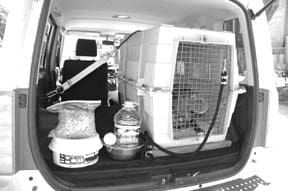
When I’m driving on the road and see a dog in someone else’s car, it makes me smile. I love it when people care enough about their dogs to chauffeur them around town. I love it even more when the dog is in a crate or seat belted in place.
My smile quickly vanishes, however, if the dog has her head stuck out the window, is sitting in the driver’s lap, darting back and forth across the seats, or worse, riding loose in the back of an open pickup truck. And the ultimate crime – leaving a dog in a hot car – motivates me to grab my cell phone and call out the animal cops.
As much as we love our dogs and want them with us all the time, we have an incontrovertible obligation to transport them safely, for their own welfare as well as ours, and that of other drivers on the roads. All dogs, large and small, should learn to ride politely in their cars. There’s a long list of safety hazards concomitant with having an unrestrained obstreperous canine in a moving vehicle. Here are some:
- A dog who interferes with driver’s physical ability to drive the car. A dog sitting on the driver’s lap can interfere with steering. A dog who gets on or under the accelerator or brake pedals, hits the gear shift, or blocks the driver’s view can cause an accident.
- A dog who interferes with driver’s mental ability to drive the car. When the driver’s attention is taken away from the road to deal with dog’s behavior, the dog has become a safety hazard.
- A loose dog can become a flying missile if the car stops abruptly or is hit by another car.
- If the car windows break or the doors pop open in an accident, a loose dog can escape, get hit on the road, or run off and become lost.
- An unsecured dog can interfere with the efforts of rescue workers in an emergency.
- A dog with her head out the window can suffer injury to her eyes from bits of flying debris, or worse, can have her head smashed by objects that pass too close to the car (other vehicle mirrors, signs, branches).
- A loose dog can fall or jump out of an open window or back of a truck.
- The temperature in a parked car on a warm (not even hot!) day can kill a dog.
I’m probably missing some, but I hope that’s enough to make you stop and think next time you’re planning an outing with your furry friend. That doesn’t mean you have to leave your dog buddy at home; there are lots of options for keeping everyone safe while enjoying canine company in your car.
Reducing the Risk
Not every dog loves car outings. Some high-risk car behavior is a result of canine stress and/or arousal. Reducing stress and arousal will decrease car-ride risks and increase car-ride enjoyment for both of you.
Tools and techniques for reducing stress in the car include covering your dog’s crate to reduce sensory stimulation; using a Calming Cap (see “Now You See It, Now You Don’t,” next page) for the same purpose; and incorporating a program of counter-conditioning and desensitization to overcome your dog’s car-related fears and arousal triggers (see “Road Scholar,” May 2001).
Additional tools for maximizing your car safety and pleasure are those that restrict your dog’s movement about the cabin. Many dog owners choose crating as a relatively safe car restraint option. This can be an excellent choice, and it does have drawbacks. To be super-safe, the crate needs to be fastened securely in the back of the vehicle.
Space is another consideration. Crates require a lot of room. If you have a mini-car and a maxi-dog, there’s no room for a crate – you need to explore other options, like canine seat belts.
When the “fasten your seatbelt” sign lights up on your dashboard, so can your dog’s. Many dogs ride comfortably and calmly secured in their seats with a belt designed for just that purpose. There are numerous models to choose from. (See “Seat Belt Your Dog,” February 2004.)
To avoid the potential for serious injury to his neck, though, be sure to select one that attaches to a harness, not your dog’s regular collar. Some dogs who habitually pace nervously back and forth in their cars settle down and relax when restricted by a seat belt. It’s easier on your nerves, too!
If you choose the seat belt route, be aware that the air bag danger that precludes small children from riding in the front passenger seat applies to dogs, too. Either disable your passenger air bag so Rover can ride in the front, or strap him into his seat belt in the back seat.
There are dogs who are not good seat belt candidates – typically puppies, young dogs, and others who might be tempted to try their teeth out on the seat belt or harness straps. Reprimanding your dog for chewing his belt comes under the “driver distraction” risk category. You can try applying a sour-tasting product such as Bitter Apple to the straps. This works for some dogs – but not all.
Another solution for strap chewers is a tasty stuffed Kong or other chew to keep their teeth otherwise occupied (see “King Kongs,” October 2000). You’ll need to secure the Kong so it doesn’t fall off the seat out of reach of your dog, by running a cord through the hole at the small end and tying it to a handy spot in the car. If that doesn’t work, you may need to give in and buy a bigger vehicle to accommodate a crate, or settle for a physical barrier. You might also teach your dog to love a basket muzzle and have him wear one while he’s belted in the back.
Barriers are designed for use in station wagons, mini-vans, and SUVs, and range in price from $40 to $80. The metal barriers are pressure mounted, and tend to be sturdier than the mesh ones, which attach with straps.
Barriers are not as safe as crates or seat belts. While they may protect human passengers from flying dog bodies in case of a wreck, they don’t protect the dog from getting bounced about the back of the vehicle, or stop him from escaping through broken windows. If you have a large dog and a small car, barriers won’t work; you’re still out of luck – and will need to reconsider the seat belt option.
Good Car Manners
Congratulations if you have already accustomed your dog to riding in the back seat (or “way back” of your car) with a harness and securely fastened seat belt. This, or a securely fastened crate, is the safest mode of car travel for your dog. But if you choose to ride with your dog unrestrained in your car, the least you must do is teach him to be calm and lie down in a safe spot other than your lap. (Dogs who are quiet and well-mannered in the car, but prefer to sit up and look out the windows, would be safer if they were secured with a harness and seat belt. When sitting up, a dog’s center of gravity is higher, putting the dog at higher risk of being thrown through the air in an accident.)
Some dogs prefer to lie down on the back seat, the floor of the back seat, or the way back of a station wagon, with little or no guidance. Dubhy, our Scottish Terrier, lies like a rock on the back seat of a car – you wouldn’t even know he’s there. In contrast, Bonnie, our newest acquisition, paces nervously in the car, and if allowed will attempt to climb into the front seat, and sometimes my lap. Given how deeply ingrained this behavior is, attempting to train her to lie down in the back seat would probably cause both of us undue stress. We crate her in the car, even for short trips. Your dog should have a solid and reliable “down” behavior on verbal cue (see “Sit Happens,” February 2001) before you expect him to ride politely in your car. If he does have a solid down, you can cue him (and reward!) for lying down quietly while you are driving (or rather, when you are safely stopped during drives).
If your dog does not reliably respond to a “down” cue, a program to teach polite car manners is in order. This will require two people – one to drive the car, one to reinforce your dog for appropriate car behavior. A large empty parking lot is a good place to start your lessons, to minimize distractions for both driver and dog.
Cue your dog to lie down on the back seat. When he does, mark the behavior, with the click! of a clicker or a verbal marker (such as the word “Yes!”), and give him a treat. Drive a short distance while your helper continues to mark the desired behavior and reward your dog at a rate of reinforcement high enough to keep the dog in his down position. Depending on your dog, this may be every few seconds to start, or it may be a slower rate if your dog is already reasonably calm in the car.
Continue to drive short distances with stops in between to give everyone a break. Gradually increase the distance of your practice runs, while your helper gradually decreases the rate of reinforcement. As you increase the length of the runs, keep the time between reinforcements of a random interval – some longer, some shorter. This way, your dog won’t get antsy as he starts anticipating the next click; he’ll never know when it’s coming! Have your helper ultimately fade the clicks and treats altogether as the car is moving, since you won’t be able to click-treat safely when you’re driving alone. Your goal is to have her reinforce polite car behavior only occasionally, and only when the car is stopped.
When your dog rides well in an empty parking lot, move your practice sessions to a parking lot with traffic, so your helper can reinforce your dog for riding politely in a more stimulating environment. Again, start with a high rate of reinforcement. When he has impeccable manners in the parking lot with clicks and treats only when the car is stopped, you’re ready to take it on the road, still with your helper present to reinforce appropriate car behavior. With that step accomplished, you can fly solo. Go back to the empty lot and give it a trial run. If your dog has learned his lessons well, you’ll zip through this part with ease. Drive a short distance with your dog lying down in his back-seat spot. Don’t try to click and treat while you are moving! Stop, click, and treat.
As long as he’s staying in his place, gradually increase the length of your runs, sometimes giving him a click and treat when you’re stopped, sometimes not. When he’s ready, move to a parking lot with traffic, and practice there until you’re ready to face the real world.
Pat Miller, CPDT, is Whole Dog Journal’s Training Editor. Miller lives in Hagerstown, Marland, site of her Peaceable Paws training center.


I just bought a Honda CRV and am wondering how to tie down two small/medium size kennels in the back cargo area. The back seats fold down but I don’t want to do that as I want the back seats available for passengers. My two miniature poodles previously shared one large kennel on the back seat of my Altima but I would have to turn it sideways for it to work In the Honda cargo area. So, I plan to used two smaller kennels. There are tie down fixtures in the Honda cargo area – just not sues what to use to secure the kennels to the fixtures. Bungee cords or ? Also wondering go if the kennels should be tied together or not.
Thank you.