

[Updated February 5, 2019]
TUG O’ WAR OVERVIEW
1. Teach your dog and other family members to play tug by the 10 Rules (explained below).
2. Play the game frequently to help get rid of your dog’s excess energy and to teach him self-control and good manners habits.
3. Use your dog’s tug toy to redirect him from inappropriate behaviors and keep his attention on you around distractions and stressors.
Contrary to conventional wisdom in some dog training circles, tug is a great game to play with most dogs – as long as you and your canine pal play by the rules. Lots of my clients have dogs with aggressive, reactive, and other stress-related behaviors. One of the best ways to help reduce stress is to increase exercise. Tug is great exercise.
I’m constantly encouraging my clients to play tug with their dogs. Inevitably when I suggest it I get a puzzled look and a tentative protest that “some trainer” told them playing tug would make their dog dominant and aggressive. I sure wish I could meet that pervasive “some trainer” some day and convince him/her otherwise. It just isn’t so.
Tug has a lot going for it besides just being good exercise. Most dogs love to tug. Of course, the caveat is that you play tug properly – with rules, which I’ll discuss in a minute. Here are some of the many other reasons this game ranks high on my list of approved activities.
Why Tug is Good for Dogs
1. Provides a legal outlet for roughhousing
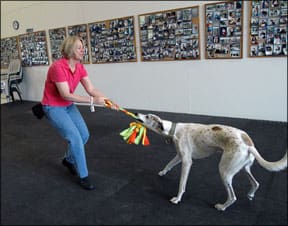
Often, one or more members of the family want to play inappropriate roughhousing games with Bruiser. Said family members are usually male. Sorry, guys, but it’s true! Of course, not all male humans want to roughhouse inappropriately with the family dog, but chances are if someone is going to, it’s Dad, Junior, or the Boyfriend. If you can get your male family members to compromise on a rousing game of tug, everyone wins.
2. Strengthens bonds between dog and guardian
Dogs love to tug. Humans love to play with dogs. Anytime you and your dog can do something together that you both love, it strengthens the bond that holds you together through think or thin, good times or bad, until death do your part. The four to six million dogs who end up in shelters every year in this country are a stark reminder of how much those bonds need strengthening.
3. Builds healthy relationships
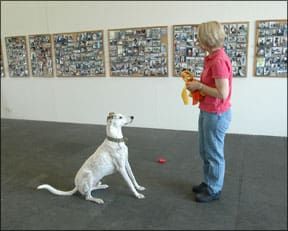
You control access to the tug toy. “Leader” is defined as the one who controls the good stuff. By playing tug and granting your dog access to the tug toy, you remind him that the toy belongs to you, the higher-ranking member of the social hierarchy, and out of the goodness of your benevolent-leader heart, you let him play with it sometimes. It actually teaches him that deference behavior (sitting and waiting) makes the game happen. (So much for the “It will make your dog dominant” myth!)
4. Offers incredibly useful reinforcement potential
While it’s important to play sometimes just for the sake of playing, play can be a valuable reinforcer for training purposes as well. Agility trainers are well aware of this; they usually have a bag full of tug toys they can use to help maintain their dogs’ enthusiasm. They even use tug-leashes! You can also use tug to motivate a dog to do really enthusiastic recalls. My own Cardigan Corgi, Lucy, would much rather stay outside and play when the farm work is done and it’s time to come inside. I used tug games with her favorite Udder Tug toy to convince her that coming inside could be fun, too.
5. Redirects inappropriate use of teeth
Some dogs, especially some puppies and adolescent dogs, just want to bite something. It can be annoying, painful, and life-threatening (the dog’s life) when dogs bite human skin, even in play. In the positive training tradition, you get better results if you redirect undesirable behavior, telling your dog what you want him to do rather than what you don’t want him to do.
When you play tug to redirect inappropriate mouthing behavior you get two benefits for the price of one – in addition to directing the teeth to an appropriate object, you exercise your dog and tire him out – which also makes him less likely to engage in inappropriate mouthing. (Again, so much for the “It will make your dog aggressive” myth.)
6. Teaches dogs self-control
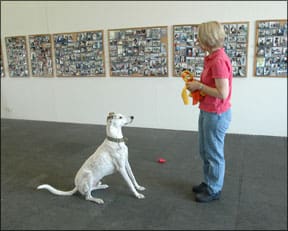
The rules of tug require that your dog sit and wait when you hold up the tug toy. He can only grab for it when you give him permission. If he jumps to grab it prematurely, you say “Oops!” and hide the toy behind your back. This is negative punishment; the dog’s behavior makes a good thing (the opportunity to play tug) go away. Since he doesn’t want the tug game to go away, he learns to control his jump-and-grab impulse in order to make the tug game happen.
7. Creates a useful distraction
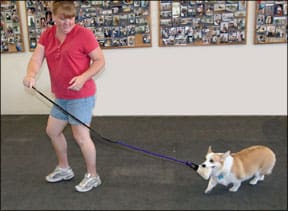
When we first got Lucy three years ago, she took delight in tormenting Dubhy, our Scottie, who hikes with me on a long line because his recall is not reliable. The long blue leash snaking through the grass would catch Lucy’s eye, and she’d latch onto it and drag poor Dubhy around. A tug toy, stuck in my back pocket was perfect for redirecting her desire to grab and pull his leash. You can also use a tug toy to keep your dog’s attention focused on you in the presence of general distractions.
8. Modifies behavior
I normally suggest using a high-value treat for the behavior modification process of counter-conditioning and desensitization (CC&D) – giving a dog a new, positive association with a previously aversive stimulus.
Canned (rinsed and drained) or boiled chicken ranks high on most dogs’ list of favorite treat. I had a client with a dog-reactive Briard, however, who was so overly aroused by the presence of a neighbor’s dog on the next-door back deck that she couldn’t even do CC&D with him in her own backyard; he was too stressed to eat chicken. She discovered that playing a low-key game of tug helped change her dog’s emotional state from anxious to happy, which then allowed her to proceed with the CC&D program using food treats.
9. Builds confidence
You can use tug to help a timid dog become more confident. A dog who lacks confidence may be reluctant to play tug at all, at first. Smear a dab of peanut butter or other tasty-but-gooey treat on the end of the toy, and let him lick it off. Keep doing this until he’s licking eagerly, even nibbling at the toy. When you see him nibbling, gently move the toy a little – not enough to scare him! He should eventually grab onto the toy. You can pull a little – gently! Over time, as he gets braver, he’ll be willing to tug harder, until you can work up to a full-blown game of tug.
Variations on the Tug O’ War
The most common style of tug consists of a dog on one end of the toy, a human on the other. You don’t have to stop there, however. Make or buy a “tease pole” toy for extra exercise benefits: tie a toy on a rope and attach it firmly to the end of a sturdy pole, then swing it around at dog-level to encourage your dog to chase it. When he catches it you can play tug, then ask him to “Give” and play chase again.
If you have two compatible dogs who love to tug you can give them each one end of a toy and let them go at it with each other. The key word here is compatible. Because tug does create a certain level of arousal, dogs who are prone to getting into fights should not be encouraged to tug together. Don’t equate growling and snarling with fights, however – a lot of healthy noise often results when compatible dogs play tug together.
If you have two dogs who can tug together, try a threesome! Find a tug toy with one handle for the human and two ends for the dogs. Tug: a game the whole family can play!
At the other end of the spectrum, you can teach your dog to play tug by himself.
Run a rope through a Kong and knot it so the knot is inside the Kong. Stuff the Kong and tie the rope to something so that your dog can tire himself out by tugging at the Kong. Of course, you lose the relationship value of tug with this variation of the game, but you might increase the exercise benefits!
Tug toys come in all shapes, sizes, colors, and materials, but the best ones have these characteristics in common:
• They are long enough that your dog’s teeth stay far away from your hand. I like toys that are at least 12-24 inches in length for teaching tug (the longer the better). Once your dog knows the rules, you can graduate to shorter toys. For some training purposes, a small tug toy you can stuff in a pocket is ideal.
• They are made of a substance that invites your dog to grab and hold, and won’t easily cause damage to teeth and gums. Braided rope and fleece toys work well, as does rubber. Stay away from wood, hard plastic, or metal.
• They are sturdy enough to withstand significant abuse. Fleece may not do quite as well in this department, especially if you have a very vigorous tugger, but could be perfect for the lightweights. Remember, you’ll put the toy away when you are done tugging, so it doesn’t have to stand up to rough chewing, just tugging.
• The “human end” has a comfortable handle or is otherwise easy to maintain a grip on. This allows you to win most of the time – an important tug rule. If it’s hard to hold onto the toy, your dog will more easily yank it out of your hands.
• They provide good value for their cost. You should be able to find a good sturdy tug toy in the $5 to $25 range, depending on your dog’s size and how energetically he tugs.
The 10 Rules of Tug
There are really only two good reasons not to play tug with your dog: 1) If either you or your dog has some kind of medical condition that rules out this kind of vigorous play (and then you still might be able to play low-key tug) or 2) if you have one of those very rare dogs who just can’t seem to learn to play by the rules, and insists on putting his mouth on you despite your best efforts to teach him otherwise. Barring those, the game is on, with the following rules:
1. Use a toy that is long enough to keep dog teeth far away from your hands, and that is comfortable for you to hold when he pulls.
2. Keep the tug toy put away. Bring it out when you want to play tug.
3. Hold up the toy. If he lunges for it say “Oops” and quickly hide it behind your back. It’s your toy – he can only grab it when you give him permission.
4. When he’ll remain sitting as you offer the toy, tell him to “Take it!” and encourage him to grab and pull. If he’s reluctant, be gentle until he learns the game. If he’s enthusiastic, go for it!
5. Randomly throughout tug-play, ask him to “Give” and have him relinquish the toy to you. If necessary, trade him for a yummy treat. After he gives it to you, you can play again (see steps 2 and 3). You should “win” most of the time – that is, you end up with possession of the toy, not your dog.
6. If, while you are playing, your dog’s teeth creep up the toy beyond a marked or imaginary line, say “Oops! Too bad” in a cheerful voice, have him give you the toy, and put it away briefly. (You can get it out and play again after 15 seconds or so.)
7. If your dog’s teeth touch your clothing or skin, say “Oops! Too bad” and put the toy away for a minute.
8. Children should not play tug with your dog unless and until you are confident they can play by the rules. If you do allow children to play tug with your dog, always directly supervise the game.
9. Only tug side-to-side, not up-and-down (up-and-down can cause injury to your dog’s spine), and temper the vigor of your play to the size and age of your dog. You can play tug more intensely with a 120-pound adult Rottweiler than you can with a Rottie puppy, or a four-pound Chihuahua.
10. When you are done playing, put the toy away until next time. You control the good stuff.
Happy tugging!
Pat Miller is Whole Dog Journal’s Training Editor. She is the author of The Power of Positive Dog Training; Positive Perspectives: Love Your Dog, Train Your Dog; Positive Perspectives II: Know Your Dog, Train Your Dog, and the brand-new Play with Your Dog.



The wholesaler can also aid you out in selection if you inform them your specifications.
Good blog you’ve got here.. It’s difficult to find high quality
writing like yours nowadays. I seriously
appreciate individuals like you! Take care!!
I was able to find good advice from your articles.