[Updated March 28, 2018]
TRAINING YOUR DOG TO GREET NICELY: OVERVIEW
1. Commit to teaching your dog polite greeting behavior so he’ll be a welcomed canine citizen wherever you want to take him.
2. Enlist the help of friends and family to practice polite greetings in different locations so your dog’s good manners behavior generalizes to all kinds of people in all kinds of places.
3. Exercise, exercise, exercise. A tired dog is far less likely to jump up than one who is bursting with energy.
Recently, I switched the group class format at my Peaceable Paws Training Center to “Levels.” Instead of a progressive curriculum with new exercises introduced each week, dogs and humans learn and practice a small, fixed set of behaviors until they’re ready to progress to the next level, where they begin working on new skills. One of the Level 1 skills is “polite greeting.” Because it can be a challenging behavior to teach, it’s often the one that keeps a student in Level 1 the longest. Because it’s an important good manners social behavior, it’s also a Level 2 and Level 3 skill.
The polite-greeting skill difficulty increases with each level. For Level 1, the dog must sit for greetings and not jump up in at least 8 out of 10 times as someone approaches. For Level 2, the dog sits for greetings, and the greeter pets the dog on his head or scratches under his chin without the dog jumping up at least 8 out of 10 times. In order to complete Level 3, the dog must be able to walk up to another dog and human, with dogs walking on the outside, further away from each other, human on the inside, closer together, as they approach. Both dogs stop and sit while handlers stop, greet each other, shake hands, and walk on. (This is one of the 10 tests a dog must pass in order to achieve a Canine Good Citizen certificate from the American Kennel Club.)
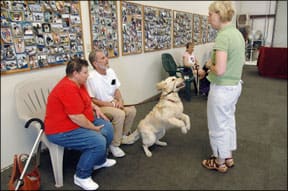
So how does one go about teaching this desirable good manners behavior? It should come as no surprise to regular readers that the answer involves reinforcing the behavior you want, and making sure the behavior you don’t want doesn’t get reinforced.
How to Greet On-Leash, with Strangers
Start with your dog on leash next to you. Have your helper approach and stop just out of leash-range, holding a tasty treat high against her chest. Hold the leash and stand still, waiting. Your dog will eventually get frustrated that he can’t jump on the helper, and he’ll sit to figure it out. The instant he sits, have your helper click her clicker (or use a verbal marker such as the word “Yes!”) and pop the treat in your dog’s mouth. This is called reinforcing an incompatible behavior. Your dog can’t sit and jump up at the same time. If he consistently gets reinforced for sitting and doesn’t get reinforced for jumping up, he’ll choose to offer the behavior that gets rewarded.
When your dog is sitting, relax the tension a tiny bit so he’s holding the sit himself, not being restrained by the leash. Only give him a little bit of slack, so you can prevent him from contacting the approaching person if he decides to revert to the jumping-up behavior that (probably) has a long history of reinforcement.
Keep repeating this exercise. It can take as few as a half-dozen repetitions for your dog to start sitting as the helper approaches. At that point, if he tries to leap up to get the treat when it is offered, have your helper whisk it out of reach and say “Oops!” in a cheerful voice, and wait, just out of jumping range. When your dog sits again, your helper clicks (or says “Yes!”) and offers the treat again. Your dog will soon learn to sit tight in order to get the treat instead of jumping for it, because jumping makes the treat go away.
In a variation of this exercise, you can click and pop the treat in his mouth when he sits. If you do it this way he’ll start looking at you and sitting when a person approaches, instead of looking at the person approaching.
Repeat this exercise with as many different humans as possible: big ones, little ones, kids, seniors, dads carrying babies, moms carrying briefcases, and so on. When you’re out walking and a stranger admires your dog and asks if she can pet him, hand her a treat and have her do the exercise. You’ll be amazed by how quickly your dog starts sitting as he sees people approach him.
NOTE: In these exercises, it’s important that you wait for your dog to sit of his own volition; do not ask him to sit. You want him to choose to sit without being asked, and the way to achieve that is to simply ignore the behavior you don’t want and reward the behavior you do want. If you ask him to sit, he may learn that he should sit for people when you (or they) ask him to, but he’s allowed to jump up if you don’t ask.
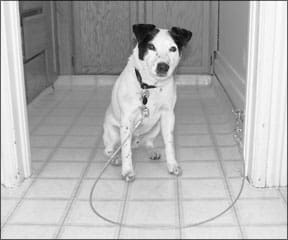
Train Your Dog to Greet You On-Leash
Okay, so you don’t always have a friendly helper handy. You can still practice this exercise on your own, by attaching your dog’s leash to a solid object. Better yet, use a tether: a plastic-coated cable with snaps at both ends. One end can be secured around a heavy piece of furniture, or attached to a strategically placed eye-bolt. Or you can attach the tether to an eye-bolt screwed into a block of wood, slip the cable under a door, and close the door; the door holds the tether in place.
Walk about 30 feet away, then turn around and start walking back to your dog. As long as he is sitting, keep approaching. The instant he jumps up, stop. When he sits, move forward again. In this exercise, the reward for sitting is simply that you come closer. You can give your dog a food treat when you reach him and he’s still sitting, but you don’t have to toss him one every time he sits.
If you want to experiment with variations on this exercise, try turning your back on him or actually backing up a step when he gets up, and see if that convinces him to sit even faster. The idea here is that not only does the reward (you) stop when the dog gets up, the reward (you, your attention, and treats) actually goes farther away!
Practice Greeting Your Dog Off-Leash
You come home from work, walk in the front door, and see your 80-pound dog flying over the back of the sofa. You know a brutal greeting is coming. There’s no leash to restrain him. What should you do?
Turn your back on him! Watch him out of the corner of your eye, and continue to turn away and step away as he tries to jump on you.
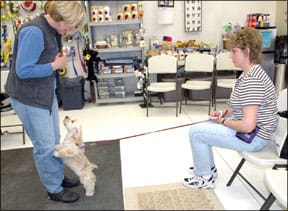
Again, in a surprisingly short period of time your dog will sit in frustration to figure out why he’s not getting his ration of attention. The instant he sits, say “Yes!” in a happy voice, feed him a treat, and pet him if he enjoys being petted (not all dogs do!). Yes, you have to have a treat with you when you walk in the door. I suggest keeping a jar of tasty biscuits on the front stoop. Or keep cookies in your pockets all the time, like I do. If he starts to jump up again after he eats the treat, turn and step away. Keep repeating this until he realizes that “Sit!” gets the attention, not “Jump!”
You want to be sure to give the click or “Yes!” marker when he is sitting. Click (Yes!) means, “Whatever behavior you are doing at the instant you hear this word has earned you a treat reward.” Because all living things repeat behaviors that are rewarding to them, using the click and reward for the sit will increase the likelihood that he sits when he greets people. If he’s consistently rewarded for sitting, and never rewarded for jumping up, he’ll quickly learn that jumping up is not a behavior worth offering.
When you do this exercise, be sure you don’t teach your dog a “behavior chain” – a series of behaviors that get connected or “chained” together because the dog thinks the reward is dependent on the performance of all the behaviors, not just the last one.
Sometimes we use behavior chains to our benefit. A dog can learn to run an entire obstacle course for a reward at the very end without any direction from the owner because the obstacles have been chained in a particular order. In the case of jumping up, if you’re not careful, your dog might learn the short behavior chain of “jump up, sit, reward.”
The way to avoid this is to look for, and frequently reward, the times when your dog sits without jumping up first. We have a tendency to ignore our dogs when they are being good, and pay attention to them when they are doing inappropriate behaviors. If you remember to look for opportunities to reward the good behavior of sitting, your dog won’t think he has to jump up to get your attention in order to get a reward for sitting.
Using Incompatible Behaviors to Shape Greeting Nicely
This works if your dog responds really well to the verbal cue for sit or down. When your dog approaches you, ask for a sit or a down before he has a chance to jump up, and reward that behavior with a click and a treat. With enough repetitions, he’ll learn that the sit or down gets rewarded, and he may start to offer them voluntarily. Be careful; as noted above, he may learn to sit if you ask, but jump up if you don’t.
Caution: This approach works only if your dog is very responsive to the cue to sit or lie down and does it the instant you ask. If you have to repeat the cue several times with your dog jumping up on you all the while, you are paying attention to him (rewarding him) for jumping on you, thereby rewarding that behavior and teaching him to ignore your verbal cues for sit or down at the same time. Oops!
Putting the Jump on Cue
I recommend this only when someone in the family finds a dog’s antics endearing and wants to be able to invite him to jump up. In this case, you teach your dog to jump up on a particular cue such as the word “Hugs!” (not patting your chest, as too many well-meaning strangers and children will likely invite the behavior), and teach him that the only time he can jump up is when someone gives the cue.
This means that he gets rewarded only when he has been invited to jump up, and never gets rewarded for jumping up without an invitation. My now-long-gone terrier-mix, Josie, was allowed to jump up if I got on my knees, patted my shoulders and said “Hugs!” Not many well-meaning strangers and children will do that!
Time-Outs on a Tether
Put a comfortable rug or bed at each tether location. When your dog is out of control and jumping on the company (or you!), he gets a cheerful, “Oops, time out!” and a few minutes on his tether. If you know in advance that he’s going to maul Aunt Maude the instant she walks in the door, clip him to the tether before you open the door, and release him once he settles down. (Have Aunt Maude practice some polite greeting approaches while your dog is tethered, if she’s able and willing.) If you release your dog and he revs up again, just do another “Oops, time out!” Remember, despite your frustration over his behavior, this is a cheerful interlude, not a forceful punishment. He’ll learn to control his own behavior in order to avoid time-outs, and you won’t need to yell at him.
Jumping up is a normal, natural dog behavior. Like so many other normal dog behaviors that are unacceptable in human society, it is up to you to communicate to your dog that jumping up isn’t rewarded. Help him become a more welcome member of your human pack by rewarding an acceptable behavior that can take the place of jumping. If you put your mind to it, it may be easier than you think!
Another Way to Stop A Dog from Jumping: Body Blocking
Dr. Patricia McConnell, noted animal behaviorist and author of The Other End of the Leash, and For the Love of A Dog, describes a process she calls “body blocking,” which simply means taking up space to prevent your dog from doing so.
Next time you are walking in the door and your leaping Lab makes a running charge for you, clasp your hands against your stomach and lean slightly forward, blocking the space with your body. It also helps to look away rather than make eye contact. Remember that you’re not trying to bump into your dog (although he may bump into you), but are simply occupying the space he was hoping to occupy.
You may have to do several repetitions of this, especially if your dog has had lots of practice leaping, but it can be very effective if you are consistent. He can learn to wait for permission to jump up, whether you are standing or sitting, with just the tiniest of barely perceptible body movements on your part. Wouldn’t that be nice?
A Dog Haven with No Jumping Dogs in Sight
I recently had the eye-misting good fortune of making an all-too-brief, nostalgic visit to my old stomping grounds (and birthplace of Peaceable Paws) in California’s Monterey and Marin Counties. A highlight of our trip was when my husband and I visited Carmel Beach, where dogs are allowed to run off-leash. We were reminded, and again amazed by, how beautifully most dogs can get along when they’re allowed to interact regularly and naturally with others of their own species.
What also impressed us, and what I hadn’t remembered from past visits to this very popular dog heaven, was that not one dog jumped up on us. The dogs were friendly, checked us out, looked for treats or balls, accepted a scratch or two under the chin, and then headed off to play in the surf with their four-legged beach pals. Not one sandy paw touched our jeans or sweaters.
We also saw no prong or shock collars, which led me to believe the dogs weren’t being coerced into being polite. Rather, I think, meeting people at the beach (and dog-savvy people at that, who probably know not to reinforce jumping up) is such a ho-hum everyday occurrence for them that there’s nothing to get excited about. In a perfect world, this would be true everywhere!