

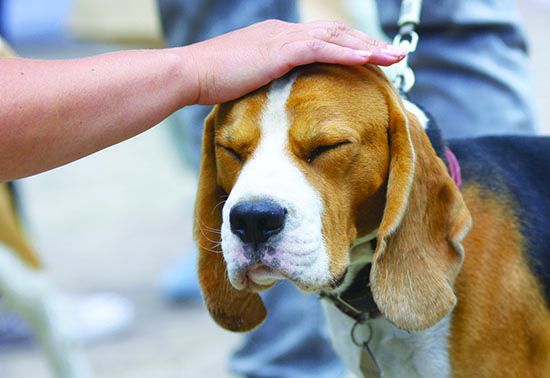
It used to be that if folks wanted to pet your dog, they just reached out and did it. Happily, in today’s more well-informed world, there’s usually a quick, “May I pet your dog?” first. All too often, though, the moment that permission is granted, the stranger is moving in close and looming over the dog, swiftly thrusting a hand an inch from the dog’s nose. The dog – perhaps pushed forward a bit by the owner who sees how eagerly the other human wants this – might find an enthusiastic, two-handed ear jostle is next.
For some dogs – the stereo-typical Golden Retriever, perhaps? – this is the moment they’ve been waiting for! That extra human attention may even be the highlight of their walk. If your family has only included extroverted canine ambassadors like this, the idea that a dog would not welcome an outstretched hand is incomprehensible.
Yet, comprehend we must. Because, believe it or not, few dogs automatically love being trapped on a leash and touched by new people. As hard as it is for us to accept, that quiet dog being petted may well be hating every moment that the human is enjoying so much. While that’s important to understand when you’re the stranger in the scenario, it’s absolutely critical when you’re the one holding the leash.
DON’T ASSUME THAT DOGS WANT TO BE PETTED
Indeed, plenty of wonderful dogs are not eager to say hello to strangers. They may feel anything from uninterested, to wary, to terrified. In some cases, they have been specially bred – by humans – to feel what they’re feeling.
Unfortunately, because we humans value petting dogs so much, we often ignore that pesky truth. We tend to believe that all good dogs should happily accept petting from anybody at any time. But dogs have plenty of reasons for choosing to say no:
- Perhaps they’ve been bred to guard, so this forced interaction with strangers is deeply conflicting.
- Perhaps they’re simply more introverted and don’t enjoy this kind of socialization.
- Perhaps something in their background has made them less trusting of people.
- Perhaps normally they’d be all in, but today their ear hurts, or they are very distracted by the big German Shepherd staring at them from across the street.
There are many reasons, all legitimate, that may make a dog prefer to skip this unnecessary interaction.
DON’T GIVE CONSENT ON BEHALF OF YOUR DOG
Becoming conscious of just how deeply some dogs do not want to be randomly touched is the first step toward realizing that we really should be asking dogs, not their handlers, whether or not we can pet them. Ultimately, it’s the dog’s consent we need in order to safely pet them, not the human’s.
Maybe the idea of giving our dogs the right to consent feels strange to you. For my part, it feels downright creepy to not give my dog the right to consent or decline to being touched by a stranger. It feels wrong that I have the power to decree, “Sure, absolutely, you go right ahead and put your hands all over this dog’s body. She’s so pretty, isn’t she? We all love to touch her.” Ew!
Of course, dogs can’t verbally answer the “May I pet you?” question (when given the opportunity to do so), but they sure do answer with their body language. Unfortunately, most people don’t have the skills to read what can be very subtle signals, and as a result, many dogs are routinely subjected to handling that makes them uncomfortable. Worse, this often happens while they’re restrained by a leash with their owner allowing it.
That experience can make dogs even less enamored of strangers, and – the saddest part – less trusting of their owners, who did not step up to help them through that moment.
TIPS FOR MAKING FRIENDS WITH A DOG
I give my dogs agency when it comes to who touches them and when. If somebody asks, “May I pet your dog?” I smile at their interest and tell them I’d love for them to ask the dog. Then I show them how:
- Keep a little distance at first.
- Turn a bit to the side, so you don’t appear confrontational.
- Use your warm, friendly voice to continually reassure.
- Crouch down, so that you’re not looming in a scary way.
- Keep your glances soft and light instead of giving a steady stare.
- Offer your hand to sniff. But instead of the fist shoved unavoidably in the dog’s face (which is what society has been taught is the polite thing to do), simply move that hand ever so slightly toward the dog so she has a choice of whether to get closer to investigate. Look elsewhere as she does so, so she can have a little privacy as she sniffs.
Often, this approach gets us to a waggy “yes” from even a shy dog in 30 seconds!
HOW TO TELL IF YOUR DOG IS GIVING CONSENT
If the dog pulls toward the stranger with a loose, relaxed, or wiggly body, the dog is saying yes. Great! The next step is to begin petting the dog in the spot she’s offering – likely her chest or rump. (A top-of-the-head pat is on many dogs’ list of “Top 10 Things I Hate About Humans.”)
If my dog does not give a quick or easy “yes,” I may try backing us up a bit and making conversation, because many dogs warm up after having a few minutes at a safe distance to size up a new human. I might feed my dog a few treats while talking to the stranger, or give him some treats to toss near my dog. If she then relaxes and leans into the experience, great!
If not, we just call it a day and move along. That is also – and this is critically important – great! No harm, no foul. No need to apologize if our dogs say, “No thanks.” We can simply and cheerily head on our way.


This was a wonderful article. I’m a guide dog handler and working with dog number six. My policy is no one pets my dog, in or out of harness unlesss and until I know them and I see that they can demonstrate being calm. If someone asks, the answer is always “no”, and I move on. I’m not interested in giving any explanation nor do I feel I need to apologize–like: “Oh I’m sorry, he’s working right now.”
I’m NOT sorry at all, and I refuse to say things as social grease and that I don’t mean. No, it’s not because my dog is working, it’s because we don’t know you and your energy. Plus most likely you’re the fiftieth person who has asked me that day and I just want to be left alone to do my business like everyone else.
When I do allow an in public introduction, I give the person specific instructions–turn slightly sideways, do not make eye contact, keep your hands low, etc. I then remove my dog’s harness and spend about five seconds giving him pets and praise—essentially saying: “Thank you. You’ve done a great job.” Removal of the harness tells him he’s off duty.
I then gesture toward the person while asking my dog: “Go visit?”
Translation: “This person wants to say hi; are you interested?”
If after an initial sniff and he’s not interested, he turns away toward me. “No thanks.”
Regardless, I’m closely monitoring the interaction the entire time. I don’t need sight to know when my dog’s body is stiff or relaxed, the position of his tail and how fast or slow it wags. I keep a hand lightly near his head to monitor movements and I’m quick to step in or end the interaction if the human violates boundaries. Same process and rules applied with my retired and pet dogs.
This is just what works for me. If others have a problem with it and get offended, that’s not my business. Find another German Shepherd to pet–there’s lots of them around.
I am 84 years old. Don’t pet my dog but I am available for immediate hugging!!!
🤣
Useful article.
Since two of my three dogs are not very friendly, most of the time I walk them in the early mornings before people are up and about. But on the VERY short break between winter and spring (I live in Houston, Texas so it’s more like fall and summer year round, TBH) I take advantage of the nice weather walk them in the early evening. That extra hour and a half of sleep is worth carefully planning out a walking route that avoids most people, especially kids. (One of my dogs is a husky, and they’re like MAGNETS for attention, too, so it gets tricky. But as this usually results in walks in wooded areas vs residential, the dogs like it just fine.) However, encounters still occur.
When they do, I’m happy to say most of the time the people ask. And when they do, I’ll say “let my dog decide. Hold out your hand, please.” Most of the time my husky will sniff the hand and approach, but sometimes he doesn’t. My GSD, however, stays firmly behind me. He doesn’t like strangers, and he avoids kids like the plague. I tell people straight off that he’s not friendly.
My daughter was with me one afternoon and as kids approached, asking if they could pet my dogs, I told my daughter to take Angus (my GSD) and keep going. The kids approached, introductions were made and since Fergus (my husky) loves kids, all were happy. One little boy asked about the “big black dog”. I told him that Angus was a rescue from people who let their kids be mean to him, so Angus didn’t like kids very much. The little boy asked me why he had to ask my dog if it was okay to pet him, and not me. I asked, “well, if I just walked up to you, petted your head, scratched you behind your ears, and rubbed your cheek, chin and neck, would you like it?” He laughed and said “No!” I sat there and smiled at him… you could see the *CLICK* and he said… “oooooh, I get it.”