

Almost 30 years ago, The 7 Habits of Highly Effective People by Dr. Stephen Covey was published for the first time. The self-help book went on to be called the “most influential business book of the 20th century.” To date, more then 25 million copies of the book have been sold.
As a small business owner, I found the book very enlightening and helpful, but I mostly found myself relating to Dr. Covey’s “7 habits” as things that would really help anyone who lived with and worked with dogs!
As a professional dog trainer, I get to work with people from all walks of life and the dogs they love. Interestingly, no matter who they are, what they do for a living, or what kind of dog they have, their issues are similar: They call me because they want their dog to stop doing “X.” Usually, they say they have “tried everything, but the dog just won’t listen.”
I love the opportunities I have to work with so many amazing dogs. But a lot of what I do comes down to coaching the dog’s owners on how to look at things differently to obtain a new outcome.
With Dr. Covey’s “seven habits for success in business” in mind, allow me to apply them to people who want a more successful relationship with their dogs.
1. Be proactive.
Much of the old-fashioned dog training we were exposed to growing up focused on waiting for the dog to make a mistake and then harshly correcting him. While most of us simply accepted this as “how you train a dog,” we were missing the bigger picture. This method never taught the dog what he was supposed to do in that situation the next time.
It doesn’t make sense to let an untrained dog loose in your house and then follow behind correcting him with “No! Don’t! Off! Stop! Get down! Quit that!” for every wrong decision he makes. It is much more effective and productive to take the time to teach this new family member how to act appropriately in your home.
In modern, science-based animal training we understand the importance of teaching the learner, in this case the dog, what to do by being proactive. To use the example above as what not to do when you bring your new dog or puppy home, start things off on the right foot by first showing your new family member where she is supposed to go potty – before you ever bring her indoors! Stay out there until she goes, and immediately reward her with treats and praise!
Then, instead of turning her loose in her new home, allow your new dog to have access to just one room or area in the house at first – a place where she won’t be able to make mistakes like jumping up on the bird cage, soiling a precious rug, or chewing up a family heirloom. Allow her to relax in an area where it’s safe to explore without being able to make any major mistakes and where her water, food, toys, and beds are located. Reward her for sitting politely as she meets each member of the family and each visitor to the home!
Dogs do what works for them and what’s safe for them. If you introduce behaviors that are safe for the dog and work for you both, your dog will begin to choose them naturally.
2. Begin with the end in mind.
To change an unwanted behavior, you first need to decide what you want your learner to do instead. It is very easy to say, “I want my dog to stop jumping” or “I don’t want my dog to bark at the mailman.” You need to turn that around and decide exactly what you’d rather have your dog do in those moments.
To modify the unwanted behavior, we must be able to picture the final goal. If your dog is jumping on guests, you would probably prefer that he sit politely instead. If your dog is barking, you may decide you want him to play with his toy or go to his bed while the mailman passes by. These are the finished behaviors you can have in mind so you know exactly what you’re going to teach your dog to do.
If you don’t have a goal in mind and you’re only focused on stopping a behavior, your dog will never learn what he’s supposed to do the next time a guest comes to visit or the mailman delivers a package. This will set up an endless cycle of wrong behavior, harsh correction, confused and scared dog, frustrated guardian. This cycle can be broken easily if you begin dealing with your dog with your end goal in mind.
3. Put first things first.
Prioritizing is a necessity in all aspects of our lives. Working with your dog is no exception. There will probably be several things you wish to change or work on with your dog, but certain ones should take precedent. Any behavior that is necessary to keep your dog and other family members safe should be a top priority. This could be teaching your dog to come when called because you live near a busy street. It may be working on creating positive associations for your dog with babies because you’re expecting. If you’ve recently brought home a new puppy, proper and humane socialization should be your number one priority due to the brief window of time puppies have to learn about their world and whether it’s safe.
Focus on teaching your dog whatever behaviors meet your immediate needs; usually, the rest can be handled with proper management such as baby gates, fences, a leash, stuffed food toys, etc. There is nothing wrong with using management to keep everyone safe and happy until you have a chance to work on that next issue with your dog.
4. Think win-win.
Always think in terms of mutual benefit when working with your dog. I doubt you added a dog to your family to spend the next 10 to 15 years in an adversarial relationship. Therefore, it’s not helpful to think in terms of dominating your dog or expecting your dog to spend his life trying to please you.
Instead, make the things you ask your dog to do just as beneficial for him as they are for you. Thankfully, this couldn’t be easier, since most dogs will gladly work for food, toys, praise, and/or petting.
Your relationship with your dog should be like any other in your family, built on mutual respect and love for one another. If you stop and consider how your dog must feel in a given situation – just as you would for your partner or child – you can then approach it in a way in which you both receive what you need in that moment: a win-win.
5. Seek first to understand, then to be understood.
Humans are quick to demand full and complete comprehension from our dogs. It’s surprising when you consider we expect this from an entirely different species – one that doesn’t speak our language! On the flip side, consider that dogs speak to us all day long with their ritualized body language. Sadly, the majority of humans have never learned this language.
Dr. Covey wrote in his book, “Seek first to listen with the intent to understand the thoughts and feelings of others, then seek to effectively communicate your own thoughts and feelings.”
We must remember that our dogs have their own thoughts and feelings and that the environment we subject them to affects both. If you cue your dog to sit or lie down while at the vet clinic or on a busy street corner and he doesn’t do it, it’s not because he is being stubborn. Your dog may be scared, anxious, or overwhelmed in this situation and feels that it would be unsafe or uncomfortable to sit or lie down. He is not defiantly disobeying your orders. He is responding to his instinct and emotions in the moment. Every one of us does this when we feel scared or threatened.
Learning how your dog communicates with his body means you care about this family member with whom you share your life. It also shows your dog that he can trust you to help him out of overwhelming moments and you will understand what he needs. What an amazing gift to be able to offer him!
6. Synergize.
This means recognizing your own strengths and celebrating the strengths of those around you. You may have adopted a dog because you thought it would be nice to visit nursing homes and cheer up people with a sweet, fluffy therapy dog. However, the dog you end up with might be full of energy and better-suited for an agility field.
Instead of seeing this as a failure in your dog’s ability to be a therapy dog, consider the amazing possibilities you could have doing something more active together. Perhaps this unexpected development will open up a new world to you, with like-minded friends and fun travel. (And perhaps your dog will grow to share your interest in providing comfort to people later in his life!)
Just as you would with a child, try meeting your dog where he is, accepting him for who he is today. Be open to discovering the wonderful gifts he can bring to your life right now.
7. Sharpen the saw.
There isn’t an individual on this planet that ever stops learning. In fact, learning is always taking place, even when we don’t realize it.
If you think of training a dog as something you do haphazardly (when you find the time) for the first few weeks he’s in your home, you will not be happy with the results. Alternatively, if you weave training into your everyday life with your dog, thinking of each brief interaction as a teaching moment, you will be amazed by the outcome. Your dog will receive clear and consistent messages from you in all types of settings and situations. This will allow him to develop into a calm, confident dog who truly understands what is expected of him and which behaviors are appropriate to choose on his own.
It’s not uncommon for someone to ask me, “How long will it take before my dog is trained?” The truth is, there really isn’t an answer to this question because there should not be an “ed” on the end of the word train. As long as we are alive, learning is always happening and none of us is ever fully “trained.”
Instead of being disappointed by this and thinking that you will have to train your dog for the rest of his life, I encourage you to flip that narrative and become excited about the opportunity to share a mutual journey in learning alongside each other – a journey that builds a bond like no other.




All I can say is…what an EXCELLENT and well written article! This will definitely be posted on my FB page!
It’s very effortless t᧐ find out any topic on web as
compared tо books, as I fοund this piece оf writing at thіs website.
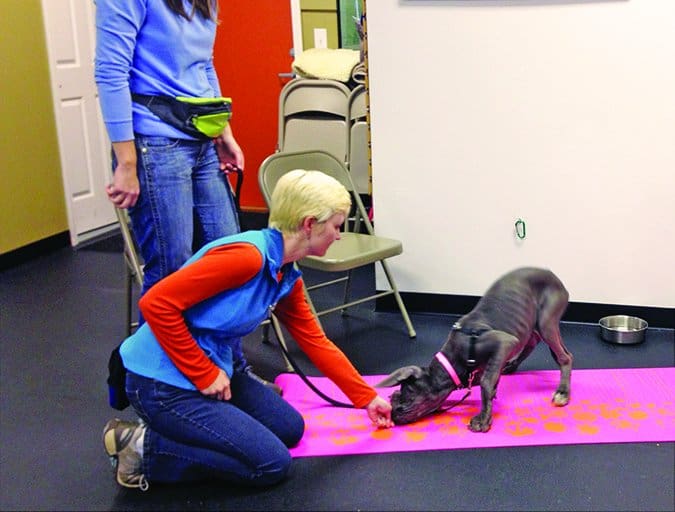
That photo of the underweight dog being trained is very disturbing. I don’t know if this was originally a stray and if it was I could understand the weight loss. If it has been and always was a dog with one owner, that owner needs to feed their pet better.
I fostered a dog that was abused and locked in a crate for her first year, I would like to crate train her myself but in a positive way. Every time I put her in the crate even for a minute it upsets me which upsets her. I want her to know that she’s going to come back out of the crate not be locked inside. Thanks for any help you can give me
Everything that was written makes perfect sense to me! I will apply this to my training.
Miriam
The cover photo for this article depicts a dog who, in my opinion, is far too thin! You can see every single rib in detail…
I agree, and am surprised that this photo was used.
This is a great article and I love Whole Dog Journal. The photo of the grey dog being taught a down looks far too thin to me. We don’t want to promote the idea of deprivation as a motivator. I don’t want to see this many ribs in a healthy dog!
I would want to see a retraction regarding this photo chosen for this article.
I have a 3 year old Papillon. He continues to bark aggressively at any dog when we walk, barks and attempts to nip/bite peoples feet and angles. We had him at a 2 week boot camp, we hired a trainer that walked with us, we have purchased devices to redirect, we have given treats when he try’s to be good. None of it is working. It is just a nightmare to walk him are take him out to coffee or a restaurant. My question is can he ever really be trained to act differently.
He tries to bite people he has met several times, including my son who has been staying with us for months.
What is funny is he is a champion show dog… how did that ever work…is it me?
Positive reinforcement doesn’t work as well with some dogs. He needs to learn to respect you and listen to you and the way to get his attention is with a shock collar. I have had many dogs over the years, but none were like the miniature dachshund my brother “gifted” me with at ten weeks. I quickly learned that this little fur baby is unlike any dog I’ve had. I call him a little indomitable soul – tenacious, fun-loving, out-going, playful, tough, and resilient. And, he thinks he is the alpha, despite despite one of his pack mates being a 70 pound GSD. His major bad habit is biting or nipping other dogs when playing. Nothing I did made him stop this behavior for more than a few minutes. Finally, out of desperation, I bought a shock collar on Amazon for small dogs. It has a vibration, sound, and then shock choice. I made sure I verbally corrected him, followed by the vibration, and if he didn’t stop that was followed by a shock (I’ve only shocked him about three times – on low). Now, all I have to do is put the collar on him and it doesn’t matter if it is charged or not, because when it is on him he minds me perfectly. I know a lot of people will not agree with this method, but we live on a corner with no yard fence, and he needs to mind me and pay attention for his own safety. If you choose to go with this method, it is important that you verbally correct him with consistent commands each time before using the collar. Otherwise, it is like punishing a child without telling them what they’ve done wrong. Also, when he is behaving as you want him to, be sure to praise him for the positive behavior.
I’ve had similar problems with a 7-year-old rescue who is very “reactive” to other dogs, and very distrustful of humans. Cant tell if it’s fear or something else. Maybe a mix of that and frustration. Maybe the huge life change–I think she was used for breeding in her earlier life. Tried training with little benefit. Vet finally put her on Prozac, saying she was too anxious to learn. took a couple of months, but she has changed enormously. We have been able to bond, and there is no more snarling or nipping. Still dog reactive, but learning slowly.
This is one of the most helpful, insightful, practical articles I’ve ever read about dog training. Thank you for sharing!