

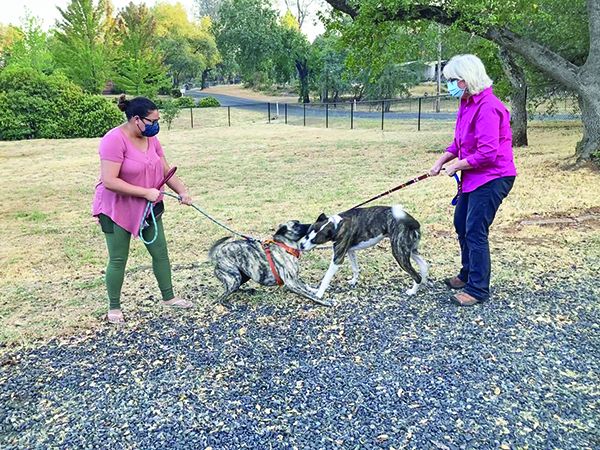
The modern dog owner spends a lot of time thinking about their dog’s social skills. We do what we can to ensure we make the most of our puppy’s sensitive socialization period; we seek out opportunities for our adolescent and adult dogs to spend time around other dogs, whether to play or to learn to ignore them. For those whose dogs react strongly to other dogs – maybe they bark and lunge – a lot of effort is spent either working on making encounters more pleasant or avoiding them altogether.
Should you allow your dog to interact with other dogs? It depends! It depends on where, and when, and with whom (for starters). Dog-dog interactions are perfectly fine under various circumstances. They can provide enrichment, a great opportunity for play and exercise, and when done well and regularly, they help maintain a dog’s social skills.
There is one particular scenario, though, that gives me a whole lot of pause. I’m talking about greetings between dogs who are leashed; I am not a fan of leashed greetings. I don’t allow dog-dog greetings while the dogs are attached to a leash – at least, not deliberately. Sometimes they’re inevitable, like when someone else allows their dog to drag them toward me and my dog despite my protests, and before we know it the dogs are nose-to-nose.
If this can’t be avoided without making matters worse, there are guidelines I follow to help the interaction go as smoothly as possible. I’ll share them with you here so you can prevent your dog from getting into a potential predicament. But first, let me tell you why I think this scenario can be a recipe for trouble in the first place.
REASONS TO AVOID ON-LEASH GREETINGS
Here are my top reasons for avoiding on-leash dog greetings:
1. Most on-leash greetings are not consensual. When two dogs meet on-leash, there are actually four parties involved: The dogs, of course, and the humans they’re attached to. In my experience, it’s extremely rare that all four parties agree to – or are interested in – a greeting or interaction.
Not all dogs enjoy being approached by other dogs, and even if both dogs are usually very sociable, it doesn’t mean they like all other dogs or that they’re interested in greeting at this particular moment.
The owners might have their own reasons for preferring to avoid interaction between dogs. There could be health reasons (the dog might not be feeling well, or he might be recovering from an injury or medical treatment), or behavior reasons (the owner knows from experience that their dog prefers not to greet other dogs).
Even if two owners and just one of the dogs are keen on letting a meet-and-greet take place, often, the humans fail to notice that the second dog is sending all kinds of subtle signals that mean “No, I’d rather not.” Humans are often not as skilled as they think at accurately reading dog body language, which can often be very subtle and understated. Trainers and animal behavior experts tend to see dog-dog interactions very differently than dog owners. For every five videos I see of dogs greeting on-leash, there are four in which one of the dogs is working very hard to make the best of an uncomfortable situation. That’s not ideal, and it’s completely unnecessary.
2. Humans don’t move quickly enough. Dogs don’t stand still, face to face, and shake paws to say hello. (In fact, if they’re standing still, face to face, and one is staring at the other, watch out!) Rather, dogs in a greeting scenario will be in constant motion. They move in a tight “smell-me, smell-you” circle, they hop back and forth, they angle their heads up, down, forward, and back, they create space between them and close it in again very quickly.
It’s an elaborate dance, and each movement is significant. Meanwhile, the humans usually remain still, clumsily trying to detangle the leashes. Or worse, they pull tightly on the leash and create pressure, preventing their dog from participating in the important social movements that make up a healthy dog-dog encounter.
3. Allowing on-leash greetings sets a precedent. Do you want your dog to be able to walk right past other dogs while staying engaged with you, or, at least, while moving in the same direction as you? It’s a common goal! In my experience, owners frequently complain that their dog pulls toward other dogs, or barks and becomes excited at the sight of another dog.
Allowing your dog to greet other dogs while on leash, even if only occasionally, makes it more difficult to teach your dog to keep walking past other dogs. It’s much more difficult to extinguish a behavior that the dog enjoys but that is allowed only sometimes (what trainers call “on an intermittent schedule of reinforcement,” meaning that sometimes he gets to do the enjoyable thing, but sometimes he doesn’t).
Also, because it’s not usually clear to your dog which encounters will result in being allowed to greet and which won’t, you risk creating what is commonly referred to as a “frustrated greeter.” These dogs may learn to pull, bark, jump up, whine, and generally become very aroused as they approach another dog. With enough practice, this type of arousal can sometimes cross the line into aggressive behavior, fueled by frustration.
4. Ending the interaction can escalate excitement. When people allow on-leash greetings, they often let them go on for too long, and then when they decide it’s time to move on, they end up tugging on the leash and dragging their dog away. Sometimes, especially if the greeting is laced with an element of tension between the dogs, pulling on the dog’s collar or harness can trigger a less-than-friendly response and, in a split second, one of the dogs being pulled away may snarl and snap at the other dog.
GUIDELINES FOR ON-LEASH DOG GREETINGS
Sometimes a greeting between unfamiliar dogs is inevitable, like when you turn a corner and suddenly find yourself face-to-face with another on-leash dog, or if someone allows their dog to approach your dog while you’re standing still. Here’s how I suggest you handle these situations:
*Move with the dogs. Work quickly to follow their circular movement and keep the leashes slack. It’s not easy – especially if the other person is just standing there. Don’t be afraid to speak up and instruct the other person to move in order to avoid creating tight or interlaced leashes. The dogs’ movements will be fast, and the direction unpredictable. That means you and the other person should both stay focused on the dogs (rather than standing and chatting), and you’ll be criss-crossing leash handles over and beneath the leashes as the dogs move.
*Limit the encounter to less than 5 seconds. Just a quick sniff and then “Let’s go!” – it’s time to move away. This greatly reduces the chances of tension or excitement building between the dogs and creating that delicate split-second trigger moment I described earlier, when one dog can snap at the other if he feels the tension on the leash.
Your dog’s ability to move away with you is a skill that needs to be practiced beforehand. Take the time to teach your dog that gentle leash pressure and a cue (like “Let’s go!”) means he should turn his attention toward you and move with you. (See “Tactical Extraction: Yielding to Leash Pressure,” below.)
If the greeting intensifies quickly, even if still in playful mode, and you’re having trouble keeping the leash slack, drop the leash. Naturally, this can be a very risky move, depending on your surroundings. I wouldn’t drop the leash on a busy street with lots of traffic! But I might do it if my dog finds himself in an unexpected greeting scenario on a walking path or on a quiet street in our neighborhood, especially if my holding the leash is creating a tangled mess that may cause the encounter to morph from playful to confrontational.
*Never allow greetings with a retractable leash. I advise against using retractable leashes in general, but I know they remain very popular and even if you don’t use one yourself, you will inevitably run into others who do. If a dog on a retractable leash is making a beeline for your dog, do your very best to avoid a greeting and move you and your dog out of the path of the other dog.
If you use one of these leashes yourself, understand how quickly it can become a dangerous tool when two dogs begin circling and moving together. You will almost certainly not be able to keep up (the handle is too bulky to make this possible), and the rope, cable, or ribbon can become extremely harmful in the blink of an eye. It can wrap around a human or canine limb and cause severe damage.
Also, if the handle is dropped, the noise it makes when it hits the ground, followed by the sound it creates as it gets dragged and bounced around can startle one or both of the dogs, leading to panicked behaviors. There’s nothing quite as alarming as dogs in a panicked state who are tied to each other.
SOCIAL DISTANCING
If you decide you want to avoid on-leash greetings, but your dog has other plans and routinely pulls toward other dogs, you can teach her how to politely navigate the presence of other dogs through behaviors like checking in (see “Train Your Dog to Check In,” WDJ February 2017) and loose-leash walking (see “Loose Leash Walking: Training Your Dog Not to Pull,” March 2017).
I much prefer to teach my dog how to keep a polite distance from other dogs and to accept their presence as just another part of their environment. Unless, of course, the leashes are off and the dogs are free to greet and interact safely in an appropriate location, without the restrictions imposed by leashes that can negatively impact how they communicate.




Good article! Marked several valid & important points. When I was training my puppy all the books & obedience instructors emphasized socialization and doing as much as possible. None of them at the time mentioned “how” and the many finer points of doing it. Consequently I let my puppy meet as many dogs (off & on leash) as possible. I tried to make sure they were positive but that can not be controlled when impromptu. My pup later became leash reactive because he’d get frustrated when unable to meet another dog & interact. I’ve since corrected that after a lot of training.
I would add to the recommendations in the article to teach your dog a command that like “Bye” so they know when an encounter with another dog is at an end and they must disengage & leave.
We live in a densely populated suburban area with very few fenced in yards so greetings are always on leash. I’m a first time dog owner so have tried my best. My small breed pup was anxious and shy in general and I needed to build his confidence. I do only allow greetings of appropriately sized dogs and always ask the owner from a distance if it’s ok to say hello. At first I used a 10 ft leash to give him maximum space to work up his courage to the other dog but any time it looks like my pup is too nervous we leave. He is submissive and greeting older, calmer dogs usually is much easier than too eager puppies who make him feel too overwhelmed. I do recognize walking alongside is best so sometimes will ask the owner if we can walk a bit with them and that will sometimes helps my pup get more comfortable, otherwise we just say nice to meet you and walk off. My pup has found some best friends of similar temperament and age and unfortunately they have to play on leash here but we make it work and they are just happy to have a friend to roll around in the grass with.
It is extremely difficult to find other compatible dogs with owners willing to work on training on a regular basis. Seemingly the only option is to find a trainer willing to use their own dog and pay for expensive private lessons just to train a puppy controlled dog-dog greeting?!?!!🙁
Why are these guidelines not accentuated in young puppy classes. Perhaps this is the reason for there being so many reactive dogs with disappointed & stressed out owners out there now along with the demand for Reactive Rover classes.
The article provides many good guidelines. Surprisingly, it is extremely difficult to find other compatible dogs with owners willing to work on training on a regular basis. Seemingly the only option is to find a trainer willing to use their own dog and pay for expensive private lessons just to train a puppy controlled dog-dog greeting?!?!!🙁
Why are these guidelines not accentuated in young puppy classes. Perhaps this is the reason for there being so many reactive dogs with disappointed & stressed out owners out there now along with the demand for Reactive Rover classes.
The article provides many good guidelines.
I agree limited and controlled on leash dog greeting should be used in puppy training. As well as training for them in a controlled situation with lots of repetitions and practice sessions. Surprisingly, it is extremely difficult to find other compatible dogs with owners willing to work on training on a regular basis. Seemingly the only option is to find a trainer willing to use their own dog and pay for expensive private lessons just to train a puppy controlled dog-dog greeting?!?!!🙁
I find it surprising that this is not accentuated in young puppy classes. Perhaps this is the reason for there being so many reactive dogs with disappointed & stressed out owners out there now along with the demand for Reactive Rover classes.